

Avoiding money laundering risks is critical for small businesses. If your business handles financial transactions, you may be required by law to create an Anti-Money Laundering (AML) program. Failing to comply can lead to severe penalties, loss of reputation, and even business closure.
Here’s what you need to know:
- What is AML Compliance? It’s a set of rules to prevent illegal funds from entering the financial system. Key elements include monitoring transactions, verifying customer identities, and reporting suspicious activities.
- Why it matters: Non-compliance can result in fines up to $1 million or more, prison time, and irreparable damage to your business.
- Key requirements in the U.S.: The Bank Secrecy Act and other laws require businesses to keep records, report large transactions, and implement strict customer identification processes.
- How to start: Appoint a Compliance Officer, write clear policies, and conduct regular risk assessments. Use tools like transaction monitoring software to streamline the process.
For small businesses, AML compliance isn’t just a legal obligation – it’s a way to protect your operations from financial crime while building trust with customers and partners.
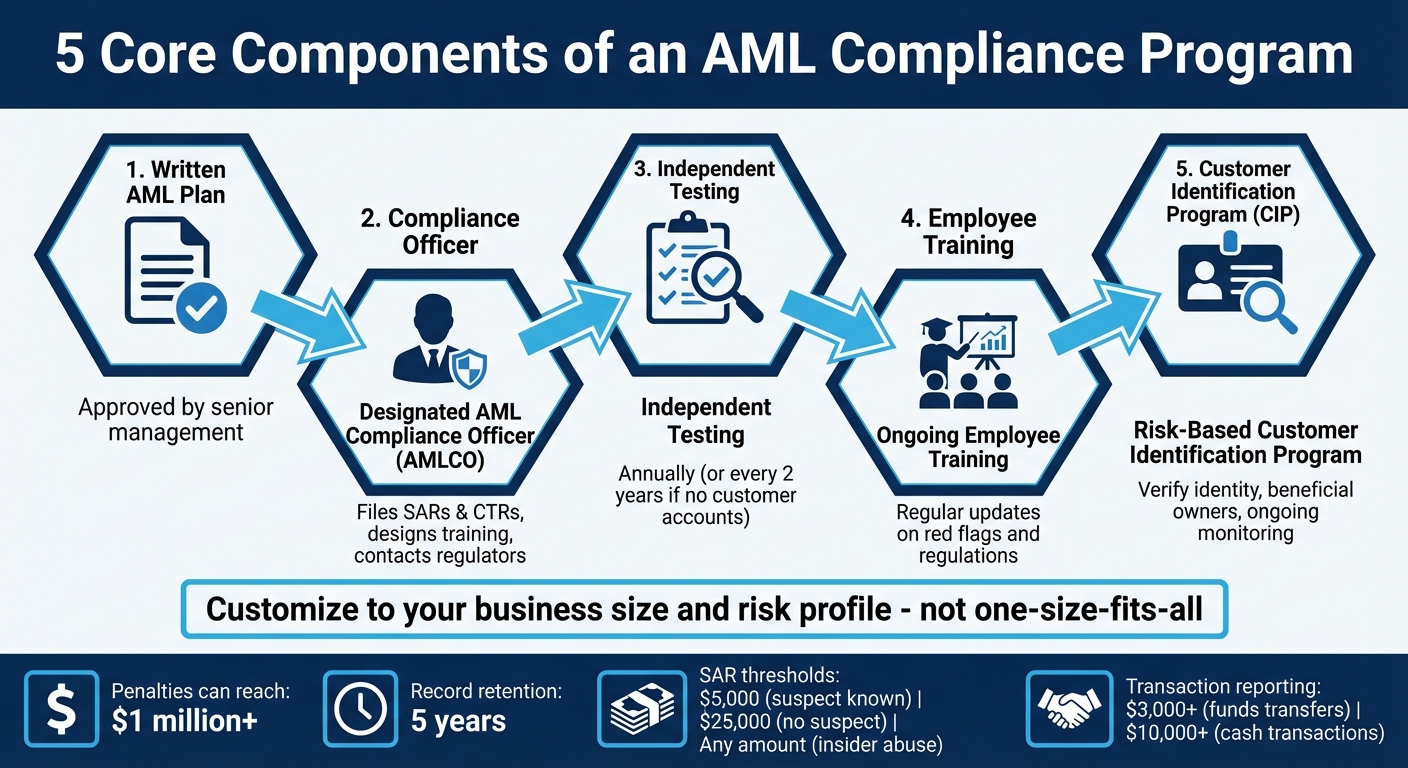
5 Core Components of an AML Compliance Program for Small Businesses
Anti-Money Laundering for Small Business | AML Regulations for Small Business | How to Comply
sbb-itb-85dd802
Core Components of an AML Compliance Program
A solid Anti-Money Laundering (AML) program has five key elements: a written AML plan approved by senior management, a designated Compliance Officer, independent testing, ongoing employee training, and a risk-based Customer Identification Program (CIP). These components should be customized to fit your business’s specific size and risk profile, rather than relying on generic templates.
Appointing a Compliance Officer
The AML Compliance Officer (AMLCO) plays a central role in your program. This individual handles daily compliance operations, files Suspicious Activity Reports (SARs) and Currency Transaction Reports (CTRs), designs employee training programs, and acts as the main contact for regulators. For smaller businesses, the AMLCO role can be combined with other responsibilities, allowing one person to oversee multiple functions. However, this individual must have enough authority to enforce compliance policies effectively.
When selecting a Compliance Officer, prioritize candidates with expertise in regulatory compliance, financial services experience, or certifications like Certified Anti-Money Laundering Specialist (CAMS) or Certified AML and Fraud Professional (CAFP). This is not a role to take lightly – recent enforcement actions have resulted in penalties reaching billions of dollars due to inadequate transaction monitoring. To avoid such pitfalls, ensure your Compliance Officer has full support from senior leadership.
Once the Compliance Officer is in place, the next step is to formalize your program with written policies.
Creating Written Policies and Procedures
Your AML program needs a written policy document approved by senior management. This isn’t just a formality – it’s about creating practical, actionable guidelines for your team. Clear escalation procedures should be included, so employees know exactly how to report suspicious activities to the compliance team.
"Firms should recognize, however, that AML compliance programs can and should be tailored to fit their business and risks, considering factors such as size, location, business activities, the types of accounts they maintain, and the types of transactions in which their customers engage." – FINRA FAQ
Your policies should cover transaction monitoring, recordkeeping, and ongoing customer due diligence. Smaller firms can use templates from FINRA to build programs that align with Bank Secrecy Act standards. The key is to adapt these guidelines to your business’s unique size and risk exposure, making them both practical and effective.
Customer Due Diligence (CDD) and Know Your Customer (KYC)
An essential part of AML compliance is verifying customer identities. Effective Customer Due Diligence (CDD) includes four main steps: identifying and verifying customers, identifying beneficial owners of legal entity customers, understanding the purpose of customer relationships to create risk profiles, and conducting ongoing monitoring.
Before opening an account, collect the following customer information:
- Name
- Date of birth (for individuals)
- Physical address
- Identification number, such as a Social Security Number or Tax Identification Number
For legal entities, identify any individual who owns 25% or more of the entity, as well as at least one person responsible for managing or controlling it. Use a layered approach to verification, combining documentary methods (like government-issued photo IDs) with non-documentary methods, such as cross-checking public databases or consumer reporting agencies. This ensures you can form a "reasonable belief" about the customer’s true identity.
Retention of customer identification records is crucial. Keep these records for five years after the account closes, and maintain documents used for verification for five years from their creation date. Consider informing customers – through a lobby notice or website statement – that identity verification is required under federal law. For higher-risk accounts, such as those opened by foreign entities or in jurisdictions with elevated money laundering risks, implement additional verification measures. Strong CDD practices not only protect your business from financial crime but also demonstrate a commitment to compliance.
How to Build an AML Compliance Program
Creating an Anti-Money Laundering (AML) compliance program doesn’t have to be overwhelming. Start with a clear risk assessment to identify where your business might be exposed. Then, set up monitoring systems and reporting procedures tailored to your specific risks. The aim? To meet regulatory standards while keeping the program manageable for your team.
Conducting a Risk Assessment
A solid risk assessment is the backbone of any AML program. It helps you pinpoint potential money laundering risks and figure out how to address them. This process typically involves two steps: identifying risk categories and analyzing the related data. Focus on these four key areas: the products and services you offer, the nature of your customer base, the geographic regions you operate in, and your overall business operations.
For instance, if your business handles 100 international funds transfers daily, your risk profile will vary depending on whether most transactions come from long-term customers or new, unknown parties. It’s not just about volume – context is crucial.
"Understanding its risk profile enables the bank to better apply appropriate risk management processes to the BSA/AML compliance program to mitigate and manage risk and comply with BSA regulatory requirements."
– FFIEC BSA/AML Manual
Make sure to document your risk assessment and revisit it whenever there are changes to your products, markets, or operations. For higher-risk customers, use Enhanced Due Diligence (EDD). This means gathering more information, such as financial statements, trade areas, and detailed descriptions of their operations, to ensure your controls adequately address potential vulnerabilities.
Once risks are identified, shift your attention to monitoring transactions and keeping accurate records.
Transaction Monitoring and Recordkeeping
Your transaction monitoring system should flag unusual behavior that doesn’t align with a customer’s typical activity. Smaller businesses with fewer transactions can start with manual monitoring, where staff review reports like currency activity logs or large item reports. As your business expands or takes on higher-risk transactions, automated systems using algorithms to detect patterns may become necessary.
Under the Bank Secrecy Act (BSA), businesses must maintain records for funds transfers of $3,000 or more and monetary instrument transactions between $3,000 and $10,000. To strengthen your monitoring efforts, review FINRA Regulatory Notice 19-18 for guidance on identifying red flags and incorporate these into your workflows. Your AML plan should clearly outline these monitoring and recordkeeping procedures and have senior management approval. Small businesses can use the FINRA Anti-Money Laundering Template to ensure all requirements are covered. Regular updates to these procedures are essential as regulations and your operations evolve.
Proper monitoring lays the groundwork for timely and accurate reporting of suspicious activities.
Filing Suspicious Activity Reports (SARs)
Set up clear procedures for identifying and reporting suspicious activities to the Financial Crimes Enforcement Network (FinCEN). Knowing the reporting thresholds is key:
| Activity Type | Reporting Threshold |
|---|---|
| Insider Abuse | Any amount |
| Suspicious Transaction (Suspect Identified) | $5,000 or more |
| Suspicious Transaction (No Suspect Identified) | $25,000 or more |
"Suspicious activity reporting forms the cornerstone of the BSA reporting system. It is critical to the United States’ ability to utilize financial information to combat terrorism, terrorist financing, money laundering, and other financial crimes."
– FFIEC BSA/AML Manual
Ensure employees know how to escalate concerns to the Compliance Officer. Document every decision, even when you decide not to file a SAR, to demonstrate sound judgment during regulatory reviews. Federal law offers safe harbor protections, shielding businesses from civil liability when SARs are filed in good faith – even if the filing is voluntary. Keep in mind, disclosing the existence of a SAR to the subject of the report is strictly prohibited. Maintain all SAR-related records securely and separately from general business files.
If you need help fine-tuning your AML compliance program, consider reaching out to experts like TC Advisors. Their experience with financial strategies for small and mid-sized businesses can help ensure your program meets all regulatory requirements effectively.
Common Challenges in AML Compliance
Small businesses face unique hurdles in implementing Anti-Money Laundering (AML) compliance programs, often stemming from limited resources and expertise. Unlike large corporations with dedicated teams, smaller firms frequently assign compliance responsibilities to employees juggling multiple roles. This "dual-hatted" approach stretches teams thin, increasing the risk of mistakes.
The financial strain is considerable. In 2020, global AML compliance costs hit $42 billion, with smaller institutions shouldering a disproportionate share. In fact, these businesses often spend 4 to 10 times more than large banks on the same compliance tasks. For example, some credit unions allocate as much as 5% of their total expenses just to meet compliance demands, while fraud losses can account for 8% to 11% of their non-interest expenses.
Regulatory complexity further complicates matters. With about $2 trillion laundered globally each year and less than 10% detected, regulators are tightening their scrutiny. Smaller entities like community banks and neobanks are increasingly under the spotlight. A case in point: In October 2024, the Office of the Comptroller of the Currency (OCC) issued a Cease and Desist Order against Clear Fork Bank, a community bank with $800 million in assets, for failing to implement a compliant AML program and monitor suspicious activity. The bank was required to conduct SAR lookbacks and improve board-level oversight, both of which are resource-intensive tasks for smaller institutions.
Finding skilled AML professionals is another persistent issue, especially in rural areas where small businesses compete with global banks for talent. Manual processes, such as ID checks and document reviews, add to the workload and are prone to human error. These challenges highlight the need for efficient resource allocation to maintain compliance without overburdening staff.
Managing AML Compliance with Limited Resources
For small businesses with limited staff, AML compliance can feel overwhelming. The solution lies in working smarter, not harder. Outsourcing specialized tasks, such as transaction monitoring, to third-party providers can help focus resources on high-risk areas.
A risk-based approach is crucial. Instead of treating every customer or transaction the same, prioritize high-risk areas identified through regular assessments. This targeted strategy allows businesses to stay compliant without overextending their teams.
Training your existing staff is another effective way to strengthen compliance without increasing headcount. Regularly educating employees on emerging red flags and new money laundering tactics can go a long way. Free or low-cost resources, such as the FINRA Anti-Money Laundering Template for Small Firms, can be invaluable for this purpose.
The importance of proactive resource management is evident in cases like the Federal Reserve’s September 2023 cease-and-desist order against Small Business Bank and its holding company, Gardner Bancshares. Following an examination that revealed staffing and compliance deficiencies, the bank was required to hire an independent third party to assess governance and staffing levels. This underscores the risks of inadequate resources and controls.
Using Technology for AML Compliance
Technology offers practical solutions to ease the burden of AML compliance. Automated tools can handle labor-intensive tasks like customer due diligence (CDD), Know Your Customer (KYC) checks, and transaction monitoring – tasks that would otherwise consume significant staff time and are prone to errors. These tools can also improve the accuracy of risk assessments and transaction reviews.
Cloud-based platforms designed for small businesses provide cost-effective alternatives to the expensive systems used by larger institutions. They require minimal IT expertise and offer real-time screening against global sanction lists, watchlists, and Politically Exposed Persons (PEP) databases – capabilities that would be nearly impossible to manage manually.
AI and machine learning are becoming more accessible for small businesses through specialized service providers. These technologies automate identity verification and detect complex suspicious patterns that traditional systems might overlook. Digital recordkeeping systems also ensure compliance with the mandatory five-year documentation requirement, making audits and reviews more manageable.
Even with automation, human oversight is essential. Assign a Compliance Officer to oversee systems and manage suspicious activity reporting. For businesses handling high-risk international transactions, robust automated monitoring tools are especially critical.
To start small, consider using free tools like the OFAC Sanctions List Search Tool to build a basic compliance program at minimal cost. As your business grows or your risk profile changes, you can scale up to more advanced solutions tailored to your needs, avoiding the expense of enterprise-grade systems meant for larger organizations.
If balancing compliance demands with limited resources feels overwhelming, TC Advisors can help you assess your needs and implement practical, budget-friendly solutions.
Conclusion
AML compliance isn’t optional – it’s a necessity to shield your business from criminal misuse. Take the Bank Secrecy Act, for instance, which applies to all broker-dealers, no matter their size. And with FinCEN actively working on new regulations to extend oversight to smaller businesses, the regulatory landscape is only becoming stricter.
The consequences of non-compliance are serious. It can tarnish your reputation, scare off investors, and even lead to the closure of your business. On the flip side, a well-structured AML program not only ensures compliance but also fosters trust among customers, partners, and financial institutions.
As M Abd’al Bari, Research Associate at KYC/AML Guide, puts it:
"In the world of AML, vigilance is your most valuable asset".
To establish a strong AML program, appoint a compliance officer, perform a risk assessment with personalized CPA support tailored to your business, and develop written policies that address customer due diligence and transaction monitoring.
You don’t have to break the bank, either. Free tools like FINRA’s AML Template and the U.S. Treasury’s OFAC Sanctions List Search Tool can help you manage costs effectively.
FINRA also highlights the importance of customization:
"AML compliance programs can and should be tailored to fit their business and risks, considering factors such as size, location, business activities, the types of accounts they maintain, and the types of transactions in which their customers engage".
Don’t forget the basics: maintain customer identification records for five years and report cash transactions over $10,000. And to keep your program sharp, schedule independent testing annually – or every two years if you don’t hold customer accounts.
FAQs
Does my small business need an AML program?
Whether your small business needs an AML (Anti-Money Laundering) program depends largely on the nature of your operations and the regulations that apply to your industry. Businesses involved in financial services or those that deal with substantial cash transactions – such as handling more than $10,000 daily – are typically subject to compliance requirements. If your business activities align with AML regulations or you’re looking to reduce potential risks, reaching out to a CPA, such as TC Advisors, can help you assess your obligations and develop a strategy that’s customized to your needs.
What are the biggest AML red flags for small businesses?
Small businesses should be aware of certain warning signs that might indicate money laundering or other illegal activities. For instance, frequent large cash deposits or withdrawals that don’t match the nature of the business could raise concerns. Similarly, a high volume of cashier’s checks, money orders, or wire transfers without a clear business purpose might signal something unusual.
Other red flags include deposits that consistently fall just below reporting thresholds, which could indicate an attempt to avoid detection, or rapid international transfers that lack a legitimate explanation. Spotting these patterns is key to staying compliant with regulations and safeguarding your business from illegal activity.
What’s the cheapest way to start AML compliance?
Small businesses can tackle AML compliance without breaking the bank by prioritizing affordable screening tools, creating clear internal policies, and maintaining regular monitoring practices. Staying updated on regulations and implementing straightforward, scalable processes can keep costs manageable while still meeting compliance standards. This strategy ensures businesses remain compliant without incurring hefty expenses.


