

Want to make smarter acquisition decisions? The key is understanding "strategic fit" – how well a target company aligns with your goals. Skipping this step can lead to costly mistakes, as 70% of mergers fail to meet expectations. Here’s a quick breakdown of the process:
- Define Goals: Identify gaps in your business that acquisitions can fill, like new markets or capabilities.
- Screen Targets: Use clear criteria (e.g., size, financial health, market reach) to filter potential companies.
- Analyze Operations & Finances: Ensure their systems and finances align with your business.
- Check Culture: Look for shared values and work styles to avoid integration issues.
- Calculate Synergies & Risks: Quantify cost savings, revenue opportunities, and potential challenges.
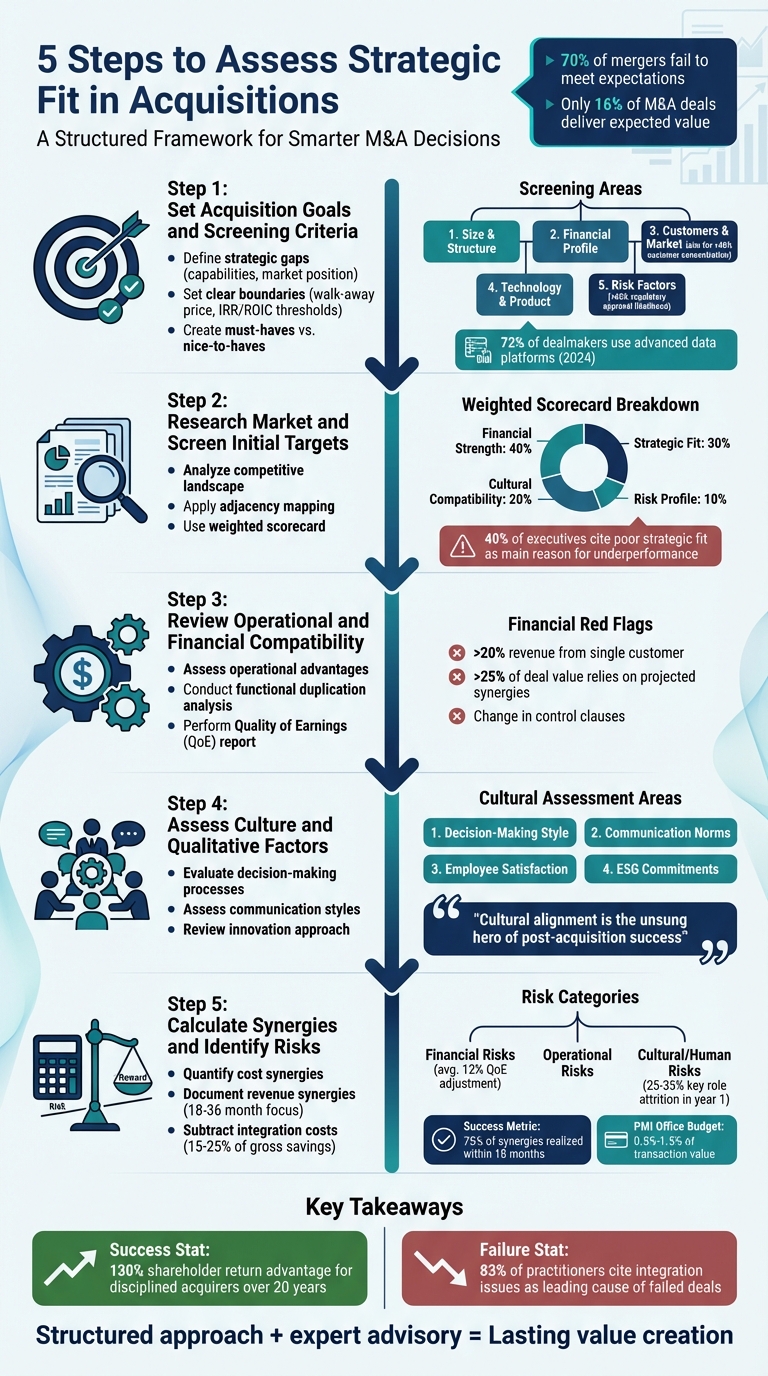
5-Step Strategic Fit Assessment Process for Acquisitions
Strategic fit is the question before the numbers. Once you are past it, our due diligence and transaction advisory page covers the financial and tax work that follows.
Choosing an Acquisition Target: Fit, Culture & Pipeline Building | Buy-Side Masterclass Moment
sbb-itb-85dd802
Step 1: Set Acquisition Goals and Screening Criteria
Before diving into target evaluations, it’s essential to pinpoint the strategic gaps your business can’t close through organic growth alone. Don’t wait for a time-sensitive deal to define your M&A strategy – be proactive and deliberate.
Define Your Objectives
Start by identifying the gaps in your capabilities or market position that need to be addressed. These could include missing product features, access to specialized talent, proprietary data, unique manufacturing processes, or regulatory licenses. On the market side, it might mean reaching new customer segments, entering untapped geographic regions, or achieving the scale needed for better unit economics.
Decide what will drive the most value for your business. Is it cost advantages through consolidation? Growth by expanding your offerings? Or perhaps improving margins with changes to your operating model? Whatever the focus, set clear boundaries, like a "walk-away price", and establish IRR or ROIC thresholds to keep emotions from clouding your judgment during negotiations. M&A should only be pursued when other growth options are slower, riskier, or less feasible.
Once your objectives are clear, translate them into measurable criteria to screen potential targets effectively.
Create Screening Criteria
Define the specific attributes your ideal target must have. Separate these into "must-haves" and "nice-to-haves", weighting them based on their potential to drive revenue, reduce costs, or mitigate risks. Establish clear "hunt zones" by outlining the market (industry), segment (customer sets or geography), and capabilities the acquisition should enhance.
Your screening process should evaluate five key areas:
- Size and structure: Revenue range and ownership model.
- Financial profile: Growth rates, profit margins, and cash flow efficiency.
- Customers and market: Customer concentration (aim for less than 40%), retention trends, and geographic reach.
- Technology and product: Strength of intellectual property and compatibility with your existing systems.
- Risk factors: Regulatory approval likelihood (above 60%) and any history of litigation.
Just as important are your "stop rules." These are deal-breakers – like excessive customer concentration or regulatory hurdles – that signal it’s time to walk away, no matter how attractive the price.
Interestingly, in 2024, 72% of dealmakers reported using advanced data platforms to identify and evaluate potential targets. This shift toward data-driven sourcing highlights the growing importance of technology in the M&A process.
Step 2: Research the Market and Screen Initial Targets
Now that you’ve set your criteria, it’s time to create a long list of potential targets and systematically narrow it down. This stage is all about separating serious opportunities from distractions. Building on the groundwork you laid in Step 1, this process involves identifying potential targets, conducting a thorough market analysis, and applying a structured screening approach that prioritizes strategic alignment before diving into financial details.
Analyze the Market
Understanding the competitive landscape is a must. Look for targets where your ownership could unlock extra value – whether through better distribution channels or reduced operational costs.
To get a full picture of the market, combine data from industry reports with insights from your sales teams. As you research, consider adjacency mapping to measure how closely a target aligns with your core business. This involves evaluating two key factors:
- Customer similarity: Do they serve the same buyers through similar channels?
- Capability similarity: Do they operate with comparable processes or face similar regulatory requirements?
A target that seems appealing but operates too far outside your core competencies could require capabilities you don’t currently have, making it a risky choice.
Also, dig into seller motivations. For example, a company selling due to management succession issues poses a different risk than one struggling with industry disruption. These insights help you identify hidden risks or opportunities and lay the groundwork for your next steps.
Evaluate Targets Initially
With your market analysis complete, apply your screening criteria to evaluate targets. A weighted scorecard can help you compare options side-by-side. Typical weightings might include:
- Financial strength: 40%
- Strategic fit: 30%
- Cultural compatibility: 20%
- Risk profile: 10%
This method helps you stay focused on the most important factors and avoid decisions driven by emotion.
As part of this evaluation, develop testable hypotheses to confirm each target’s strategic fit. For instance: "Customer overlap is sufficient to support cross-selling without channel conflict". These hypotheses keep your research focused and ensure you’re not wasting time on irrelevant data.
It’s also essential to separate a target’s intrinsic value from potential synergies. While synergies can be exciting to imagine, they’re often harder to achieve in practice.
Here’s a sobering statistic: only 16% of mergers and acquisitions deliver their expected value. Furthermore, 40% of executives cite poor strategic fit as the main reason for underperformance. That’s why it’s crucial to establish clear "stop rules" – conditions that automatically disqualify a target. Examples include:
- A valuation that exceeds your maximum justified price
- Reliance on key personnel who cannot be retained
These guardrails protect you from pursuing deals that don’t meet your core requirements, helping you stay focused on opportunities that truly align with your goals.
Step 3: Review Operational and Financial Compatibility
When considering an acquisition, it’s not just about what the company does (strategic fit); it’s also about how they operate. This "how" can often make or break the success of the deal. Here’s what to focus on when reviewing operational and financial compatibility.
Review Operations
Start by asking yourself: Can we create more value from the target’s assets than other potential buyers? This is a critical way to assess your competitive edge. Whether it’s better distribution networks, lower costs, or quicker product scaling, identifying your operational advantages is essential.
Dive deep into the target’s operations. Look at manufacturing efficiency, asset utilization, supply chain stability, and technology infrastructure. Legacy systems or IT setups that don’t align with yours can create significant hurdles during integration. A useful tactic here is to conduct a functional duplication analysis. This means pinpointing overlapping roles in areas like HR, accounting, logistics, and production. By identifying these redundancies, you can explore opportunities for consolidation without sacrificing service quality.
Before committing to a deal, bring together key department heads – like your CFO, CIO, and HR lead – to map out how the combined company will generate value. This session should focus on specific operational strategies to ensure everyone is aligned.
However, even the best operational fit won’t matter if the financial foundation isn’t solid. That’s where financial due diligence comes in.
Conduct Financial Due Diligence
Financial compatibility goes beyond skimming profit-and-loss statements. Start by requesting several years of audited financials to get a clear picture of long-term trends. A Quality of Earnings (QoE) report is particularly valuable here – it adjusts EBITDA to exclude one-off events or non-operational expenses, giving you a clearer view of the company’s true earnings potential.
Revenue stability is another critical area to evaluate. For example, does one customer account for more than 20% of revenue? If so, that’s a major risk. Break down recurring versus non-recurring revenue and examine overdue invoices in accounts receivable, as these could signal disputes or bad debt. Compare past budgets to actual results to gauge whether the management team reliably hits their financial targets.
You’ll also need to analyze the target’s debt structure. Review interest rates, maturity dates, and any restrictive covenants. Don’t overlook "change in control" clauses, which could require immediate debt repayment upon acquisition. Cash flow trends and working capital requirements are equally important – profits on paper don’t always translate to healthy cash reserves. Be cautious if more than 25% of the deal’s value relies on projected synergies, as this poses a material risk to your equity.
To avoid surprises, consider working with firms like TC Advisors, which specialize in transaction advisory services and can help flag financial risks before they escalate into costly issues.
Step 4: Assess Culture and Qualitative Factors
Once operational and financial compatibility is confirmed, it’s time to focus on cultural alignment – a factor that often determines whether an acquisition thrives or falters. While financial metrics provide a clear picture of a company’s health, culture drives how well the two organizations will work together. As TKM Consultants explains, "Cultural alignment is often the unsung hero of post-acquisition success, while cultural misalignment can lead to friction, productivity dips, and in some cases catastrophic failure."
Evaluate Culture Compatibility
Start by examining the target company’s decision-making process. Is it autocratic, with decisions flowing from the top down, or collaborative, encouraging input from multiple levels? If your organization values consensus but the target prefers rigid hierarchies, this could create significant challenges during integration.
Next, look at communication styles. Does the target operate with formal, structured communication, or is it more informal and casual? Consider how quickly they expect responses and how transparent they are in their interactions. These elements need to align with your company’s norms to avoid miscommunication or misunderstandings.
Zachary Scott emphasizes that "The most critical element of cultural alignment in the first twelve months post-acquisition is the collection of norms around how decisions are made in the company." To gain a deeper understanding, go beyond official statements. Conduct on-site visits and engage directly with employees at all levels. Ask pointed questions like: Who has the final say in decisions? How are stakeholders involved in strategy? Are meetings held in formal boardrooms or more relaxed settings? If responses vary widely, it may indicate unclear or fractured cultural practices.
Also, assess the target’s approach to innovation and risk. For example, a company that thrives on quick, experimental changes might clash with one that prioritizes stability and proven methods. Aligning these cultural practices ensures that the strategic goals established earlier remain achievable.
Consider Other Qualitative Factors
Cultural alignment goes beyond decision-making and communication. Other qualitative factors can significantly impact integration success:
- Employee satisfaction and flexibility: High turnover rates or poor employee reviews might signal internal issues that could complicate integration.
- Brand reputation and customer relationships: Understand how the target treats its customers and measures satisfaction. This is especially critical for service-focused businesses.
- ESG commitments: Environmental, social, and governance practices are increasingly important. If your company prioritizes sustainability or social responsibility, acquiring a target with conflicting values could create internal and external tensions.
Brian Stroh, Director of Integration at Acquira, offers a simple yet effective way to evaluate culture: "The best single metric for workplace culture is: ‘Is this a place where I would choose to work?’"
These cultural and qualitative insights are key to identifying potential synergies and mitigating risks, paving the way for a smoother acquisition process.
Step 5: Calculate Synergies and Identify Risks
Once you’ve confirmed alignment between the companies, it’s time to dig into the numbers. This step is all about figuring out the tangible financial benefits of the acquisition and identifying potential pitfalls. Essentially, you’re turning earlier qualitative insights into hard financial data.
Measure Potential Synergies
To justify the acquisition, you need to translate synergies into precise dollar amounts. These synergies represent real cash flow improvements. As Umbrex puts it:
Value creation in a deal is not a slogan; it is a dated, costed, and evidenced plan to expand revenue, lift CM2, accelerate cash, and mitigate risk within the hold period.
Start with cost synergies, which are usually the easiest to control. Look for consistent savings in areas like procurement, logistics, manufacturing, and IT. For instance, if your company pays $2.50 per pound for raw materials while the target pays $3.00, calculate the savings by multiplying the target’s annual volume by the $0.50 difference. Other examples include cutting redundant software subscriptions or consolidating shipments to secure bulk discounts.
Revenue synergies are trickier but just as critical. Instead of assuming a flat percentage boost, pinpoint specific opportunities. These might include cross-selling to the target’s customers, bundling complementary products, or entering new markets. Document each initiative using a detailed "Revenue Synergy Card", as Umbrex suggests. Include factors like the customer base, expected attach rates, pricing, and timelines. Focus on synergies that generate cash within 18–36 months; longer-term possibilities can remain strategic considerations.
Don’t forget to calculate the net value of these synergies. Subtract integration costs – often 15–25% of gross savings – to determine the actual financial benefit. For example, if you expect $2 million in annual procurement savings but face $400,000 in integration costs, your net first-year benefit would be $1.6 million.
Once you’ve quantified these gains, it’s time to assess the risks that could jeopardize them.
Assess and Mitigate Risks
Even the best-planned acquisitions come with risks that can chip away at expected benefits. Identifying and addressing these risks early is essential.
Financial risks include overpaying for the target, taking on excessive debt, or relying on overstated earnings. Quality of Earnings (QoE) reports can help you adjust for sustainable EBITDA. For instance, middle-market acquisitions in 2025 saw average QoE adjustments of about 12% of reported EBITDA. If a target reports $5 million in EBITDA, the sustainable figure might only be $4.4 million.
Operational risks often emerge during integration. These might include supply chain hiccups or temporary performance drops as teams adapt to new workflows. Review these risks thoroughly during due diligence.
Cultural and human risks are just as critical. Even after confirming operational alignment, talent attrition can be a major issue. Key employees may leave, and competitors might try to poach them during the transition. Attrition rates for key roles can reach 25–35% in the first year if integration isn’t handled well. To mitigate this, put retention agreements in place early.
Start risk mitigation efforts during due diligence. Establish a Post-Merger Integration (PMI) office, funded with 0.5%–1.5% of the transaction value, to manage the process. Use earn-outs to share performance risks with the seller, and offer retention bonuses – typically 50–150% of annual salary – for critical personnel before announcing the deal. As BCG researchers point out:
Integration planning should begin not after the deal is signed, but during the due diligence phase.
Finally, use scenario modeling to stress-test your assumptions. For example, what happens if customer retention drops to 85% instead of 95%, or if rising interest rates increase debt costs by $500,000 annually? Since 75% of synergies are typically realized within 18 months, understanding potential downsides helps set realistic goals and allocate resources wisely.
For small to mid-sized businesses tackling their first acquisition, TC Advisors (https://tcadvisorscpa.com) offers expert services like financial modeling, risk assessment, and due diligence support. They can help you quantify synergies and uncover hidden risks before making a financial commitment.
Conclusion: A Structured Approach to Strategic Fit
Evaluating strategic fit takes discipline and a clear process – not just gut instincts. The five steps outlined earlier offer a repeatable framework to safeguard resources and challenge assumptions before committing to exclusivity. By setting predefined fit tests and economic thresholds, your team can make quicker decisions – whether to pursue or decline opportunities – backed by documented reasoning.
The stakes are high. A staggering 83% of M&A practitioners point to integration issues as the leading cause of failed deals. However, companies that approach acquisitions with discipline have achieved a 130% edge in shareholder returns over the past two decades. The key lies in prioritizing timely integration planning and focusing on the critical decisions that drive real value.
For small to mid-sized businesses and entrepreneurs navigating acquisitions, the process can feel daunting. It’s not just about crunching numbers – acquisitions require balancing valuation models, assessing organizational dynamics, calculating synergies, and mitigating risks, all while keeping your main business running. A structured approach ensures you avoid costly mistakes, like ignoring warning signs or overpaying for a seemingly attractive target that ultimately underperforms.
TC Advisors (https://tcadvisorscpa.com) specializes in transaction advisory services tailored for businesses like yours. Their team helps you thoroughly evaluate targets, quantify synergies, conduct in-depth due diligence, and structure deals to maximize tax benefits and align financial goals. Acting as a neutral third party, they facilitate sensitive discussions with sellers, ensure critical information is exchanged, and only move forward when the fit is genuinely right.
With a well-organized strategy and the right advisory support, whether you’re evaluating your first acquisition or finalizing your tenth, the focus should always be on creating lasting value – not just closing the deal.
FAQs
What are the best “stop rules” to avoid a bad deal?
When it comes to avoiding a bad deal, having solid "stop rules" in place can make all the difference. These are essentially pre-set criteria that tell you when it’s time to hit the brakes on an acquisition. A few key practices stand out:
- Use a disciplined decision-making framework. This means assessing strategic fit and deal economics early in the process.
- Set clear thresholds for critical factors like financial metrics, strategic goals, and even cultural alignment – because a mismatch in company culture can be as damaging as poor financials.
- Stay ready to walk away. If due diligence uncovers risks that are too big to handle or if your initial assumptions don’t hold up, it’s better to step back than to push forward into a deal that could backfire.
Having these rules in place ensures you’re making decisions with clarity and purpose, not out of momentum or pressure.
How do I validate synergies without overestimating them?
To assess synergies effectively, zero in on measurable opportunities like cutting costs or boosting cross-selling efforts – ones that can be clearly calculated and supported. Assign specific dollar amounts or percentages, spell out the assumptions behind your estimates, and highlight any dependencies. Start planning as early as possible, tie due diligence findings directly to integration plans, and monitor progress closely. Be proactive about tackling obstacles, whether they’re technical issues or workplace dynamics, to ensure your projections are realistic and attainable.
What’s the quickest way to spot culture mismatch before closing?
To spot a potential culture clash early on, take a close look at decision-making processes, communication styles, and core values during the due diligence phase. Pay attention to how decisions are made, the leadership styles in place, and common behavioral tendencies within the organization. Tools such as cultural assessment matrices and employee surveys can be incredibly useful for identifying differences. These insights can help you prepare for a smoother integration process.


