

In today’s unpredictable business environment, CFOs play a critical role in preparing companies for potential disruptions. From financial planning to risk assessment, their strategies focus on ensuring businesses can withstand challenges like cyberattacks, supply chain issues, or economic shifts. Here’s how CFOs are tackling these challenges:
- Risk Identification: CFOs assess threats like cyber risks, supply chain breakdowns, and economic changes, using tools like Business Impact Analyses (BIA) to prioritize vulnerabilities.
- Scenario Planning: By modeling different financial outcomes (e.g., best, base, and worst cases), CFOs ensure readiness for unexpected events.
- Cash Flow Management: Regular 13-week cash flow forecasts and stress tests help identify potential liquidity gaps early.
- Financial Reserves: Maintaining 3–6 months of operating expenses as a buffer ensures stability during crises.
- Contingency Plans: Recovery Time Objectives (RTO) and pre-approved actions help businesses respond quickly to disruptions.
- Fractional CFO Services: For smaller businesses, hiring part-time CFOs provides expert financial guidance without the cost of a full-time hire.
CFOs combine proactive planning, financial safeguards, and regular monitoring to minimize risks and ensure business continuity. Read on for detailed strategies to protect your organization against disruptions.
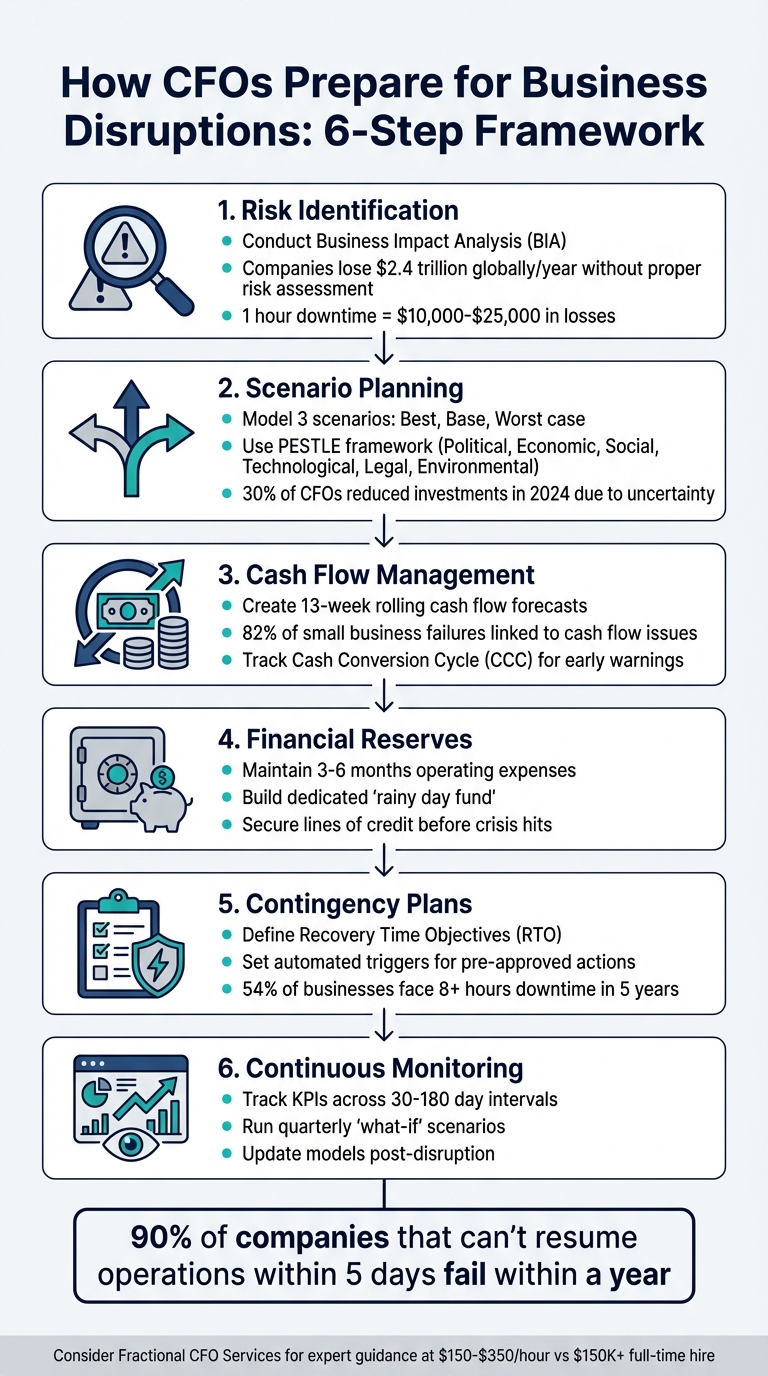
CFO Disruption Preparedness Framework: 6-Step Risk Management Strategy
Strengthening Resilience with Business Continuity Management System
sbb-itb-85dd802
Identifying and Assessing Risks
Before CFOs can put safeguards in place, they need a clear understanding of the threats they face. Risk identification is a structured process that separates the causes of disruptions – like cyberattacks or supply chain breakdowns – from their consequences, such as lost revenue or regulatory fines. Kraft Business Systems explains it this way:
"In simple terms, a risk assessment identifies the storms on the horizon, while a BIA tells you which parts of your ship must be protected at all costs to stay afloat."
The numbers highlight the urgency. Companies that fail to conduct thorough impact analyses lose an estimated $2.4 trillion globally each year, which equates to about 3.8% of worldwide corporate investment spending. For smaller businesses, the stakes are equally high – just one hour of downtime can cost between $10,000 and $25,000 in lost revenue and recovery costs. A structured approach is critical to avoid these preventable losses.
Conducting a Business Impact Analysis (BIA)
A Business Impact Analysis (BIA) helps pinpoint the essential functions that keep a company running. It identifies critical operations – like payroll, order fulfillment, and customer service – and evaluates the impact of their disruption.
The process typically begins with interviews involving department heads. CFOs need to uncover key interdependencies and seek industry-specific guidance: Does the finance team rely on customer service data to issue invoices? Would a failure in your payment processor bring revenue collection to a halt? Companies using data-driven BIAs report 58% higher accuracy in forecasting outcomes and reduce investment risks by 41%.
Another key step is defining RTO (maximum allowable downtime) and RPO (tolerable data loss) to guide recovery strategies.
The BIA also quantifies impact in two categories: financial (such as lost sales, contractual penalties, and overtime costs) and reputational (including customer trust, brand damage, and employee morale). For example, a healthcare provider losing access to its Electronic Health Record (EHR) system could face immediate revenue losses from canceled appointments and regulatory fines tied to patient safety violations. CFOs must evaluate both types of damage to fully grasp the cost of disruption.
Once critical functions are identified and their impacts quantified, CFOs can use a risk matrix to prioritize threats strategically.
Prioritizing Risks by Likelihood and Impact
Not all risks deserve the same attention. A Risk Matrix helps CFOs rank threats by evaluating their probability and potential severity. Threats that combine a high likelihood with a high impact – like cyberattacks, which have affected 54% of businesses for eight hours or more in the past five years – demand immediate action. On the other hand, low likelihood + high impact risks, such as natural disasters, require contingency plans but not daily focus.
Take the February 2016 Bangladesh Bank cyberattack as an example. Hackers exploited weaknesses in the SWIFT system to steal $101 million. Beyond the financial loss, the attack exposed how a single vulnerable system could jeopardize an entire institution’s credibility. CFOs must identify and address similar vulnerabilities in their own organizations before they are exploited.
This prioritization approach ensures resources are allocated effectively. High likelihood + low impact risks, like minor equipment failures, are managed with routine safeguards, while low likelihood + low impact threats are monitored without heavy investments. The objective is to focus resources where they can prevent the most damage, rather than spreading them thinly across every potential risk. CFOs should revisit this analysis at least once a year or whenever significant changes occur, such as launching new products, adopting new technology, or entering new markets.
Financial Resilience Through Scenario Planning
Strengthen your financial safeguards by embracing scenario planning. Unlike traditional forecasting, which focuses on predicting outcomes, scenario planning equips businesses to prepare for a range of possible futures. As Intuit aptly states:
"Forecasting is about prediction; scenario planning is about preparation".
This approach helps CFOs stay agile, enabling them to act quickly during disruptions. By building on risk assessments, scenario planning becomes a key tool for reinforcing financial stability.
A practical way to identify external forces is by using the PESTLE framework. This framework examines six key areas:
- Political: Tariffs, changes in tax policies
- Economic: Interest rate shifts, inflation
- Social: Consumer confidence trends
- Technological: AI adoption, cybersecurity threats
- Legal: New compliance regulations
- Environmental: Energy price fluctuations, natural disasters
For example, in late 2024, 30% of CFOs reduced investments due to political uncertainty, illustrating how external events directly shape financial decisions.
CFOs can prioritize risks by plotting them on a 2×2 grid that measures "Business Impact" against "Uncertainty." High-impact, high-uncertainty risks – like a sudden 25% demand drop or the bankruptcy of a major supplier – demand detailed preparation. Lower-priority risks, on the other hand, can be monitored with minimal resource allocation. This approach ensures focus on the most critical issues, paving the way for in-depth cash flow analysis and stress testing.
Creating Cash Flow Forecasts and Stress Testing
Scenario planning becomes actionable when paired with 13-week cash flow forecasts, a cornerstone of short-term financial resilience. These rolling forecasts track every dollar flowing in and out weekly, pinpointing when cash shortages might arise. Timing is everything – delays in addressing cash flow gaps can erode revenue, even when sales are strong.
CFOs should create at least three financial models:
- Base Case: Normal business operations
- Best Case: A surge in growth
- Worst Case: Stress test for adverse conditions
Simulating extreme scenarios, such as a 25% drop in demand or losing a key client, helps test the company’s financial limits. Considering that 82% of small business failures are linked to cash flow issues, these simulations are critical survival tools.
Automated triggers can further enhance these forecasts. For instance, if the cash buffer falls below 30 days of operating expenses for two consecutive weeks, pre-planned actions like halting new hires or deferring capital purchases can be activated. Additionally, tracking the Cash Conversion Cycle (CCC) – which measures how quickly inventory investments turn into cash – can provide early warnings of potential liquidity challenges. A rising CCC often signals trouble ahead.
Building Cash Reserves and Accessing Emergency Funding
Stress testing highlights potential cash gaps, making it essential for CFOs to secure financial buffers. A dedicated "rainy day fund" can cover fixed costs without resorting to high-interest debt. Beyond operational stability, a strong cash reserve also instills confidence in growth plans.
The size of this reserve should reflect the business model and potential risks. For example, a five-day ransomware attack might result in $85,000 per day in lost revenue, plus $40,000 in IT recovery costs. A substantial cash buffer ensures the business can weather such disruptions.
Emergency funding options should also be in place before a crisis arises. Lines of credit are particularly useful, as interest applies only to the amount used, offering a flexible and cost-effective safety net. However, as M&T Bank warns:
"Access to capital fuels growth, but it’s not always guaranteed. Lenders may tighten standards, investors may wait for the ‘right moment,’ and funding windows can open and close quickly".
To mitigate these challenges, CFOs should maintain relationships with multiple lenders and explore diverse funding options, such as invoice factoring, to secure capital when needed.
For businesses lacking in-house expertise in areas like capital raising or advanced forecasting, fractional CFO services can provide strategic guidance at a fraction of the cost of a full-time executive. Partnering with experienced firms like TC Advisors can enhance financial modeling and improve risk management strategies during uncertain times. These cash management strategies are vital for supporting long-term continuity planning and ensuring businesses are prepared for whatever challenges may come their way.
Developing and Testing Response Plans
Cash reserves and financial forecasts are only part of the equation. To truly safeguard a business, CFOs must turn financial stress tests into actionable recovery plans that address both operational and financial priorities.
Creating Detailed Contingency Plans
Start by establishing Recovery Time Objectives (RTO) and Recovery Point Objectives (RPO) for your critical systems. RTO measures how quickly operations need to be restored, while RPO defines the maximum acceptable data loss. For instance, payment processing systems might need an RTO of 0–4 hours for immediate recovery, while accounting systems could tolerate 1–3 days of downtime. Make sure these goals align with your vendor Service Level Agreements (SLAs) to avoid any gaps in coverage.
Assign clear roles and backup responsibilities to your team. Prepare pre-written communication templates for employees, customers, vendors, and regulators to ensure swift and clear messaging during a crisis. Keep your contingency plans accessible by storing them in the cloud, secure off-site locations, and on key devices.
Stress test results should feed directly into your contingency plans. For example, if your financial models show that a significant revenue drop could strain cash reserves, set specific trigger points – like a 10% gross margin decline over two months – at which pre-approved actions, such as cost reductions or emergency funding requests, are initiated. As Prescient Solutions aptly puts it:
"Disaster recovery is not a luxury – it’s a necessity".
Downtime costs can range from thousands to millions of dollars per hour, depending on your industry. These steps ensure your financial safeguards and recovery plans are ready when disruptions hit.
Testing Plans Through Regular Drills
A plan that hasn’t been tested is as good as no plan at all. Once your contingency plans are in place, test them regularly to confirm they’re ready for real-world challenges. Quarterly tabletop exercises can bring stakeholders together to simulate scenarios like supplier bankruptcies or cyberattacks, all without interrupting day-to-day operations. These exercises are critical for identifying weak points in communication and decision-making processes before they escalate into real crises.
Simulation drills take it a step further. Annual full-scale simulations help evaluate recovery speed and uncover technical issues under pressure. Don’t just assume your backups work – test them by restoring files to ensure everything functions as expected. With 54% of businesses reporting downtime lasting eight hours or more in the past five years, and 90% of companies that can’t resume operations within five days failing within a year, these drills are essential survival tactics.
Keep your plans up to date. Whenever there are changes to key personnel, vendors, or systems, revise your response plan accordingly. Additionally, refresh your PESTLE analyses every quarter to account for new risks. For expert support in financial modeling and recovery planning, TC Advisors offers fractional CFO services that can help bolster your strategies without the expense of a full-time hire.
Using Fractional CFO Expertise and Resources
For small and mid-sized businesses, the cost of hiring a full-time CFO – often exceeding $150,000 annually – can be hard to justify. Yet, these businesses face many of the same financial risks as larger organizations. This is where fractional CFO services come into play. These professionals offer high-level financial expertise on a flexible basis, tailored to a company’s needs. Whether billed hourly (typically $150 to $350) or through annual retainers ranging from $60,000 to $150,000+, fractional CFOs provide businesses with strategic financial planning and analysis without the steep cost of a full-time C-suite hire.
Improving Financial Modeling and Budgeting
Fractional CFOs bring a fresh approach to financial planning by replacing static annual budgets with dynamic rolling forecasts and scenario-based models. These models often include three scenarios: a Base Case, a Downside Case (10% revenue decline), and a Severe Case (25% revenue loss or loss of a major contract). Each scenario comes with detailed monthly cash burn analysis and runway projections, identifying potential cash shortfalls ahead of time.
Additionally, fractional CFOs implement action plans triggered by specific financial thresholds. For example, if the company’s cash runway dips below six months, pre-approved measures – like cutting the marketing budget by 30% or initiating a hiring freeze – are automatically put into place. This proactive approach removes emotional decision-making during crises and ensures the business is ready for disruptions. By categorizing expenses into fixed, variable, and discretionary buckets, these CFOs can quickly identify areas for cost-cutting when needed.
This level of detailed planning ensures businesses are not only prepared for unexpected challenges but can also transition smoothly to cost-saving strategies when necessary.
Strengthening Risk Management and Cost Optimization
Beyond financial modeling, fractional CFOs play a key role in managing risks and optimizing costs. By leveraging expertise across various industries, they identify vulnerabilities and implement safeguards, such as dual-approval processes and risk matrices, to strengthen daily cash management.
On the cost optimization front, fractional CFOs focus on improving the cash conversion cycle (CCC). They analyze payment cycles and suggest strategies like renegotiating supplier terms or automating invoicing to speed up receivables. These quick adjustments can significantly improve cash flow. To further bolster financial resilience, they might recommend setting aside a portion of monthly profits into a reserve fund. This “rainy day fund” helps businesses handle unexpected expenses without resorting to high-interest credit lines. In tight financial conditions, capital expenditures are prioritized based on strategic importance and potential ROI, while discretionary spending is deferred until the economic outlook stabilizes.
Continuous Monitoring and Adaptation
Once a detailed plan and response strategy are in place, the next step is continuous monitoring. This ensures that strategies remain effective in a world where risks and challenges are constantly evolving. Building on earlier contingency and scenario planning, regular monitoring helps businesses stay prepared for emerging threats.
The business environment never stays the same – new risks surface, customer behaviors shift, and economic conditions fluctuate. CFOs who treat their disruption plans as static documents risk falling behind, whereas fractional CFO leadership ensures these strategies remain dynamic and scalable. Regularly updating these plans ensures they remain relevant and effective as circumstances change.
Tracking KPIs and Updating Models
Having real-time access to data is crucial for identifying potential issues early. CFOs can benefit from automating the collection of cash flow data through ERP and banking systems, reducing manual errors and providing instant insights into the company’s financial health. Moving away from spreadsheets and adopting integrated analytics platforms allows finance teams to shift from simply reporting issues to proactively addressing them.
By monitoring KPIs over 30-, 60-, 90-, and 180-day intervals, CFOs can spot liquidity risks before they escalate. This also helps identify which variables – like revenue, interest rates, or supply costs – are most affecting cash flow. To strengthen this approach, CFOs should regularly run "what-if" scenarios to test how their metrics would respond to extreme events, such as sudden revenue drops or unexpected interest rate hikes. Automated planning tools have proven to save time and improve productivity, delivering measurable ROI.
But risk monitoring shouldn’t stop at financial metrics. CFOs need to keep an eye on cross-functional indicators, including cybersecurity spending, supply chain reliability, and even qualitative measures like employee morale and customer feedback. As M&T Bank points out:
"Cybersecurity isn’t just an IT issue; it’s a financial and reputational one, too".
By combining insights from financial data and cross-functional metrics, CFOs can refine and adjust their strategies to keep up with changing conditions.
Adjusting Post-Disruption Strategies
Responding to disruptions is one thing, but learning from them is what strengthens future strategies. After navigating a crisis, CFOs should evaluate what worked, what didn’t, and how the organization’s response can improve next time. This post-crisis analysis is essential for building stronger plans moving forward.
For example, reviewing performance after a disruption can reveal whether the business model needs adjustments. Customer needs often change significantly during and after major disruptions, requiring finance leaders to realign strategies to meet these new demands. A case in point: In 2024, Databricks adopted AppZen’s AI-powered Expense Audit during a period of rapid growth. Within a year, the company achieved a 72% auto-approval rate for expense reports, saved 3,000 hours of auditor time, and eliminated $483,000 in unnecessary spending.
Updating projections with fresh data ensures that post-disruption strategies remain sharp and relevant. Flexibility is especially critical during uncertain times. For instance, a Duke-Fed Q3 survey revealed that 30% of CFOs scaled back investments due to political and economic instability. This kind of adaptability allows businesses to navigate volatility while staying focused on long-term goals.
Conclusion
CFOs must shift their approach from merely managing crises to building resilience proactively. As Scott Crawford from Preferred CFO aptly states:
"The best leaders don’t just fight fires; they stop them from starting in the first place".
This involves implementing early warning systems and routinely stress-testing financial models to pinpoint weaknesses before they escalate into major problems. Such preparation lays the groundwork for effective cash management during uncertain times.
Cash flow remains the backbone of business survival. CFOs who streamline their cash conversion cycles, diversify funding options, and secure credit lines ahead of disruptions can help their companies endure unexpected challenges – and even seize opportunities when competitors falter.
Dynamic forecasting and scenario planning are key tools for making objective decisions. By setting clear trigger points – like what steps to take if cash reserves dip below a 30-day threshold – CFOs can act decisively rather than react emotionally. As indinero highlights:
"Planning removes emotion from moments when emotions are running high".
This structured approach underscores the importance of fractional CFO support, which provides expert guidance in crafting these strategies.
For small and mid-sized businesses, fractional CFO services offer access to top-tier financial expertise and advanced forecasting without the expense of a full-time hire. These professionals help businesses create detailed financial models, detect early warning signs, and devise data-driven strategies that balance immediate needs with long-term goals. Jerry Vance puts it well:
"Instead of going it alone – or scrambling to adjust when headwinds arise – businesses can collaborate with a fractional CFO to develop informed, data-driven strategies that support both immediate needs and long-term growth".
In 2026’s landscape of inflation, tariff uncertainties, and energy market fluctuations, successful CFOs will view disruption planning as an ongoing responsibility. By continuously monitoring key performance indicators, updating financial models, and refining strategies, they can adapt to evolving conditions. In this volatile environment, partnering with experts like TC Advisors ensures businesses receive the strategic leadership and advanced financial modeling they need, supported by year-round fractional CFO services.
FAQs
What should my company’s RTO and RPO be?
Your company’s RTO (Recovery Time Objective) and RPO (Recovery Point Objective) should match the needs of your critical business operations and your organization’s risk tolerance. These metrics are designed to reduce downtime and data loss, but the specific targets will vary based on your industry requirements and operational priorities. To set the right goals, it’s a good idea to create a disaster recovery plan that fits your unique business needs.
How do I set cash-flow trigger points for cost cuts or funding?
To establish effective cash-flow trigger points, start by using cash flow forecasts to track when your finances hit surplus or deficit levels. Regularly review these forecasts and set specific thresholds that signal action is needed. For example, decide in advance what steps to take – like cutting costs or securing additional funding – when those thresholds are reached. This approach helps you stay ahead of potential cash shortages and ensures you don’t miss out on investment opportunities.
When is it worth hiring a fractional CFO from TC Advisors?
Hiring a fractional CFO can be a smart move when your business is expanding and you need to keep rising costs under control. These professionals bring expertise in areas like resource allocation, implementing cost-saving strategies such as zero-based budgeting, and streamlining financial processes through automation.
They’re especially helpful during periods of rapid growth or when navigating complicated financial hurdles. A fractional CFO offers high-level financial planning and strategy without the hefty price tag of a full-time CFO.


