

Cash flow can make or break your business. Even profitable companies fail when they run out of cash. In fact, 82% of business failures are due to cash flow problems, and nearly 90% of small businesses face cash flow challenges. But here’s the good news: tracking the right metrics can help you avoid financial trouble and plan for growth.
Here are the 5 essential cash flow metrics every business owner should monitor:
- Cash Runway: How long your cash reserves will last at your current spending rate.
- Cash Conversion Cycle (CCC): How quickly you turn investments in inventory into cash.
- Free Cash Flow (FCF): The cash left after covering operating and capital expenses.
- Cash Flow Forecast Variance: The difference between your predicted and actual cash flow.
- Operating Cash Flow Ratio: Your ability to cover short-term debts with cash from operations.
These metrics provide a clear picture of your financial health and help you make smarter decisions about hiring, investing, and scaling with fractional CFO services. For example, a healthy Cash Runway ensures you’re ready for growth opportunities, while a short CCC keeps cash flowing smoothly.
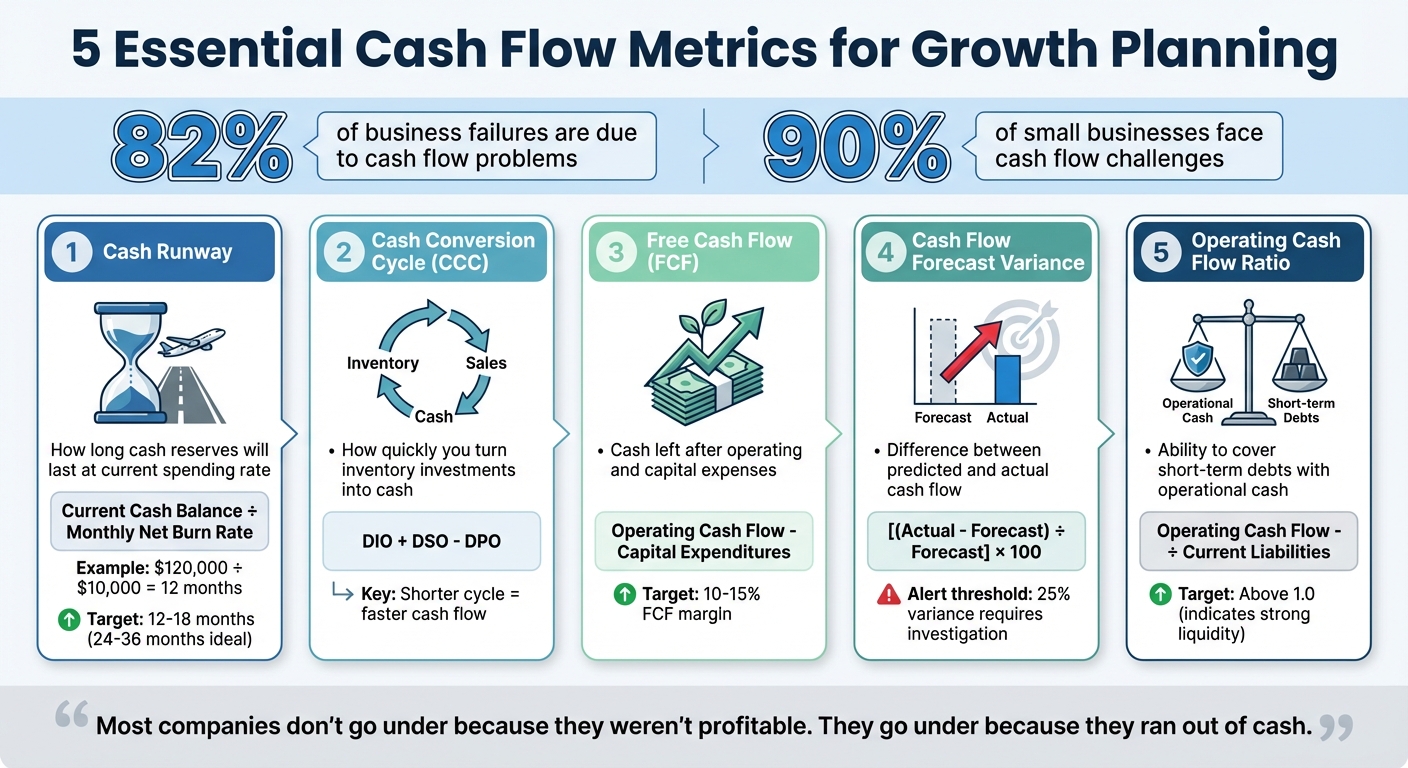
5 Essential Cash Flow Metrics Every Business Owner Should Track
How to Calculate Cash Flow Ratios and Key Metrics Easily
sbb-itb-85dd802
1. Cash Runway

Cash runway shows how many months your business can keep running with its current spending before the money runs out. To calculate it, divide your current cash balance by your monthly net burn rate – the amount you’re spending minus what you’re earning.
For instance, if you’ve got $120,000 in the bank and your monthly net spending is $10,000, your runway is 12 months. Experts often suggest keeping 12 to 18 months of runway as a baseline, though 24 to 36 months can provide extra breathing room, especially in tougher fundraising environments.
Why It’s Crucial for Growth
Cash runway plays a major role in growth planning. It helps determine whether you’re financially prepared for big moves like launching a product, hiring staff, or scaling operations. A healthy runway also strengthens your position when negotiating with investors or lenders, as it signals financial stability rather than desperation. As the Runway team wisely notes:
"Most companies don’t go under because they weren’t profitable. They go under because they ran out of cash".
Simple to Calculate
To ensure accuracy, use cash-based figures from your bank statements, not accrual-based profit and loss data. Leave out one-time expenses and calculate your average net burn over the past three to six months. These calculations can help you make informed decisions to stretch your runway.
Practical Steps to Extend Your Runway
Here are a few ways to keep your runway longer:
- Speed up customer payments: Send invoices as soon as work is done and offer discounts for early payments.
- Renegotiate vendor terms: Ask for extended payment terms, like moving from net-30 to net-60 or even net-90, to hold onto cash longer.
- Cut unnecessary costs: Cancel unused software subscriptions or pause underperforming ad campaigns.
- Run "what-if" scenarios: Regularly model how decisions, like hiring new employees, might impact your runway.
These steps can help you manage your finances more effectively and give your business the flexibility to grow.
2. Cash Conversion Cycle
The Cash Conversion Cycle (CCC) tracks how long it takes to convert investments in inventory into cash. Here’s the formula:
CCC = DIO + DSO – DPO.
In this equation, DIO stands for the time inventory sits before being sold, DSO represents how long customers take to pay, and DPO measures the time you take to pay suppliers.
Why It Matters for Growth
A shorter CCC means your business cycles cash faster, giving you more room to handle expenses, invest in opportunities, or cover emergencies. As Ramp puts it:
"A shorter cash conversion cycle means you’re getting your money back faster, which gives you more flexibility to pay bills, invest in growth, or handle unexpected expenses."
For larger companies, fine-tuning the CCC can significantly improve cash flow. For small businesses, it minimizes the working capital needed to keep things running smoothly. Understanding this metric helps pinpoint where cash flow might be stalling.
How It Affects Financial Stability
The CCC can act as a financial health check. If it starts increasing, it might signal issues such as slow-moving inventory, delayed customer payments, or paying suppliers too quickly. Catching these inefficiencies early can prevent bigger problems down the road.
Practical Tips for Small Business Owners
A focus on CCC can directly improve cash flow, which is essential for growth. To tighten your CCC, target its three key components:
- Speed Up Inventory Turnover: Use demand forecasting tools and clear out inventory that isn’t selling.
- Get Paid Faster: Offer discounts for early payments and switch to electronic invoicing to reduce delays.
- Negotiate Better Payment Terms: Extend supplier payment terms from Net 30 to Net 60 or 90, giving you more time to hold onto cash.
Tools like receivables aging reports and modern accounting software can help you identify overdue payments and take action before they become a problem. By addressing these areas, you’ll create a smoother cash flow cycle and strengthen your financial foundation.
3. Free Cash Flow
Free Cash Flow (FCF) represents the cash left over after covering operating expenses and capital expenditures. Essentially, it’s the money your business can use for growth, repaying debt, or addressing unexpected costs. Similar to the Cash Conversion Cycle (CCC), FCF provides a clear picture of liquidity, showcasing your ability to reinvest in your business.
Why It Matters for Growth
Understanding your FCF is essential for planning expansion. It not only helps you assess how much cash you have on hand but also determines if your business can grow using its own resources instead of relying on loans or external funding. Consider this: 61% of small businesses around the world face cash flow challenges, and 32% have struggled to pay vendors, employees, or loans due to cash shortages. A strong FCF sends a positive signal to lenders and investors, demonstrating that your business is prepared to scale. This financial stability allows you to take bold steps like hiring more staff, acquiring competitors, or opening new locations – all without stretching your finances too thin.
Take Ecophyse, for example. In 2025, this French waste recovery company with $32 million in annual revenue adopted Agicap’s automated management platform. Under General Manager Patrick Doucet, the company centralized its cash flow data across multiple bank accounts. This shift allowed them to identify surplus cash and transition from reactive cash management to proactive planning, using excess liquidity to fuel new growth initiatives.
How to Calculate Free Cash Flow
The formula for FCF is straightforward: Operating Cash Flow – Capital Expenditures. Alternatively, you can calculate it using the Net Income Method: Net Income + Non-cash Expenses – Change in Working Capital – Capital Expenditures.
For a healthy cash flow, most companies aim for an FCF margin (calculated as FCF divided by Revenue) of 10% to 15%.
Tips for Improving Your FCF
Boosting your FCF doesn’t have to be overly complex. Here are some practical steps to help you improve:
- Encourage faster payments: Offer early payment discounts to speed up receivables.
- Negotiate with suppliers: Secure better payment terms to retain cash longer.
- Optimize inventory: Use tracking systems to avoid tying up money in unsold stock.
- Cut unnecessary costs: Audit subscriptions and eliminate expenses that don’t directly support your business goals.
- Hire financial expertise: If a full-time CFO is out of reach, consider a fractional CFO to fine-tune your financial strategy and resource allocation.
4. Cash Flow Forecast Variance
Cash Flow Forecast Variance measures the gap between your predicted cash position and the actual outcome. It’s a way to check how accurate your financial forecasting and planning is. For instance, if you estimated $10,000 in revenue for March but brought in only $7,500, that $2,500 shortfall points to issues in your assumptions. Keeping track of this variance helps you adjust your strategies and maintain enough liquidity to meet your business goals.
Importance for Growth Planning
Tracking variance does more than just highlight errors – it helps create a dependable framework for decision-making. When your forecasts regularly match actual results, you’re better equipped to make big moves, like hiring new staff, increasing inventory for peak seasons, or launching marketing campaigns. Positive variances, where actual cash exceeds your forecast, mean extra funds that can be used for reinvestment or paying down debt. On the flip side, negative variances signal the need to cut costs, rethink pricing, or find additional working capital.
"We were always focused on our profit and loss statement. But cash flow was not a regularly discussed topic. It was as if we were driving along, watching only the speedometer, when in fact, we were running out of gas".
This quote from Michael Dell, Founder and CEO of Dell Technologies, underscores why poor cash flow management is behind 82% of business failures. Variance tracking works like a financial fuel gauge, giving you a heads-up before trouble strikes.
Ease of Calculation
The formula for variance is simple: [(Actual – Forecast) / Forecast] × 100. For example, if you forecast $10,000 but actually receive $12,500, the variance is 25%. Most small businesses review these numbers monthly or quarterly, looking for trends like seasonal slowdowns or periodic expense spikes. This straightforward calculation not only highlights discrepancies but also sets the stage for timely adjustments.
Impact on Financial Stability
Regular variance analysis plays a key role in protecting your cash flow during critical times. It helps you catch small issues – like late receivables or gradually rising subscription costs – before they grow into major problems. Over time, tracking variance also builds credibility with lenders and investors, proving that your financial projections are reliable. This is especially crucial since only 38% of U.S. businesses with under $5 million in revenue qualify for bank loans, often due to concerns about financial accuracy.
"When they trust your financials, your interest expense is going to go down".
Brad Jungers, Founder & CEO of CFO Insights, highlights how accurate forecasting can lead to lower borrowing costs.
Actionable Insights for Small Business Owners
Start by conducting a monthly plan vs. actual analysis. If you spot a variance of 25% or more, dig into the reasons – whether it’s unexpected overhead increases or delayed payments from key clients. Consider using accounting software that syncs with your bank accounts in real time to eliminate manual errors and provide live comparisons of actuals to forecasts. If you experience positive variance, set aside an emergency fund to prepare for future challenges. For negative variance, consider delaying major purchases, pausing hiring, or negotiating better terms with vendors.
| Variance Type | Definition | Impact on Growth Planning |
|---|---|---|
| Favorable | Actual revenue is higher (or expenses lower) than forecast | Extra cash can be reinvested, used for debt repayment, or expansion. |
| Unfavorable | Actual revenue is lower (or expenses higher) than forecast | May require cost-cutting, pricing adjustments, or finding more working capital. |
5. Operating Cash Flow Ratio
The Operating Cash Flow (OCF) Ratio shows how well your business can handle short-term debts using only the cash generated from daily operations. The formula is simple: divide your operating cash flow by your current liabilities. For example, if your business has $50,000 in operating cash flow and $40,000 in current liabilities, the ratio is 1.25. This means you have $1.25 in operational cash for every dollar of debt owed.
Why It Matters for Growth
A ratio above 1.0 indicates strong liquidity, showing that your business can meet short-term obligations without needing loans or other external funding. This financial flexibility allows you to reinvest cash into areas like hiring, equipment, or inventory growth. Investors also value this metric because cash flow is less prone to accounting adjustments. However, it’s worth noting that large retailers might report lower ratios due to their size and payment cycles.
"In business, the adage of cash is king holds true for a reason. Without a healthy cash flow, your company’s profitability, growth, and viability are threatened."
- Thomas Huckabee, CPA
Simple to Calculate
Both operating cash flow and current liabilities can be easily found on your Statement of Cash Flows and Balance Sheet. Most accounting software tracks these numbers, offering real-time insights into your liquidity. This simplicity makes it practical to monitor the ratio monthly or quarterly.
How It Affects Financial Stability
If your ratio falls below 1.0, it signals a liquidity issue, meaning you might need external funding or asset sales to cover short-term debts. A consistently negative OCF is particularly concerning, as it indicates you’re burning through cash to stay operational – even if your income statement shows a profit. Tracking this ratio over time can reveal trends. For instance, if the ratio drops while sales are climbing, it could be a sign that costs are rising too quickly.
Practical Tips for Small Business Owners
If your ratio is under 1.0, there are steps you can take to improve it. Speed up cash inflows by requiring down payments, offering early payment discounts, or using automated invoicing. On the flip side, negotiate longer payment terms with vendors – shifting from Net-30 to Net-60 or Net-90 can help maintain cash reserves. For example, Penntek Coatings significantly increased its annual transaction volume by adopting real-time cash flow monitoring and automating accounts receivable processes. Additionally, evaluate your inventory turnover and tighten credit terms for customers with a history of late payments.
| OCF Ratio | What It Means | Next Steps |
|---|---|---|
| Above 1.0 | Strong liquidity; cash fully covers short-term debts | Use surplus cash for growth investments |
| Below 1.0 | Possible liquidity issues; may require external funding | Speed up receivables, extend payables, or cut costs |
How These Metrics Support Business Growth
These five metrics work together to align day-to-day cash management with long-term growth goals. Operating Cash Flow shows whether your core business is generating enough cash to keep things running smoothly. Meanwhile, Free Cash Flow highlights the cash available for key activities like expanding operations, paying off debt, or distributing profits. Cash Runway provides a clear estimate of how long your current reserves will last, while the Cash Conversion Cycle measures how efficiently you’re turning inventory and receivables back into cash. Finally, Cash Flow Forecast Variance flags any gaps between your projected and actual cash flows. Together, these metrics offer a well-rounded view to help you catch potential liquidity issues early.
By tracking these metrics as a group, you can avoid financial blind spots that might jeopardize your business. A company may look profitable on paper, but poor cash flow management – like delayed collections or excess inventory – can quickly lead to liquidity problems. Often, the key to survival lies in understanding your entire cash flow picture, not just your profit margin or bank balance.
These tools also help businesses balance growth opportunities with financial risks. For instance, rapid revenue growth might put pressure on liquidity if receivables outpace collections. Monitoring metrics like Days Sales Outstanding alongside the Operating Cash Flow Ratio allows companies to spot and address collection delays before they hurt cash flow. Similarly, comparing actual cash burn to forecasts helps business leaders distinguish between planned investments and unexpected financial strains.
Conclusion
Incorporating these metrics into your regular review process can pave the way for more informed growth strategies. The five cash flow metrics – Cash Runway, Cash Conversion Cycle, Free Cash Flow, Cash Flow Forecast Variance, and Operating Cash Flow Ratio – offer the transparency needed to make sound decisions. Without these tools, you’re essentially relying on intuition instead of concrete data. It’s worth noting that 82% of small businesses fail due to poor cash flow management, not because of insufficient sales or profitability. Knowing your cash position at all times often determines whether your business thrives or struggles.
"Cash flow is not just about earnings – it’s about the movement of money."
- David White, Senior Content Marketing Manager, Relay
Tracking these metrics consistently turns uncertainty into confidence.
If you’re unsure how to interpret these numbers or apply them effectively, professional help can make a difference. For example, in 2025, the agency TEN7 partnered with a Virtual CFO team to tackle significant cash flow issues, including a 25% profit loss. By implementing structured cash flow management and forecasting, they reversed the loss and achieved a 10% profit within a year. This example highlights how expert guidance can transform financial challenges into opportunities for growth. TC Advisors (https://tcadvisorscpa.com) provides fractional CFO services and business consulting to help businesses turn raw data into actionable strategies – whether it’s renegotiating vendor contracts, cutting unnecessary expenses, or timing critical hires and expansions.
The takeaway? You can’t manage what you don’t measure. These five metrics create a solid framework for identifying planned investments and avoiding unexpected financial setbacks. Leverage these insights to make strategic choices and build a stable foundation for long-term success.
FAQs
Which cash flow metric should I watch first?
Tracking operating cash flow is essential because it shows the cash your business generates from its main activities. This metric gives you a clear view of your financial health and helps evaluate whether your business can maintain operations and support growth over time.
How often should I review these cash flow metrics?
You should review cash flow metrics weekly or monthly to keep a close eye on your business’s financial well-being. By doing this regularly, you can spot patterns, tackle potential problems early, and make timely adjustments to help maintain steady growth.
What’s the easiest way to improve cash flow fast?
The fastest way to boost cash flow is to focus on getting paid more quickly. Start by building strong connections with your clients’ accounts payable teams – good relationships can make a big difference. Ensure your invoices are clear, accurate, and easy to understand. On top of that, stick to a firm accounts receivable policy. Regular, clear communication and timely follow-ups can help speed up payments and cut down on delays.


