

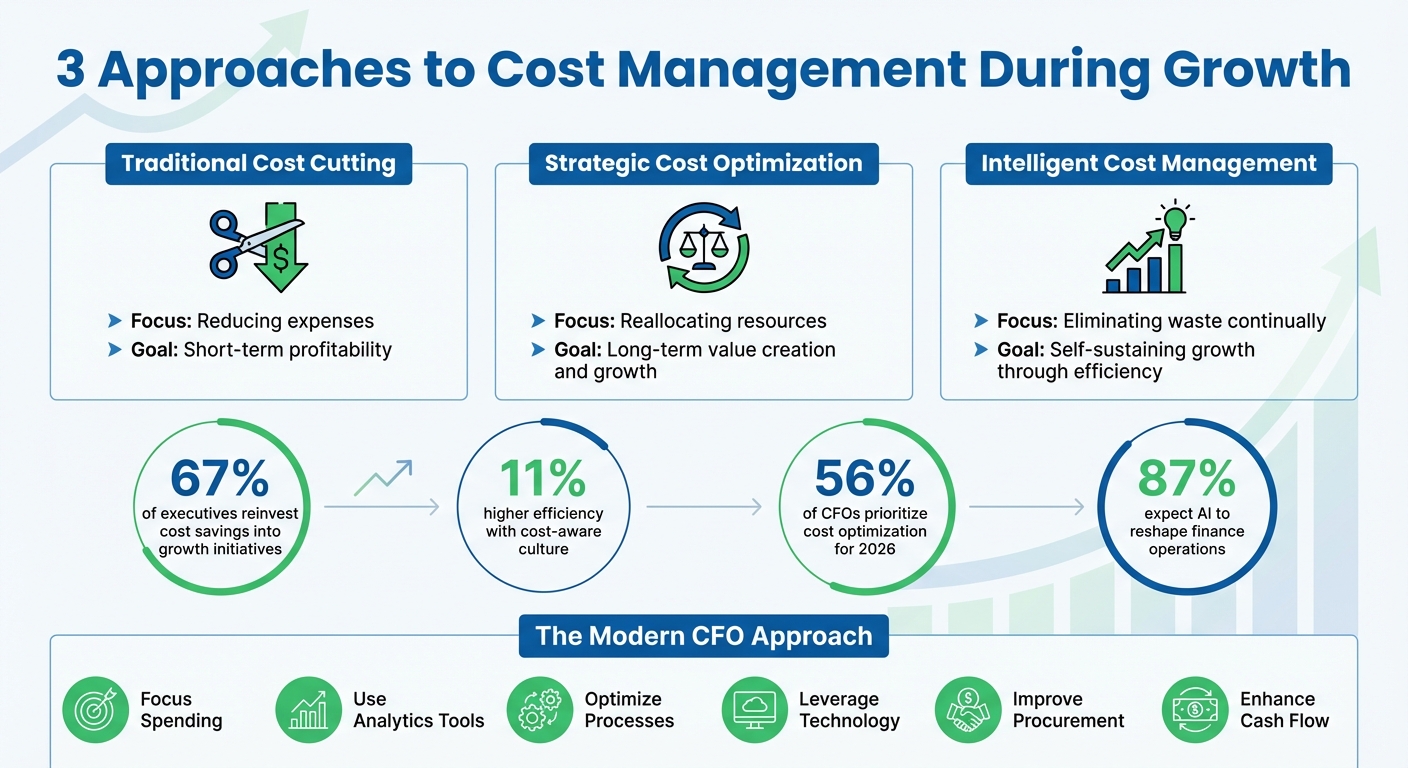
Scaling a business can increase revenue but often leads to rising costs that outpace profits. CFOs face the challenge of controlling expenses while supporting growth. The key? Managing costs strategically – not just cutting budgets but reallocating resources to fuel growth initiatives. Here’s how:
- Focus Spending: Differentiate between growth-driving expenses (like key hires or customer success teams) and non-core costs (like unused software or inefficient marketing).
- Use Tools: Activity-Based Costing (ABC) and metrics like Lifetime Value (LTV) to Customer Acquisition Cost (CAC) help identify inefficiencies.
- Optimize Processes: Implement Zero-Based Budgeting (ZBB) and rolling forecasts to ensure every dollar spent aligns with business goals.
- Leverage Technology: Automate financial processes, audit software usage, and adopt ERP systems to reduce manual inefficiencies.
- Improve Procurement: Negotiate better supplier contracts, extend payment terms, and monitor vendor performance.
- Enhance Cash Flow: Use rolling forecasts, optimize inventory, and shorten payment cycles to maintain liquidity during growth.
The goal isn’t just cost-cutting – it’s smarter spending that supports scalable, long-term growth. CFOs who combine financial analytics, automation, and disciplined planning can protect margins and ensure sustainable success.
Cost structure is one of the first things we rebuild in a fractional CFO engagement, because pricing decisions depend on knowing which costs actually scale.
Traditional Cost Cutting vs Strategic Cost Optimization for CFOs
CFOs Evaluate Revenue Growth Rate AND Profit Margin Like This
sbb-itb-85dd802
Aligning Cost Management with Business Goals
Managing costs effectively during periods of growth isn’t just about slashing expenses – it’s about channeling resources where they matter most. CFOs who approach spending as a strategic tool rather than just a line item on a balance sheet tend to achieve better results. The challenge lies in distinguishing between costs that fuel growth and those that drain resources.
Identifying Which Costs Support Growth
The first step is to categorize expenses into two buckets: differentiated capabilities and non-core spending. Differentiated capabilities – such as your core engineering team, sales operations targeting high-value clients, or customer success for key accounts – are essential for maintaining a competitive edge and should be safeguarded during scaling. On the other hand, non-core expenses, like redundant software subscriptions or underperforming marketing channels, can often be trimmed or restructured.
Activity-Based Costing (ABC) is a powerful tool that helps CFOs dig deeper into spending patterns. It doesn’t just show what was spent but explains why the money was spent. For instance, ABC can highlight whether high customer service costs are due to technical issues with the product (a potential red flag) or routine billing questions (a sign of process inefficiencies). This level of insight uncovers waste that traditional budget reviews might overlook.
Another critical metric is unit economics, especially the ratio of Customer Lifetime Value (LTV) to Customer Acquisition Cost (CAC). A healthy benchmark is 3:1 or higher. If this ratio dips, it’s a sign that sales and marketing efforts aren’t delivering profitable growth, signaling the need for resource reallocation. Similarly, breaking down profitability at the SKU level can reveal which products are worth scaling and which are dragging down operational efficiency.
A common area of hidden waste is software sprawl. During rapid growth, companies often accumulate duplicate tools or licenses they don’t fully utilize. For example, an audit might reveal you’re paying for 100 software seats when only 40 are actively in use. Addressing these inefficiencies can deliver immediate savings without disrupting operations. By aligning spending with growth objectives, CFOs can create a foundation for scalable, sustainable progress. These insights also enable cost control to become a part of ongoing strategic planning.
Building Cost Control into Long-Term Planning
Once CFOs identify which costs support growth, the next step is embedding these insights into long-term financial planning. The best CFOs treat cost management as an ongoing process, not just a one-time exercise. For instance, Zero-Based Budgeting (ZBB) requires every expense to be justified from scratch each period. This method eliminates "zombie costs" – expenses that linger simply because they were included in last year’s budget.
Dynamic capital allocation models are replacing rigid annual budgets. By using rolling forecasts, CFOs can reassess resource allocation quarterly, allowing for quick pivots when certain initiatives underperform or new opportunities arise. Some companies even establish an "innovation reserve" – a small pool of funds dedicated to testing new ideas without overcommitting resources.
Cost awareness shouldn’t just live within the finance department – it needs to become part of the company culture. With 67% of executives planning to reinvest savings from cost reductions into growth initiatives, it’s clear that cost control isn’t about austerity. Instead, it’s about creating self-sustaining growth. Companies that foster this mindset often see up to 11% higher efficiency in their cost optimization efforts. This alignment between cost management and business goals not only saves money but also strengthens the company’s competitive position.
| Approach | Focus | Goal |
|---|---|---|
| Traditional Cost Cutting | Reducing expenses | Short-term profitability |
| Strategic Cost Optimization | Reallocating resources | Long-term value creation and growth |
| Intelligent Cost Management | Eliminating waste continually | Self-sustaining growth through efficiency |
Analyzing and Optimizing Cost Structures
Once growth-driving expenses are identified, CFOs need to dig deeper into the company’s cost structure. This involves categorizing expenses to understand how money flows through the business and pinpointing inefficiencies. A key factor here is the distinction between fixed costs – like rent, full-time salaries, and insurance – and variable costs, which include raw materials, shipping, and payment processing fees. Fixed costs set the "burn floor", or the minimum revenue needed to operate, while variable costs influence the gross margin on each sale.
Understanding Fixed vs. Variable Costs
Breaking down costs into fixed and variable categories reveals a company’s operating leverage – its ability to grow revenue without a proportional increase in fixed costs. This leverage can significantly boost profit margins during periods of growth. For instance, if a SaaS company has $500,000 in monthly fixed costs and gains 1,000 new customers without needing extra staff, the added revenue directly improves profitability. Josh Richards from Mercury explains:
"Understanding what’s fixed and what’s variable makes it possible to model those scenarios. It tells you how much of your spend will scale with growth, and how much will sit on your books no matter what" – Josh Richards, Mercury
There’s also a middle ground: semi-variable costs. These remain constant until a threshold is reached, at which point they "jump" to a new level. Examples include tiered software subscriptions or the need for additional staffing as customer numbers grow. CFOs should model these "step jumps" to anticipate when scaling will require new fixed investments, such as expanding warehouse space or adding management layers. Calculating the breakeven point – using the formula (Fixed Costs / (Selling Price per Unit – Variable Cost per Unit)) – helps determine how many units need to be sold to cover costs and turn a profit. After this analysis, the next step is to audit these cost structures for inefficiencies.
Conducting Expense Audits
Expense audits are essential for uncovering waste, especially during rapid growth. The process starts by categorizing all costs – fixed, variable, direct, and indirect – and identifying high-cost activities or vendors in each category. Reviewing historical spending data can highlight inefficiencies, trends, or anomalies. However, many organizations fall short; 82% of businesses missed their cost reduction targets in 2023 because they treated audits as a one-off task rather than a continuous strategy.
One common area of loss is poor contract management, which costs businesses an average of 9.2% of a contract’s value due to missed renewal dates or hidden fees. Regular SaaS audits can help by identifying unused software licenses or consolidating tools with overlapping features. Cloud infrastructure is another area ripe for savings; adjusting over-provisioned resources can reduce costs by 5–15% in as little as 1–4 weeks. The Ravix Group emphasizes:
"Conducting a detailed audit can uncover hidden costs and inefficiencies, allowing for strategic reallocations that drive greater impact" – The Ravix Group
Armed with these insights, CFOs can leverage financial analytics to refine cost structures even further.
Using Financial Analytics to Find Savings
Financial analytics transform spending data into actionable insights, helping CFOs move from reactive cost-cutting to proactive cost optimization. The aim isn’t just to slash expenses – it’s about reallocating funds to areas that deliver the highest returns. By 2026, 87% of CFOs expect AI to play a critical role in operations, using it to automate tasks like reconciliation and flagging questionable expenses before they’re paid. Real-time dashboards also provide instant visibility into cash flow and spending, enabling quick adjustments when variances arise.
Benchmarking costs against industry standards is another effective tool. It highlights areas where the company may be overspending compared to competitors. For example, if customer acquisition costs are unusually high, analytics can help identify whether the issue lies in inefficient marketing channels or a product-market fit problem. Jason Mountford, a finance expert, cautions:
"Cost-cutting alone is not a strategy. CFOs who approach cost control purely as an exercise in slashing expenses risk weakening their company’s long-term growth potential" – Jason Mountford
Instead, financial analytics should guide strategic decisions, ensuring that every dollar spent contributes to sustainable growth and long-term success.
Using Technology to Reduce Costs
Investing in the right technology can significantly boost operational efficiency by enabling businesses to handle greater workloads without adding to their workforce. In fact, 69% of finance leaders in 2025 have identified cost optimization and efficiency improvements as their primary goals for driving growth. The secret lies in selecting tools that eliminate manual inefficiencies, integrate seamlessly with existing systems, and scale as the business grows. Combined with thorough expense audits, these tools can help finance teams streamline operations and maintain scalability.
Implementing Spend Management and ERP Systems
Modern ERP and spend management systems provide real-time insights into spending, replacing outdated spreadsheets and delayed reports. These platforms centralize critical financial functions like general ledger management, accounts payable/receivable, compliance, and expense tracking. Rose Punkunus, CEO of Sudozi, highlights their importance:
"A good sign you need to update your CFO’s stack is when your team is doing repetitive manual tasks instead of deriving actionable insights."
When choosing a platform, CFOs should prioritize API-first systems with modular designs. These features enable smooth integration with payroll, CRM, and other essential tools, eliminating the need for repetitive data entry. Outdated processes, like paper invoicing and siloed tools, create inefficiencies that modern platforms can resolve. Notably, 51% of CFOs managing expense systems now rely on cloud-based solutions to reduce costs and establish scalable infrastructure.
Once these systems are in place, the next step is automating routine financial processes to further drive efficiency.
Automating Financial Processes
Automation can deliver impressive returns, especially in areas with high transaction volumes, like accounts payable, payroll, and reconciliations. For example, top-performing AP teams process invoices 82% faster – cutting the time from 17.4 days to just 3.1 days – while reducing costs by 78% to about $2.78 per invoice. AI-powered invoice processing can lower operational costs by up to 80%, and automating bookkeeping tasks can save 30% to 40% of the time spent on financial processes.
To implement automation effectively, start with straightforward, high-volume transactions like utilities or recurring services. This approach secures early wins and builds team confidence before tackling more complex processes. As Arron Bennett, Founder of Bennett Financials, puts it:
"Automation is working when it shortens close, improves accuracy, strengthens controls, and frees finance capacity for analysis."
However, automation doesn’t mean eliminating human oversight. Tasks like handling exceptions, material journal entries, and tax-sensitive classifications still require careful review. Striking this balance allows finance teams to shift their focus from spending 70% of their time on transactional tasks to dedicating that time to strategic analysis.
These automation efforts directly impact the return on investment (ROI) from technology.
Calculating ROI on Technology Investments
Today’s leadership teams expect faster payoffs from technology investments. A simple ROI calculation – (Net Benefits – Total Costs) / Total Costs × 100 – can provide clarity, but it’s essential to also factor in the Total Cost of Ownership (TCO). This includes subscription fees, implementation, data migration, training, maintenance, and infrastructure costs.
Net benefits include both tangible savings, like reduced labor costs and quicker reporting cycles, and less tangible gains, like improved decision-making, better compliance, and lower employee burnout. For example, manual invoice processing costs around $12 per invoice, while automation reduces that to about $3. Additionally, real-time data access can boost decision-making efficiency, delivering an ROI exceeding 300%.
| Metric | Manual Process | Automated Process |
|---|---|---|
| Work Hours (75 employees) | 42 hours/week | 12 hours/week |
| Month-End Close Time | 8–10 days | 2–3 days |
| Cost Per Invoice | ~$12.00 | ~$3.00 |
Most CFOs aim for a return of 30% to 60% within the first 12 to 24 months. Achieving this requires setting clear, measurable KPIs, such as days to close, the percentage of auto-coded transactions, and invoice cycle times. Establishing baseline metrics is also vital to track improvements accurately. One common mistake to avoid is replicating old manual processes in a new digital environment.
Improving Procurement and Cash Flow Management
Combining smart technology investments with disciplined procurement and cash flow strategies can lead to significant financial benefits. For instance, businesses without structured procurement processes often overpay by 15% to 30%, and nearly half of small business owners have less than three months of cash reserves. These gaps can strain finances, especially during growth phases.
Negotiating Better Supplier Contracts
The best time to negotiate supplier contracts is before signing. As Eagle Rock CFO puts it:
"The leverage point is before you sign – after signing, you have little negotiating power until renewal"
Sharing growth forecasts with suppliers can help secure better pricing and ensure readiness for future demand. Beyond the upfront cost, focus on the Total Cost of Ownership (TCO), which includes maintenance, support, and hidden fees. Effective vendor management can lower spending by 10% to 20% while improving service quality. Procurement analytics can further cut costs by up to 20% by enhancing negotiation leverage and supplier selection.
Pay attention to key contract terms to avoid surprises. For instance, capping annual price hikes at 3% to 5% can shield against sudden cost increases. Negotiating longer payment terms, such as moving from Net 30 to Net 45 or Net 60, can ease cash flow pressures. Include termination clauses with notice periods of 30 to 90 days and avoid auto-renewals without at least 60 days’ notice. Timing your negotiations strategically – like near the end of a vendor’s fiscal quarter – can also provide leverage.
| Contract Term | Recommended Strategy |
|---|---|
| Price Escalation | Cap annual increases at 3–5% |
| Payment Terms | Extend to Net 45–60; avoid prepayments |
| Termination | Require 30–90 days’ notice; avoid penalties |
| Auto-Renewal | Demand 60+ days’ notice before renewal |
| SLAs | Define clear metrics and remedies |
Since 80% of spending often centers on 20% of suppliers, maintain strong relationships with this key group. Regularly solicit competitive bids – ideally twice a year – from at least three to five vendors to validate pricing and maintain leverage. Additionally, standardizing purchase orders for transactions over $1,000 ensures an audit trail and reduces unauthorized spending.
Managing Working Capital
Once supplier contracts are optimized, the next step is managing cash flow and working capital. Fabian Bodoky of Efficio highlights:
"A successful cost-savings program begins with alignment between finance and procurement"
Effective working capital management involves balancing accounts receivable, inventory, accounts payable, and cash flow. Companies can often unlock 5% to 15% of their revenue in cash through disciplined optimization, all without reducing staff.
Using 13-week rolling forecasts with weekly updates helps identify liquidity risks early and encourages timely decision-making. Negotiating extended payment terms (60–90 days) delays cash outflows, while offering dynamic discounts for early payments can secure cost savings.
For accounts receivable, automated reminders, clear credit policies, and digital payment systems can reduce Days Sales Outstanding (DSO). Aligning sales team incentives with cash collection rather than just booked revenue ensures a focus on actual cash flow. As Growth Operators aptly states:
"Revenue doesn’t matter until it converts to cash"
Inventory management can also unlock capital. Using ABC analysis to prioritize high-value, fast-moving stock while trimming slower-moving items streamlines operations. For example, middle-market strategies achieve an average of 27.9 inventory turnovers annually, compared to 14.11 in hybrid strategies and 13.99 in terminal markets. Setting approval thresholds for purchases – for instance, Manager <$500, CFO >$5,000 – balances oversight with efficiency.
Shortening Payment Cycles and Improving Inventory Turnover
Manufacturers often face DSOs of 50 to 65 days, compared to an industry benchmark of 45 days. Optimizing the invoice-to-cash cycle with AI can reduce DSO by 35%, recovering two to three weeks of working capital. For a $200M manufacturer, this translates to $2.4M in annual savings.
Automating invoice delivery through electronic systems like EDI or email ensures invoices reach customers immediately, saving three to five days in transit. AI-powered cash application tools can match payments to invoices with 70% less manual effort. Offering discounts (e.g., 2/10 net 30) encourages faster payments.
For inventory, Just-in-Time (JIT) ordering aligns stock levels with production or sales needs, cutting excess and holding costs. Regularly review product performance to eliminate low-margin or slow-moving items, freeing up capital. Predictive analytics can fine-tune safety stock levels based on historical and seasonal patterns, while monthly physical audits ensure accuracy and identify obsolete inventory early.
Finally, automating dispute resolution for issues like freight or quality claims prevents cash from being tied up unnecessarily. Clear credit policies with upfront limits help avoid high-risk accounts bloating receivables. These practices collectively improve the Cash Conversion Cycle, enhancing liquidity and reducing reliance on debt.
Improving Efficiency While Supporting Growth
After addressing procurement and technology cost controls, the focus now shifts to internal operational efficiency. The aim isn’t just cutting expenses – it’s about redirecting resources from low-yield activities to initiatives that drive growth. Companies that build a culture of cost awareness often see up to 11% higher success in their cost-reduction efforts. However, most businesses only achieve 48% of their intended savings.
Removing Waste from Operations
Activity-Based Costing (ABC) provides insights into why money is spent, not just where it goes. For instance, ABC might reveal that routine billing inquiries consume a large share of support budgets, signaling an opportunity for automation.
Auditing departments often exposes duplicate subscriptions or underused software licenses. Consolidating these can lead to volume discounts and eliminate unnecessary spending. Energy-efficiency upgrades also offer substantial savings; modern systems can significantly lower operating costs. In 2024, a Middle Eastern automotive retailer tackled inefficiencies like slow receivables and inflated inventory. By implementing 20 cost-saving measures, including stricter credit policies and inventory reductions, the company boosted annual profits by $19 million.
Simplifying Product or Service Lines
Overly complex product or service offerings often inflate costs without generating proportional revenue. Portfolio rationalization – removing underperforming SKUs or non-core products – reduces complexity, streamlines operations, and boosts profitability. Campbell Soup Co. offers a great example: in 2025, they launched an "Enablers" program to optimize costs through product line simplification and vendor renegotiation. The result? A 4.5% reduction in controllable expenses, with all savings reinvested into growth-focused initiatives.
Chen Amit, CEO of Tipalti, shared how simplifying processes can improve efficiency:
"We designed it a few years ago, but in the last couple of years, we added to our 14-step process, making it a 27-step process… 95 percent of customers are suffering from what they don’t need."
By removing unnecessary steps, Tipalti enhanced customer satisfaction while cutting costs. Similarly, target costing – determining the selling price minus the desired profit during the development phase – ensures that new offerings are designed within profitable limits, avoiding cost overruns.
Creating Accountability for Cost Management
Streamlining product lines is just the first step; sustaining those savings requires embedding accountability across the organization. Cost management can’t rest solely on the finance team. CFOs need to involve department heads in identifying savings opportunities without sacrificing performance. Unfortunately, only 11% of businesses maintain cost reductions for more than three years, often due to unclear accountability.
Decentralized decision-making helps spread cost awareness throughout daily operations. Tools like scoring templates can guide budget owners in deciding which activities to keep, optimize, or cut. Regular progress reviews, led by initiative sponsors, keep cost-saving measures on track.
Gartner highlights the challenge:
"CFOs are navigating a complex, volatile environment where they need to keep tight control over costs and be more agile with financial forecasting."
Gain-sharing programs, where teams meeting budget goals can reinvest a portion of the savings, promote ownership. Additionally, real-time dashboards and AI-driven analytics empower non-finance teams to monitor spending trends and address issues early. Transitioning from slow annual budget cycles to quarterly reviews ties spending to measurable outcomes and ensures accountability.
These strategies align cost efficiency with sustainable growth, complementing earlier procurement and technology improvements. Partnering with experienced financial consultants can further enhance these efforts. For instance, TC Advisors offers fractional CFO services and tailored financial consulting to help organizations integrate cost management into their growth strategies effectively.
Conclusion
Managing costs during periods of growth isn’t about cutting budgets blindly – it’s about adopting a disciplined approach that eliminates waste while channeling resources toward initiatives that create a competitive edge. Successful CFOs are moving away from reactive cost-cutting and embracing Intelligent Cost Management (ICM). This method focuses on reallocating capital to high-return projects rather than making uniform spending cuts across the board.
The numbers speak volumes: 56% of CFOs are prioritizing cost optimization across their organizations for 2026, and 87% anticipate AI will reshape finance operations. These aren’t just efforts to improve efficiency – they’re strategic moves. As Dennis Gannon from Gartner highlights:
"Financially conservative themes focused on improving financial strength and downside risk mitigation are among the most common CFO goals for 2026".
The secret lies in combining cost discipline with agile, forward-looking forecasting.
To make this work, theory must give way to actionable strategies. Replace outdated annual budget cycles with quarterly rolling allocation models that rely on real-time performance data. For capacity planning, aim to scale investments approximately 30–50% above current demand, ensuring reasonable payback periods. Regularly auditing SaaS and cloud expenditures is another key step – companies can often cut 25–40% of these costs by canceling unused subscriptions and optimizing over-provisioned resources. These habits build a foundation for technology-driven and advisory-backed growth strategies.
When used wisely, technology enhances these efforts. Cost optimization should directly support profitable growth. As Nikita Alexander from The CFO points out, leveraging tools like automated reconciliations, zero-based budgeting, and AI-driven analytics for capital allocation can help businesses redirect resources to high-impact growth opportunities. These tech-enabled practices strengthen the ICM framework, ensuring that every dollar spent aligns with strategic goals.
For businesses seeking customized support, external expertise can make all the difference. Firms like TC Advisors offer fractional CFO services and business consulting to help small and mid-sized companies implement these strategies effectively. By combining advanced financial analytics with hands-on execution, they ensure that cost management evolves into a lasting competitive advantage.
FAQs
How do I know which costs actually drive growth?
To figure out which costs fuel growth, look at expenses that either directly or indirectly affect revenue. Revenue drivers could be things like hiring more salespeople or running advertising campaigns. On the flip side, non-revenue drivers, such as office supplies, tend to have a smaller impact on your bottom line.
Take a close look at where your money is going to ensure it’s backing efforts that truly support growth. Focus on initiatives that add value, and cut back on spending that doesn’t contribute much. This kind of thoughtful planning can help streamline operations and set the stage for stronger growth.
When should we use zero-based budgeting vs rolling forecasts?
Zero-based budgeting (ZBB) requires starting from square one with every budgeting cycle, justifying every expense anew. This makes it a solid choice for cutting costs, prioritizing spending, or reallocating resources efficiently. On the other hand, rolling forecasts are continuously updated, making them ideal for environments that demand flexibility and quick adjustments to real-time changes.
ZBB is perfect when you need strict cost control and want to align spending with strategic goals. Meanwhile, rolling forecasts shine in periods of rapid growth or uncertainty, offering the agility to adapt financial plans as circumstances evolve.
What KPIs best prove ROI from finance automation or an ERP?
Key performance indicators (KPIs) that showcase the return on investment (ROI) from finance automation or an ERP system often include metrics like lower operational costs, faster cycle times, and better real-time financial insights. These measurable improvements emphasize increased efficiency and cost savings, providing CFOs with clear evidence to validate the investment while aligning with long-term growth plans.


