

When mergers and acquisitions (M&A) close, the real work for CFOs begins. Integration is where most deals fail – 70% of mergers stumble during this phase, and 70-90% of acquisitions fall short of their projected value. CFOs must address financial missteps, system incompatibilities, and leadership misalignment to protect the deal’s value.
Key Takeaways:
- Financial Risks: Hidden liabilities, tax compliance issues, and overestimated synergies can derail success. About 40% of companies neglect internal controls, leading to errors and penalties.
- Leadership and Team Alignment: Nearly 50% of M&A failures stem from leadership and team misalignment. Early planning and communication are critical.
- Technology Challenges: System incompatibilities, like mismatched ERP or payroll platforms, create inefficiencies and cybersecurity risks.
- Mitigation Strategies: CFOs should prioritize early due diligence, set up an Integration Management Office (IMO), and track synergy progress with clear metrics.
By focusing on these areas, CFOs can reduce risks, align teams, and ensure smooth integration for long-term success.
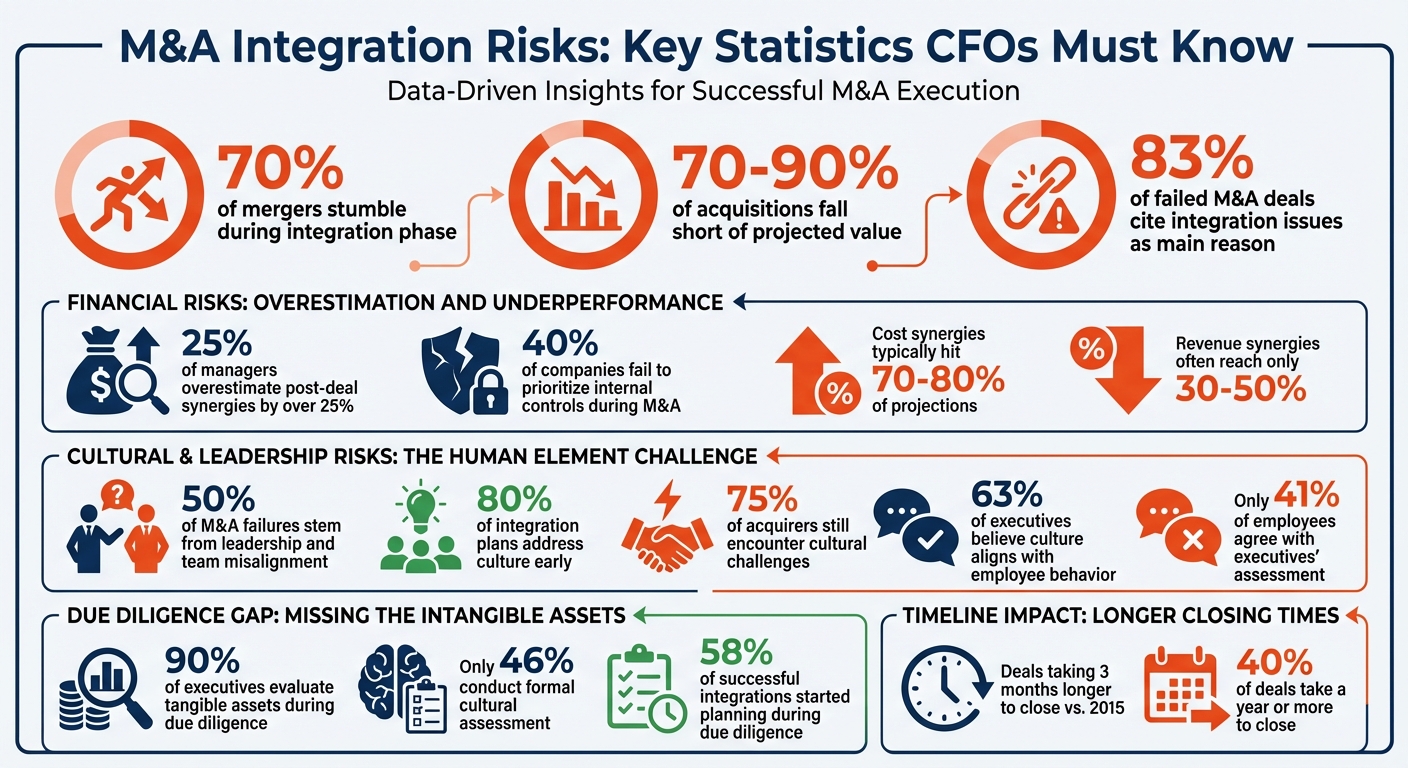
M&A Integration Risk Statistics and Key Failure Points for CFOs
Mastering M&A: Strategy, Integration, and Avoiding Costly Mistakes
sbb-itb-85dd802
Identifying Key M&A Integration Risks
CFOs play a critical role in spotting risks that can derail mergers and acquisitions (M&A). These risks generally fall into three main areas: financial, cultural, and operational. Each presents its own challenges, and addressing them early is crucial to preserving the deal’s value.
Financial Discrepancies and Liabilities
Financial risks often surface after the deal closes. Issues like weak governance or unfamiliar accounting practices can lead to errors in financial data or the opening balance sheet. When financial systems don’t align, consolidating statements becomes a slow and messy process. Delays in integrating treasury functions can even result in liquidity problems. On top of that, about 25% of managers overestimate post-deal synergies by over 25%, creating overly optimistic expectations that CFOs must later temper.
Tax compliance is another minefield. Without a clear tax strategy for the transition, companies risk falling short of regulatory requirements in multiple jurisdictions. The numbers are sobering: 40% of companies fail to prioritize internal controls during the M&A process, which opens the door to financial misstatements and penalties.
These challenges highlight why thorough financial due diligence is non-negotiable. But even with solid financial planning, cultural alignment is just as critical to success.
Cultural Misalignment
Numbers alone won’t guarantee a successful integration. Nearly half of M&A professionals point to cultural misalignment or difficulties merging management teams as a leading cause of deal failure. Cultural clashes often arise in three areas: conflicting values and purposes, differing approaches to decision-making, and varied styles of employee engagement.
Even when 80% of integration plans address culture early, 75% of acquirers still encounter cultural challenges that demand serious attention. Preconceived notions like "they’re arrogant" or "they’re outdated" can quickly escalate into entrenched divisions if not tackled head-on. A case study from Bain & Company in 2023 illustrates this point. When two professional services firms merged, their decision-making styles clashed – one favored consensus, while the other prioritized quick, decisive action. The solution? Establishing new, shared norms that removed personal blame from the equation.
Leadership inconsistency can make things worse. When leaders fail to align their actions with their messaging about the new culture, it breeds mistrust and widens cultural gaps. A 2023 survey found that 63% of executives and board members believe their culture aligns with employee behavior, but only 41% of employees agree. This disconnect can quickly turn into a retention problem if left unchecked.
To address cultural risks, companies need proactive planning and continuous monitoring. And because culture often intersects with operations, mismatched systems and redundant processes only add to the complexity.
Operational and Technology Challenges
Technology integration is often underestimated but can create enormous headaches. Incompatible ERP systems, payroll platforms, and AP/AR workflows lead to duplication, missed transactions, and reporting errors. The scale can be daunting. During Royal Bank of Scotland‘s 2003 acquisition of National Westminster Bank, over 4,200 people worked to transfer 250 GB of data, including 14 million customer records and 33 million direct debit records.
The costs can also spiral. Interpublic Group spent $300 million in professional fees to meet Sarbanes-Oxley compliance for its newly merged entities during its global expansion. Similarly, Bank of America faced significant delays in its 2003 acquisition of Fleet-Boston due to difficulties merging incompatible IT systems.
On top of these challenges, integration often disrupts day-to-day operations, draining resources and morale. Duplicate processes waste time and require constant management oversight to reconcile. Cybersecurity is another concern. Merging systems creates vulnerabilities – so-called "dark spaces" – that hackers can exploit, while also risking non-compliance with regulations like SOX or GDPR.
"An acquisition’s value thesis is only as durable as its risk controls. While financial models celebrate upside, unseen threats – regulatory missteps, cyber intrusion, supply-chain shocks – lurk in the dark spaces between disparate systems." – Umbrex Post-Merger Integration Playbook
Addressing these operational risks requires a detailed assessment of systems and a clear plan to integrate them effectively.
Assessing Risks Through Due Diligence
Due diligence transforms the process of identifying risks into one of quantifying them, typically taking between 30 and 90 days to complete. These evaluations focus on uncovering financial inconsistencies, operational hurdles, and mismatches in organizational culture that were previously flagged.
Conducting Financial Due Diligence
Financial due diligence revolves around four key areas. First, Financial Statement Analysis looks at growth trends and cash flow to understand the target’s financial trajectory. Next, Quality of Earnings (QoE) adjusts for one-time events, providing a clearer picture of the company’s earning potential. Working Capital Assessment ensures there’s enough cash flow post-transaction to maintain operational stability. Lastly, a review of Debt and Contingent Liabilities highlights any financial obligations you’ll inherit, including off-balance-sheet items that could pose future risks.
A structured approach minimizes errors. The 90-Day Model incorporates historical driver analysis, scenario-based Discounted Cash Flow (DCF) projections, and a synergy heat map with confidence ratings. This process shapes your letter of intent and sets realistic expectations. However, if the net present value (NPV) of synergies accounts for more than 25% of the deal’s value, the equity risk becomes significant.
"Companies that merely view diligence as a cost to obtain financing and insurance, and only focus on finance and tax, will miss key risks in today’s market." – Elyse A. Reilly, Partner, Ernst & Young LLP
Establishing a walk-away price before negotiations is essential to avoid overcommitting financially. To streamline the process, use a well-organized virtual data room (VDR) with a single taxonomy and numeric prefixes, which can reduce review time by up to 30%.
Once the financial picture is clear, the next step is to evaluate cultural alignment to ensure the organizations can work together effectively.
Evaluating Cultural and Organizational Fit
Cultural compatibility is often underestimated but plays a critical role in M&A success. While 90% of executives evaluate tangible assets during due diligence, only 46% conduct a formal cultural assessment. This oversight is risky, as cultural mismatches are a leading cause of M&A failures. Start by using external social listening tools to gauge employee sentiment, then dive deeper with leadership interviews and retention analysis. Address misperceptions early through structured conversations to avoid further divisions. To ensure a smooth transition, create a culture integration sponsor team to manage accountability and resolve cultural differences within the first 100 days.
Equally important is determining whether the target’s technology infrastructure can support the combined entity’s growth.
Technology and Systems Assessment
Technology due diligence is critical to avoiding costly surprises. CFOs need to evaluate infrastructure viability, assessing whether the target’s hardware, servers, and networks can handle the increased demands of a merged organization. Software compatibility is another key factor – standardized solutions often lead to lower integration costs compared to custom-built systems. Watch for technical debt, as outdated systems or those with heavy customizations can hinder scalability and increase maintenance expenses. Reviewing the target’s product and software roadmaps ensures alignment with your long-term goals.
Cybersecurity is another area that requires attention. Conduct vulnerability scans and check for compromised credentials on the dark web as part of your diligence. For tech-heavy acquisitions, review architecture diagrams and code repositories to uncover hidden technical debt.
The consequences of overlooking technology risks can be severe. For example, Bank of America struggled with operational issues after acquiring Fleet-Boston due to challenges in integrating their IT systems. Additionally, review IT vendor contracts for change-of-control clauses and assess the skills of the target’s IT staff to identify any gaps.
For companies navigating the complexities of M&A, TC Advisors (https://tcadvisorscpa.com) offers transaction advisory services, including due diligence support, risk mitigation strategies, and deal optimization to help CFOs make informed decisions throughout the integration process.
Developing Risk Mitigation Strategies
Once you’ve assessed the risks, the next step is to create a solid management plan. Integration challenges are the leading cause of deal failures – 83% of the time. The difference between success and costly missteps often boils down to how well you anticipate and plan for potential pitfalls.
Integration Planning and Roadmapping
Integration planning should start during due diligence. Early preparation not only ensures you’re ready to integrate but also lets you capture value right away. Establish an Integration Management Office (IMO) to define strategies, create a roadmap, and address cross-functional challenges. The IMO should focus on critical decisions – like structuring combined sales teams or aligning R&D efforts – rather than getting bogged down in minor details.
Take Dell’s acquisition of EMC in 2016 as an example. By keeping their sales teams separate, Dell prioritized revenue synergies and began cross-selling products immediately. This approach helped them achieve multibillion-dollar synergies within the first year, avoiding the delays often caused by full sales-force integration.
Another important step is defining your Target Operating Model (TOM) early on. This outlines how the combined organization will operate across people, processes, and technology. Tools like Ready Checkpoints (RCPs) can assess operational readiness across functions, regions, and processes before "Legal Day One". Additionally, a Day 1 Checklist should cover immediate priorities like payroll, cash management, and stakeholder communications.
Tracking synergies is crucial. Assign ownership, set timelines, and measure actual results against your deal model.
| Integration Phase | Key CFO/Finance Focus Areas |
|---|---|
| Pre-Close | Synergy validation, "clean team" data analysis, Day 1 cash/payroll readiness |
| Day 1 to Week 1 | Treasury consolidation, financial controls, stakeholder communications |
| First 100 Days | Chart of accounts mapping, purchase accounting, synergy tracking |
| Long-term | ERP integration, process standardization, continuous control monitoring |
With a clear roadmap in place, you can align cross-functional efforts and execute plans effectively.
Cross-Functional Team Collaboration
The success of your integration hinges on collaboration across departments. Form an integration team with members from finance, HR, IT, operations, and legal. Appoint a dedicated integration leader who can focus exclusively on the integration process for at least 90 days. This person will oversee workstreams, monitor progress, and ensure each aspect of the merger benefits from specialized expertise.
Collaboration should begin even before the deal closes. Work with teams from legal, HR, and IT to document systems, map internal controls, and identify regulatory gaps. Implement shared business management solutions, such as ERP systems, to provide real-time dashboards that help departments make data-driven decisions.
A great example is Hitachi’s $9.6 billion acquisition of GlobalLogic in July 2021. To avoid cultural clashes, Hitachi formed cross-cultural teams and conducted intensive workshops. This approach preserved GlobalLogic’s autonomy while integrating its digital engineering strengths into Hitachi’s operations.
A three-tiered governance structure can help streamline efforts. This includes an Executive Steering Committee for oversight, an IMO for coordination, and functional workstreams for operational execution. Standardizing the chart of accounts early ensures financial data can be compared across the organization. Weekly meetings and shared dashboards can track whether projected cost savings and efficiency gains are being realized.
Contingency Planning for Key Risks
Even with strong planning and collaboration, unforeseen issues can arise. That’s why robust contingency measures are essential. Maintain a dynamic risk register to track strategic, financial, regulatory, and operational risks. Include "Trigger Thresholds" to determine when contingency plans should be activated.
An Issue Escalation SLA Matrix can provide clear response times based on issue severity. For example, critical issues should be contained within 30 minutes and escalated to the Chief Integration Officer within 60 minutes. This helps prevent minor problems from spiraling into larger ones.
| Severity Tier | Containment SLA | Escalation SLA | RCA | Resolution/Fix SLA |
|---|---|---|---|---|
| Critical | ≤ 30 minutes | ≤ 60 minutes | ≤ 24 hours | ≤ 5 days |
| High | ≤ 2 hours | ≤ 4 hours | ≤ 48 hours | ≤ 10 days |
| Medium | N/A | Weekly Review | ≤ 5 days | ≤ 30 days |
| Low | N/A | Monthly Batch | N/A | Batched Monthly |
For critical talent, identify employees essential to business continuity and create retention plans. If key staff decline offers, have backup staffing or transition plans ready. On the technology side, delays in ERP integration – which typically takes 6 to 12 months – can be managed with manual consolidation or spreadsheet-based solutions to maintain financial visibility.
Prepare tiered cost-cutting plans for areas like sales, marketing, and real estate, which can be activated if cash flow becomes an issue. Add 15% buffers to regulatory filing schedules to account for potential delays. When risks materialize, use methods like the "5-Whys" or "Fishbone" diagrams to identify and address root causes within 24 hours.
TC Advisors (https://tcadvisorscpa.com) specializes in transaction advisory services, helping CFOs create integration plans, manage risks, and develop contingency strategies to navigate the complexities of mergers and acquisitions effectively.
Monitoring Progress and Adjusting Strategies
Creating a solid integration plan is just the starting point. The real challenge lies in keeping track of how well your strategies are working and making changes when things go off course. Over 70% of M&A deals fail to deliver their expected value, often because CFOs don’t identify problems early enough. To avoid this, set clear metrics, monitor progress consistently, and act quickly when the data signals a problem. This requires a well-thought-out framework of KPIs that can highlight when adjustments are necessary.
Establishing Key Performance Indicators (KPIs)
Your KPIs should go beyond just financial metrics. Taking a balanced scorecard approach allows you to monitor financial, operational, and employee-related factors all at once. For example:
- Financial metrics like EBITDA impact and synergy run rate show the deal’s bottom-line results.
- Operational metrics such as system uptime and employee output reveal whether the merged processes are functioning smoothly.
- Employee-focused indicators like engagement scores and turnover rates can flag potential talent retention issues.
Every KPI should tie directly to the goals of the deal. If the acquisition was aimed at cutting costs, track metrics like headcount reduction and facility consolidation. For revenue-focused deals, monitor cross-selling success and market share shifts. Assign a specific owner to each metric, who will report updates to the Integration Management Office. Without clear accountability, metrics lose their value and become just numbers on a dashboard.
It’s crucial to define these metrics during the due diligence phase – not after the deal closes. You’ll also need to standardize definitions across the merging companies. For instance, what one company considers "headcount" or "cost of goods sold" might differ from the other, leading to reporting errors. Break your tracking into phases: Day 1 readiness, the first 100 days for stabilization, and long-term synergy realization.
| KPI Category | Example Metrics | Purpose |
|---|---|---|
| Financial | Synergy run rate, EBITDA impact, cost savings | Tracks direct impact on profitability and ROI. |
| Operational | System uptime, output per employee, efficiency | Measures how well combined processes are functioning. |
| Customer/Market | NPS, customer churn rate, market share changes | Ensures customer satisfaction and stability during the transition. |
| Employee/Talent | Retention of key employees, engagement scores | Monitors morale and prevents talent loss. |
With clear KPIs in place, setting up a regular reporting schedule is critical to staying on track.
Regular Reporting and Analysis
Once your KPIs are set, quarterly reviews won’t cut it for fast-moving integrations. Instead, aim for a fortnightly reporting schedule to spot problems before they escalate. This enables proactive adjustments rather than scrambling to fix issues later. Your Integration Management Office should serve as the central hub for collecting and validating data from across the organization.
Use automated dashboards to track synergy progress in near-real time and identify lagging indicators. Manual data entry often introduces delays and errors, so automation is key. These dashboards should feed into regular leadership meetings, where bottlenecks can be addressed, and additional resources allocated to struggling areas.
"A well-structured integration plan is only as effective as its measurement and tracking strategy." – Umbrex Operational Due Diligence Playbook
To ensure accountability, only mark risks or tasks as "closed" when there’s concrete evidence, such as signed contracts or completed test logs. For the first few weeks post-closing, consider setting up a command center to handle reporting issues and stakeholder concerns daily.
A quantified risk register can also help you stay ahead of potential threats. By scoring risks based on their impact, likelihood, and detectability, you can trigger contingency plans when specific thresholds are breached. For instance, if customer churn exceeds a set level, an automatic response plan can kick in.
Making Data-Driven Adjustments
When your data reveals deviations from the plan, quick action is essential. Use tools like the "5-Whys" or "Fishbone" diagrams to get to the root cause of problems within 24 hours. For example, if duplicate invoices are discovered, the issue might stem from inadequate vendor validation rather than just clerical errors.
Dell’s $67 billion acquisition of EMC offers a great example of this approach. Early data showed that fully integrating their sales teams would delay revenue. Instead, Dell pivoted to a cross-selling strategy using separate sales teams, achieving multibillion-dollar revenue synergies within the first year.
To stay prepared, build three scenarios – Base Case, Execution Slippage, and Macro Stress – to test the sensitivity of your plans. If your deal barely meets expectations under the slippage scenario, it’s a sign you need to either speed up execution or adjust your targets. Test your model further by shifting timelines by a quarter; if this causes major swings in Net Present Value, your assumptions may not hold up.
Maintain "one set of numbers" by ensuring all performance data aligns with a frozen baseline synergy model. This prevents teams from altering targets to hide underperformance. Instead of waiting for quarterly reviews, hold bi-weekly risk clinics to address issues while there’s still time to recover.
TC Advisors (https://tcadvisorscpa.com) specializes in fractional CFO services and transaction advisory, helping businesses implement effective monitoring systems, establish strong KPIs, and make smart, data-driven decisions throughout the integration process.
Conclusion
Key Takeaways for CFOs
Successfully managing M&A integration risks isn’t just about ticking boxes – it’s about honing a repeatable skill that adapts to the unique drivers of each deal’s value. Consider this: 83% of failed M&A deals cite integration issues as the main reason. On the flip side, 58% of executives who achieved successful integrations started planning earlier during the due diligence phase.
To succeed, focus on a few critical areas. Start by establishing an Integration Management Office (IMO) to align cross-functional teams and keep the process moving. Next, zero in on the "pivotal decisions" – like defining the combined operating model or sales strategy – that create value quickly, instead of getting bogged down by smaller details. And don’t overlook the importance of integrating organizational culture to avoid losing key talent and maintaining operational efficiency.
Financial discipline is equally crucial. Consolidate reporting within the first 100 days and rigorously track synergy realization. Keep in mind that cost synergies typically hit 70-80% of projections, while revenue synergies often reach only 30-50%. Plan for these realities and build contingencies to address potential shortfalls.
These insights highlight the importance of detailed preparation, which leads to a key point: advance planning is essential for maximizing deal value.
The Value of Advance Planning
Effective advance planning is the foundation for mitigating risks and capturing integration synergies.
"The better prepared you are on Day 1, the faster you can capture value and the lower the risk of disruption." – Eagle Rock CFO
Advance preparation is critical. The window to realize synergies is short, and delays during integration can quickly erode value. Use the diligence phase to craft an integration thesis that outlines how you’ll deliver on the strategic goals of the deal. Address retention risks, outline Day 1 priorities like payroll and cash access, and have stakeholder communications ready to go before the deal is announced.
Flexibility is just as important as preparation. Deals are taking longer to close – by an average of three months longer compared to 2015, with 40% taking a year or more – so planning for multiple closing scenarios is essential. Create scenario models, maintain risk registers with quantified scores, and be ready to adjust course when early indicators point to challenges.
With these strategies in hand, CFOs can confidently navigate the complexities of M&A integration. For further guidance, TC Advisors (https://tcadvisorscpa.com) offers fractional CFO services and transaction advisory expertise. Their team supports businesses at every stage, from due diligence to post-close execution, helping identify risks early, develop robust integration plans, and achieve successful outcomes.
FAQs
What should a CFO do first on Day 1 after close?
On the first day after the deal closes, a CFO has some key priorities to tackle to ensure everything stays on track. The focus should be on essential tasks like:
- Communicating with stakeholders: Keep everyone – employees, investors, and other key parties – informed about the transition and next steps.
- Ensuring system access: Verify that all necessary systems, accounts, and tools are accessible to maintain seamless operations.
- Double-checking payroll, cash flow, and insurance: Make sure payroll is set up correctly, cash management processes are in place, and insurance coverage is active.
These initial steps create stability and set the stage for a smooth integration process.
Which KPIs best prove M&A synergies are real?
Key performance indicators (KPIs) play a crucial role in showcasing whether mergers and acquisitions (M&A) are delivering the expected benefits. Two primary areas to focus on are cost savings and revenue growth. These are measured using detailed financial models and specific operational metrics.
To ensure the integration is on track, organizations rely on ongoing monitoring and variance analysis. This process helps confirm whether the actual results align with the projections. Regular reviews are also essential to ensure synergy goals are being met and to provide clear evidence of a successful merger or acquisition.
How can we spot culture issues before they cause turnover?
To avoid potential conflicts later, it’s crucial to identify cultural differences right from the start. Conduct in-depth cultural assessments during the due diligence process. Pay close attention to variations in management practices, work styles, and employee behaviors between the organizations.
By understanding these differences early, you can create a proactive plan to manage potential friction points. Addressing these issues before the integration phase begins can help ensure a smoother transition and foster better collaboration across teams.


