

Small businesses often face hidden risks due to insurance gaps. These gaps arise when policies fail to fully cover key risks, leaving businesses vulnerable to financial loss. Common areas where coverage falls short include:
- Liability Limits: General liability policies often don’t cover high-cost claims, leaving businesses exposed to excess costs.
- Cybersecurity Risks: Cyberattacks target 43% of small businesses, yet general liability doesn’t cover digital threats like ransomware or phishing.
- Employment Claims: Workplace lawsuits for harassment, discrimination, or wrongful termination are on the rise, but many businesses lack Employment Practices Liability Insurance (EPLI).
- Vehicle Coverage: Personal auto insurance won’t cover business-related driving, creating risks for companies relying on employee vehicles.
- Property and Business Income Coverage: Many businesses underinsure their property, failing to account for inflation or rising replacement costs.
To stay protected, businesses must regularly review policies, update coverage based on growth, and consider adding specialized insurance like cyber liability, EPLI, or umbrella coverage. Without addressing these gaps, even a single claim could lead to financial strain or closure.
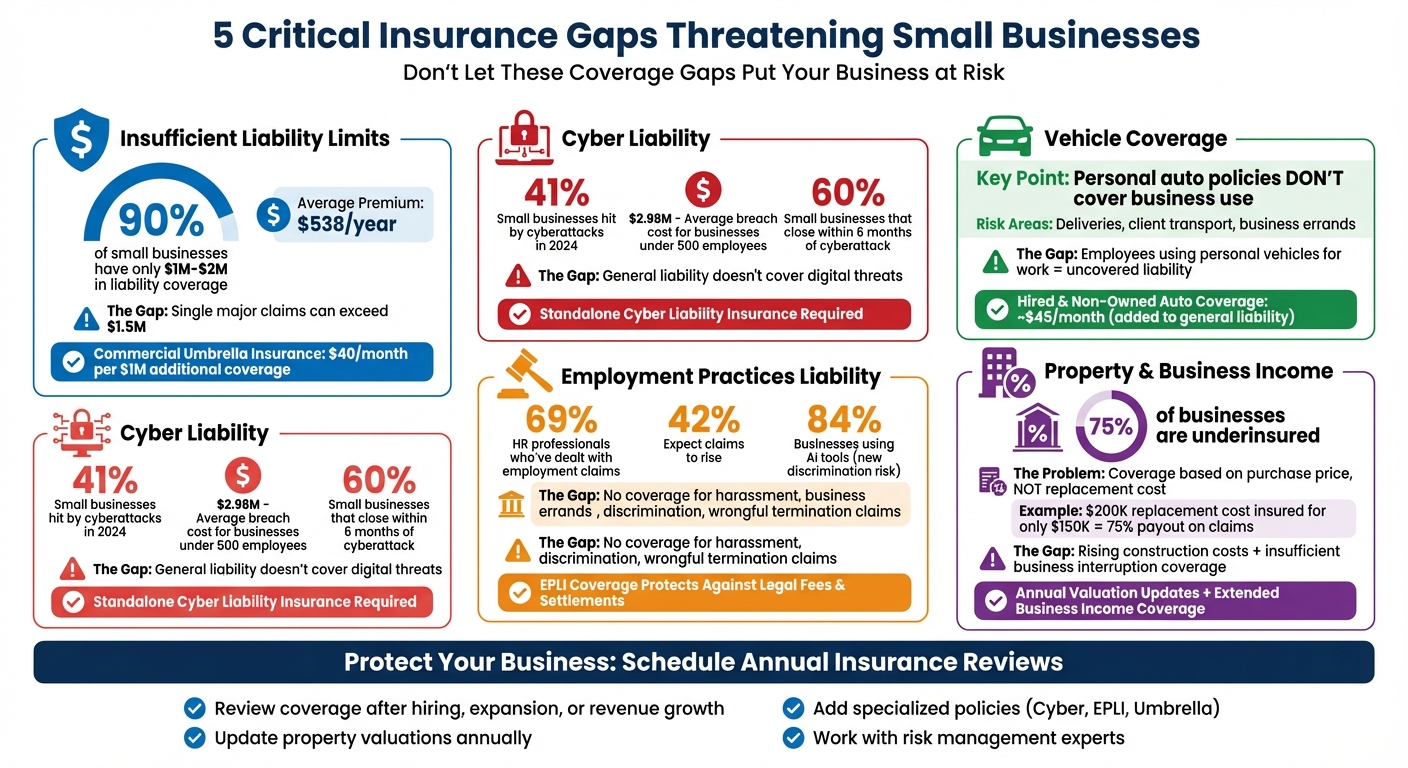
5 Critical Insurance Gaps Facing Small Businesses: Statistics and Coverage Solutions
1. Insufficient Liability Limits and Commercial Umbrella Insurance
1.1 Why Standard General Liability Policies Fall Short
More than 90% of small businesses opt for general liability coverage with limits of $1 million per occurrence and $2 million in aggregate, paying an average annual premium of $538. But here’s the issue: a single major claim can easily surpass these limits.
Imagine this scenario: a claim results in a $1.5 million judgment, but your policy only covers $1 million per occurrence. Your business is left to cover the $500,000 difference. And that’s not all – multiple claims could quickly exhaust your aggregate limit, leaving you without coverage for the rest of the policy period. Businesses with higher risks, like those with significant foot traffic or upscale locations, often need aggregate limits of $5 million or more.
"If the claims from a single incident exceed the per-occurrence limit of $1 million, your business will have to pay any amount over the limit." – Insureon
Another factor to consider is defense costs. If these are included within your liability cap, they can significantly reduce the funds available for settlements, especially in long legal battles.
This is where commercial umbrella insurance steps in as a practical solution.
1.2 How Commercial Umbrella Insurance Fills the Gap
Commercial umbrella insurance acts as an additional safety net, providing coverage once your general liability, commercial auto, or employers liability policy limits are maxed out. It’s designed to handle the gaps left by your primary policies.
At roughly $40 per month for each additional $1 million in coverage, umbrella insurance is often a more affordable way to increase protection compared to raising the limits on individual policies. Plus, it applies across multiple underlying policies, offering broader protection.
To qualify for umbrella coverage, insurers typically require minimum limits on your primary policies – usually $1 million per occurrence for general liability and commercial auto. After meeting these requirements, umbrella insurance provides a higher level of protection, safeguarding business assets like accounts receivable and investments from large jury awards. Experts recommend setting umbrella limits that match or exceed the total value of your business assets.
Additionally, many commercial leases and client contracts now mandate liability coverage between $3 million and $5 million, which standard policies alone may not satisfy. However, a critical piece of advice: never lower your primary policy limits to cut costs without consulting your umbrella insurer, as this could void your umbrella coverage.
sbb-itb-85dd802
2. Cyber Liability Coverage for Digital Risks
2.1 Cyber Threats That Target Small Businesses
Digital threats are becoming an increasingly dangerous reality for small businesses, exposing them to financial risks they may not be prepared for. In 2024, 41% of small businesses experienced a cyberattack, and half of small to mid-sized businesses reported an increase in attacks compared to the prior year. One major reason small businesses are targeted? Their security measures often lag behind those of larger corporations.
The financial consequences of these breaches are staggering. For small businesses with fewer than 500 employees, the average cost of a data breach is $2.98 million. Even more troubling, 60% of small businesses shut down within six months of a cyberattack. These numbers aren’t just abstract – they represent real companies struggling to recover.
Take Efficient Escrow of California, for example. A Trojan horse malware attack allowed cybercriminals to steal $1.5 million from their accounts. Despite recovering $400,000, the remaining $1.1 million loss forced the company to close its doors. Banks, unfortunately, are not legally required to reimburse funds stolen through cyber theft.
Another case involves Green Ford Sales, a Kansas-based car dealership. In 2025, hackers infiltrated their network, adding nine fake employees to the payroll and disbursing $63,000. While $40,000 was recovered, the dealership still lost $23,000.
These attacks come in many forms:
- Phishing: Deceptive emails trick employees into revealing credentials, leading to data breaches and legal complications.
- Ransomware: Hackers encrypt business data and demand payment, resulting in ransom costs, recovery expenses, and operational downtime.
- Business Email Compromise (BEC): Criminals impersonate executives to redirect funds through fraudulent wire transfers.
- Malware: Programs like Trojan horses can drain bank accounts and, in severe cases, force businesses to shut down.
"Small businesses are particularly vulnerable to cyber threats… because they may have weaker security measures in place compared to larger organizations." – IT Solutions
These examples underline the critical need for businesses to address digital risks proactively.
2.2 Why You Need Standalone Cyber Liability Insurance
While general liability insurance is essential for physical injuries and property damage, it doesn’t address the risks posed by cyberattacks. This leaves many businesses exposed to the financial fallout of digital threats.
Standalone cyber liability insurance fills this gap by covering both first-party losses (like forensic investigations, data recovery, ransom payments, business interruptions, breach notifications, credit monitoring, and public relations) and third-party losses (such as legal defense, settlements, and regulatory fines).
A major benefit of these policies is access to Data Breach Coaches – privacy attorneys who guide businesses through incident response under attorney-client privilege. They also ensure compliance with regulatory requirements, which can be overwhelming during a crisis.
"Business owners also underestimate how fast costs build when dealing with investigations, data restoration and income loss that pop up in just the first hours of an incident." – Kyle Jude, Program Manager for Insurance Canopy
To secure coverage and potentially lower premiums, insurers often require businesses to implement certain security measures. These include Multi-Factor Authentication (MFA), regular data backups, employee training to spot phishing attempts, and vetting third-party vendors. Reviewing your policy regularly is also crucial to ensure it keeps up with the evolving threat landscape.
Cyber liability insurance isn’t just a safety net – it’s an essential tool for navigating today’s digital risks.
3. Employment Practices Liability Insurance (EPLI) for Workplace Claims
3.1 Growing Risks of Harassment, Discrimination, and Wrongful Termination Claims
Small businesses are increasingly vulnerable to employment-related lawsuits. According to a 2025 study, 69% of HR professionals have dealt with employment claims, with 42% expecting these cases to rise in the future. Common accusations include wrongful termination, sexual harassment, retaliation, defamation, invasion of privacy, and discrimination based on factors like race, gender, age, or disability.
For small businesses, especially those without dedicated HR teams, these claims can come from employees or even third parties, alleging harassment or discrimination. The financial consequences can be overwhelming, with attorney fees, court costs, settlements, and jury awards potentially draining limited resources. Even unfounded claims can lead to significant legal expenses and damage to a company’s reputation.
Adding to these challenges, new types of claims are emerging. Issues related to wages, working hours, leave policies (55%), breaches of employment contracts (55%), and disputes involving AI in HR processes (51%) are becoming more common. Remote work and return-to-office conflicts are also fueling workplace disputes. With 84% of businesses using AI tools for hiring or evaluations, biased algorithms have introduced fresh concerns about discrimination lawsuits.
"EPLI is a good way to mitigate risk to a company, and it’s unfortunate that many small and midsize companies don’t carry it." – Danna Hewick, Vice President of Human Resources
Employment lawsuits are no longer just a problem for large corporations. Small businesses face these risks too, making preparation essential.
3.2 How EPLI Coverage Protects Your Business
EPLI provides critical financial protection by covering attorney fees, court costs, and settlements – even if the claim is baseless. For small businesses with limited resources, including those utilizing strategic financial leadership, this coverage can make the difference between surviving a legal challenge and facing financial ruin. EPLI works alongside other insurance policies to fill gaps in coverage and offer added security.
The scope of EPLI policies is broad, typically covering claims like wrongful termination, discrimination, sexual harassment, retaliation, and negligent evaluations. Some policies also extend to third-party claims, such as those from customers or vendors. Beyond financial support, many insurers offer resources like legal advice, training programs, and templates for policies to help businesses stay compliant with employment laws and reduce the likelihood of claims.
When choosing an EPLI policy, it’s important to understand the difference between two key options: "Duty to Defend" and "Reimbursement." With a duty-to-defend policy, the insurer selects and manages your legal representation. In contrast, reimbursement policies allow you to choose your own attorney and then request repayment for eligible expenses.
To enhance protection, consider these proactive steps:
- Update employee handbooks with clear anti-harassment and pay transparency policies.
- Conduct regular HR training sessions.
- Keep detailed performance records.
- Periodically review and adjust policy limits to ensure adequate coverage.
"A lawsuit, even if unfounded, can damage a small business’s reputation. EPLI can help manage the legal process and potentially resolve issues before they escalate." – Jason Armogida, Coverme360
However, it’s essential to note that EPLI policies typically exclude coverage for criminal acts, intentional wrongdoing, workers’ compensation claims, and court-imposed fines.
While EPLI addresses employment-related risks, don’t overlook other potential vulnerabilities, such as vehicle coverage, to strengthen your business’s overall protection against unexpected liabilities.
4. Business Auto and Employee Vehicle Coverage Gaps
4.1 What Personal Auto Policies Don’t Cover
Personal auto insurance is meant for private use – think commuting, grocery runs, or weekend getaways. However, it doesn’t cover business-related activities, which can leave small businesses vulnerable when employees use their own vehicles for work. Tasks like delivering products, driving clients, or even making a quick trip to the bank for a deposit fall outside the protection of personal policies.
"Any time you or an employee drives as part of the job, your business is at risk. While you may think that your personal auto policy will cover you, that may not be the case." – Chubb
The risks are real and costly. If an employee causes an accident while on a work-related task, the injured party could sue your business directly. Even if the employee has high liability limits on their personal policy, those limits might not apply if the insurer determines the vehicle was used for commercial purposes. Vehicles specifically designed for business, such as food trucks, limousines, or tow trucks, are also excluded from personal auto coverage. Without the right coverage, your business could face hefty legal fees, settlements, and damage costs. To avoid these risks, additional insurance is essential.
4.2 Adding Hired and Non-Owned Auto Coverage
To address these gaps, businesses should consider adding hired and non-owned auto (HNOA) coverage. This type of insurance can often be added as an affordable endorsement to an existing general liability policy, which typically costs about $45 per month for $1 million in coverage.
- Hired auto coverage protects your business when you rent, lease, or borrow vehicles for work.
- Non-owned auto coverage applies when employees use their personal vehicles for company tasks, acting as secondary protection once their personal insurance limits are exhausted.
HNOA coverage serves as secondary or "excess" insurance, kicking in only after the employee’s personal auto insurance has been maxed out. Because of this, it’s crucial to ensure employees maintain adequate personal insurance and that their policies are current. If an underinsured employee causes an accident during work, your business could still be held liable.
For vehicles owned by the business, you’ll need a dedicated commercial auto policy. Some commercial policies can extend coverage to personally owned vehicles used regularly for work, though they usually exclude standard commuting. It’s also wise to implement driver screening by routinely checking the driving records of employees who use their vehicles for business. If your business faces significant risk on the road, consider adding commercial umbrella insurance for extra liability protection. This typically costs about $40 per month for each $1 million in additional coverage.
HNOA coverage is a vital safety net, bridging the gaps left by standard policies and protecting your business from unexpected financial exposure.
5. Property Insurance, Business Income Coverage, and Contract Requirements
5.1 Rising Construction Costs and Underinsured Property
Protecting your physical assets is critical, yet an alarming 75% of businesses are underinsured. The issue often begins with how property values are calculated. Many small business owners mistakenly insure their property based on the original purchase price or its current market value. However, when disaster strikes, what really matters is the Replacement Cost Value (RCV) – the current cost of labor and materials to rebuild. Thanks to inflation and rising construction costs, the RCV is often much higher than the original purchase price.
Most insurers require that property coverage equals at least 80% of the RCV. Falling short of this threshold can leave you financially vulnerable. For example, if a property has a $200,000 replacement cost but is only insured for $150,000, a $50,000 claim might result in only a 75% payout – just $37,500 after deductibles. The remaining gap comes directly out of your pocket.
This risk grows when businesses expand or make changes, such as hiring more staff, purchasing new equipment, opening additional locations, or increasing revenue. Each of these actions raises replacement costs, and failing to adjust your policy accordingly can leave you exposed. Even physical upgrades, like installing a new roof or adding rooms, increase replacement costs and should be reported to your insurance agent immediately. You should also consult with a tax professional to understand how these asset changes impact your business valuation and tax strategy.
Beyond safeguarding physical assets, having sufficient business income coverage is just as important to maintain financial stability during unexpected closures.
5.2 Updating Valuations and Extending Business Income Coverage
While property coverage protects your assets, business income coverage (also known as business interruption insurance) ensures your cash flow remains intact during a forced closure. Without it, essential expenses like rent, payroll, and vendor payments could go unpaid during downtime. A common mistake is underestimating how long recovery might take. Supply chain delays and labor shortages are frequent hurdles, often stretching rebuilding timelines far beyond expectations. If your policy’s indemnity period is too short, you could run out of coverage before operations resume.
Moreover, landlords, lenders, and major clients often require proof of specific insurance limits as part of lease agreements, loans, or service contracts. Being underinsured could violate these agreements, potentially resulting in lease termination, loan default, or losing key clients. To avoid these pitfalls, review property values, revenue, payroll, and equipment annually. Ensure sub-limits are sufficient, and update your equipment inventory regularly to meet the terms of your contracts.
"Cheap is something poorly made or built to fail." – Michael Fusco, CEO & Principal, Fusco Orsini & Associates
Staying compliant with contractual obligations and maintaining adequate coverage for both replacement costs and realistic recovery periods is essential to protecting your business from financial risks.
5 Insurance Gaps That Could Derail Your Business (And How to Close Them)
6. Working with TC Advisors for Risk Management
Closing insurance gaps starts with a thorough risk analysis of your business. TC Advisors offers fractional CFO and business consulting services designed to help small businesses assess risks unique to their operations, industry, and growth plans. Instead of relying on one-size-fits-all coverage, a fractional CFO evaluates potential exposures specific to your business. This ensures you’re choosing policies that address your actual needs, reducing the chances of critical gaps in coverage. This analysis also lays the groundwork for financial modeling that matches your coverage to the risks you face daily.
Financial modeling is key to determining if standard insurance limits meet your needs. For example, while most small businesses opt for general liability policies with $1 million per-occurrence and $2 million aggregate limits, those limits may not reflect your true risk exposure. TC Advisors uses financial analysis to identify whether additional protection – like commercial umbrella coverage – is necessary. They also help set deductibles, often around $500, that align with your cash flow and risk tolerance.
As your business grows, your insurance needs will evolve. Hiring new employees, increasing inventory, opening new locations, or boosting revenue all raise your exposure to risk. These changes often require adjustments to your coverage. TC Advisors stays on top of these developments, ensuring your policies adapt accordingly. This includes documenting key updates like renovations, new equipment, or significant inventory changes to share with your insurance providers during annual reviews.
"If a significant loss exceeds a business’s insurance policy limits, the business may have to cover the remaining costs out of pocket." – BHS Insurance
Beyond addressing gaps, TC Advisors also helps you manage insurance costs effectively. For many low-risk small businesses, a Business Owner’s Policy (BOP) – which bundles general liability and property insurance – costs about $83 per month. This option reduces costs while eliminating potential coverage gaps between separate policies. For businesses with higher risks or larger operations, a Commercial Package Policy (CPP) offers more flexibility and higher coverage limits. This tailored approach ensures you get the right balance of protection and affordability.
Regular insurance reviews are critical to maintaining adequate coverage. These reviews should happen at least once a year or after significant operational changes. TC Advisors facilitates these reviews, using accurate financial projections to guide decisions on premiums, liability limits, and business interruption coverage durations. Staying proactive with your risk management strategy can help you avoid the financial challenges that arise from being underinsured.
Conclusion
Insurance gaps are often an underestimated threat to small businesses – yet even one gap could cost more than just money; it could jeopardize everything you’ve worked so hard to build. Many standard general liability policies create a false sense of security, leaving critical risks like cyberattacks, employment-related claims, and professional mistakes uncovered. With nearly half of all cyberattacks targeting small businesses, relying solely on basic coverage simply doesn’t cut it anymore.
As your business grows, your insurance needs change. Hiring employees, expanding services, or upgrading technology can all create new exposures. Without routine policy reviews, you could face unexpected financial risks that might drain your resources – or worse, force you to shut down. Rising construction costs, increasing liability concerns, and persistent digital threats make it essential to stay ahead of these evolving challenges.
To tackle these risks, make annual insurance reviews a priority. These reviews help ensure your coverage keeps pace with your business’s realities. Keep detailed records of major changes – like new equipment purchases, renovations, or additional hires – and share them with your insurance provider to maintain up-to-date protection. Consider adding specialized policies, such as Cyber Liability or Employment Practices Liability Insurance (EPLI), to address gaps that general liability insurance won’t cover.
Earlier sections highlighted the importance of proactive risk management in avoiding financial pitfalls. Companies like TC Advisors specialize in helping small businesses uncover hidden vulnerabilities through detailed risk assessments and financial modeling. Their fractional CFO and consulting services ensure your insurance strategy evolves with your business, protecting what you’ve built.
"By identifying these hidden gaps, you can safeguard your business and secure its future." – Arnold Insurance
Don’t wait for a claim to expose a gap in your coverage. Take charge of your risk management strategy now to protect the foundation of your business.
FAQs
How do I know if my liability limits are too low?
Your liability limits might fall short if they don’t provide enough protection for your business’s assets and future income. Many small businesses choose coverage of $1 million per occurrence and $2 million aggregate, but the right amount for you depends on the unique risks and potential claims your business could face. It’s a good idea to review your exposure regularly and work with an insurance professional to make sure your limits match your financial and legal risks.
What does cyber liability insurance cover that general liability doesn’t?
Cyber liability insurance is designed to handle risks tied to cyberattacks and data breaches – areas that general liability insurance doesn’t cover. It provides protection against threats like hacking, data theft, and other cyber-related incidents. On the other hand, general liability insurance is more focused on physical risks or property-related issues, leaving digital vulnerabilities outside its scope.
When do I need hired and non-owned auto coverage?
Hired and non-owned auto coverage is a must-have if your business relies on vehicles that aren’t company-owned – like those rented or owned by employees – for work-related tasks. This type of insurance provides liability protection in case an accident happens while these vehicles are being used for business purposes.


