

When it comes to mergers and acquisitions (M&A), tax risks can derail deals or significantly impact their financial outcomes. Key issues include double taxation, limitations on net operating losses (NOLs), uncertain tax liabilities, state and local tax (SALT) nexus rules, and depreciation recapture. Each of these challenges can create unexpected costs for buyers and sellers, reduce deal value, or complicate negotiations.
Here’s a quick summary of the risks:
- Double Taxation in Asset Sales: Sellers face taxes at both the corporate and shareholder levels, reducing net proceeds.
- NOL Limitations: Section 382 caps how much of the target’s NOLs a buyer can use, often leaving tax benefits unrealized.
- Uncertain Tax Liabilities: Buyers may inherit unresolved tax issues, leading to escrow holdbacks or purchase price adjustments.
- SALT Nexus Expansion: State-specific tax rules can introduce unanticipated liabilities, especially for remote or multi-state businesses.
- Depreciation Recapture: Sellers may face higher tax rates on prior depreciation deductions, while buyers need to account for deferred tax liabilities.
Addressing these risks early through due diligence, deal structuring, and expert tax advice can save both parties time and money while ensuring smoother transactions.
📢 Tax Risk Profiling & Mitigation in Tax Due Diligence ⭐ from Online M&A Courses of mnainstitute.com
sbb-itb-85dd802
1. Double Taxation in Asset Sales
Double taxation in asset sales is a frequent and challenging tax issue in mergers and acquisitions (M&A).
Impact on Transaction Structure
When a C corporation sells its assets instead of its stock, the tax burden doubles. First, the corporation pays taxes on the gain from selling its assets at the current 21% federal corporate tax rate. Then, shareholders are taxed again on the remaining proceeds when distributed as dividends or liquidation payouts. This double layer of taxation makes asset sales more expensive for sellers compared to stock sales, where only shareholders are taxed.
"If the entity being sold is a C corporation, the seller will typically be subject to double taxation, as the corporation is taxed on the gain from the sale and the shareholders are then taxed on any proceeds they receive individually." – Matthew J. Koch, McBrayer McGinnis Leslie & Kirkland PLLC
This tax discrepancy creates a natural conflict between buyers and sellers. Buyers prefer asset sales because they benefit from a stepped-up basis to fair market value, which increases future depreciation deductions and lowers taxes. On the other hand, sellers lean toward stock sales to bypass the double-tax hit and take advantage of lower long-term capital gains rates.
These structural tax dynamics play a crucial role in shaping the financial outcomes for both parties.
Financial Implications for Buyers and Sellers
Double taxation can slash deal value by 20%–25%, factoring in corporate taxes, shareholder taxes, and depreciation recapture. For sellers, this often means reduced net proceeds, which might compel them to demand a higher purchase price to offset their tax burden. Buyers, however, may still face risks, such as inheriting unpaid state sales, use, or employment tax liabilities when acquiring most of a seller’s assets.
Strategies for Mitigation or Resolution
To counter these financial challenges, strategic planning is essential. A Section 338(h)(10) election is one option, allowing a legal stock sale to be treated as an asset sale for tax purposes. This approach provides the buyer with a stepped-up basis while easing the seller’s tax liability.
"The failure to include the tax advisor at this early stage can mean lost dollars to the seller or additional cost to the buyers." – Jeffrey C. Wagner and Daniel N. Zucker, McDermott Will & Schulte LLP
Addressing tax structure during the Letter of Intent (LOI) phase is critical. If a buyer later insists on an asset sale structure, sellers can negotiate a gross-up – additional compensation to cover their higher tax costs. For S corporations, an F-reorganization before the sale can provide a buyer with an asset step-up while offering sellers more flexibility. Buyers should also consider securing tax clearance certificates from state agencies and using escrow accounts to shield against potential liabilities for unpaid taxes.
TC Advisors offers transaction advisory services to help buyers and sellers navigate these tax complexities, ensuring deals are structured to minimize tax burdens and avoid unexpected issues after closing.
2. Limitations on Tax Attributes like NOLs
Net Operating Losses (NOLs) can be a valuable tax deduction, but they come with strict limitations under Section 382 of the Internal Revenue Code. These restrictions can create significant hurdles in mergers and acquisitions (M&A), directly impacting the overall deal value.
Impact on Transaction Structure
How a deal is structured determines whether NOLs can be retained or utilized. In stock purchases, the buyer inherits the target’s NOLs, but their usage is capped annually under Section 382 once an ownership change occurs. This is triggered when there’s a 50-percentage-point increase in ownership among 5% shareholders. After this threshold, the IRS limits the annual use of pre-acquisition NOLs.
On the other hand, asset purchases or Section 338(h)(10) elections result in the complete forfeiture of the target’s NOLs. While these structures allow buyers to benefit from a stepped-up asset basis and higher depreciation deductions, they lose the opportunity to leverage the NOLs.
"IRC Section 382 was enacted to prevent loss trafficking. The premise of the provision was to promote tax neutrality when acquiring a corporation."
– Nathan Chu, Transaction Advisory, Withum
Potential Financial Implications for Buyers and Sellers
Section 382 places a cap on NOL usage by multiplying the target company’s equity value (immediately before the ownership change) by the IRS’s long-term tax-exempt rate. For example, if a company valued at $10 million is subject to a 4% cap, only $400,000 of NOLs could be used annually. This often leaves a substantial balance unused, especially if the NOLs expire before full utilization.
This expiration risk can significantly reduce the value of NOLs. Imagine a target with $5 million in NOLs but a buyer limited to using $400,000 per year. It would take 12.5 years to fully utilize the NOLs, but if they expire in seven years, a large portion would go unused, forcing the buyer to write down a significant part of the NOL balance immediately upon closing.
Additional restrictions add to the complexity. For instance, the target must continue core operations for at least two years after the acquisition. Failing to do so could reduce the Section 382 limit to zero. Similarly, if non-business assets like cash or securities make up one-third or more of the company’s total assets, the valuation used to calculate the annual cap is reduced.
"The buyer’s usage of target company-generated NOLs is often significantly limited by the ownership change rules in Section 382 of the Internal Revenue Code."
– Timothy C. Smith, Tax Attorney, Godfrey & Kahn
These limitations can create substantial financial challenges, requiring careful planning to protect the value of NOLs.
Strategies for Mitigation or Resolution
Given these challenges, buyers and sellers need to adopt well-thought-out strategies to address NOL limitations. One critical step is conducting a Section 382 ownership study before closing to determine if a prior ownership change has already triggered restrictions. It’s equally important to examine the expiration dates of NOL carryforwards – if they don’t align with the buyer’s ability to use them, adjustments to the purchase price may be necessary.
Securing an accurate valuation of the target before the ownership change can also help. A higher defensible valuation increases the annual usage cap, making more of the NOLs accessible. Additionally, a "closing of the books" election can allocate income between pre- and post-change periods, ensuring the Section 382 limit doesn’t apply to pre-change income.
To further mitigate risks, buyers can negotiate contingent payment provisions tied to the actual usage of NOLs, aligning incentives between both parties. Documenting clear, non-tax business reasons for the acquisition in board minutes can also help avoid disallowed NOL usage if the IRS suspects tax avoidance as the primary motive.
TC Advisors specializes in helping buyers and sellers navigate these complexities. From conducting due diligence to modeling deal structures and implementing tax strategy, they assist in preserving the value of tax attributes while ensuring compliance with Section 382. Schedule a consultation to discuss your specific M&A tax needs.
3. Uncertain Tax Positions and Undisclosed Liabilities
Uncertain tax positions, much like double taxation and NOL limitations, require detailed attention during due diligence to protect deal value.
These positions can be a costly headache in M&A transactions, often arising when a company’s tax stance has only a 20–30% chance of holding up under scrutiny by tax authorities. Common culprits include unrecorded sales tax obligations, weak documentation for R&D tax credits, and transfer pricing practices that could invite IRS challenges.
Impact on Transaction Structure
The way a deal is structured plays a huge role in deciding who shoulders the burden of these liabilities. In stock deals or mergers, tax liabilities stick with the business, meaning the buyer inherits all unresolved tax issues and uncertain positions. This transfer of risk can leave the buyer fully exposed to past compliance problems. On the other hand, asset deals typically let buyers avoid liabilities outside the agreed-upon scope. However, successor liability laws in states like California, Florida, and New York can still make buyers responsible for unpaid sales and use taxes.
These structural choices directly shape the financial risks involved, as outlined below.
Potential Financial Implications for Buyers and Sellers
Hidden liabilities can lead to reduced purchase prices or require buyers to set aside 10%–15% of the deal value in escrow, often held for 12 to 24 months.
Claims related to undisclosed liabilities now make up 24% of all indemnification claims for breaches of representations and warranties. These claims take a median of 14 months to resolve – longer than any other type of M&A claim – and have more than doubled since 2022.
"In line with the market trend of hunkering down and trying to hold on to more cash, buyers seem to be pursuing claims the parties may not have identified in due diligence or claims that buyers may not have previously cared to pursue." – Ruth Mackey, Director, SRS Acquiom
Legal and Compliance Risks
The impact of uncertain tax positions isn’t just financial – it also brings legal and compliance challenges.
Undisclosed liabilities can lead to reclassification of transactions that lack a valid business purpose, along with reputational harm. Since the South Dakota v. Wayfair ruling, states have ramped up tax collection efforts based on sales volume, creating risks for digital and service-based businesses. By 2024, 22 states are expected to impose taxes on Software-as-a-Service (SaaS), increasing potential nexus risks for these businesses.
Other complications include invalid S-corporation elections and improper Employee Retention Credit (ERC) claims. The IRS has extended the statute of limitations to five years in certain cases for ERC repayment, adding to its risk profile during M&A due diligence.
Strategies for Mitigation or Resolution
To manage these risks, buyers should prioritize sales and use tax reviews early in the due diligence process to assess potential exposure. Additionally, ensuring that R&D tax credits are supported by detailed qualified research expense calculations can help avoid IRS challenges after the acquisition. Limiting exceptions to "No Undisclosed Liabilities" (NUL) representations – now present in 97% of M&A deals – can further streamline indemnification paths.
Sellers, on the other hand, should work with a tax adviser early to identify and address exposures. Voluntary Disclosure Agreements (VDAs) with states can help resolve unpaid taxes with reduced penalties before negotiations begin. Establishing "special escrows" for high-risk issues, such as ongoing audits, can also provide added protection for both parties.
"A seller’s goal is to identify issues and eliminate them or minimize risk before it is discovered by the buyer’s advisers." – The Tax Adviser
Representations and Warranties Insurance (RWI) is becoming more common, covering 45% of North American M&A deals today compared to 34% in 2017. Tax liability insurance is another option, allowing sellers to walk away with more cash while transferring specific risks to an insurer, protecting buyers from unforeseen liabilities.
TC Advisors offers a full range of transaction advisory services to help buyers and sellers tackle these challenges. From thorough due diligence to structuring indemnification provisions and implementing risk management strategies, TC Advisors ensures uncertain tax positions don’t derail deals or erode value after closing.
4. State and Local Tax Nexus Expansion
State and local tax (SALT) nexus rules determine when a state can impose tax obligations on a business based on its physical presence or economic activities. In mergers and acquisitions (M&A), an expanded nexus can introduce unforeseen liabilities that may disrupt deals or reduce value for both parties.
With over 12,000 sales tax jurisdictions in the U.S., even remote businesses can face tax obligations due to economic thresholds established by the 2018 Wayfair decision. For example, generating $100,000 in annual sales or completing 200 transactions in a state can create nexus, even without a physical presence. Additionally, as of 2024, 22 states tax Software-as-a-Service (SaaS), posing challenges for digital or remote-first businesses.
Impact on Transaction Structure
The type of transaction – stock sale or asset sale – can influence whether taxes are triggered. Stock sales, which involve intangible assets, are generally exempt from sales tax. However, asset sales often result in taxes on tangible property like machinery or vehicles. Stock sales also transfer the target company’s entire nexus footprint, including any historical liabilities, to the buyer. Asset sales limit this exposure, but successor liability laws in states such as California, Florida, and New York can still hold buyers accountable for unpaid taxes unless bulk sale notifications are filed.
Potential Financial Implications for Buyers and Sellers
Nexus issues can significantly affect deal valuations by revealing liabilities that may have accumulated over years. If tax returns were never filed, the statute of limitations does not apply, leaving buyers exposed to liabilities stretching back to a company’s inception in a jurisdiction.
"The statute of limitations never tolls when a taxpayer fails to file required returns." – Plante Moran
Sales tax, categorized as a "trust fund" tax, can result in significant liabilities when small errors in taxability or nexus determination are compounded over time. These liabilities, combined with penalties and interest, often lead to post-closing disputes, escrow requirements, or purchase price adjustments. For instance, California imposes an "LLC fee" based on gross receipts, which can total up to $11,790 annually for businesses operating in the state.
Legal and Compliance Risks
Nexus issues extend beyond financial concerns to legal and compliance challenges. States are tightening their interpretations of Public Law 86-272, targeting revenue from digital and service-based businesses. This law does not protect service providers like SaaS companies or shield them from taxes on gross receipts or sales. Remote work has further complicated compliance, as states assert nexus based on the location of remote employees, creating income tax and withholding obligations even without a physical office. Ownership changes can also trigger state tax audits when flagged in state systems.
"Sales tax is often the biggest SALT problem found in due diligence, especially after the 2018 Wayfair case." – Allison Civello, CPA, Senior Manager, Wegmann Dazet
Strategies for Mitigation or Resolution
To address these risks, both buyers and sellers should prioritize conducting nexus studies early in the due diligence process to identify noncompliance and estimate potential exposure. For example, in late 2024, a mid-sized manufacturing company discovered it had unknowingly created sales tax nexus in 27 states due to nationwide shipments. By working with Miles Consulting Group, the company filed Voluntary Disclosure Agreements (VDAs) and retroactive filings in all 27 jurisdictions, reducing its financial risk and enabling the sale to proceed.
VDAs allow companies to report and pay back taxes for a limited look-back period, typically three to four years, while avoiding penalties. Buyers should also request tax clearance certificates from state authorities to confirm the seller has no outstanding tax debts. In states like New York and Pennsylvania, filing bulk sale notifications can protect buyers from being held personally liable for the seller’s unpaid taxes.
For division acquisitions, Transition Services Agreements (TSAs) can ensure the seller continues managing tax filings while the buyer establishes their own compliance systems. Post-closing steps, such as re-registering entities, consolidating exemption certificate management, and updating tax coding in ERP systems, can help prevent compliance issues down the road.
TC Advisors provides tailored transaction advisory services to help businesses address SALT nexus risks in M&A deals. Their services include conducting nexus studies, negotiating VDAs, structuring indemnification provisions, and managing post-closing integration to protect deal value and minimize unexpected liabilities.
5. Depreciation Recapture and Deferred Tax Liabilities
Depreciation recapture and deferred tax liabilities (DTLs) add layers of complexity to M&A transactions, impacting how deals are structured and valued.
When depreciated assets are sold for more than their tax basis, the IRS requires recapture of prior depreciation deductions. This can significantly affect financial outcomes in a deal. For example, under Section 1245, personal property like machinery or vehicles is taxed at ordinary income rates, while Section 1250 applies to real property like buildings, taxing unrecaptured depreciation at a maximum rate of 25%.
DTLs, on the other hand, result from timing differences between financial reporting (GAAP) and tax accounting. Companies using accelerated depreciation for tax purposes but straight-line depreciation under GAAP create future tax obligations that show up on the balance sheet. These liabilities are often a key negotiation point in M&A deals, as their treatment varies between asset and stock transactions. Understanding these tax issues is critical for structuring deals efficiently.
Impact on Transaction Structure
In asset sales, depreciation recapture is triggered immediately, converting what might have been taxed as capital gains into ordinary income, which can be taxed at rates as high as 37%. This creates an immediate cash tax burden for the seller, reducing net proceeds. However, buyers benefit from a stepped-up basis, allowing them to claim higher depreciation deductions in the future.
In stock sales, buyers inherit the target company’s historical tax basis, which typically results in DTLs on the opening balance sheet. This happens because assets are revalued to fair market value for GAAP purposes while retaining a lower tax basis. Sophisticated buyers may even treat these DTLs as "debt" in their valuation models, recognizing them as future tax obligations stemming from accelerated depreciation.
"In essence, the DTL value calculation is ‘debt’ for transaction purposes." – Zachary Scott
Potential Financial Implications for Buyers and Sellers
The financial effects of depreciation recapture can be considerable. In asset deals, sellers often face higher tax liabilities since the recapture is taxed at ordinary income rates, rather than the lower capital gains rate. This difference can be substantial, especially under the current corporate tax rate of 21% and individual ordinary income rates that can reach up to 37%. Combined with the 3.8% net investment income tax, the contrast with capital gains treatment (approximately 20%) can significantly increase the tax burden in mid-sized transactions.
For buyers in stock deals, DTLs reduce the perceived economic value of the transaction. For instance, while a balance sheet might show a DTL of $500,000, the present value of those future tax payments is often less than the reported amount. Buyers must factor this into their valuation. Even in pass-through entities like S-corporations or LLCs, depreciation recapture affects overall transaction economics, as the tax liability flows through to the owners’ personal returns.
Strategies for Mitigation or Resolution
To address these challenges, several strategies can be considered:
- Sellers should evaluate the impact of DTLs on shareholder value before a C-corporation stock sale, as buyers often treat these liabilities as debt during valuation.
- Early agreement on purchase price allocation to specific asset classes (as required on IRS Form 8594) is crucial, as it determines how much of the gain is taxed as ordinary income versus capital gains.
- Section 338 elections can allow a stepped-up basis while retaining the legal structure of a stock deal.
- For pass-through entities, a Section 754 election lets buyers adjust the "inside" basis of assets to reflect the purchase price, enabling higher depreciation deductions.
- In transactions involving real estate, a 1031 like-kind exchange can help defer depreciation recapture liabilities.
Engaging tax advisors early in the process is essential to optimize the deal structure. Overlooking tax considerations can lead to missed opportunities, such as failing to secure a Section 338(h)(10) election without paying a premium if it’s not included in the LOI.
TC Advisors offers specialized guidance on depreciation recapture and DTL issues in M&A transactions. Their services include economic analyses of DTLs, negotiating purchase price allocations, structuring tax elections, and collaborating with legal counsel to craft deal structures that align with the tax objectives of both buyers and sellers.
Tax Outcomes: Stock vs. Asset Deals
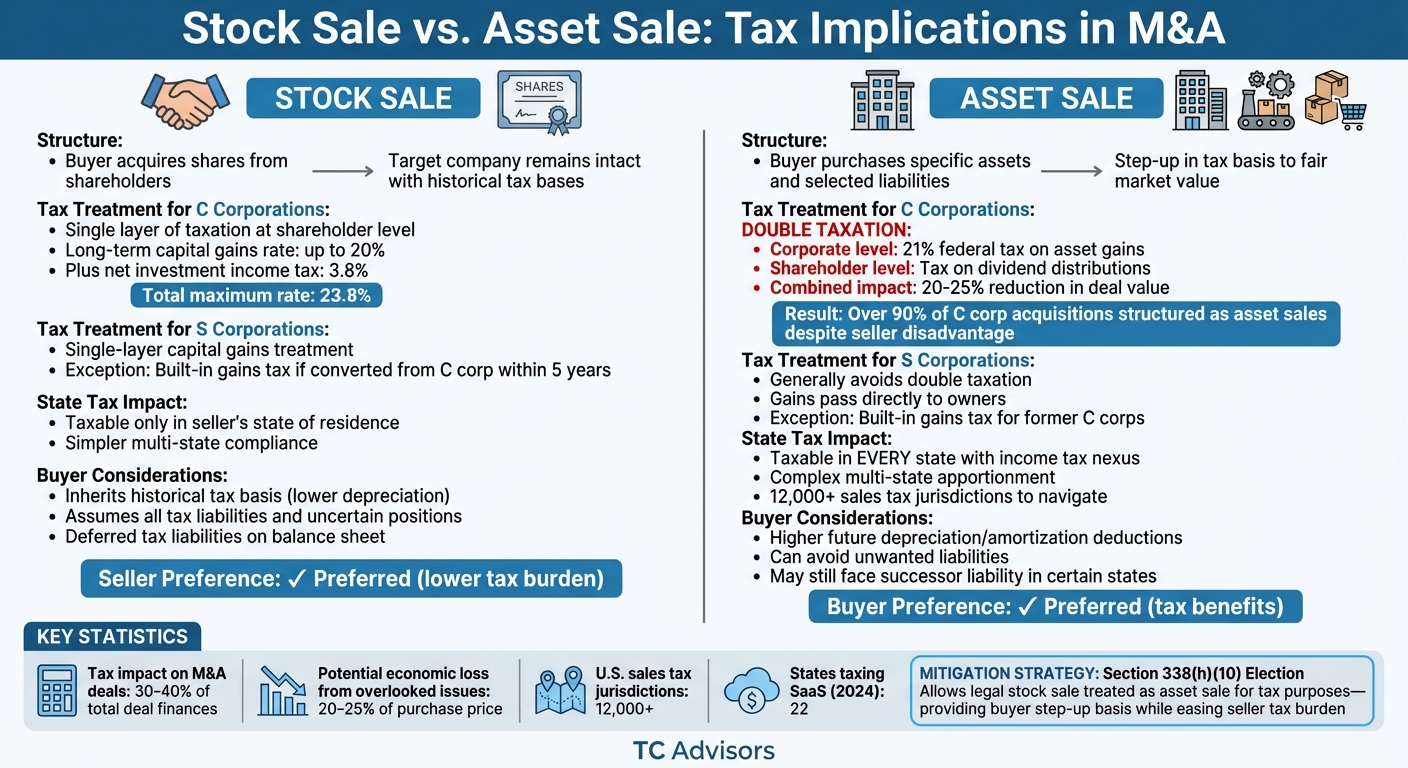
Stock Sale vs Asset Sale Tax Comparison in M&A Transactions
Understanding how deal structures influence tax outcomes is a key part of navigating mergers and acquisitions. Factors like double taxation and limitations on net operating losses (NOLs) highlight just how much the structure of a deal can shape tax liabilities.
When comparing stock sales and asset sales, the tax consequences differ significantly for both buyers and sellers. In a stock sale, the buyer acquires shares directly from the shareholders, leaving the target company intact, along with its historical tax bases and liabilities. On the other hand, an asset sale involves the buyer purchasing specific assets and assuming selected liabilities, which allows for a step-up in the tax basis to fair market value – unlocking greater opportunities for future depreciation and amortization.
For C corporations, the choice of deal structure has major tax implications. Asset sales trigger double taxation: a 21% corporate tax on gains from the assets, followed by taxes on dividends distributed to shareholders. In contrast, stock sales result in a single layer of tax at the shareholder level, with gains typically taxed at long-term capital gains rates (up to 20%) plus a 3.8% net investment income tax. This tax advantage for stock sales explains why buyers often lean toward asset sales, as the depreciation benefits outweigh the seller’s higher tax burden. Over 90% of C corporation acquisitions are structured as asset sales for this reason.
When it comes to S corporations and pass-through entities, asset sales generally avoid double taxation since the gains pass directly to the owners. However, S corporations that were previously C corporations (within the last five years) may face a "built-in gains" tax, reintroducing an element of double taxation. In stock sales, shareholders of S corporations benefit from single-layer capital gains treatment, much like their C corporation counterparts.
State tax rules add an extra layer of complexity, especially in multi-state deals. Stock sales are typically taxable only in the seller’s state of residence. In contrast, asset sales are taxable in every state where the business has an income tax nexus and operates. States use different apportionment formulas to calculate taxable income, and buyers in asset deals may still face successor liability for unpaid sales, use, or employment taxes – even if those liabilities were not part of the transaction.
To navigate these challenges, TC Advisors offers expert guidance on structuring M&A transactions to minimize tax exposure at both federal and state levels. Their services include comparative tax modeling for stock versus asset deals, detailed analysis of state nexus and apportionment issues, and strategies like Section 338(h)(10) elections to align buyer and seller priorities. These strategies build on earlier tax risk assessments to help achieve the best possible outcomes for all parties involved.
Conclusion
Navigating tax risks in M&A transactions is no small feat. Challenges like double taxation and historical liabilities can directly impact deal value, reshape transaction structures, or even halt negotiations altogether. As Pete Miller, Shareholder at Clark Nuber, puts it:
"Federal tax due diligence is not merely a step in the M&A process – it is a fundamental safeguard that protects the interests of both buyers and sellers."
The stakes are undeniably high. Taxes can influence 30% to 40% of total M&A deal finances, and overlooking technical issues like Section 197 anti-churning rules could result in economic losses amounting to 20% to 25% of the purchase price. With the complexity of more than 12,000 sales tax jurisdictions in the U.S. and increased IRS scrutiny on M&A-related activities, early involvement of tax advisors is essential. Engaging them at the Letter of Intent (LOI) stage ensures that parties retain bargaining power over tax benefits.
For sellers, conducting sell-side diligence well before hitting the market allows them to address material exposures, reducing the risk of buyers demanding steep discounts or backing out of deals altogether. On the other hand, buyers who perform thorough independent verification can identify hidden liabilities – such as unreported income, unpaid payroll taxes, or overly aggressive tax positions – before they turn into costly post-closing surprises.
TC Advisors specializes in M&A tax advisory services, offering expertise in areas like early risk assessment, strategic deal structuring, comparative tax modeling, state nexus analysis, and post-closing support. By addressing tax risks proactively, parties can protect deal value, improve after-tax outcomes, and ensure smoother transactions.
FAQs
Asset sale or stock sale – which is usually better for taxes?
When selling a business, stock sales tend to be more favorable for sellers from a tax perspective. This is because they usually bypass taxes at the asset level and may qualify for lower individual tax rates. On the other hand, asset sales can be less advantageous for sellers due to the risk of double taxation. However, buyers often prefer asset sales since they provide the flexibility to choose specific assets and can offer certain tax advantages.
The decision between these options depends on several factors, including the type of business entity and the tax strategies of both the buyer and the seller.
How do Section 382 limits change the value of NOLs?
Section 382 places restrictions on how net operating losses (NOLs) can be used following an ownership change. The allowable NOL usage is determined by multiplying the value of the old loss corporation by the IRS-published rate. This rule can sharply limit the amount of NOLs available to offset future taxable income, especially in mergers and acquisitions. The goal is to prevent full utilization of pre-change losses in specific M&A situations.
What SALT nexus issues should I check before closing?
Before wrapping things up, take a closer look at state and local tax (SALT) nexus issues. This includes evaluating:
- Existing liabilities: Are there any outstanding tax obligations that could transfer with the deal?
- Compliance risks: Could the transaction expose the business to penalties or audits for non-compliance?
- Impact on state income and sales tax: How will the deal affect ongoing tax responsibilities in different states?
Digging into these areas during due diligence can help you avoid unpleasant surprises – like unexpected tax bills – after the transaction is complete.


