

Cost segregation is a tax strategy that helps property owners speed up depreciation deductions, reducing their taxable income earlier. Instead of depreciating a property over 27.5 or 39 years, this method breaks it into components like appliances, lighting, or parking lots, which can be depreciated over shorter periods (5, 7, or 15 years). This approach can significantly boost cash flow, especially in the early years of ownership.
Here’s why it matters:
- Faster tax savings: Reallocating 20%-40% of a property’s cost can save tens of thousands in taxes upfront.
- Who benefits: Ideal for properties worth over $500,000, including offices, rentals, and warehouses.
- Time-sensitive: Bonus depreciation phases out by 2027, so acting soon is critical.
Cost segregation requires an engineering-based analysis and IRS-compliant documentation. It’s best done when acquiring or improving a property, but missed opportunities can often be recovered through a "look-back" study. By accelerating deductions, property owners can reinvest savings, strengthen cash flow, and optimize their tax strategy.
Cost Segregation Explained By CPA | #1 Real Estate Investor Strategy
How Cost Segregation Works
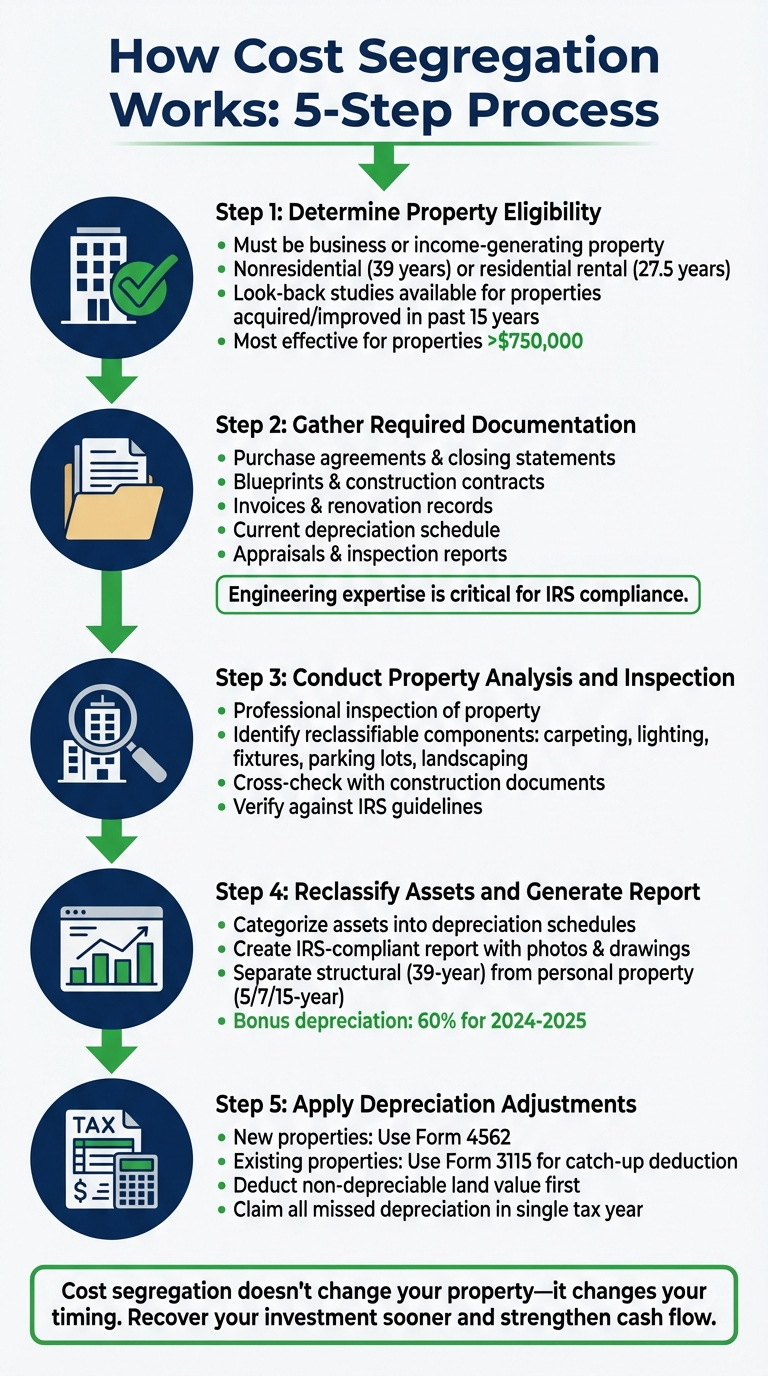
5-Step Cost Segregation Study Process for Property Owners
Now that we’ve covered the advantages and eligibility criteria, let’s break down the steps to effectively carry out a cost segregation study.
Step 1: Determine Property Eligibility
To qualify, your property must be used for business or income-generating purposes. This includes nonresidential properties (typically depreciated over 39 years) and residential rental properties (depreciated over 27.5 years). Eligible properties can be newly built, purchased, expanded, or remodeled. The focus here is on identifying components that qualify for shorter depreciation schedules, such as 5-, 7-, or 15-year lives, instead of the standard long-term depreciation of real property.
If your property was acquired or improved within the past 15 years, you might qualify for a "look-back" study using IRS Form 3115 to claim missed deductions, even as far back as 1987. Generally, cost segregation studies are most effective for properties with a purchase or remodel cost exceeding $750,000. For example, reallocating $1 million of a $5 million commercial property purchase to a 5-year depreciation category can significantly boost first-year deductions.
Step 2: Gather Required Documentation
Once you’ve confirmed eligibility, the next step is collecting all the necessary documentation. Key items include purchase agreements, closing statements, blueprints, construction contracts, invoices, and records of any past renovations. If the property is already in use, you’ll also need the current depreciation schedule and any appraisals or inspection reports.
The IRS Cost Segregation Audit Technique Guide highlights the importance of expertise in this process:
"A study by a construction engineer is more reliable than one conducted by someone with no engineering or construction background".
Keeping these documents organized – ideally in a digital format – can help the study withstand IRS scrutiny.
Step 3: Conduct Property Analysis and Inspection
With all documentation in place, a qualified professional will inspect the property thoroughly. This step involves identifying components eligible for reclassification, such as carpeting, specialized lighting, fixtures, parking lots, and landscaping. These findings are then cross-checked with construction documents and IRS guidelines. An engineering-based approach is critical to ensure the study holds up in the event of an IRS audit.
Step 4: Reclassify Assets and Generate Report
At this stage, assets are categorized into appropriate depreciation schedules. A detailed, IRS-compliant report is then created, including photos, engineering drawings, and cost reconciliations. The report separates structural components (remaining on a 39-year schedule) from personal property and land improvements, which qualify for accelerated depreciation. Under Section 168(k), reclassified property may also qualify for bonus depreciation at 60% for 2024 and 2025.
Step 5: Apply Depreciation Adjustments
If the study is completed in the first year, the results can be integrated using Form 4562. For properties already in service, Form 3115 is used to claim missed depreciation through a Section 481(a) adjustment, allowing you to capture all missed depreciation in a single tax year.
As AE Tax Advisors puts it:
"Cost segregation doesn’t change your property – it changes your timing. It lets you recover your investment sooner, strengthen your balance sheet, and compound wealth more efficiently."
Before calculating the depreciable basis, make sure to deduct the non-depreciable land value from the purchase price. Acting promptly after acquiring or improving a property ensures you maximize the time value of your investment.
Assets Commonly Reclassified in Cost Segregation
Cost segregation identifies which parts of a property qualify for faster depreciation, often reclassifying 20% to 30% of a property’s total cost into shorter recovery periods. Instead of waiting 39 years to fully depreciate these assets, you could write them off in as little as 5, 7, or 15 years. Below are examples of how this works in practice.
Examples of Reclassified Assets
To understand reclassification, it’s important to distinguish between components that serve the building’s structure and those that support a specific business function. Assets classified as personal property – those directly tied to your business operations – often qualify for 5- or 7-year depreciation schedules. For example, dedicated wiring installed for kitchen equipment or data center servers can be classified as 5-year property instead of being lumped into the building’s 39-year electrical system.
Land improvements, which fall under a 15-year schedule, include features like parking lots, sidewalks, fencing, landscaping, outdoor lighting, signage, and drainage systems. Although outside the building’s footprint, these assets are key to the property’s functionality. Similarly, Qualified Improvement Property (QIP) – interior, non-structural upgrades to nonresidential buildings – qualifies for a 15-year schedule and may also be eligible for bonus depreciation.
Some systems, like HVAC, offer additional opportunities for reclassification. While a central HVAC system serving the entire building remains a 39-year asset, specialized systems installed for specific purposes – like cooling a server room or ventilating a commercial kitchen – can be reclassified as 5-year property. In one case study, a $1 million building included $100,000 in HVAC costs, of which $80,000 was identified as specialized units serving individual rooms. Reclassifying these units as 5-year property increased the first-year deduction from $2,564 to $32,513, resulting in $7,487 in tax savings.
Depreciation Schedule Comparison
Here’s a breakdown of depreciation schedules for various reclassified assets:
| Asset Category | Standard Schedule | Accelerated Schedule | Common Examples |
|---|---|---|---|
| Personal Property | 39 Years (Straight-Line) | 5 or 7 Years (200% Declining Balance) | Carpeting, specialty lighting, cabinetry, furniture, dedicated electrical for equipment |
| Land Improvements | Non-depreciable or 39 Years | 15 Years (150% Declining Balance) | Parking lots, sidewalks, fencing, landscaping, site lighting, signage |
| Qualified Improvement Property | 39 Years | 15 Years (Straight-Line) | Interior non-structural improvements to nonresidential buildings |
| Structural Components | 39 Years (Straight-Line) | 39 Years (Straight-Line) | Walls, roofs, foundations, central HVAC, main plumbing, elevators |
For properties with contracts signed after January 19, 2025, the One Big Beautiful Bill Act reinstates 100% bonus depreciation on reclassified assets, allowing you to deduct the full cost in the first year. For contracts signed on or before that date, bonus depreciation phases out: 40% in 2025, 20% in 2026, and 0% in 2027.
sbb-itb-85dd802
Tax Savings and Financial Benefits
Cost segregation offers a powerful way to reduce taxable income and improve cash flow by accelerating depreciation. This approach shifts more deductions to the early years of property ownership, providing immediate tax benefits.
Calculating Tax Savings
Let’s break it down with an example: for a $1 million property, reallocating 20%–40% of costs can significantly boost first-year deductions. Instead of the typical $25,641–$36,364, deductions can soar to $200,000 or more. Depending on your tax bracket, this translates into $50,000–$70,000 in tax savings in the first year alone.
The return on investment for a cost segregation study is impressive. On average, property owners see $15 in tax savings for every $1 spent on the study, with some cases reaching ratios as high as 10:1 or better. However, time is of the essence – bonus depreciation, currently a major driver of these savings, will drop to 20% in 2026 and phase out entirely by 2027.
"Cost segregation is a strategic tax planning tool that allows property owners to accelerate depreciation deductions, increase cash flow, and defer federal and state income taxes." – Real Estate Financial Planner
These tax savings don’t just reduce your tax bill – they free up capital, giving you greater financial flexibility.
Cash Flow and ROI Impact
Accelerating depreciation can more than double your annual deductions compared to the straight-line method. This increased cash flow can be reinvested into new opportunities or used to pay down existing debt.
The time value of money makes early tax savings especially valuable. Even though depreciation recapture may occur at rates up to 25%, the upfront benefits often outweigh the eventual cost. For properties held over time, a look-back study using IRS Form 3115 allows you to claim missed accelerated depreciation as a one-time "catch-up" deduction – no need to amend previous tax returns.
When to Conduct a Cost Segregation Study
Timing plays a crucial role in maximizing the benefits of a cost segregation study, particularly when it comes to taking advantage of accelerated depreciation.
Best Timing for a Study
The ideal moment to conduct a cost segregation study is right after acquiring or improving your property – before filing your first tax return that includes the property. Acting early ensures you can capitalize on immediate cash flow advantages.
For new construction or planned renovations, it’s smart to perform the study during the construction phase. This approach allows you to use current contract files and establish a clear baseline before any improvements are made.
If you’ve already missed this window, don’t worry. A look-back study can still help. Properties placed in service within the last 15 years may qualify for a one-time catch-up deduction in the current year using IRS Form 3115. This method avoids the need to amend prior tax returns.
"The best time to perform a cost segregation study is: Immediately after purchase or construction; Within the first year of ownership; Before filing your first tax return including the property." – AE Tax Advisors
Cost and Timeline Expectations
Once you’ve identified the right timing, it’s important to understand the costs and duration of the process. A professional cost segregation study typically ranges from $5,000 to $15,000, depending on the size and complexity of your property. The fee is usually based on the estimated time required rather than a percentage of your potential tax savings. Many reputable firms offer a free feasibility analysis to assess whether the study will generate meaningful tax savings.
The process itself generally takes about four to eight weeks, provided you have all the necessary documentation ready. For purchased properties, this includes appraisals and closing documents. For new construction, you’ll need contractor invoices and construction drawings. The timeline can vary depending on factors like property type, location, and the intricacies of your tax situation.
If you’re looking for tailored advice to optimize your depreciation strategy, reaching out to TC Advisors could be a helpful next step.
Conclusion
Cost segregation is a tax strategy that reshapes how real estate depreciation works. By reclassifying parts of a building from the standard 27.5-year or 39-year depreciation schedules into shorter 5-, 7-, or 15-year recovery periods, property owners can significantly speed up their depreciation deductions. This approach reduces taxable income in the near term, offering immediate cash flow advantages rather than spreading savings out over decades. Essentially, it shifts tax benefits forward, creating tangible financial returns.
For example, a cost segregation study on a $1,000,000 property might reclassify 20% to 40% of its cost. This could increase first-year deductions from roughly $36,000 to over $200,000, potentially delivering a return on investment of 10:1 or more. These savings underscore the importance of professional guidance.
"Cost segregation is a strategic tax planning tool that allows property owners to accelerate depreciation deductions, increase cash flow, and defer federal and state income taxes." – Real Estate Financial Planner™
Given its complexity, cost segregation requires professional expertise. The IRS closely examines these studies, and a thorough, engineering-based analysis is essential to withstand audits. By following the proper steps and working with knowledgeable tax professionals, investors can unlock these upfront savings while ensuring compliance. This strategy not only strengthens cash flow but also positions property owners for long-term financial success.
FAQs
Will a cost segregation study increase my audit risk?
A cost segregation study, when carried out by experienced professionals and in line with IRS guidelines, generally does not raise the likelihood of an audit. However, if the study is conducted improperly or fails to meet IRS standards, it could draw unwanted attention and potentially trigger an audit. Accuracy and strict compliance with IRS regulations are critical to reducing any associated risks.
How does cost segregation affect taxes when I sell the property?
When selling a property that has benefited from cost segregation, you might face depreciation recapture, where some of the depreciation you claimed is taxed as ordinary income (up to 25%). This can lead to a higher tax bill, so it’s crucial to plan ahead and account for these potential tax implications.
Can I do a cost segregation study on a property I bought years ago?
Yes, you can. A retroactive, or "look-back", cost segregation study lets you recover missed depreciation on a property you’ve owned for several years. This approach allows you to claim extra tax benefits for up to 10 years of prior ownership, which could lead to a substantial reduction in your tax bill.


