

Small business owners face constant financial decisions, and involving a CPA early can simplify the process. CPA-led planning goes beyond traditional accounting, offering forward-looking strategies that align financial resources with long-term goals. This approach helps businesses save money, improve cash flow, and prepare for growth.
Key Benefits:
- Tax Savings: Avoid overpaying taxes with optimized strategies (e.g., S-Corp tax elections can save S-Corp structures can save $15K–$50K annually5K–$50K annually for qualifying businesses).
- Cash Flow Management: Create accurate forecasts to prevent financial shortfalls and ensure stability.
- Growth Planning: Use scenario analysis and forecasting to guide hiring, expansions, or investments.
- Risk Mitigation: Identify financial risks, improve documentation, and prepare for audits or market changes.
Why It Matters: Businesses with CPA-led plans grow 30% faster, avoid costly mistakes, and are better positioned for loans or investments. Whether you’re starting out, scaling, or planning for succession, a CPA can turn financial data into actionable plans for success.
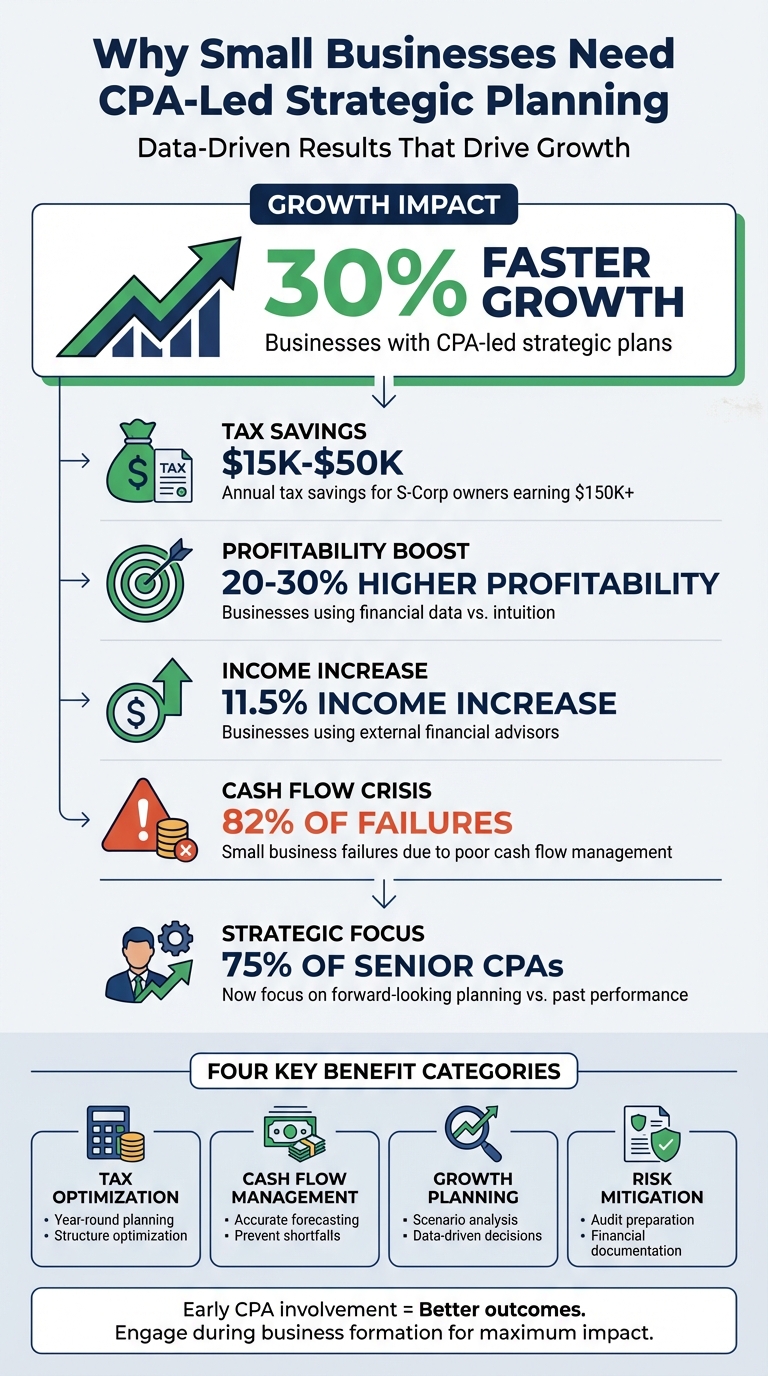
Key Benefits and ROI of CPA-Led Strategic Planning for Small Businesses
Benefits of Working with a CPA for Strategic Planning
Forward-Looking Financial Planning
CPAs help businesses shift from merely reacting to challenges toward actively pursuing growth. Instead of focusing solely on year-end tax filings, they provide ongoing strategic advice that digs into what drives costs and impacts profitability. For example, if your profits are stagnant due to rising labor or overhead expenses, a CPA can run "what-if" scenarios to guide decisions about hiring, expansion, or investments.
Fractional CFO services offered by CPAs take this a step further. They create financial models for major decisions, helping you understand the potential outcomes before making commitments. This approach provides a roadmap that highlights opportunities and prepares for potential obstacles well in advance.
Tax Optimization and Compliance
CPAs don’t just handle taxes – they optimize them. The IRS estimates that small businesses collectively overpay billions each year due to poor tax planning. CPAs address this by analyzing your business structure – be it LLC, S-Corp, or C-Corp – to reduce self-employment taxes and maximize deductions. For instance, S-Corp owners earning over $150,000 can often save $15,000–$50,000 annually through optimized salary and distribution strategies.
Tax planning is a year-round effort. CPAs use strategies like timing income and expenses to ensure you stay in the most advantageous tax bracket. They also stay current with legislative changes, such as the restoration of 100% bonus depreciation in 2026 and the permanent 20% Qualified Business Income deduction. While tax preparation answers, "What do I owe?" strategic planning asks, "How can I owe less?".
Better Cash Flow Management
Strong cash flow management is essential for keeping your business stable, and this is another area where CPAs excel. By analyzing payment histories and vendor timelines, they create cash flow projections that help you avoid shortfalls. Practical tactics, like offering early payment discounts (e.g., 2% for payments made within 10 days) or implementing strict follow-up processes for overdue invoices, can accelerate cash inflow.
Beyond managing daily cash flow, CPAs help identify which products or services are profitable and which might be draining resources. This level of insight is crucial, especially since the Federal Reserve has found that inadequate financial documentation is a leading reason small businesses are denied loans. By improving cash flow and ensuring audit-ready records, CPAs strengthen your financial foundation and position you for growth.
sbb-itb-85dd802
The Role Of Strategic Accounting In Business Growth With Tabitha Regan | LittleOwl CPA
Main Elements of CPA-Led Strategic Planning
CPA-led strategic planning weaves together financial forecasting, entity structuring, and risk assessment to create a roadmap that supports sustainable business growth.
Financial Forecasting and Scenario Analysis
CPAs use real-world data – like payment patterns, vendor schedules, and customer cycles – to develop financial projections. These insights highlight cash positions and help you tackle potential shortfalls before they disrupt payroll or tax obligations. For instance, if you’re considering opening a second location, a CPA can simulate scenarios like a 15% revenue drop or rising payroll costs to show how they might affect your profitability and cash flow.
"Forecasting isn’t just projecting revenue or guessing next quarter’s numbers. It’s the discipline of understanding your financial trajectory, preparing for challenges ahead, and aligning decisions with real data, not instincts." – Sunny Patel, Business Strategy & Growth, Empyrean
Scenario analysis also plays a role in timing major purchases for tax benefits. With the Section 179 deduction limit set at $2.56 million for 2026, CPAs can guide you on when to buy equipment to fully expense its cost immediately. Businesses that prioritize accurate forecasting are, on average, 10% more profitable than those that don’t.
These precise financial forecasts naturally inform decisions around structuring your business for growth.
Entity Structuring and Business Growth
Your business structure significantly impacts taxes and growth potential. CPAs evaluate various options to ensure your setup minimizes taxes while supporting future scalability. For example, an S-Corp election is a popular choice for businesses with consistent income above $75,000, as it reduces self-employment taxes by splitting income between salary and distributions.
For S-Corp owners earning over $150,000, this strategy can save between $15,000 and $50,000 annually. The trick lies in setting a salary that meets the IRS’s "reasonable compensation" standards while maximizing the 20% Qualified Business Income (QBI) deduction, which became permanent under the One Big Beautiful Bill Act (OBBBA) of 2025. CPAs also adapt your structure as your business grows, ensuring it can handle expansions, new partnerships, or even succession planning.
Risk Assessment and Contingency Planning
Once your forecasts are solid and your entity structure is optimized, the next step is identifying and mitigating risks to protect your business’s future.
CPAs pinpoint financial risks and develop strategies to safeguard business continuity. This includes setting up internal controls to prevent fraud, monitoring worker classifications to avoid audits, and tracking multi-state sales to address tax nexus issues before they escalate. According to the Federal Reserve, a lack of prepared financials is one of the top reasons small business loans are denied.
Risk assessment also involves creating detailed financial reports for contingency planning. Using SWOT analysis (Strengths, Weaknesses, Opportunities, Threats), CPAs help you identify potential challenges and prepare for them. They also review specialized insurance policies, such as cyber liability, alongside traditional coverage like property and liability insurance. By addressing these risks upfront, your business is better equipped to handle market changes without significant disruption.
At TC Advisors, we bring these elements together to deliver tailored strategic planning services, helping your business face challenges head-on and achieve long-term growth.
CPA Planning Approaches for Different Business Stages
Businesses evolve through different stages, and each phase brings unique financial challenges and opportunities. A CPA with a deep understanding of these stages can tailor strategies to meet your specific needs, whether you’re just starting out, scaling up, or planning for succession.
Startup Phase
In the early days of a business, establishing a solid financial framework is key. CPAs play a crucial role by setting up accounting systems, selecting software that fits your business model, and designing a chart of accounts that aligns with your goals. They also guide you in choosing the best legal structure to limit personal liability and attract future investors.
Managing cash flow is often the biggest challenge for startups. CPAs provide regular cash flow forecasts to help you anticipate gaps and maintain sufficient runway. This is vital, considering that 20% of small businesses fail in their first year, and nearly half don’t make it past five years. One SaaS startup, for example, discovered $75,000 in missed tax deductions and $23,000 in overpaid sales tax after switching from DIY accounting to professional help.
Tax planning during this phase can also yield substantial benefits. CPAs identify opportunities like R&D tax credits, handle 83(b) elections to minimize future tax liabilities, and navigate multi-state sales tax complexities. If you’re preparing to raise capital, they create GAAP-compliant financial statements and detailed financial models to attract investors. Poor accounting practices can delay fundraising by up to six months and reduce valuations by as much as $15 million.
Growth Phase
As your business expands, the focus shifts to managing the complexities of growth. This often involves transitioning from cash-basis to accrual accounting to meet the reporting standards of lenders and investors. CPAs also help optimize working capital by addressing the "cash gap" – the lag between paying suppliers and receiving customer payments – through better management of receivables, inventory, and payables.
"Compliance Is the Floor. Strategy Is the Ceiling." – Meinershagen & Co
Tax structuring becomes increasingly important during this stage. For instance, converting to an S-Corp can save certain small business owners over $18,000 annually in self-employment taxes. CPAs can also leverage Section 179 deductions to allow you to expense the full cost of qualifying equipment in the year it’s purchased, helping offset the cost of upgrades. Businesses that use external financial advisors often see an 11.5% increase in income.
If acquisitions are part of your growth strategy, CPAs assist with due diligence and structuring deals, including earnouts and installment payments, to help you acquire new revenue streams. They also recommend scalable accounting platforms with automated data feeds, giving you real-time insights into your financial health.
As your business reaches maturity, CPAs help refine strategies to maintain profitability and prepare for eventual transitions.
Maturity and Succession Planning
For mature businesses, succession planning becomes a top priority. Surprisingly, about 50% of business owners lack a transition plan, even though 80% of their wealth is often tied up in their business. Adding to the urgency, roughly half of business transitions are involuntary, triggered by unforeseen health or market events.
Regular valuations – ideally every two years – are essential to ensure accurate pricing. CPAs use industry-standard methods like Asset-Based, Income-Based, or Market-Based approaches. They also help you evaluate different exit strategies, such as family succession, management buyouts, Employee Stock Ownership Plans (ESOPs), or third-party sales, while comparing the tax implications of each. For example, an asset sale versus a stock sale can lead to vastly different tax outcomes.
Minimizing taxes during a transition is another critical focus. CPAs implement strategies like installment sales, gifting shares, or establishing trusts to reduce estate and capital gains taxes. For owners of qualified small business stock (C-corps), Section 1202 allows for up to $10 million – or 10 times the adjusted basis – in capital gains to be excluded from federal taxes if the stock is held for more than five years. The IRS annual gift exclusion limit for 2025 is $19,000.
"Succession planning isn’t a someday task, it’s a today imperative for protecting wealth, people and the future of your clients’ businesses." – Mark Valentino, Head of Business Banking, Citizens
At TC Advisors, we align our financial strategies with your business stage, ensuring you have the right tools and guidance to navigate each phase with confidence.
How to Measure Strategic Planning Results
Businesses with strategic plans tend to grow 30% faster. The key? Tracking measurable indicators and using real data to guide decisions. Relying on financial data rather than intuition can boost profitability by 20–30%.
Financial metrics provide a clear picture of your business’s overall health.
Key Financial Metrics
Specific financial ratios act as a quick health check for your business. For instance, liquidity metrics like the Current Ratio (ideal range: 1.5–3.0) and the Quick Ratio (target: 1.0–2.0) help assess whether you can meet short-term obligations without scrambling for funds. Cash flow is critical – 82% of small businesses fail due to poor cash flow management. Monitoring your Cash Ratio (minimum 0.2–0.3) can serve as an early warning system.
Profitability metrics are equally telling. For service businesses, the Gross Profit Margin should generally fall between 60–80%, while retail businesses should aim for 25–50%. Another key metric, the Operating Profit Margin (target: 5–15%), shows how well you’re managing costs after accounting for overhead. Additionally, tracking your effective tax rate over time can reveal areas for tax optimization.
Leverage ratios provide a deeper understanding of financial stability. A Debt Service Coverage Ratio of at least 1.25x ensures you can comfortably manage debt payments. To simplify tracking, consider using a "Traffic Light System" on a dashboard to monitor 6–8 critical ratios. Green means everything’s on track, yellow signals caution, and red indicates urgent action is needed.
While financial metrics focus on outcomes, operational efficiency indicators dig into the reasons behind those numbers.
Operational Efficiency Indicators
Operational efficiency metrics help you understand what’s driving your financial performance. Days Sales Outstanding (DSO), for example, measures how quickly you’re collecting receivables. Reducing DSO by just 10 days can free up cash for other needs. For B2B service companies, a DSO target of 30–45 days is a good benchmark. Similarly, Inventory Turnover identifies slow-moving stock that ties up cash. Industries like apparel often aim for a turnover rate of 4–6x.
Another key metric is Revenue per Employee, which gauges productivity and scalability. A decline in this metric as headcount grows might signal over-hiring rather than sustainable growth. For service businesses, tracking utilization rates (billable hours vs. total hours) and realization rates (actual billing vs. standard billing) ensures that strategic plans translate into operational efficiency.
"Measurement keeps strategy alive." – Adams Brown Strategic Allies and CPAs
Establish a regular review process to keep your strategy dynamic. Monitor KPIs weekly to catch immediate trends. Hold monthly financial reviews to translate data into actionable insights. And, every quarter, take a deeper dive to reassess long-term assumptions. Without proper planning and follow-through, nearly 90% of business resolutions fail by February’s first week. Regular measurement transforms your strategic plan from a static document into a living, actionable framework.
Conclusion
Financial leadership today goes far beyond balancing books or filing taxes. Modern CPAs are stepping into strategic roles, with 75% of senior CPAs dedicating significant time to forward-looking planning instead of just reviewing past performance. This shift gives small businesses access to executive-level insights without the expense of hiring a full-time CFO.
The financial risks of neglecting strategic planning are undeniable. Small businesses lose billions each year due to poor tax planning. Even worse, the Federal Reserve highlights incomplete or unprepared financial documentation as a leading cause of loan rejections. Bringing a CPA on board early – ideally during the business formation phase – can save businesses from structural missteps that are far harder and more expensive to fix later.
"The earlier a CPA is looped into strategy talks, the more grounded, and sustainable, that strategy becomes." – Burch Piper
As businesses reach revenue milestones like $250,000, $1 million, or $5 million, the need for detailed financial oversight grows. Regular financial reviews help ensure strategies stay aligned with market changes, while monitoring key performance indicators weekly can catch potential issues before they spiral into larger problems.
Throughout this guide, we’ve seen how CPAs can move beyond crunching numbers to become strategic partners. Their ability to turn financial data into actionable growth plans makes them invaluable – especially when engaged before financial challenges arise. Whether you’re setting up an LLC, planning for growth, or preparing for succession, a CPA can provide the financial clarity needed to navigate the journey.
For CPA-led planning that supports long-term growth, consider partnering with TC Advisors. Their expertise can help turn your financial data into a roadmap for success.
FAQs
When should I bring a CPA into strategic planning?
When your business is gearing up for major financial decisions or planning significant growth, it’s time to bring a CPA into your strategic planning. Their expertise goes far beyond basic bookkeeping and taxes. CPAs can assist with cash flow planning, identifying potential blind spots, and fine-tuning financial processes. This guidance helps businesses map out a clear, actionable plan for the next three to five years, ensuring smarter decisions and smoother growth.
Is an S-Corp right for my business?
If you’re looking to cut down on self-employment taxes, an S-Corp could be worth considering – particularly if your annual income is over $150,000. By combining a reasonable salary with distributions, you could potentially save anywhere from $15,000 to $50,000 each year. That said, these savings come with responsibilities. You’ll need to stick closely to IRS regulations and engage in proactive tax planning to make the most of this structure.
Which KPIs should I track to prove the plan is working?
To measure how well your strategic plan is working, keep an eye on key performance indicators (KPIs) like cash flow, revenue growth, profit margins, and operational efficiency. Start by comparing your cash flow projections to actual cash flow to gauge financial stability. Then, track revenue trends and profit margins to get a clearer picture of profitability. For operational efficiency, look at metrics such as project completion rates or inventory turnover. Regularly reviewing these KPIs helps ensure your plan stays on track and delivers the improvements you’re aiming for.


