

When buying or selling a business, financial due diligence is critical to avoid costly surprises and ensure accurate valuations. CPAs play a key role in this process by analyzing financial records, identifying risks, and verifying the true financial health of the business. Here’s what you need to know:
- What CPAs Do in M&A: They review years of financial statements, tax filings, and operational data to confirm earnings, uncover liabilities, and ensure the purchase price reflects the business’s actual value.
- Common Issues Found: Inaccurate financial statements, hidden tax liabilities, and overvalued assets often complicate deals.
- Why CPAs Are Essential: Their expertise helps buyers avoid overpaying, minimize tax risks, and structure deals effectively.
- Post-Merger Role: CPAs also help integrate financial systems and ensure the merged entity operates efficiently.
Without thorough CPA-led due diligence, nearly half of M&A transactions fail due to financial or tax mismanagement. Whether you’re acquiring or selling, involving a CPA ensures a smoother process and better outcomes.
Both of our partners did this work for private equity clients before founding the firm. Our due diligence and transaction advisory page sets out what an engagement delivers.
M&A Due Diligence -The Inside Track – Jonathan Jay 2025
sbb-itb-85dd802
Common Challenges in M&A Financial Due Diligence
M&A transactions often encounter financial hurdles that can either derail deals or lead to unpleasant surprises after the deal closes. In fact, nearly half of failed M&A transactions stem from financial or tax mismanagement. These challenges typically fall into three categories: unreliable data, hidden tax exposures, and overinflated valuations. Let’s dive into these issues, starting with inaccuracies in financial reporting.
Inaccurate Financial Statements and Reporting
Financial statements don’t always paint a full or accurate picture. For instance, some sellers include nonrecurring gains or one-time windfalls in their revenue figures, presenting them as if they were part of the business’s ongoing income. This practice creates a skewed perception of sustainable earnings. On top of that, sellers often fail to adjust for discretionary expenses or shareholder-related costs that won’t continue under new ownership, adding to the confusion.
Another major concern is off-balance-sheet liabilities. These can include undisclosed property liens, environmental violations, pending lawsuits, or even "golden parachute" clauses – none of which are visible in standard financial reports.
Emily Feeley, CPA, MBA, and Director at AAFCPAs, highlights the challenge:
"Buyers enter due diligence expecting confirmation, not discovery. When documentation is incomplete, inconsistent, or poorly explained, diligence shifts from confirmation to investigation."
When financial documentation is lacking or unclear, due diligence turns into a deeper probe, creating delays and raising concerns about the deal.
Hidden Tax Liabilities and Compliance Risks
Tax compliance issues can lead to some of the most costly surprises in M&A transactions. Common pitfalls include unpaid payroll or sales taxes, overly aggressive deductions that could trigger IRS audits, and overlooked state tax obligations. For example, the 2018 Wayfair ruling introduced economic nexus requirements, which many businesses fail to address. This oversight can leave buyers with substantial state tax debts to settle.
Another frequent issue is worker misclassification. Companies that treat employees as independent contractors (issuing 1099s instead of W-2s) risk back taxes and penalties if those classifications are challenged. These risks are especially problematic in stock deals, where the buyer inherits the target company’s entire tax history.
Shaun Hunley, Tax and Accounting Executive Editor at Thomson Reuters, warns:
"The one buying the company could be on the hook, legally, for taxes that are due when they are buying stock."
The structure of the deal plays a critical role here. Asset purchases generally allow buyers to avoid historical liabilities and take advantage of a stepped-up basis for tax purposes. In stock purchases, however, buyers assume the target’s full tax history, underscoring the importance of thorough tax due diligence.
Overvaluation and Asset Misrepresentation
Beyond tax concerns, overvaluation and asset misrepresentation can further complicate a transaction.
Overpaying for a business often happens when inflated EBITDA figures are used without proper normalization. A quality of earnings analysis can uncover discretionary spending, shareholder perks, or unsustainable revenue streams that artificially boost reported earnings, revealing a much lower true value.
Catherine T. Marchelletta, CPA, MST, and Partner at Louis Plung & Company, explains:
"Due diligence often uncovers information that leads to a purchase price adjustment, so the effort can result in more accurate pricing."
Unrecorded liabilities are another issue. Items like accrued vacation time, pending lawsuits, or environmental obligations may not show up on balance sheets but can significantly impact valuations. Similarly, asset misrepresentation is a serious risk. For example, financial reports may list equipment and inventory at full value, even when they are obsolete, damaged, or improperly written down. Accounts receivable aging reports can also reveal unexplained credits or reconciliation issues, inflating asset values.
In some cases, updated financials provided during due diligence show flat or declining revenue, signaling that the initial valuation was overly optimistic. A thorough CPA-led quality of earnings analysis can help identify these discrepancies, reducing the risk of overpayment and ensuring a fair deal.
How CPAs Solve Financial Due Diligence Challenges
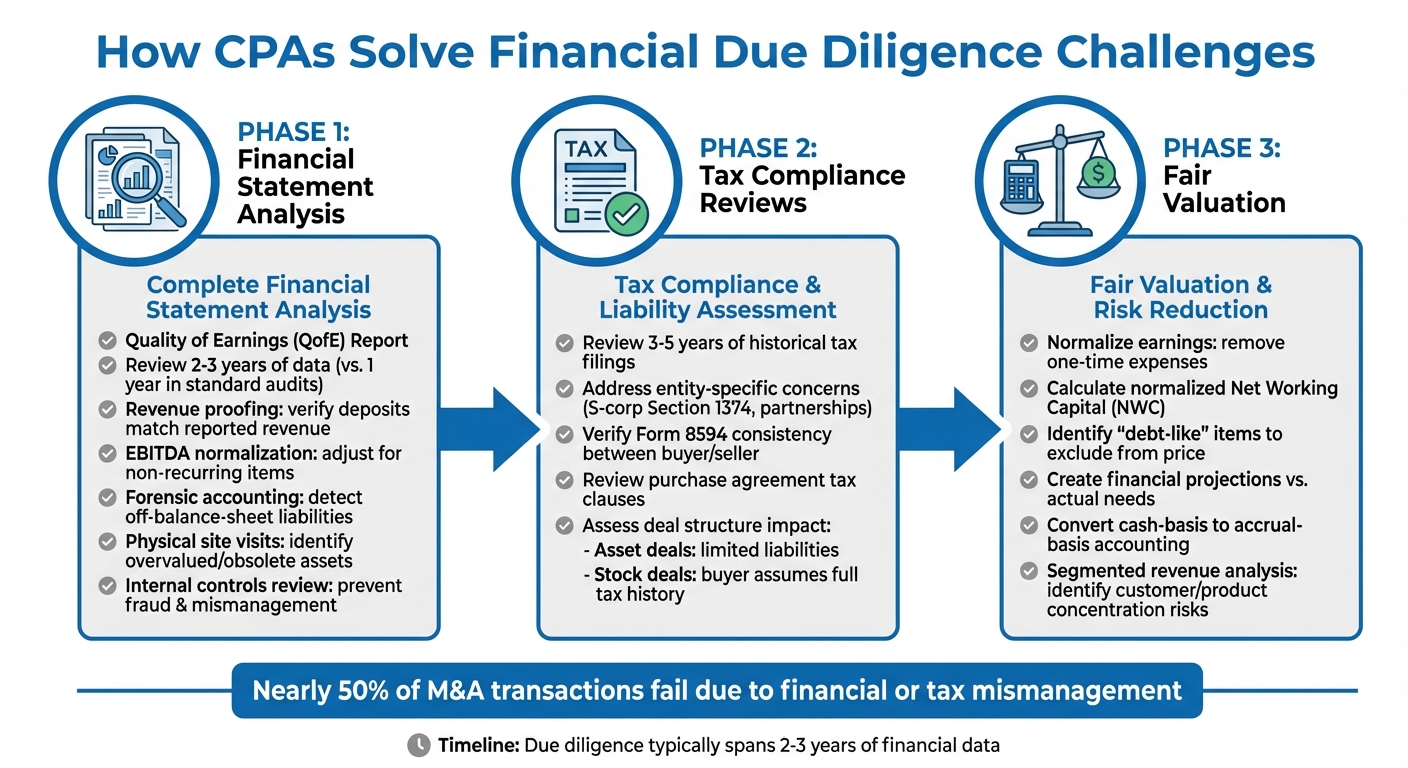
CPA Due Diligence Process in M&A Transactions
CPAs address financial challenges with a targeted approach, focusing on three main areas: financial statement analysis, tax compliance reviews, and fair valuation. These efforts aim to tackle risks like inaccurate reporting, hidden liabilities, and overvaluation.
Complete Financial Statement Analysis
To uncover inaccuracies and hidden liabilities, CPAs start with a thorough financial analysis. A key tool in their arsenal is the Quality of Earnings (QofE) report, which delves deeper than standard audits. Unlike traditional audits that typically cover one year, financial due diligence spans two to three years, allowing CPAs to identify patterns and inconsistencies in financial data.
One essential technique is revenue proofing, which verifies that reported revenue matches actual deposits. Another is EBITDA normalization, where CPAs adjust for non-recurring or irregular items, ensuring a clearer view of a business’s recurring profitability [25, 28]. As WG Consulting explains:
"Financial due diligence is not just another audit; it is a credibility exercise. It confirms that every figure in your financials is supported, consistent, and explainable."
CPAs also use forensic accounting to detect off-balance-sheet liabilities, such as undisclosed liens or pending lawsuits [23, 27]. Physical site visits reveal issues like obsolete or damaged equipment that might be overvalued on the balance sheet [23, 24]. Additionally, reviews of internal controls help identify weak points in processes like inventory tracking or segregation of duties, which could lead to fraud or operational mismanagement [23, 27]. Once financial accuracy is established, CPAs shift their focus to tax compliance to further mitigate risks.
Tax Compliance Reviews and Liability Assessments
Tax due diligence involves reviewing three to five years of historical filings, focusing on compliance and potential exposures [3, 1]. CPAs also address entity-specific concerns, such as built-in gains taxes for S-corporations under Section 1374 or complications when partnerships hold stock.
The structure of a deal plays a significant role in tax liability. Asset deals limit liabilities to agreed-upon terms, while stock deals transfer the seller’s entire tax history to the buyer. As Catherine T. Marchelletta, CPA, MST, explains:
"In a stock deal, the buyer ‘steps into the shoes of the seller,’ meaning that the buyer assumes all liabilities of the seller, whether disclosed or not."
CPAs ensure consistency in reporting between buyer and seller on forms like Form 8594 (Asset Acquisition Statement) to avoid IRS scrutiny. They also comb through purchase agreements to verify that tax clauses, indemnifications, and definitions of assumed liabilities are properly outlined [3, 1]. With tax risks addressed, CPAs then focus on fair valuation to prevent overpayment.
Fair Valuation and Risk Reduction
To ensure buyers pay a fair price, CPAs normalize earnings by removing one-time expenses and owner-specific costs, revealing true profitability [29, 13]. They calculate normalized Net Working Capital (NWC) targets to confirm the business has adequate liquidity at closing, while identifying "debt-like" items that should be excluded from the purchase price [28, 31].
CPAs also create financial projections to test growth assumptions against actual needs, such as staffing or equipment [29, 30]. When necessary, they convert cash-basis financials to accrual-basis accounting for a clearer picture of when goods or services were delivered. Segmented revenue analysis further helps pinpoint risks, such as over-reliance on a single customer or product line [13, 32].
This detailed process ensures that buyers base their decisions on reliable financial data, reducing the risk of overpaying for inflated projections.
CPA Support for Post-Merger Integration
Once the deal is finalized, CPAs transition from analyzing the transaction to ensuring the newly merged entity functions as a cohesive financial organization. This integration phase can take anywhere from 6 to 24 months, depending on the complexity of the deal. Building on the groundwork laid during due diligence, CPAs focus on unifying financial operations to achieve the expected benefits of the merger. Poor integration, however, is a common reason deals fall short of their potential.
Aligning Financial Systems and Processes
With risks addressed and the financial value of the deal confirmed, CPAs play a key role in guiding the merged organization toward operational alignment. This process begins with a detailed review and standardization of financial systems. CPAs harmonize the chart of accounts, align accounting policies, and consolidate treasury functions to establish a unified financial reporting system – a single source of truth. During the initial months, they conduct parallel financial closes to compare results and address discrepancies swiftly.
Key operational processes, such as payroll, cash handling, and vendor approvals, also come under scrutiny. CPAs identify and standardize internal controls to reduce the risk of fraud and errors. They oversee the migration of financial data to the new platform, ensuring its accuracy and integrity throughout the process. As Magistral Consulting highlights:
"CPA firms collaborate with management teams to harmonize accounting policies, financial reporting practices, and operational workflows across acquiring and target entities, facilitating seamless integration."
CPAs also manage post-close tasks, such as finalizing working capital adjustments and establishing clear, auditable processes for tracking performance metrics tied to earnout payments.
Forecasting and Long-Term Financial Planning
Successful integration depends on validating the financial assumptions made during the deal. Beyond aligning systems, CPAs focus on securing the long-term financial health of the merged entity. They create unified cash flow forecasts and establish key performance indicators (KPIs) to ensure that projected cost savings and synergies are realized. This can be especially challenging, as integration costs and working capital issues often strain the expected return on investment. As Synpact Consulting puts it:
"The ‘paper value’ created at signing only becomes real if integration execution supports the assumptions behind the valuation."
Additionally, CPAs develop tax-efficient structures and long-term tax strategies to minimize liabilities and enhance post-merger profitability. For businesses navigating the complexities of mergers and acquisitions, TC Advisors (https://tcadvisorscpa.com) offers transaction advisory services that go beyond the deal itself. Their expertise in financial leadership and integration support helps small to mid-sized businesses unlock the full potential of their acquisitions.
Conclusion
Mergers and acquisitions go far beyond legal formalities and celebratory milestones – they demand detailed financial analysis at every step. CPAs play a central role in coordinating with stakeholders to align financial goals, uncover potential tax liabilities, validate purchase prices through Quality of Earnings reports, and flag compliance risks that could jeopardize the deal or lead to costly penalties after closing.
With the sheer size of the U.S. M&A market, even small mistakes can result in significant financial losses or liabilities. CPAs help prevent such pitfalls by diving deep into EBITDA trends, addressing worker classification concerns, and analyzing successor liability risks – particularly in stock deals where buyers inherit all historical obligations. As Jeremy A. Johnson, CPA, puts it:
"A CPA/advisory firm serves as the operational and technical center, the one partner who touches every aspect of the deal and ensures all parties are working from the same financial reality."
Thorough due diligence and expert CPA guidance are essential for ensuring long-term success in any transaction. For small to mid-sized businesses, having the right CPA partner can make all the difference in turning a transaction into a lasting financial win. TC Advisors (https://tcadvisorscpa.com) exemplifies this approach by combining technical expertise with personalized service. In one instance, their tax due diligence uncovered compliance issues that led to a restructured deal, cutting the client’s risk exposure by 20% and delivering substantial tax savings post-close.
Whether you’re selling a business, acquiring a competitor, or integrating a new entity, partnering with the right CPA ensures your transaction achieves its intended value – delivering measurable and sustainable financial outcomes.
FAQs
What’s included in a Quality of Earnings (QoE) report?
A Quality of Earnings (QoE) report dives into key financial areas like revenue quality, expense normalization, and working capital. It also sheds light on potential risks that could influence a company’s valuation during a merger or acquisition. This analysis is essential for assessing a business’s financial stability and arriving at a fair valuation.
How can due diligence change the purchase price or deal terms?
Due diligence plays a key role in shaping the purchase price or deal terms by identifying potential risks and opportunities. For instance, uncovering issues like unpaid taxes, misclassified workers, or compliance violations can lead to adjustments such as price reductions, escrow holdbacks, or, in some cases, the cancellation of the deal altogether. On the flip side, due diligence might also highlight tax advantages or other hidden opportunities that could increase the overall value of the transaction.
What should I expect from a CPA after the deal closes?
After the deal is finalized, a CPA often steps in to offer continued support through financial reporting, tax compliance, and post-transaction planning. These services are crucial for maintaining a seamless transition, staying aligned with regulatory standards, and tackling any financial or operational hurdles that might come up along the way.


