

Mergers and acquisitions (M&A) can be high-stakes endeavors, with financial missteps often leading to failure. In 2022, nearly half of unsuccessful deals were tied to gaps in financial due diligence. Certified Public Accountants (CPAs) play a critical role in helping businesses avoid these pitfalls by identifying risks, verifying financial data, and ensuring compliance with tax and regulatory requirements.
Key CPA contributions during M&A include:
- Financial Due Diligence: CPAs analyze financial statements, uncover hidden liabilities, and verify revenue and cash flow accuracy.
- Tax Risk Management: They review tax filings, assess successor liability risks, and structure deals for tax efficiency.
- Operational Risk Assessment: CPAs evaluate internal controls, business processes, and revenue quality to protect deal value.
- Post-Merger Support: They assist with integrating financial systems, ensuring compliance, and monitoring risks after closing.
With the U.S. M&A market exceeding $1 trillion in 2024, CPA expertise is essential for navigating the complexities of transactions and safeguarding long-term success.
Due Diligence: 3 Stages Every Business Buyer Must Know
sbb-itb-85dd802
Financial Due Diligence: Finding Risks in Target Companies
Financial due diligence involves CPAs digging into a target company’s records to confirm their accuracy. Unlike a standard one-year audit, this process usually spans two to three years of financial records, offering a much deeper look. For small businesses, this review typically takes 45 to 60 days, while larger private equity or strategic deals can stretch anywhere from 60 to 180 days.
The goal? To verify seller claims while uncovering hidden risks. CPAs analyze key financial statements – balance sheets, income statements, cash flow statements, and statements of retained earnings – to piece together a full picture of the company’s financial health. They also dive into operational ledgers, like accounts receivable aging reports and inventory listings, to spot any inconsistencies with the general ledger .
But it’s not just about numbers. CPAs examine corporate records, customer contracts, and employment agreements. They look for clauses that could complicate the deal, such as change-of-control provisions that might cancel contracts post-sale, "golden parachute" clauses leading to unexpected payouts, or restrictive terms in leases for real estate or equipment . For professional service firms, CPAs often review the top 20 clients by revenue and randomly sample 5–10% of the remaining client base to ensure fees and work quality are consistent. This thorough examination sets the stage for identifying deeper risks, as detailed below.
Reviewing Financial Statements for Warning Signs
CPAs carefully analyze profit and loss statements to identify any red flags. They pay close attention to revenue recognition practices, ensuring sales aren’t prematurely recorded or artificially inflated by one-time gains. Cash flow patterns are another critical focus – a company might show strong earnings but struggle with cash collections, hinting at potential problems.
Debt levels and hidden liabilities also come under the microscope. CPAs review off-balance-sheet obligations like pending lawsuits, regulatory violations, or unrecorded accruals (e.g., unpaid vacation or deferred payroll taxes). They also adjust for personal expenses – such as travel, meals, or company vehicles – that may have been improperly run through the business .
Richard Weiner, CPA, MST, CM&AA, and Tax Partner at AAFCPAs, highlights a common issue:
"Missing or inaccessible corporate records often surface late in the process. Buyers commonly request formation documents, historical tax returns, and tax election filings… Difficulty locating them raises questions about documentation discipline and internal controls".
Site visits are another key step. By inspecting inventory and equipment, CPAs can uncover obsolete, damaged, or missing assets that might still appear on the balance sheet at full value.
Beyond these financial reviews, tax and compliance issues are also a major focus to help reduce risks tied to successor liability.
Reviewing Tax Liabilities and Compliance Issues
Tax due diligence generally takes between one and three months, though more complex stock deals can stretch the timeline to six months. During this phase, CPAs review federal, state, and local tax returns from the past three to five years, looking for aggressive tax positions that could invite future IRS audits . For S-Corporations, they verify election filings and IRS approval letters. They also request trust documents to confirm all shareholders are eligible – an ineligible shareholder could jeopardize the company’s tax status.
Stock purchases come with added risk due to something called successor liability. Shaun Hunley, Tax and Accounting Executive Editor at Thomson Reuters, explains:
"If you are buying the stock of a company or ownership interest, that is a little bit riskier for the buyer because of something called successor liability. The one buying the company could be on the hook, legally, for taxes that are due".
CPAs also review 1099 forms to spot misclassified workers – mistaking employees for independent contractors can lead to hefty back taxes and penalties . Additionally, they assess economic nexus to determine whether the company has generated revenue in jurisdictions where it failed to file required state and local sales tax returns. This issue has become more common as businesses expand into new regions .
These detailed financial and tax reviews lay the groundwork for assessing operational risks that are critical to the success of mergers and acquisitions.
Operational Risk Assessment: Protecting Deal Value
Once financials and tax records are reviewed, CPAs turn their attention to the company’s daily operations. This deeper dive into operations helps uncover control weaknesses and process inefficiencies that might reduce the deal’s value – issues that a standard financial review might overlook. Stefan Ozer, Audit & Assurance Partner at Deloitte & Touche LLP, highlights why this step is crucial:
"Understanding how a company is run and how the financial data flows into key reports helps determine how reliable the financial data is and substantiates other information uncovered in the pre-deal diligence."
Interestingly, a survey of C-suite executives and senior leaders revealed that 40% of companies may neglect internal controls during the M&A process. For buyers, this oversight introduces serious risks, especially if they assume operational systems are functioning as expected. By adding an operational review to the financial analysis, CPAs help ensure that no hidden inefficiencies jeopardize the deal’s success.
Reviewing Internal Controls and Business Processes
CPAs carefully examine key business processes to pinpoint design flaws or gaps in execution. These reviews target areas like revenue recognition, inventory management, cash handling, and payroll disbursements – the systems that form the backbone of any business. They also evaluate the company’s Governance, Risk, and Controls (GRC) framework to assess how financial data flows into reports and whether that data is reliable.
Emily Feeley, CPA, MBA, and Director of AAFCPAs’ Business Transaction Advisory practice, describes a common issue:
"One of the most common issues arises in the data room. Files are often uploaded without prior review… Buyers may receive an accounts receivable aging report only to find unexplained credits or balances that do not match the general ledger."
To address such risks, CPAs check for segregation of duties, ensuring no single individual is responsible for both cash receipts and bank reconciliations. They also assess personnel roles to identify inefficiencies. For example, accrued liabilities like unpaid vacation time must be accurately recorded on the balance sheet to prevent unpleasant surprises after closing.
Technology systems are another critical focus. CPAs evaluate whether the company uses cloud-based or server-based systems and ensure that data is both structured and accessible. Mismatched technology stacks can significantly delay integration timelines.
Once internal processes are vetted, CPAs shift their focus to revenue and asset quality to further safeguard the deal.
Analyzing Revenue Streams and Fixed Assets
Revenue isn’t just about how much a company earns – it’s about the quality of that revenue. CPAs analyze revenue streams using metrics like recurrence (e.g., monthly retainers versus one-off projects), concentration (ensuring no single client dominates total revenue), and aging (e.g., work-in-progress under 30 days, accounts receivable under 45 days). For instance, if the top three clients account for more than 30% of total revenue, the deal carries heightened risk if those relationships don’t survive the transition.
| Metric | High-Quality | Low-Quality |
|---|---|---|
| Recurrence | Monthly retainers (CAS/Advisory) | One-off projects or hourly billing |
| Concentration | No client > 5% of total revenue | Top 3 clients > 30% of revenue |
| Aging | WIP < 30 days, AR < 45 days | Significant WIP write-offs, AR > 90 days |
| Pricing | Value-based or fixed fee | Low hourly rates requiring high volume |
Fixed assets require more than a quick glance at the balance sheet – they need physical verification. CPAs conduct site visits to identify obsolete, damaged, or outdated equipment and inventory that may still be listed at full value. They validate fixed asset registers and depreciation schedules through sampling and third-party confirmations. Additionally, they check for property improvements that may have been misclassified as expenses instead of being capitalized, which can distort the company’s asset base.
Finally, CPAs review customer and vendor contracts for "change-of-control" provisions. These clauses can trigger termination rights or pricing adjustments once the deal closes, potentially affecting the deal’s overall value.
Tax and Regulatory Risk Management in M&A
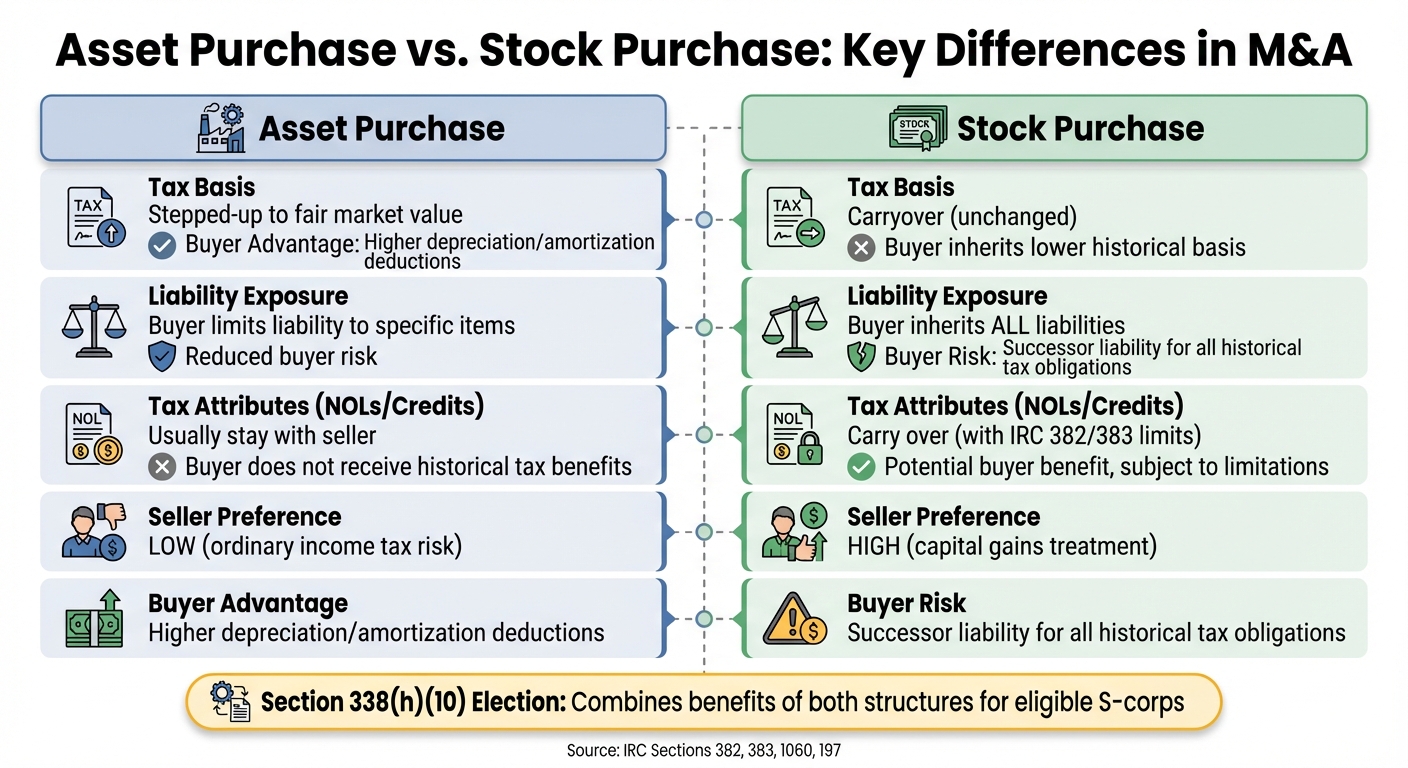
Asset Purchase vs Stock Purchase: Tax and Liability Comparison for M&A
When it comes to mergers and acquisitions, CPAs play a crucial role in navigating tax laws and regulatory requirements that directly affect the value of a deal. With the U.S. M&A market surpassing $1 trillion in 2024, even small tax missteps can lead to millions in unforeseen liabilities or lost deductions.
Pete Miller, CPA, CFE, CM&AA, and Shareholder at Clark Nuber P.S., underscores the importance of tax diligence:
"The manner in which a targeted company has handled its federal tax obligations can directly impact a deal’s value, alter its structure, and even derail it entirely."
Tax due diligence is a meticulous process that can take several months for complex transactions. During this time, CPAs uncover unpaid taxes, pending audits, disputes, or unfiled tax returns at the state or sales tax level. This thorough examination builds on financial due diligence, ensuring all fiscal risks are accounted for.
Structuring Deals for Tax Efficiency
Once tax issues are identified, CPAs focus on creating deal structures that minimize tax burdens. The decision between an asset purchase and a stock purchase can significantly impact both buyers and sellers.
- Asset Purchases: Buyers gain the ability to "step-up" the tax basis of acquired assets to their fair market value. This allows for higher depreciation and amortization deductions in the future. However, sellers often face higher taxes since certain assets may trigger ordinary income rather than capital gains.
- Stock Purchases: Sellers typically prefer this option due to lower capital gains tax rates. However, buyers inherit all historical tax liabilities, which can pose risks. Shaun Hunley, Tax and Accounting Executive Editor at Thomson Reuters, explains:
"If you are buying the stock of a company or ownership interest, that is a little bit riskier for the buyer because of something called successor liability. The one buying the company could be on the hook, legally, for taxes that are due."
To balance these considerations, CPAs may recommend a Section 338(h)(10) election for eligible S-corporations. This strategy allows a stock purchase to be treated as an asset purchase for tax purposes, giving buyers the benefit of a stepped-up basis while retaining the simplicity of a stock deal. CPAs also evaluate whether net operating losses (NOLs) and tax credits can be preserved, keeping in mind the limitations under IRC Sections 382 and 383.
Another critical task is the purchase price allocation under IRC Section 1060. CPAs negotiate how the purchase price is divided between tangible assets (like inventory) and intangible assets (like goodwill). Goodwill, for instance, is amortized over 15 years under Section 197. Buyers often prefer allocations favoring assets with shorter depreciation schedules, while sellers aim for capital gains treatment on goodwill.
| Feature | Asset Purchase | Stock Purchase |
|---|---|---|
| Tax Basis | Stepped-up to fair market value | Carryover (unchanged) |
| Liability Exposure | Buyer limits liability to specific items | Buyer inherits all liabilities |
| Tax Attributes | NOLs/credits usually stay with seller | NOLs/credits carry over (with limits) |
| Seller Preference | Low (ordinary income tax risk) | High (capital gains treatment) |
Bob Houston, M&A Leader at BPM, stresses the importance of early tax planning:
"The biggest tax planning mistakes happen before the deal even starts. Too many companies treat tax strategy as a checkbox item during due diligence, but by then, you’ve already locked yourself into suboptimal structures."
To mitigate risks like successor liability, buyers should include indemnification clauses in the purchase agreement. These clauses ensure sellers remain responsible for any pre-closing tax liabilities discovered after the deal closes.
Ensuring Regulatory Compliance
Once tax structures are optimized, CPAs shift focus to regulatory compliance, a critical step in managing deal risks and protecting transaction value.
CPAs review the target company’s compliance with federal, state, and local regulations. They analyze federal income tax returns from the past three to five years, identifying discrepancies or aggressive tax positions. At the state and local level, they conduct SALT compliance reviews, including nexus studies to determine if the company has unfulfilled filing obligations in jurisdictions where it operates.
Employment and payroll compliance is another key area. CPAs confirm that FICA and FUTA taxes are properly withheld and investigate worker classification issues. Misclassifying employees as independent contractors can lead to significant back-tax liabilities and penalties.
For companies with international operations, CPAs examine foreign regulatory filings and transfer pricing strategies to ensure compliance with global tax laws. They also verify foundational corporate records, such as formation documents and S-corporation election approval letters from the IRS.
If compliance gaps are identified, CPAs can leverage voluntary disclosure programs to address past issues and reduce penalties before closing. They also quantify potential tax exposures, which can inform negotiations for purchase price adjustments or escrow holdbacks. This proactive approach ensures regulatory issues don’t derail the deal or diminish its value post-closing.
Post-Merger Integration: Supporting Long-Term Success
Closing a deal is just the beginning. The real challenge lies in integrating two companies, a process that brings its own set of risks. This is where CPAs play a vital role in smoothing the transition.
Identifying Synergies and Integrating Financial Systems
Once the deal is finalized, aligning financial systems, internal controls, and reporting processes becomes essential to achieving the cost savings and operational improvements that justified the merger in the first place. Without proper integration, those expected benefits can slip through the cracks. CPAs step in to conduct thorough reviews of processes like revenue recognition, inventory management, and payroll. Their goal? To standardize procedures and ensure compliance with ASC 805. They also handle purchase price allocations for both tangible and intangible assets.
But it’s not just about the numbers – people are a key factor, too. Employees from the acquired company may continue using outdated processes if clear guidance isn’t provided, which can undermine the entire merger. As Sarah Beckett Ference, Risk Control Director at CNA, explains:
"Failure to integrate the operations, culture, and quality control into a single cohesive unit after a merger or acquisition can pose increased professional liability risk."
To tackle these challenges, CPAs help roll out training programs for new controls and reporting standards. They also recommend placing leadership on-site at newly acquired locations to foster a unified "one firm" culture. During the early stages of integration, increased monitoring ensures that everything stays on track.
Monitoring Financial and Operational Risks After Closing
Even after systems are integrated, new risks can crop up as the merged company begins functioning as a single entity. CPAs provide ongoing oversight to address these potential issues before they spiral out of control. They reconcile records to ensure the general ledger aligns with subsidiary reports and uncover unrecorded liabilities, such as accrued vacation or unresolved lawsuits, that could unexpectedly burden the buyer. Additionally, CPAs review change-of-control clauses in customer and vendor agreements to avoid surprises like terminated contracts or sudden pricing changes.
Haskell & White highlight the importance of early CPA involvement:
"Early CPA involvement streamlines the post-transaction reporting requirements, helping reduce the time and effort required to catch up on complex accounting issues."
For companies struggling with post-deal operational challenges, fractional CFO services or outsourced accounting support can provide the expertise needed to integrate systems smoothly and maintain financial stability in the long run.
TC Advisors‘ Transaction Advisory Services

Navigating the complexities of mergers and acquisitions (M&A) can be daunting, especially for small and mid-sized businesses that may lack the necessary expertise. TC Advisors offers a range of transaction advisory services aimed at identifying risks, verifying financial performance, and structuring deals that deliver long-term value.
How TC Advisors Reduces M&A Transaction Risks
TC Advisors employs a multi-layered approach to reduce risks during M&A transactions. One key tool is their Quality of Earnings (QoE) reviews, which help validate EBITDA by identifying non-recurring items, converting cash-based records to accrual, and reflecting consistent run-rate performance. For sellers seeking a preliminary review before buyers conduct their full investigations, TC Advisors provides QoE Lite – a focused analysis that highlights critical adjustments and uncovers potential red flags early in the process.
Tax risk assessments are another cornerstone of their service. These assessments include nexus analyses to identify multi-state filing risks, reviews of worker classifications, and evaluations of state and local tax (SALT) footprints to uncover missing filings. By addressing these issues, TC Advisors helps businesses avoid exposure to back taxes and successor liabilities.
In addition to financial and tax reviews, TC Advisors assesses contractual risks by examining customer and vendor agreements for clauses like change-of-control provisions, geographic restrictions, or termination rights that could be triggered by the transaction. Their oversight of data rooms ensures that uploaded documents are consistent and complete, which is critical for maintaining buyer confidence. As Emily Feeley, CPA, MBA, and Director at AAFCPAs, explains:
"One of the most common issues arises in the data room. Files are often uploaded without prior review… Buyers must resolve every open question before moving forward."
These comprehensive risk assessments are an essential part of TC Advisors’ tailored support for smaller enterprises.
Customized Support for Small and Mid-Sized Businesses
TC Advisors extends its services to small and mid-sized businesses by providing specialized support that complements internal teams. For many smaller companies, balancing due diligence with day-to-day operations can be overwhelming. TC Advisors alleviates this burden by assisting with due diligence documentation, ensuring that business operations remain uninterrupted.
They recommend that sellers start preparing 6–12 months before entering the market. This preparation helps address common documentation gaps, such as missing S-corp election letters or incomplete historical tax filings, which often surface in smaller businesses. Early planning not only strengthens internal controls but also establishes the level of documentation discipline that buyers expect.
Additionally, TC Advisors tailors deal structures to align with the personal goals of business founders, whether those goals involve estate planning, internal succession, or other considerations. Their fractional CFO services and year-round financial guidance provide ongoing support to startups, entrepreneurs, and real estate investors across the U.S., ensuring that their assistance extends well beyond the transaction’s closing date.
Conclusion
In 2022, only 61% of M&A transactions were successfully completed – and nearly half of the failures were tied to shortcomings in financial due diligence. Jeanette Roatch, Partner and Director at Shannon & Associates, underscores the importance of accurate financial analysis:
"A proper consultative approach (and getting the numbers right) is so important because if you don’t get the numbers right, it can cost you millions."
This data underscores why having expert CPA oversight is essential. CPAs play a critical role in mitigating risks tied to financial, operational, and tax factors. They ensure financials are accurate, uncover hidden liabilities, and maintain regulatory compliance. These efforts help prevent costly surprises and protect the value of deals throughout the transaction process.
For businesses facing these challenges, expert guidance is a must. TC Advisors offers tailored transaction advisory services designed to simplify due diligence and safeguard deal value for small and mid-sized businesses. Their offerings include everything from Quality of Earnings reviews to post-merger integration support, turning due diligence into a strategic advantage.
Starting preparations 6–12 months in advance and involving CPAs can transform due diligence into a powerful tool. With the U.S. M&A market expected to hit $1.09 trillion by 2024, the pressure to get every detail right has never been greater.
FAQs
What’s the difference between financial due diligence and a Quality of Earnings (QoE) review?
When examining a company’s financials, financial due diligence focuses on verifying the accuracy of financial statements and ensuring compliance with relevant standards. This process primarily looks at the company’s historical financial health to provide a clear picture of its past performance.
On the other hand, a Quality of Earnings (QoE) review dives deeper into the sustainability of the company’s earnings and cash flow. It also identifies potential risks that could affect future performance. Unlike financial due diligence, which is backward-looking, a QoE review is more forward-focused, helping to predict how the business might perform in the future.
Both approaches are essential in mergers and acquisitions, as they provide distinct insights into a company’s financial stability and potential.
How can a CPA help reduce successor liability in a stock purchase?
A CPA plays a key role in minimizing successor liability during a stock purchase by ensuring the right legal and contractual safeguards are implemented. This process often involves drafting and enforcing confidentiality agreements and conducting a meticulous review of tax and liability obligations. By addressing these areas, a CPA helps shield the buyer from unexpected risks associated with the seller’s past liabilities.
What operational red flags should I look for before closing an M&A deal?
Before closing an M&A deal, it’s crucial to keep an eye on potential operational risks that could derail success. For instance, supply chain vulnerabilities – like over-reliance on specific vendors – might disrupt business flow. Similarly, employee-related issues, such as high turnover rates, can lead to instability within the organization.
Another area to examine is outdated technology systems or cybersecurity weaknesses, which could expose the company to operational inefficiencies or security threats. Don’t overlook legal compliance risks either, as they can create significant liabilities. Lastly, integration challenges, such as differences in workplace culture, can complicate the post-merger process.
Conducting thorough due diligence is essential to uncover and address these risks, ensuring a smoother and more successful transition.


