

Expense policy compliance is critical for protecting company resources, preventing fraud, and meeting regulatory requirements. Here’s what you need to know:
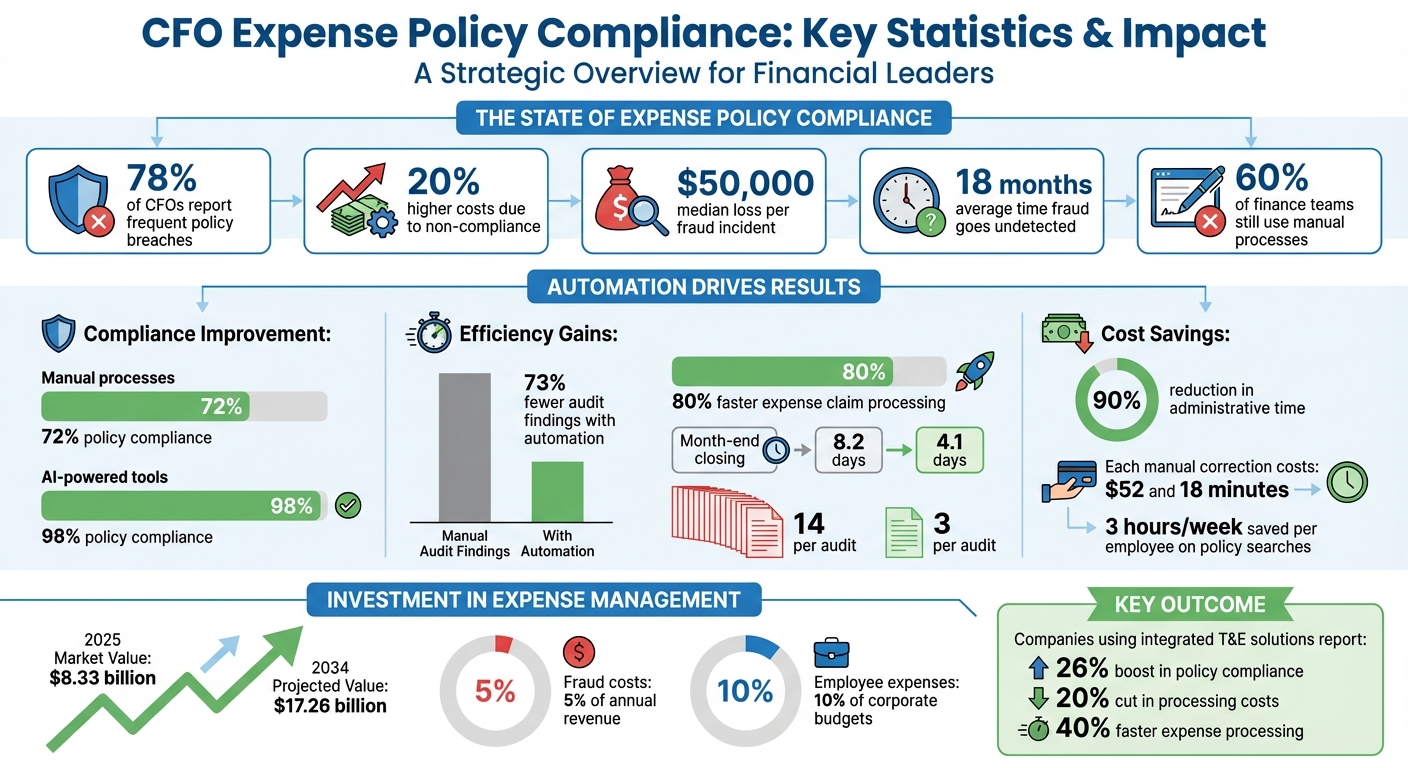
- 78% of CFOs report frequent policy breaches, costing businesses up to 20% more.
- Expense fraud often goes undetected for 18 months, with a median loss of $50,000 in 2025.
- IRS "accountable plan" rules require expenses to include: amount, date, place, business purpose, and business relationship (for meals/entertainment) to remain tax-free for employees.
- Manual processes, still used by 60% of finance teams, increase risks and administrative burdens.
Key steps to improve compliance:
- Clear policies: Define reimbursable vs. non-reimbursable expenses (e.g., IRS mileage rate is 72.5 cents/mile for 2026).
- Deadlines and documentation: Require submissions within 3–5 business days and itemized receipts for expenses over $75.
- Approval workflows: Use structured hierarchies and pre-approvals for high-value transactions.
- Technology integration: Automate expense tracking, flagging, and auditing with AI-powered tools.
- Employee training: Incorporate policy education into onboarding and provide easy access to guidelines or schedule a consultation for expert policy review.
CFO Expense Policy Compliance Statistics and Impact 2025-2026
How to Manage Spending with Employees
sbb-itb-85dd802
Core Components of an Expense Policy
An effective expense policy lays out clear guidelines for reimbursable expenses, enforces submission deadlines, and ensures proper documentation. By doing so, it eliminates confusion, minimizes policy violations, and safeguards both the company and its employees.
What Expenses Can Be Reimbursed
Your expense policy should clearly outline what qualifies as a reimbursable expense. Common categories include:
- Transportation: Airfare, rideshare services, and mileage (set at 72.5 cents per mile for 2026 by the IRS).
- Lodging: Hotel stays or other accommodations.
- Meals: Expenses for client meetings or work-related travel.
- Office Supplies: Items needed for work-related tasks.
- Professional Development: Costs for certifications, conferences, or training.
Equally important is specifying non-reimbursable expenses, such as personal entertainment, traffic fines, unauthorized travel upgrades, or alcohol (unless pre-approved for client-related events). To keep spending fair and realistic, set location-based limits – for example, $300 for Manhattan versus $200 in less expensive cities.
To comply with IRS "accountable plan" rules and ensure reimbursements remain tax-free for employees, every expense must include these five elements: amount, date, place, business purpose, and (for meals and entertainment) the business relationship.
"Tax compliance doesn’t have to feel like decoding ancient scrolls. A solid travel and expense policy keeps the IRS happy, your employees reimbursed correctly, and your finance team from drowning in receipts".
- Lindsey Revill, Expensify
Submission Deadlines and Required Documentation
Strict deadlines ensure smooth expense reporting and accurate financial forecasting. While the IRS allows a "reasonable period" of up to 60 days for expense substantiation, a best practice is to require submissions within 3–5 business days of each transaction. Employees should also return any unused advances within 120 days to avoid turning reimbursements into taxable income.
Proper documentation is just as critical. Itemized receipts are mandatory since credit card summaries often lack the detail required for IRS audits. For lodging, an itemized hotel folio is needed, regardless of the expense amount. Additionally, receipts are required for all expenses over $75. The IRS accepts digital copies, so companies can store records electronically for the required seven-year retention period.
A great example of streamlining compliance comes from Sports Basement, which achieved a 99% employee compliance rate in 2025 by using automated notifications. These alerts prompted employees to upload receipts immediately after purchases.
"For any paper receipts, the notifications are huge – text, push notifications, email – I don’t have to do the outreach myself. It’s all automated".
- Will Oldehoff, Director of Finance, Sports Basement
When deadlines and documentation requirements are clear, your expense policy becomes a solid framework for maintaining compliance and controlling costs.
Policy Objectives and Alignment
The best expense policies align with key objectives like cost management, regulatory compliance, and employee ease of use. According to IRS guidelines, reimbursable expenses must be "ordinary and necessary" for business purposes.
Tailor spending limits to reflect roles, departmental needs, or regional cost variations. Most importantly, write the policy in plain, straightforward language so employees can easily understand it.
"Many policies fail when written for accountants instead of the employees who enforce them".
- Engine Marketing
When employees clearly understand the rules, they’re more likely to follow them. This reduces administrative headaches and improves compliance across the board.
Designing Approval Workflows
A well-structured approval workflow helps avoid delays, catches policy breaches early, and speeds up reimbursements. The challenge is finding the right balance – too many approval steps can frustrate employees, while too few can open the door to fraud or unnecessary spending.
Setting Up Approval Hierarchies
Define approval levels based on expense amounts and employee roles. For example:
- Automatically approve routine expenses under $100 with valid receipts.
- Mid-range expenses may need a manager’s approval to confirm business relevance, followed by a finance team review to check tax documentation and policy adherence.
- High-value transactions over $10,000 should be escalated to senior executives, like a fractional CFO, for detailed scrutiny.
Keep the process efficient by limiting approval layers to two or three. For instance, in 2025, Medicinal Genomics introduced automated approval workflows that followed pre-set policy rules, cutting down 10 hours of manual review weekly. Set a 48-hour response deadline and use automated reminders to keep the process moving smoothly.
Sync your approval hierarchy with your HR system to ensure that changes in employee roles or departments automatically update expense routing. Assign backup approvers to avoid delays during vacations or other absences.
Pre-Approval Requirements for Large Expenses
Adding pre-approval steps for significant expenses can further reduce risks. For purchases exceeding a set amount – like $1,000 – require employees to submit requests before spending. This gives department heads a chance to review upcoming costs, negotiate better deals, or suggest alternatives, enabling better cost management and compliance.
Modern expense platforms can streamline this by embedding pre-approval rules directly into the workflow. Requests are routed automatically based on the type and value of the expense. This proactive approach is more effective than relying solely on reviews after the purchase. As Engine Marketing aptly notes:
"The real problem: employees spend money in real-time while you manage it in accounting-time".
Handling Policy Violations
Even with structured approvals, enforcing rules consistently is essential. Most policy violations stem from minor errors rather than intentional fraud. Automated systems can flag out-of-policy expenses as they’re submitted, reducing the need for uncomfortable manual follow-ups. Melissa Lenos of King Business Solutions highlights this benefit:
"It automates the nagging. Instead of awkward reminders, the system enforces the rules for you".
For first-time, minor violations, automated alerts often resolve the issue. Repeat offenses may require escalating measures such as formal warnings, repayment requests, card suspensions, or even termination. Employees with a history of corporate card violations might be switched to a reimbursement-only system with stricter oversight.
Apply these rules uniformly, even for senior executives, to prevent abuse of high-value transactions. Uneven enforcement can undermine trust and lead to confusion or more frequent non-compliance. To further strengthen oversight, conduct random spot-checks and rotate the staff reviewing expense reports to avoid overly lenient "friendly" patterns in approvals.
Using Technology to Enforce Policies
For CFOs aiming to tighten expense compliance, technology provides a way to monitor and review expenses with greater efficiency and accuracy. Manual reviews are often tedious and prone to mistakes. The global expense management software market is a testament to the growing reliance on such tools, valued at $8.33 billion in 2025 and expected to exceed $17.26 billion by 2034. Modern systems powered by AI and machine learning can now detect policy violations as they happen.
Automated Expense Tracking and Flagging
Mobile apps equipped with Optical Character Recognition (OCR) technology can instantly pull details like merchant names, dates, and amounts from receipts. This eliminates manual entry, cutting down on errors. These apps also translate company policies into machine-readable rules, flagging violations on the spot.
For instance, companies can block specific keywords such as "alcohol" or "cigar", or use Merchant Category Codes (MCC) to stop charges from luxury retailers or bars before they even occur. In 2024, Calm.com adopted Divvy AI’s "Spend Guard" feature to benchmark employee spending against peers. Within just one quarter, the tool flagged questionable travel expenses and improved overall compliance.
Virtual corporate cards add another layer of control by setting spending limits and merchant restrictions at the point of sale. Non-compliant purchases are declined immediately, sidestepping disputes after the fact. Pivot Bio, an AgTech company, deployed Expensify’s full suite in 2024, including virtual cards. This initiative not only reduced administrative time by 90% but also earned cash-back rewards that covered all travel and entertainment expenses.
Direct card feeds further enhance efficiency by syncing transactions with expense apps within 15–30 minutes, enabling near-instant reconciliation. Seasonal Magic, a retail chain with 27 locations, digitized receipt capture for 750 seasonal employees using Expensify. Within a year, they saved $23,000 by improving visibility and eliminating manual data entry.
This level of real-time tracking lays the groundwork for even more efficient automated auditing.
Automated Auditing vs. Manual Reviews
Building on real-time tracking, automated auditing takes compliance reviews to the next level. Manual audits are not only slow but also costly, with each correction averaging $52 and 18 minutes. Automated systems, however, use AI to cross-check card transactions, OCR data, and receipts in real time, catching duplicates and anomalies that manual processes might overlook.
Businesses using automated expense tools report 73% fewer audit findings, thanks to more accurate, automated records. Expense claim processing times drop by over 80%, and month-end closings are significantly faster – falling from an average of 8.2 days to 4.1 days. Additionally, AI-driven audits require just 3 adjustments per audit on average, compared to 14 adjustments with manual methods.
CFOs are increasingly on board. A 2025 survey revealed that 55% of CFOs believe AI can identify more expense-reporting errors and potential fraud than internal teams. As SAP Concur highlights:
"Manual expense processing can lead to wasted time and money, ineffective compliance due to increased risk of fraud and human error, and ultimately poor business decisions due to inaccurate data".
Modern platforms also incorporate "Green Path" workflows, which automatically approve low-risk, compliant expenses – like taxi receipts under a set amount – while flagging higher-risk or unusual claims for detailed review by professional bookkeeping and advisory experts. This targeted approach ensures the team focuses on genuine exceptions rather than routine approvals. Companies leveraging AI bookkeeping tools achieve 98% policy compliance, compared to just 72% for those using manual processes.
Employee Training and Policy Communication
Helping employees understand and easily access guidelines is key to running an efficient and compliant expense management system. Without clear communication, even the most advanced systems can falter. Since employee expenses can account for up to 10% of a company’s total turnover, ensuring proper training and communication is essential to safeguarding this portion of the budget. CFOs who provide strategic financial leadership by approaching policy education as an ongoing effort, rather than a one-time task, typically see better compliance outcomes.
Adding Policy Training to New Hire Onboarding
The perfect time to instill good expense habits is during onboarding. Yet, only 12% of new hires report feeling adequately trained on expense policies, meaning many companies miss this critical window. HR teams should review policies with new employees before their first business trip, covering essential topics like allowable expenses (travel, meals, office supplies), spending limits, and documentation requirements.
A step-by-step approach works best. Start with the basics in Week 1, explaining why compliance is important for protecting company resources and maintaining tax benefits. Over the next few weeks, gradually introduce core processes and shift responsibilities to the employee.
Keep materials concise. Instead of overwhelming new hires with long manuals, provide a simple one-page checklist of key compliance tasks and a brief 5-minute video from the CFO explaining the policy’s purpose. Use short, focused micro-learning modules (10–15 minutes each) to demonstrate specific tasks, such as booking compliant travel or forwarding email receipts to the system. This approach ensures employees retain the information they need.
Strong training creates a foundation for employees to access and apply policies seamlessly during their daily tasks.
Making Policies Easy to Access
Initial training is just the beginning – employees need quick, easy access to policies for on-the-go decisions. On average, employees lose about 3 hours each week searching for policy details. This wasted time could be avoided with tools that make policies readily available.
Modern expense management platforms can integrate policy rules directly into workflows. For instance, when an employee searches for a hotel, the system can display the nightly rate cap for that city (e.g., $350 for major metros and $275 for smaller cities). This kind of "just-in-time" guidance prevents violations before they happen, eliminating the need to dig through lengthy documents.
Centralizing policies on a mobile-friendly intranet also helps employees find answers quickly. Write policies in plain, straightforward language that addresses practical questions like, "How much can I spend on dinner?" Avoid dense accounting jargon. If the document exceeds 3–4 pages, use bullet points and infographics to make it easier to navigate.
Turning Mistakes into Training Moments
Expense claim rejections can be transformed into learning opportunities. Frequent mistakes might signal that the policy is unclear or that budgets no longer align with current market conditions. Instead of penalizing employees for minor errors, focus on educating them.
Automated reminders can explain why a claim was rejected and help employees avoid similar mistakes in the future. For example, if a claim lacks a business purpose description, the system could send a message explaining that IRS accountable plan rules require details about the time, place, and purpose to ensure reimbursements remain non-taxable.
For recurring issues, consider appointing departmental champions to model compliance and answer peer questions. These champions can share anonymized examples from recent audits during team meetings, making the training more relatable and practical. Additionally, conducting surveys a month after introducing a new policy can highlight any lingering confusion and provide insights to refine the documentation further.
Auditing and Fraud Prevention
While technology and training help simplify compliance, strong audit and fraud prevention practices remain critical. Continuous oversight protects company assets, especially when fraud costs organizations about 5% of their annual revenue. Expense reimbursement fraud alone makes up 13% of all asset misappropriation cases, with a median loss of $50,000 per incident. These numbers highlight why regular audits are a necessity, not a luxury. The following sections delve into specific strategies like audits, spending pattern monitoring, and digital controls to ensure expense policy compliance.
Conducting Regular Expense Audits
Expense audits involve several steps: defining the scope, gathering relevant documents, reviewing transactions, reconciling discrepancies, and documenting findings. When manual audits aren’t practical, focus on high-risk areas like cash purchases, frequent travelers, new hires, and departments with a history of issues. Pre-approval audits can catch errors early, reducing the need to recover funds later.
Key data points to verify include merchant names, transaction dates, itemized descriptions, total amounts (tax and gratuity included), and payment methods. Be alert for red flags like duplicate receipts, inflated claims (e.g., fake tips), perfectly rounded amounts, or spending just under approval thresholds.
In 2024, Chobani adopted AI-driven automation through Concur Expense and Verify. This system, overseen by Finance Systems Specialist Marcy Hagenbuch, saved the team three to four hours of manual work daily. Hagenbuch explained:
"Once we established that we were using Verify and we were going to an AI audit tool, I saw compliance immediately improve. Employees knew that every line item, every expense in every report was going to be reviewed by AI."
This shift not only streamlined processes but also encouraged better adherence to policies, as employees understood that every expense would face scrutiny.
Tracking Spending Patterns
Keeping an eye on spending trends – both by departments and individuals – can uncover issues before they grow. For instance, claims just under approval limits (e.g., $24.99 instead of $25.00) may suggest manipulation. Other signs include spikes in spending at the end of a fiscal period, excessive backdated expenses, or claims for weekends and holidays without clear business reasons. Peer outliers, where an individual’s spending significantly deviates from departmental averages or similar roles, can also signal fraud or misunderstanding of policies.
Errors are common, with about 19% of expense reports containing mistakes. Fixing just one report costs finance teams an average of $52 and 18 minutes of labor, underscoring the importance of proactive monitoring.
Methods to Prevent Expense Fraud
Combining digital tools with human oversight is key to preventing fraud. AI-powered audits can cut audit times by up to 90% while reviewing 100% of reports, compared to manual methods that often cover only a fraction. Modern systems can even analyze receipt metadata to spot fake receipts.
Requiring corporate cards adds another layer of security, as their bank data can be instantly matched with submitted receipts, reducing the risk of inflated or false claims. For new hires, auditing all expense reports during their first 90 days helps build good compliance habits. Another effective tactic is mandating itemized receipts for expenses over $25, which prevents employees from hiding non-reimbursable costs, like alcohol, in generic credit card slips.
In 2024, Uber introduced AI-powered automation for expense reviews. The system automatically flagged policy violations and sent employees clear explanations for rejections. This change led to a 70% drop in help desk tickets related to expense questions.
Conclusion
Expense compliance requires clear policies, streamlined workflows, and modern technology. For finance teams, taking control of travel and expense systems is key to aligning with IRS accountable plans and maintaining strong internal controls. Using straightforward language and concrete examples helps employees understand exactly what’s expected of them.
Shifting from traditional after-the-fact audits to real-time enforcement changes the game. With modern platforms, policy rules are embedded directly into the spending process. These systems flag or block non-compliant transactions at the point of sale, eliminating delays caused by manual reviews weeks later. Companies like Sports Basement and Heirloom have shown how automation and integrated notifications can drive high compliance rates.
Efficient workflows are just as important as technology when it comes to staying ahead. Limiting approvals to two or three levels and setting a 48-hour response deadline ensures timely reviews without unnecessary bottlenecks. As Alexandr Wang, CEO of Scale AI, puts it:
"Most people want to make the right decision for the company. Most people aren’t trying to go out of policy or do bad things".
Automation helps, but consistent monitoring remains essential. Quarterly surprise audits can prevent "policy drift", where small violations gradually become normalized. Fraud costs organizations about 5% of annual revenue, with duplicate payments alone accounting for $5 million in losses per $1 billion processed. Keeping digital receipts for at least seven years ensures audit readiness and strengthens compliance. These steps not only reduce policy violations but also enhance overall financial control.
When policy, technology, and workflows work together, the financial impact is clear. Employee expenses typically make up 10% of corporate budgets, so strong compliance frameworks lead to cleaner data, faster closures, and better forecasting. Companies using integrated travel and expense solutions report a 26% boost in policy compliance, a 20% cut in invoice processing costs, and expense processing that’s up to 40% faster. By transitioning from a "reimbursement processor" to a "system owner", finance teams can deliver benefits across the entire organization.
FAQs
How do I choose the right spending limits by role and location?
To determine the right spending limits, start by crafting a clear expense policy that considers both job roles and geographic differences. For example, costs can vary significantly between regions, and senior executives or employees in high-cost areas may require higher limits. Ensuring these limits align with tax compliance standards is essential to avoid potential misuse.
Leverage automation tools to help enforce these policies and simplify the approval process. Additionally, make it a habit to regularly review and adjust spending limits based on actual spending patterns and the changing needs of your business. This approach keeps your policies practical and relevant over time.
What’s the simplest way to meet IRS accountable plan requirements?
To align with IRS accountable plan rules, establish a reimbursement system that adheres to these principles:
- Limit reimbursements to business-related expenses only. Personal expenses should not be covered under this plan.
- Require employees to provide proper documentation. This includes receipts, invoices, or other records that substantiate the business purpose of the expense.
- Ensure employees return any excess reimbursements. If an advance exceeds the actual expense, the surplus must be paid back to the company.
By following these guidelines, reimbursements remain tax-free for employees while staying deductible for the business. This approach also makes tax reporting more straightforward and compliant.
How can I spot expense fraud early without slowing approvals?
Automated monitoring tools are a game-changer when it comes to spotting potential issues like duplicate submissions, inflated claim amounts, or mismatched receipt details. By incorporating AI-driven controls, you can simplify the approval process while staying vigilant against synthetic fraud. These tools not only speed things up but also ensure everything stays compliant, balancing efficiency with strong fraud detection.


