

Managing costs is critical for any business aiming to stay profitable. Here’s the key takeaway: fixed costs (like rent and salaries) remain constant regardless of production levels, while variable costs (like materials and shipping) fluctuate with business activity. Understanding these two cost types is essential for better pricing, break-even analysis, and financial planning.
Key Points:
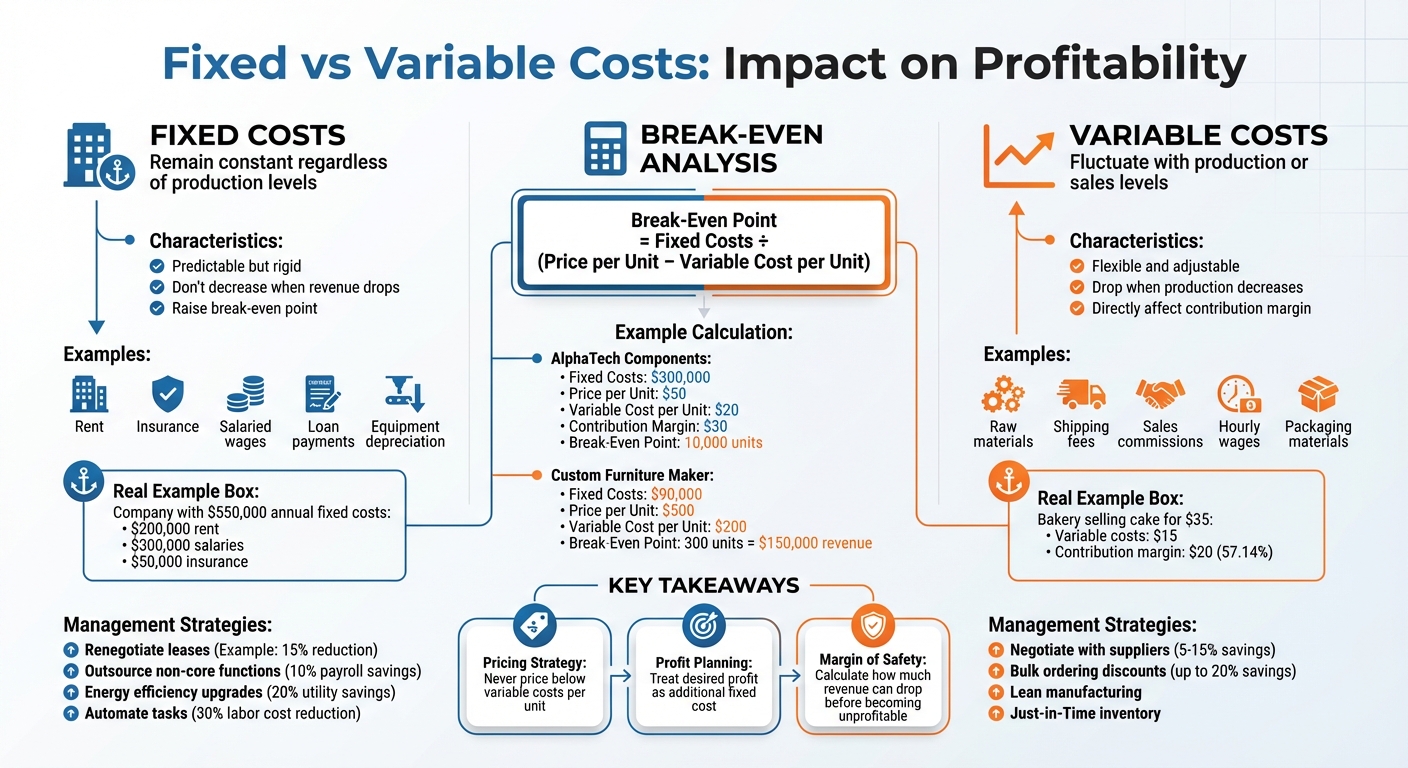
- Fixed Costs: Predictable but rigid; they don’t decrease when revenue drops. Examples include rent, insurance, and salaried wages.
- Variable Costs: Change with production or sales levels. Examples include raw materials, shipping fees, and sales commissions.
- Break-Even Analysis: Helps determine the sales volume needed to cover costs using the formula:
Fixed Costs ÷ (Price per Unit – Variable Cost per Unit). - Cost Management Tips:
- Lower fixed costs by renegotiating leases, outsourcing, or automating tasks.
- Control variable costs by improving efficiency, negotiating with suppliers, and reducing waste.
By mastering these concepts, businesses can protect profit margins, set smarter pricing strategies, and plan for growth effectively.
Fixed vs Variable Costs: Key Differences and Impact on Business Profitability
Fixed Costs and How They Affect Profitability
What Are Fixed Costs?
Fixed costs include expenses like rent, salaried wages, insurance premiums, loan payments, and equipment depreciation. These costs stay the same regardless of how much you produce or sell. While they’re usually predictable, they’re also tough to adjust quickly. For instance, a lease agreement locks you into monthly payments for years, and paying full-time salaries can be a long-term commitment. If you need to make cuts, you may face tough decisions like layoffs or relocating. To manage your budget more effectively, it’s a good idea to convert non-monthly expenses into a monthly average. However, the stability of fixed costs can become a challenge when revenues take a hit.
Problems with High Fixed Costs
Even though fixed costs are predictable, their rigidity can create cash flow problems during slow periods. Here’s the issue: these costs don’t decrease when your revenue does. That means you need to hit a minimum revenue level just to cover them, which raises your break-even point and forces you to sell more just to avoid falling into the red.
"The biggest danger of fixed costs is that they don’t shrink when revenue drops." – Jen Roney
This rigidity can be especially problematic during economic downturns, seasonal slumps, or unexpected slow periods. While variable costs naturally drop when business slows, fixed costs remain constant, quickly draining your cash reserves. Imagine a company with $200,000 in rent, $300,000 in salaries, and $50,000 in insurance – totaling $550,000 in fixed costs annually. These obligations don’t go away, even if revenue suddenly declines, putting the business at risk of burning through cash rapidly.
On the flip side, fixed costs can work in your favor once you pass your break-even point. At that stage, every additional sale only adds variable costs, meaning your profit margins can grow significantly. But this advantage only pays off if you can consistently generate sales above that critical threshold. Managing and keeping a close eye on fixed costs is essential for improving profitability and maintaining financial stability.
sbb-itb-85dd802
Variable Costs and How They Affect Profitability
What Are Variable Costs?
Variable costs are expenses that fluctuate based on production or sales levels. When production increases, these costs rise; when production decreases, they drop. Examples include raw materials (like flour and sugar for a bakery), hourly wages for production workers, sales commissions, shipping fees, packaging materials, and credit card processing fees. This adaptability allows businesses to align their spending with current demand.
These costs are short-term and adjustable, offering businesses the ability to respond quickly to changes in demand. For instance, when sales slow down, less is spent on materials and labor. While this flexibility can reduce risk during economic downturns, it also introduces challenges for profitability. The way variable costs behave influences not only spending but also pricing strategies and profit margins.
Managing Flexibility and Profit Margins
Variable costs have a significant impact on pricing strategies and profit margins. They directly affect the contribution margin, which is the revenue remaining after covering variable costs. For example, if a bakery sells a cake for $35 and incurs $15 in variable costs, the contribution margin is $20, or 57.14%.
"Variable costs are a key factor in determining a product’s contribution margin, the metric used to determine a company’s break-even number or its target profit number." – Investopedia
Selling a product below its variable cost per unit results in a loss on every sale. While variable costs provide flexibility during slower periods, they can also limit growth potential. Businesses with high variable costs gain less from economies of scale because each additional sale still incurs significant expenses. To maintain profitability, managing these costs is crucial. Strategies like negotiating with suppliers, improving operational efficiency, and reducing waste can help businesses control variable costs and protect their profit margins.
How Fixed Costs and Variable Costs Affect Profit in Business (Explained Step by Step)
Break-Even Analysis: Understanding Cost and Profit Relationships
Break-even analysis connects fixed and variable costs by identifying the sales level where revenue equals costs, resulting in neither profit nor loss. This calculation is essential for determining the minimum sales volume or pricing needed to start making a profit.
"The break-even point (BEP) is the exact level of sales – measured either in units sold or total revenue – at which your total revenue equals your total costs." – Financial Models Lab
Knowing your break-even point takes the guesswork out of financial planning. It helps you understand how much you need to sell to cover expenses and how changes in pricing or costs impact profitability. Without this knowledge, businesses run the risk of underpricing their products or expanding prematurely.
How to Calculate Your Break-Even Point
The break-even formula is simple:
Total Fixed Costs ÷ (Price per Unit – Variable Cost per Unit).
This calculation reveals how many units you need to sell to cover all costs.
For instance, AlphaTech Components, with fixed costs of $300,000, a unit price of $50, and variable costs of $20 per unit (giving a contribution margin of $30), must sell 10,000 units to break even. Another example is a US-based custom furniture maker specializing in high-end office chairs. With fixed costs of $90,000, a unit price of $500, and variable costs of $200 per chair, their break-even point is 300 units, equating to a minimum annual revenue of $150,000.
For businesses offering multiple products or services, you can calculate the break-even point in sales dollars by dividing total fixed costs by the contribution margin ratio.
Using Break-Even Analysis for Pricing and Planning
Break-even analysis helps establish a minimum price per unit since pricing below variable costs guarantees a loss. It also aids in profit planning and forecasting by treating the desired profit as an additional fixed cost to calculate the required sales volume.
Another valuable tool is calculating the margin of safety, which shows how much revenue can decrease before the business becomes unprofitable. Running "what-if" scenarios – like a 10% increase in material costs or a competitor’s price cut – can prepare you for market fluctuations. Regularly revisiting and updating your break-even calculations is also crucial to account for inflation or supply chain changes.
These calculations provide a foundation for smarter cost management strategies, which will be explored further.
How to Reduce Fixed Costs
Lowering fixed costs can make a big difference in your bottom line, especially during slower periods. By identifying areas where expenses can be trimmed or adjusted, you can maintain efficiency without disrupting daily operations.
Cutting Overhead Expenses
Start by renegotiating lease agreements. For example, ABC Manufacturing managed to lower its rent by 15% in 2025. Similarly, Telecom Titan Inc. cut fixed overhead by 20% by consolidating office spaces and renegotiating long-term leases.
Energy efficiency is another area where savings are often overlooked. Simple upgrades like installing LED lighting, programmable thermostats, and motion sensors can cut utility bills by up to 20%. ABC Manufacturing also switched to energy-efficient equipment, further reducing its utility costs.
Outsourcing is another effective strategy. By outsourcing non-core functions such as HR and payroll, you can turn fixed labor costs into variable ones. For instance, ABC Manufacturing trimmed its fixed payroll costs by 10% through outsourcing. Meanwhile, FinTech Innovations reduced fixed labor costs by 30% by automating processes with AI-driven analytics.
Other practical steps include:
- Auditing subscriptions and software licenses to eliminate unused tools.
- Adopting remote or hybrid work models to reduce office space needs.
- Refinancing high-interest debt to lower monthly interest payments.
- Using zero-based budgeting, which requires justifying every expense each period, to identify and cut unnecessary costs.
For more advanced cost management, consider the benefits of fractional CFO services, which can help pinpoint and restructure persistent expenses.
Working with Fractional CFO Services
Sometimes, businesses struggle to spot creeping fixed costs. That’s where fractional CFO services come in. These services offer high-level financial expertise without the hefty price tag of a full-time CFO, which can exceed $150,000 annually. A fractional CFO can identify expense creep, adjust pricing strategies, and implement data-driven solutions to free up capital.
Take Luis, a home service business owner, and Julia, a serial entrepreneur, as examples. With fractional CFO guidance, Luis grew his revenue by 89% and sold his business for $5,850,000. Julia, on the other hand, added $600,000 to her annual free cash flow.
"A fractional CFO delivers strategic insights at a fraction of the cost of a traditional hire." – Adam L. Turco, CPA, Oregon
TC Advisors offers tailored financial modeling and analysis to help businesses prioritize which fixed costs to cut, forecast the impact of these changes, and create sustainable growth strategies. This forward-thinking approach turns cost management into a strategic tool, paving the way for better control over variable costs and stronger profitability overall.
How to Control Variable Costs
Variable costs, unlike fixed costs, shift with production and sales levels. Keeping these expenses in check is key to maintaining healthy profit margins. Here’s how you can better manage them:
Improving How You Operate
Streamlining operations is a powerful way to control variable costs. Start by reducing waste through lean manufacturing techniques and Just-in-Time inventory systems. These methods help minimize excess stock and cut down on storage costs. Pairing these approaches with IoT sensors can give you real-time insights into production inefficiencies, allowing for quicker adjustments.
Automation is another game-changer. Robotic Process Automation (RPA) can handle repetitive office tasks, while automated machinery can lower labor costs per unit and reduce mistakes. Additionally, cross-training your workforce provides flexibility, letting you adjust labor hours to match production needs without sacrificing expertise.
Implementing Standard Operating Procedures (SOPs), the 5S methodology, and regularly tracking Cost of Goods Sold (COGS) can further streamline your processes. These steps ensure you can quickly spot and address any cost spikes. Beyond internal improvements, focusing on supplier relationships can also drive savings. Engaging fractional CFO services can provide the strategic oversight needed to manage these complex vendor dynamics.
Negotiating Better Supplier Terms
Suppliers often represent a large portion of variable costs, making effective negotiation a critical strategy. Regularly request competitive quotes from three to five suppliers every six to twelve months to ensure you’re paying fair market rates. Bulk orders or long-term contracts can cut costs by 5% to 15%, while working with suppliers on material innovations or packaging redesigns could lead to savings of up to 20%.
Payment terms are another area to explore. For instance, negotiating to pay 30 days after shipment can improve cash flow, which might be more beneficial than a small discount on unit prices. You can also negotiate for lower Minimum Order Quantities (MOQs) for trial runs, shorter lead times during busy periods, or logistics terms like FOB (Free On Board) to reduce shipping costs.
"The true goal of learning how to negotiate with suppliers is not to squeeze every last penny out of a single transaction, but to build a strong, sustainable, and mutually beneficial partnership that yields compounding value for years to come."
– Aaron Li, Expert in Quality Sourcing
Sharing monthly inventory forecasts with suppliers is another effective tactic. This transparency helps them plan their production more efficiently, giving you leverage to negotiate better pricing or terms. Framing negotiations as a win-win opportunity strengthens supplier relationships for the long haul.
Working with TC Advisors to Improve Profitability
TC Advisors doesn’t just focus on cutting costs – they aim to help businesses make smarter financial decisions that lead to long-term growth. By combining cost management strategies with proactive financial planning, they deliver year-round support that goes far beyond traditional accounting.
Custom Financial Models and Analysis
TC Advisors creates tailored financial models to help businesses understand how their costs impact profitability. Tools like Cost-Volume-Profit (CVP) analysis and break-even calculations give clear insights into financial performance and set realistic sales goals. Their fractional CFO services also break down fixed costs – such as rent and insurance – and variable costs like materials and commissions, enabling businesses to create solid budgets that minimize uncertainty.
In one example from 2025, TC Advisors helped a tech entrepreneur in Fairmount by integrating AI-driven forecasting with QuickBooks. The result? A 25% reduction in tax liabilities and a clear financial roadmap. Similarly, a retailer in Southeast Hackensack benefited from a SWOT analysis that uncovered inefficiencies. By leveraging state-specific tax exemptions, the retailer increased profitability by 15%.
The firm also offers real-time KPI dashboards through platforms like Xero and QuickBooks, giving businesses instant visibility into their financial health. For instance, when partners Nick Termine and Stephen Calvo facilitated a $3M acquisition for a manufacturing startup, they applied private equity-level diligence and structured the deal to reduce transaction-related liabilities by 22%. These tools and strategies drive ongoing improvements through consistent oversight.
Year-Round Financial Support
To ensure businesses maintain profitability, TC Advisors provides continuous financial guidance. Instead of simply reviewing past performance, they focus on forward-looking strategies. Dedicated relationship managers work closely with clients, offering quarterly planning sessions, monthly financial reports, and real-time monitoring. This hands-on approach allows businesses to adapt their cost structures as they grow and evolve.
"Any accounting firm can help you record history. We’ll help you build a future!"
One e-commerce startup took advantage of TC Advisors’ quarterly review services to stay on top of financial performance and tax obligations. This proactive approach helped the business reduce its effective tax rate by 18%.
TC Advisors also ensures transparency by agreeing on costs upfront, so clients know exactly what to expect. Whether it’s negotiating supplier contracts, refining entity structures, or implementing lean production techniques, the firm offers expertise tailored to the unique needs of each business and its growth stage.
Conclusion
Fixed costs – like rent, salaries, and insurance – stay the same regardless of output, while variable costs – such as raw materials, shipping, and commissions – change with production levels. Understanding these two cost categories is crucial for making smart financial decisions. It helps you navigate pricing, production planning, and overall cost management with confidence.
Break-even analysis is another essential tool. By using the formula Q = FC / (P – VC), you can determine the revenue needed to cover all expenses. This calculation allows you to test different scenarios, fine-tune pricing strategies, and set achievable sales targets as market conditions shift. It’s a straightforward way to guide decisions that support steady profit growth.
Effective cost management goes beyond understanding numbers – it calls for both immediate actions and long-term strategies. For fixed costs, this might mean renegotiating leases or automating repetitive tasks. On the variable side, you could focus on securing bulk discounts or implementing lean production techniques like Just-in-Time inventory. Every cost-saving measure strengthens profitability and boosts your competitive position.
To support these efforts, TC Advisors offers customized financial tools, like real-time KPI dashboards and detailed financial models, along with ongoing guidance. Whether you’re conducting cost-volume-profit analysis, eliminating inefficiencies in software use, or applying Zero-Based Budgeting to justify every expense, their fractional CFO services provide the expertise you need to optimize costs and maintain profitability over the long haul.
FAQs
How do I tell if a cost is fixed or variable?
To figure out whether a cost is fixed or variable, think about how it behaves as your business activity changes. Fixed costs remain constant no matter how much you produce or sell – examples include rent and salaries. On the other hand, variable costs change depending on your output, like the cost of raw materials or payments for hourly workers. Taking the time to review these costs regularly can give you better insight into your expenses and help you manage them more effectively.
What changes my break-even point the most?
Fixed costs play a major role in determining your break-even point because they represent the expenses that must be covered regardless of how much you sell. These costs remain constant and directly influence the total amount of revenue needed to start making a profit. In contrast, variable costs change with sales volume, making their impact on the break-even point less significant.
How can a fractional CFO help lower my costs?
A fractional CFO can help trim costs by taking a close look at both fixed and variable expenses. They pinpoint areas where you can save and streamline processes to run more efficiently. Beyond just cutting costs, they offer strategic financial advice, helping you refine your cost structures and manage cash flow more effectively. By guiding your financial planning and resource allocation, a fractional CFO ensures your business operates more economically, boosting overall profitability.


