

Form 1120-REIT is the tax return required for Real Estate Investment Trusts (REITs) in the U.S. Filing this form ensures compliance with IRS rules and helps maintain REIT status, which comes with significant tax benefits. Key points to know:
- Who Must File: All REITs, even those with no income or activity.
- Filing Deadlines: April 15 for calendar-year REITs; September 15 for fiscal-year REITs ending June 30.
- Key Compliance Tests: Ownership limits, income sources (75% real estate-related), and asset composition.
- Dividends Requirement: REITs must distribute at least 90% of taxable income to shareholders.
- Filing Method: Most REITs must e-file using authorized platforms.
Missing deadlines or filing incorrectly can lead to penalties or loss of REIT status. This guide outlines eligibility checks, required documents, form completion, and submission tips to help you file accurately and on time.
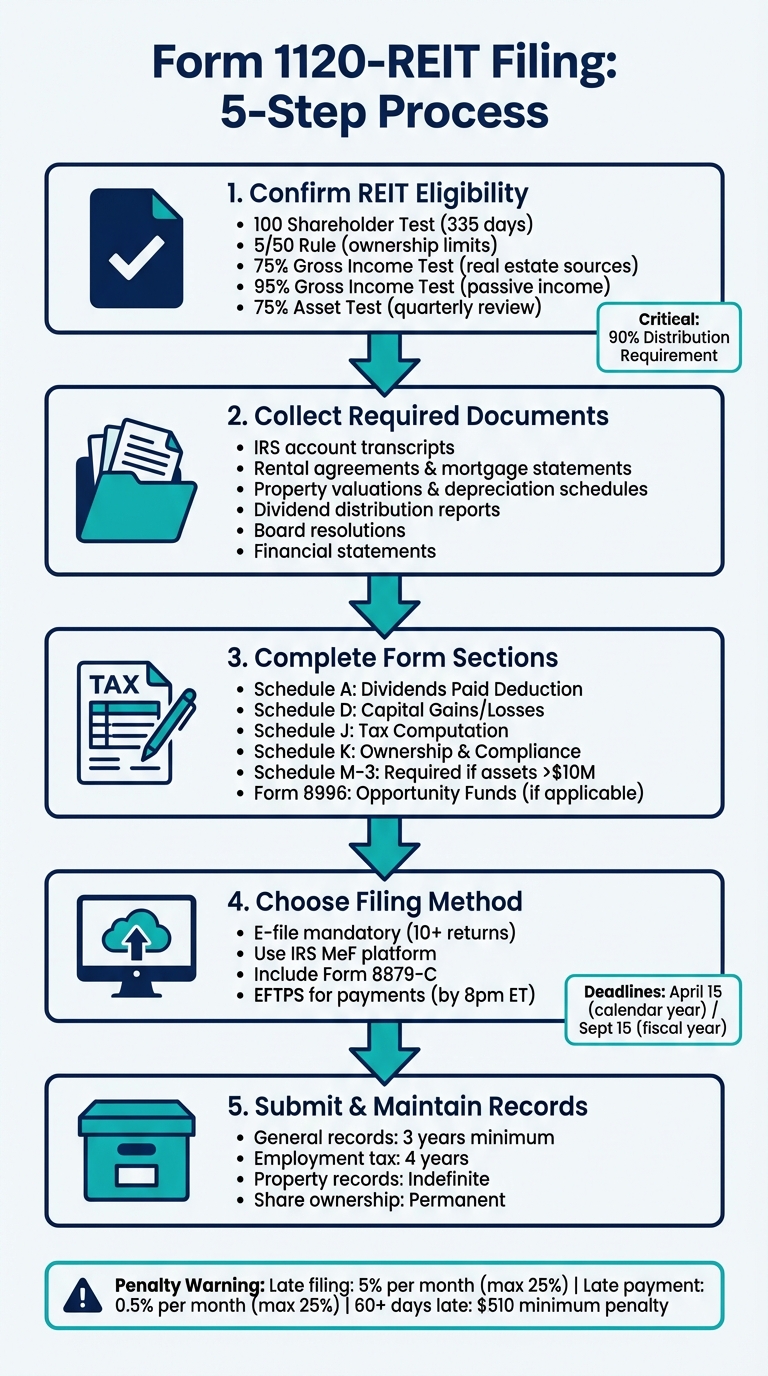
Form 1120-REIT Filing Process: 5-Step Compliance Guide
Step 1: Confirm REIT Eligibility and Election Status
Getting your REIT (Real Estate Investment Trust) status right is the first step to filing Form 1120-REIT successfully. It’s critical to ensure your entity qualifies as a REIT and has formally elected this status. Missing even one requirement could disqualify your REIT status and result in corporate taxation instead.
Check Structure and Ownership Requirements
To qualify, your entity must meet certain structural criteria. First, it needs to be a U.S.-based entity, formed in one of the 50 states or the District of Columbia, and taxable as a corporation. This includes corporations, trusts, associations, limited partnerships, or LLCs that elect corporate taxation. Your entity must also be managed by one or more directors or trustees, and its shares must be fully transferable.
After your first taxable year, two important ownership tests come into play:
- 100 Shareholder Test: Your REIT must have at least 100 shareholders who are individuals, and they must hold ownership for at least 335 days within a 12-month period.
- 5/50 Rule: No more than 50% of your REIT’s stock can be owned by five or fewer individuals. Attribution rules apply here, meaning family and business entity ownership is included in the calculation for this rule but not for the 100 Shareholder Test.
"The ‘100 Shareholder Test’ is aimed at maintaining a broad and diverse REIT ownership base." – CIEL
To ensure compliance, send shareholder letters within 30 days after the year ends to confirm beneficial ownership.
Verify Income and Asset Test Requirements
Once you’ve confirmed your structure and ownership meet the requirements, you’ll need to evaluate your REIT’s income and asset composition.
Your REIT must pass two annual income tests and one quarterly asset test:
- 75% Gross Income Test: At least 75% of your annual gross income must come from real estate-related sources. This includes rents from real property, interest on mortgages, gains from selling real property (excluding dealer property), and dividends from other REITs.
- 95% Gross Income Test: At least 95% of annual gross income must come from the above real estate sources, plus passive income like bank interest, non-REIT dividends, and gains from selling stocks or securities.
For the asset test, review your REIT’s holdings quarterly. At least 75% of total assets must consist of real estate-related items (like real property, mortgage interests, or REIT shares), cash, or government securities. Additionally, no more than 25% of assets can be in non-qualifying securities, and ownership in any single non-REIT issuer’s securities must not exceed 5% of the total value or 10% of voting power.
Starting January 1, 2026, the asset limit for Taxable REIT Subsidiaries (TRS) increases from 20% to 25%. TRSs are useful tools for conducting non-qualifying activities – like running a hotel or offering non-customary services – without risking your REIT’s compliance with income tests.
If you happen to fail one of these tests, you can still avoid losing your REIT status by attaching a schedule to your tax return that lists each item of gross income. This could make you eligible for "reasonable cause" relief, allowing you to pay a penalty tax instead of forfeiting your REIT status.
sbb-itb-85dd802
Step 2: Collect Required Documents and Financial Records
Before diving into Form 1120-REIT, make sure you’ve gathered all the necessary documents and financial records. This step is crucial to avoid errors and delays when filing. The IRS expects detailed records to confirm your REIT’s income, assets, and distributions.
Start by requesting IRS account transcripts. These will help you confirm prior payments, penalties, and any capital gains taxes you’ve already reported. Double-check that your legal name, address, and Employer Identification Number (EIN) match previous filings exactly – this simple check can save you from unnecessary processing delays. Once that’s done, focus on collecting income, asset, and dividend records to back up the information you’ll include in your return.
Income and Asset Records
When it comes to income records, start with real estate-related revenues. This includes rental agreements, mortgage interest statements, and portfolio interest records. If you sold any properties or securities during the year, make sure you have documentation showing the cost basis, sale price, and holding periods – these details are essential for Schedule D.
For asset records, maintain a current list of all real estate investments, improvements, and equipment. Include property valuations, acquisition dates, and detailed depreciation schedules. If foreclosure income applies, keep those records separate since it’s taxed at corporate rates. Similarly, track prohibited transactions carefully, as they could trigger a 100% tax. Lastly, prepare financial statements that outline your gross income, business income, and deductions.
Dividend and Distribution Records
Next, gather reports on all dividends declared and paid during the tax year. These reports are key for claiming the dividends-paid deduction on Schedule A. Be sure to keep board resolutions authorizing each distribution, as they provide legal support for your practices.
Organize your records to clearly separate ordinary dividends from capital gain distributions. This distinction is critical for accurate reporting on Schedule D and Schedule A. Cross-check your distribution totals against internal statements and bank confirmations to ensure everything matches. Remember, to maintain REIT status, you’re required to distribute at least 90% of your taxable income (excluding net capital gains). Lastly, hold onto all dividend-related records, schedules, and supporting documents for at least three years after the return’s due date.
Step 3: Fill Out Form Sections and Schedules
Once your documents are ready, it’s time to carefully complete Form 1120-REIT. Accuracy is critical here to avoid delays or jeopardizing your REIT status. The form is divided into sections that address different aspects of your REIT’s financial activities and compliance requirements.
Complete Basic Information and Income Sections
Start with the header section of the form. Enter your REIT’s legal name, mailing address, and Employer Identification Number (EIN) exactly as previously filed. Specify whether you’re filing for a calendar year or a fiscal year. If this is your first, final, or amended return, make sure to check the appropriate box. You’ll also need to include the name and title of the authorized officer signing the return.
In the income section, report all relevant earnings. This includes rental income (adjusted for any incentives), mortgage and portfolio interest, and dividends received from corporations or other REITs. If your REIT sold properties or securities during the year, you’ll need to complete Schedule D and, if necessary, Form 8949 to document capital gains. Be sure to include details like the cost basis, sale price, and holding periods. Additionally, report foreclosure property income separately, as it’s taxed at the standard corporate rate rather than the lower REIT rates.
Don’t forget to list the dividends-paid deduction on Schedule A to avoid double taxation. Remember, REITs are required to distribute at least 90% of their taxable income as dividends to maintain their status. Also, provide a detailed breakdown of operating expenses, such as employee compensation, property taxes, business licenses, loan interest, and repair costs. Include depreciation for buildings and improvements based on the latest IRS guidelines.
If your REIT was inactive during the year, you still need to file the form, reporting ‘0’ in the income and deduction sections.
Once the income and deductions are finalized, move on to ownership details and additional schedules.
Complete Schedule K and Additional Schedules
Schedule K focuses on other important information, such as ownership details, foreign operations, and compliance-related questions. Use this section to report any changes in shareholder diversification or ownership limits. The IRS uses this information to verify compliance with rules like the 100-shareholder minimum and other ownership-related requirements.
Schedule J is where you calculate your tax liability, considering any credits and excise taxes. This section also includes qualification tests that are critical for maintaining REIT status. Failing these tests could result in your REIT being taxed as a standard corporation.
Depending on your REIT’s specific activities, you may need to attach additional schedules. For example:
- If your total assets exceed $10 million at the end of the tax year, you must include Schedule M-3 for book-to-tax reconciliation.
- If your REIT has investments in Qualified Opportunity Funds, attach Form 8996.
- Cross-check Schedule L (Balance Sheets per Books) with your trial balance to ensure consistency. Reconcile all declared and paid dividends with Schedule A and the 1099-DIV forms issued to shareholders, as discrepancies could draw IRS attention.
Here’s a quick reference for the schedules:
| Schedule | Purpose | Requirement |
|---|---|---|
| Schedule A | Dividends Paid Deduction | Reconcile with shareholder distribution records |
| Schedule D | Capital Gains and Losses | Report property/security sales with cost basis and holding periods |
| Schedule J | Tax Computation | Includes REIT qualification tests; noncompliance risks REIT status loss |
| Schedule K | Other Information | Reports on ownership, foreign operations, and compliance |
| Schedule M-3 | Book-to-Tax Reconciliation | Mandatory if total assets are $10 million or more |
| Form 8996 | Qualified Opportunity Funds | Required for REITs investing in Qualified Opportunity Funds |
Accurate completion of these schedules is essential for maintaining compliance and avoiding penalties. Double-check all figures and ensure alignment across all relevant sections and forms.
Step 4: Choose Filing Method and Meet Submission Requirements
Once your Form 1120-REIT is complete, the next step is submitting it correctly and ensuring all payments are made on time. Proper submission is just as important as accurate preparation, as it ensures your REIT maintains compliance and avoids unnecessary penalties.
Electronic Filing and Payment Options
As of 2024, most REITs are required to file Form 1120-REIT electronically. Treasury Decision T.D. 9972 lowered the e-filing threshold from 250 to just 10 returns. If your REIT falls under this mandate, you’ll need to use the IRS Modernized e-File (MeF) platform through an authorized e-file provider or approved software. Make sure your chosen provider is authorized to handle Form 1120-REIT. Additionally, electronic returns must include Form 8879-C (IRS e-file Signature Authorization for Corporations).
For the 2025 tax year, the IRS has announced temporary relief, waiving penalties for not e-filing as the capability won’t be fully available until March 2026. If your REIT files fewer than 10 aggregated returns and this relief applies, you may submit a paper return to the appropriate IRS center, based on your location and asset size.
All federal tax deposits and estimated payments must be made through the Electronic Federal Tax Payment System (EFTPS). To use EFTPS, enroll at www.eftps.gov well before your payment due date. Payments must be initiated by 8:00 p.m. Eastern Time the day before the deadline. For same-day payments, wire transfers via the Federal Tax Collection Service (FTCS) are available if initiated by 2:00 p.m. Eastern Time on the due date.
Filing Timeline and Deadlines
After completing your return and selecting your submission method, stick to the IRS deadlines. Calendar-year REITs must file by April 15, while fiscal-year REITs with a June 30 year-end must file by September 15.
If you need additional time to file, submit Form 7004 by the original due date to request an automatic six-month extension. Keep in mind, though, that this extension only applies to filing – not payment. Any taxes owed must still be paid by the original deadline to avoid interest charges.
REITs that expect to owe $500 or more should make quarterly estimated tax payments on April 15, June 15, September 15, and December 15. Each payment should cover at least 90% of the current year’s tax or 100% of the prior year’s liability to avoid penalties.
Penalties for late filing and payment include:
- Returns filed more than 60 days late: a minimum penalty of $510 or the taxes due, whichever is smaller.
- Late filing: 5% of unpaid tax per month, up to a maximum of 25%.
- Late payment: 0.5% of unpaid tax per month, also capped at 25%.
For personalized help with preparing and submitting Form 1120-REIT, you can consult TC Advisors (https://tcadvisorscpa.com) for expert guidance tailored to your specific needs.
Step 5: Submit Form and Maintain Records
Double-check every detail before submitting your return. Make sure it’s signed and dated by an authorized corporate officer or a court-authorized fiduciary, with the necessary documentation included to avoid penalties. An unsigned return is invalid and could lead to fines.
If professional tax preparation services are involved, ensure they sign the return, include their PTIN, and check the authorization box allowing the IRS to address any issues directly with them.
After verifying signatures, use this pre-submission checklist to catch potential errors before filing.
Pre-Submission Checklist
- Confirm that the legal name, EIN, and tax year dates are consistent with prior filings to avoid delays.
- Attach all required schedules and forms in the proper IRS sequence: Schedule N, Schedule D, Form 8949, Form 8996, followed by other forms in numerical order.
- Complete all fields accurately – don’t leave blanks or use "See attached" as a placeholder.
- For paper submissions, use registered mail or a private delivery service to ensure proof of timely filing.
Once the return is submitted, focus on maintaining organized and accessible records.
Record Retention Guidelines
Proper record-keeping is key to showing compliance with REIT qualification tests. The IRS requires you to keep records supporting income, deductions, or credits for three years from the later of the return’s due date or filing date. Employment tax records must be kept for at least four years after the due date or payment. Keep property records indefinitely if they’re needed to calculate the basis of original or replacement property. Additionally, REITs must maintain permanent records of actual share ownership to meet the requirements of Regulations section 1.857-8.
"Keep the REIT’s records as long as they may be needed for the administration of any provision of the Internal Revenue Code." – IRS Instructions for Form 1120-REIT
Create a compliance folder that includes the filed return, attached schedules (especially Schedules A, J, K, L, and M-1/M-3), board resolutions authorizing dividends, and EFTPS confirmations. Periodically request IRS account transcripts to verify that payments and credits are correctly applied to your REIT’s account. Even if your REIT is dormant and has no activity, you must continue filing and maintaining records to document compliance with REIT qualification standards.
Conclusion
This guide has walked you through the key steps – verifying eligibility, gathering records, completing schedules, and submitting on time – to help ensure your REIT remains in compliance.
Filing Form 1120-REIT accurately and on time is crucial for preserving your REIT’s tax-advantaged status. This form acts as your official report to the IRS, confirming that you meet the strict qualification requirements, such as the 90% distribution rule, asset composition tests, and ownership standards. Even if your REIT is inactive, filing is mandatory to prevent automatic termination of its status.
The financial consequences of missing deadlines can be steep. Late returns trigger penalties, including a minimum charge for excessively delayed filings. Specifically, late filing penalties accrue at 5% of unpaid taxes per month, up to 25%, while late payment penalties add 0.5% per month. Beyond financial repercussions, losing REIT status means you can’t re-elect for four years – a major setback for any real estate investment trust. These strict rules highlight the importance of accuracy and timeliness.
Keep in mind, Form 7004 only provides an extension for filing, not for tax payments, which must still be made by the original deadline. To stay updated, regularly check the IRS website at irs.gov/form1120reit, as forms and penalty amounts are subject to change.
If you encounter difficulties, seeking professional assistance is a smart move. Tax professionals can help ensure compliance with income tests, address IRS notices, and negotiate penalty abatements when necessary. They can even represent you directly with the IRS through power of attorney. For independent help, you can also contact the Taxpayer Advocate Service at 877‑777‑4778.
FAQs
What happens if my REIT fails an income or asset test?
If a REIT doesn’t meet an income test, it can address the problem by reporting it, providing a valid reason, and proving the failure wasn’t intentional. However, this might result in extra taxes. For asset test failures, the REIT usually gets 30 days after the quarter ends to resolve the issue. This can involve actions like selling the problematic asset or boosting its gross assets, and it’s often resolved without penalties.
Which schedules are most commonly required with Form 1120-REIT?
The most frequently required schedules accompanying Form 1120-REIT are Schedule D, used to report capital gains, and Schedule I, which covers additional income or deductions. However, the exact schedules a REIT must file will vary based on its specific financial and operational details.
How do I know if my REIT must e-file Form 1120-REIT?
Starting in mid-February 2026, the IRS will allow and encourage electronic filing of Form 1120-REIT. If your REIT qualifies and chooses to file electronically, this option becomes available and is either required or strongly recommended for filings from 2026 onward.
Make sure to check the IRS instructions for detailed filing requirements and guidance.


