

Discounting might seem like an easy way to boost sales, but it comes with serious risks that can harm your business in the long run. While lower prices can attract customers and clear inventory, they can also erode profit margins, damage brand perception, and create operational challenges. Here’s a quick breakdown of the key issues:
- Profit Margin Impact: Even small discounts require a significant increase in sales to maintain the same profit. For example, a 20% discount on a product with a 50% margin means you need to sell 67% more units to break even.
- Customer Behavior: Frequent discounts train customers to wait for sales, reducing their willingness to pay full price and turning them into deal-seekers instead of loyal buyers.
- Brand Devaluation: Overuse of discounts can shift your brand’s image from premium to cheap, making it harder to justify regular prices.
- Operational Strain: Unpredictable demand during sales periods creates inventory and cash flow challenges, while added costs like overtime and expedited shipping eat into profits.
Instead of relying on discounts, businesses can focus on strategies like bundling, loyalty programs, or offering value-adds like free shipping. These approaches maintain pricing integrity while building long-term customer relationships. If discounts are necessary, they should be tied to specific goals, like clearing old inventory or acquiring new customers, and managed with strict guidelines to protect margins.
Bottom Line: Discounts are a tool, not a strategy. Use them sparingly and intentionally to avoid long-term damage to your profitability and brand.
The Hidden Cost of Discounting in Business
sbb-itb-85dd802
Hidden Costs of Discounting Strategies
Discounting might seem like a quick way to boost sales, but the hidden costs can quietly erode profitability and damage your brand’s reputation. These effects are far-reaching, impacting everything from your margins to customer behavior, and they tend to snowball over time, making them difficult to undo. Let’s break down how these hidden costs can undermine your business.
Profit Margin Erosion and Sales Volume Requirements
Even small price cuts can demand massive increases in sales just to maintain the same profit. Here’s an example: if you sell a product for $100 with a 20% profit margin (meaning $20 profit per sale), a 20% discount drops the price to $80. With costs still at $80, your profit vanishes entirely. To make up for this, you’d need a significant jump in sales volume just to earn back the original $20 profit.
This issue became apparent with Kohl’s in Q3 2025. The retailer saw a slight improvement in gross margin year-over-year, but its operating income took a hit. Why? Softer sales combined with the high costs of promotional campaigns to clear inventory under pressure. While the discounts helped move products off shelves, the required sales increase wasn’t enough to offset the squeezed margins.
"Discounts move inventory – but they rarely move customer lifetime value in the same direction."
– Elery Pfeffer, CEO, Nift
Brand Devaluation and Customer Expectations
When discounts become the norm, they reshape how customers perceive your brand and pricing. If shoppers see sale prices frequently, those discounts become their new baseline. Suddenly, your regular price seems inflated, and customers start waiting for sales instead of buying at full price.
Take Lululemon, for example. Between 2024 and 2025, the company faced slowing demand in the U.S. and rising competition from brands like Vuori and Athleta. To keep foot traffic up and manage inventory, they leaned heavily on promotions. While this brought in deal-seekers, it alienated the loyal customers who had supported Lululemon’s premium pricing. Instead of buying because the brand mattered, customers shifted to buying based on price alone.
This shift doesn’t just affect individual purchases – it changes customer behavior long-term. Those drawn in by discounts develop "deal loyalty" instead of brand loyalty. They stick around for the sale price, not the brand itself, and they’ll leave as soon as a competitor offers a better deal.
But the damage doesn’t stop there. Discounting also disrupts your operations and financial stability.
Operational Strain and Cash Flow Challenges
Frequent discounting creates unpredictable demand patterns, which can wreak havoc on your operations. When customers hold off on purchases until a sale, your revenue becomes erratic – spiking during promotions and dropping off in between. This inconsistency makes it nearly impossible to plan inventory effectively and can lead to cash flow issues that affect your entire business.
Target faced this dilemma when it had to address excess inventory in its home and apparel categories. The company took aggressive markdowns to rebalance stock levels, which worked in the short term. However, the heavy discounts weighed down profitability, leaving less cash flow to cover fixed costs like rent and wages.
"The risk isn’t that retailers will discount, it’s that discounting becomes the strategy rather than the symptom."
– Elery Pfeffer, CEO, Nift
Operationally, discount-driven sales surges can overwhelm production and fulfillment teams. Meeting sudden spikes in demand often requires overtime pay or expedited shipping, both of which eat into already-thin margins. At the same time, the reduced prices shrink your operating leverage – the buffer you rely on to cover fixed expenses. This creates a vicious cycle where deeper discounts are needed to maintain sales, pushing your pricing to unsustainable levels.
When Discounting Makes Sense
Discounting can be a tricky tool – it’s not without its costs, but when used thoughtfully, it can help tackle specific challenges while keeping your business on track. The secret? Be intentional. Know exactly what you’re aiming for and keep discounts controlled, so they don’t turn into a habit.
Targeted Promotions for Specific Goals
Discounts are most effective when tied to clear, measurable objectives. For example, they can help move inventory that’s been sitting for over 120 days, freeing up cash flow and storage space.
Another smart use of discounts is attracting new customers. Offers like sign-up bonuses or early-bird deals can bring first-timers through the door, giving you a shot to showcase your product or service’s value. But here’s the catch: it’s not just about getting them in once – you need to track whether these customers stick around. Are they coming back to buy at full price, or are they only deal-hunters? A cohort analysis can help you compare the lifetime value of these discount-driven customers against those who pay full price.
Before launching a customer acquisition discount, set clear financial boundaries. Define your maximum customer acquisition cost (CAC) and minimum acceptable margin. If the promotion doesn’t hit these targets, be ready to pull the plug.
You can also explore alternative discount strategies to bring in traffic without setting long-term price expectations.
Loss Leaders and Limited-Time Offers
Loss leaders and limited-time offers are two strategies that can generate buzz and drive immediate action, all while keeping your pricing integrity intact. Loss leaders work by encouraging customers to spend more overall. For instance, a deal like “Spend $100, get 20% off” ensures that the discount is tied to a higher total purchase, helping boost margins.
On the other hand, limited-time offers create urgency. Flash sales lasting 24–48 hours are a great example – they push customers to act quickly, without setting the expectation of ongoing discounts. The short window signals that the deal is a one-off, not the new normal. To avoid misuse, limit the number of items per customer to prevent stockpiling.
Real-time monitoring is critical during these types of promotions. Keep an eye on sell-through rates daily, and adjust inventory limits as necessary to maintain control.
Alternatives to Discounting
Shifting the focus from price to value can improve customer satisfaction, build loyalty, and protect your profit margins through strategic financial oversight.
Increasing Perceived Value
Creating bundles of complementary products is a great way to boost perceived value without reducing prices. For example, offering a "Self-Care Set" that includes a candle, bath salts, and tea for $45 instead of the usual $60 makes the purchase feel like a deal while maintaining your margins. Similarly, value-adds such as free shipping, extended return policies, or expert consultations can appeal to customers without the financial hit of traditional discounts. Did you know that 90% of online shoppers say free shipping is their top incentive, and it often increases order values by about 30%?
Another smart approach is ecosystem lock-in. Instead of a 20% discount, offer $20 in store credit. This keeps your product’s price intact while encouraging repeat purchases. Customers often spend more than the credit amount when they return, making it a win-win.
"Strategic discounting is a powerful lever for growth; panic discounting is a slow-motion liquidation of brand value" – Nebulab
Rather than cutting prices, consider strategies that deepen customer relationships and create lasting loyalty.
Building Loyalty Without Price Cuts
Loyalty isn’t just about offering the lowest price – it’s about making customers feel valued. Tiered loyalty programs are a great way to reward engagement beyond spending. For instance, you could offer points for writing reviews, referring friends, or sharing your brand on social media. This builds a sense of community and keeps customers engaged without training them to wait for discounts.
Post-purchase engagement also plays a key role in loyalty. Sending guides, tutorials, or tips that help customers get the most out of their purchases can turn a simple transaction into a meaningful experience. Even small touches like curated "unboxing" experiences or seasonal challenges can create emotional connections with your brand.
"Loyalty isn’t a transaction with a strike price; it’s a series of experiences that make a customer feel recognized, appreciated, and connected" – Elery Pfeffer, CEO of Nift
Another way to foster loyalty is through cause-related programs. For instance, donating 10% of an order total to a charitable cause resonates with customers’ values. Research shows that 86% of consumers prefer buying from purpose-driven companies, and 71% of millennials are willing to pay extra if it supports a cause they care about.
Using Targeted Pricing Strategies
Alongside value-based and loyalty-focused approaches, targeted pricing strategies can help you connect with specific customer groups. Offering segment-specific deals – like unique discount codes for lapsed customers or discounts on orders over a certain amount – can address price sensitivity without slashing margins.
Automatic discounts at checkout are another effective tactic. They simplify the buying process, especially on mobile, and reduce friction.
"Our conversion rates are much higher when we apply automatic discounts versus when we send customers discount codes. It’s a hassle-free checkout for the customer and results in better sales for us" – Chuck Mazzone, Digital Marketing Director at Out of Print
One personal care brand even used a personalized "shop quiz" to recommend products and offer targeted discounts. This strategy ended up driving over 25% of their revenue. The takeaway? Precision and personalization often outperform blanket discounts.
How to Set Discounting Guidelines
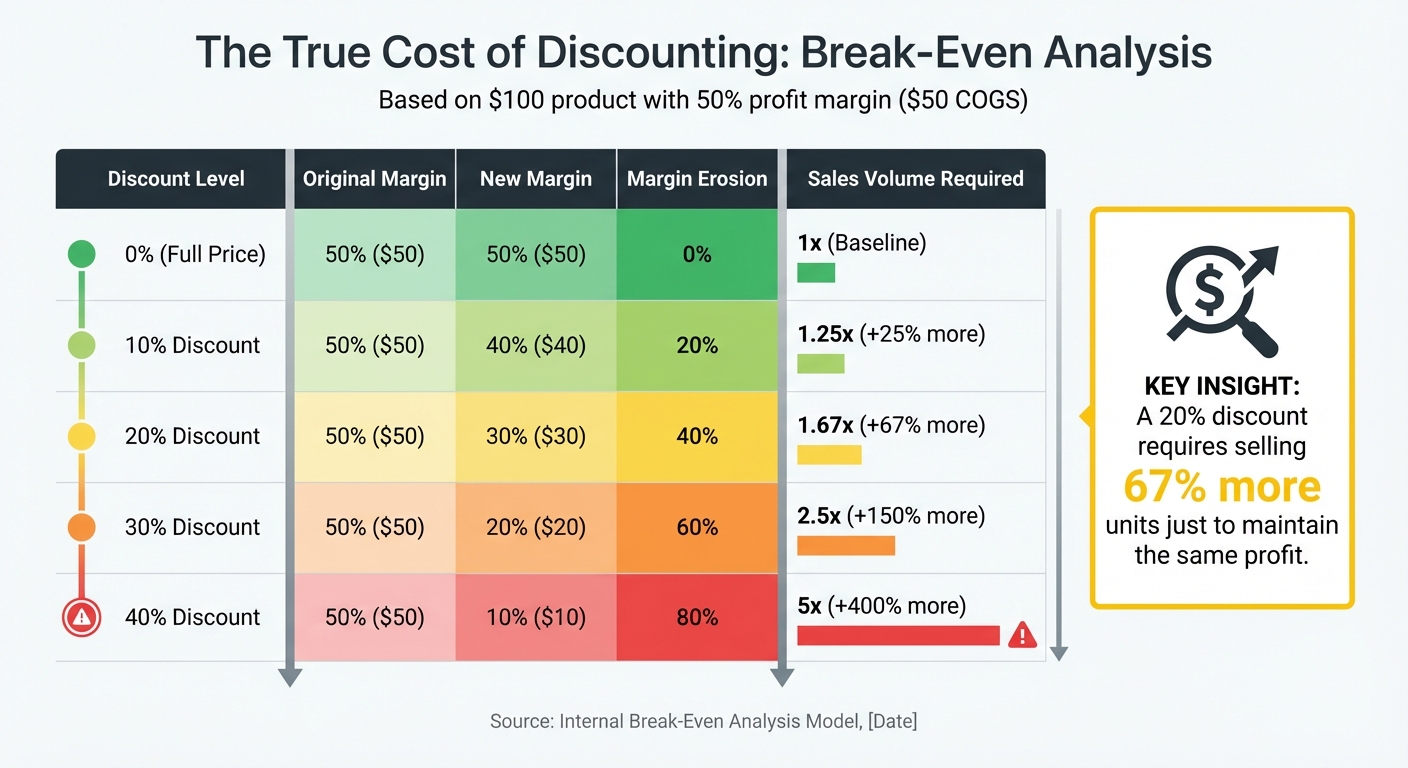
How Discounts Erode Profit Margins: Sales Volume Required to Break Even
When it comes to managing discounts, clear and strict guidelines are essential to protect your bottom line. Without these rules, discounts can quickly eat into profits, leaving your business vulnerable.
Setting Discount Policies and Limits
Start by establishing margin floors – a minimum profit margin below which no discounts are allowed, regardless of the promotion. This ensures that even during sales, your business doesn’t lose money on each transaction.
Introduce a policy requiring finance approval for discounts exceeding 20%. This adds a layer of accountability and prevents hasty decisions, especially during slower sales periods.
Another critical step is to prevent discount stacking. Set rules to block customers from combining multiple offers, such as a sitewide sale with loyalty or affiliate codes. Automated systems can help manage overlapping promotions by enforcing start and end dates.
Rather than offering blanket discounts, consider threshold-based offers like "Spend $75, Get 10% Off" or "Spend $150, Get 20% Off." These deals encourage customers to spend more, helping to cover fixed costs like shipping and payment processing.
"Discounting without discipline isn’t just a lost opportunity – it’s a liability." – Symphony Commerce
Understanding the Impact of Discounts on Margins
Before offering any discount, calculate how it will affect your profit margins. For instance, a 20% discount might seem manageable, but it could reduce your profit by 40% or more, depending on your original margins.
The table below illustrates how discounts impact profit margins and the additional sales volume required to maintain the same profit:
| Discount Level | Original Margin | New Margin | Margin Erosion | Sales Volume Multiple |
|---|---|---|---|---|
| 0% (Full Price) | 50% ($50) | 50% ($50) | 0% | 1x (Baseline) |
| 10% Discount | 50% ($50) | 40% ($40) | 20% | 1.25x |
| 20% Discount | 50% ($50) | 30% ($30) | 40% | 1.67x |
| 30% Discount | 50% ($50) | 20% ($20) | 60% | 2.5x |
| 40% Discount | 50% ($50) | 10% ($10) | 80% | 5x |
Note: Based on a $100 retail price with $50 cost of goods sold (COGS).
For example, if you offer a 10% discount on a product with a 50% margin, you’ll need to sell 25% more units just to maintain the same profit. A 20% discount? That requires selling 67% more units. Many businesses overlook these numbers and end up losing money.
Don’t forget to factor in your Customer Acquisition Cost (CAC) when calculating discounts. Even if a discount seems profitable per unit, it could result in a loss when you account for the cost of acquiring new customers. By calculating your break-even discount threshold – the maximum discount you can offer without eroding your contribution margin – you can make smarter pricing decisions.
"A poorly designed eCommerce discounting strategy is a lot like pouring jet fuel into an engine with a cracked fuel line. The acceleration looks impressive, but underneath… the system is quietly leaking." – Sumeet Bose, Content Marketing Manager, Saras Analytics
It’s worth noting that 64% of online shoppers now wait for sales before making a purchase. Each discount trains customers to anticipate the next one, creating a cycle that’s hard to break.
Conclusion
Discounting might look like an easy way to boost sales, but the hidden downsides can stack up quickly. From cutting into profit margins and weakening your brand to training customers to expect lower prices and adding operational headaches, frequent price reductions can harm your long-term success.
The data backs this up: even small discounts can take a serious toll on net profit. Beyond the immediate hit to your bottom line, discounts can complicate operations, skew revenue predictions, and attract deal-hunters who care more about savings than about your brand.
"Discounts can be a powerful pricing tool when used strategically, but they often mask a deeper cost that erodes profitability and operational efficiency." – Michael Stanisz, Partner, RevenueML
Thankfully, there are smarter ways to drive sales while protecting your margins. Strategies like value-based pricing, bundling, loyalty programs, or limited-time offers can help maintain momentum without sacrificing your brand’s integrity. Take REI, for example – they’ve avoided constant discounting and instead focused on strengthening customer loyalty and reinforcing their brand values.
Before you roll out your next discount, take the time to assess its full impact on your profits, set clear rules for when and how discounts are used, and explore other approaches that add value without cutting prices. With thoughtful planning and a focus on long-term goals, you can make pricing decisions that support sustainable growth. Pricing isn’t just about numbers – it’s a reflection of the value your business delivers.
For professional advice on refining your discounting strategy and building robust pricing models, visit TC Advisors at https://tcadvisorscpa.com.
FAQs
How do I calculate the break-even sales lift for a discount?
To figure out the break-even sales lift, you’ll need to calculate how many extra units must be sold to make up for the lower profit margin caused by offering a discount. Here’s what you’ll need:
- Your current price per unit
- The number of units sold
- The discount percentage
- Your fixed costs
- The variable costs per unit
Another way to approach this is by dividing your total fixed costs by the contribution margin per unit (which is the selling price minus the variable cost). This will give you the sales volume increase required to break even.
How can I stop customers from waiting for sales?
To dissuade customers from holding out for sales, focus on making the buying process as smooth and hassle-free as possible. Keep them updated on shipping or delivery timelines and address potential delays before they become an issue. Clear communication and faster service can enhance their experience, encouraging loyalty and reducing the temptation to wait for discounts.
What can I offer instead of a price discount?
Instead of simply cutting prices, think about adopting strategies that emphasize value rather than cost. For instance:
- Value-based pricing: Align your pricing with the perceived value your product or service offers.
- Bundling: Package complementary products or services together to create a more attractive deal.
- Loyalty programs: Reward repeat customers to encourage long-term engagement.
- Personalized offers: Tailor promotions to individual customer preferences or behaviors.
Another effective approach? Focus on enhancing the overall customer experience. A positive experience can build lasting loyalty and satisfaction, which ultimately supports your business’s profitability while still delivering value to your audience.


