

Getting an IRS audit notice can be stressful, but preparation is your best defense. Less than 1% of small businesses are audited, but maintaining organized records year-round can save you time, money, and stress if the IRS comes knocking. Here’s what you need to know to stay ready:
- Understand Your Audit Notice: Check the tax year, items under review, and response deadline. Verify the notice is legitimate (IRS contacts only via mail).
- Types of Audits:
- Correspondence: Limited to specific items, handled by mail.
- Office: Broader review, requires a visit to an IRS office.
- Field: Comprehensive, conducted at your business or home.
- Organize Your Records: Gather income proof (W-2s, 1099s), expense documentation (receipts, invoices), and other supporting materials. Keep everything categorized and linked to your tax return.
- Audit Focus Areas: Common triggers include mismatched income, excessive deductions, and worker misclassification.
- Response Plan: Submit documents promptly, stay within the scope of the audit, and consider professional help from a CPA.
Pro Tip: Regular bookkeeping, monthly reconciliations, and digital record storage can make audits less daunting. Always keep records for at least three years, or longer for specific cases like property sales or omitted income. A CPA can also represent you and handle communication with the IRS, ensuring a smoother process.
How to Prepare for an IRS Tax Audit: 5 Must Know Tips
sbb-itb-85dd802
Reading Your IRS Audit Notice
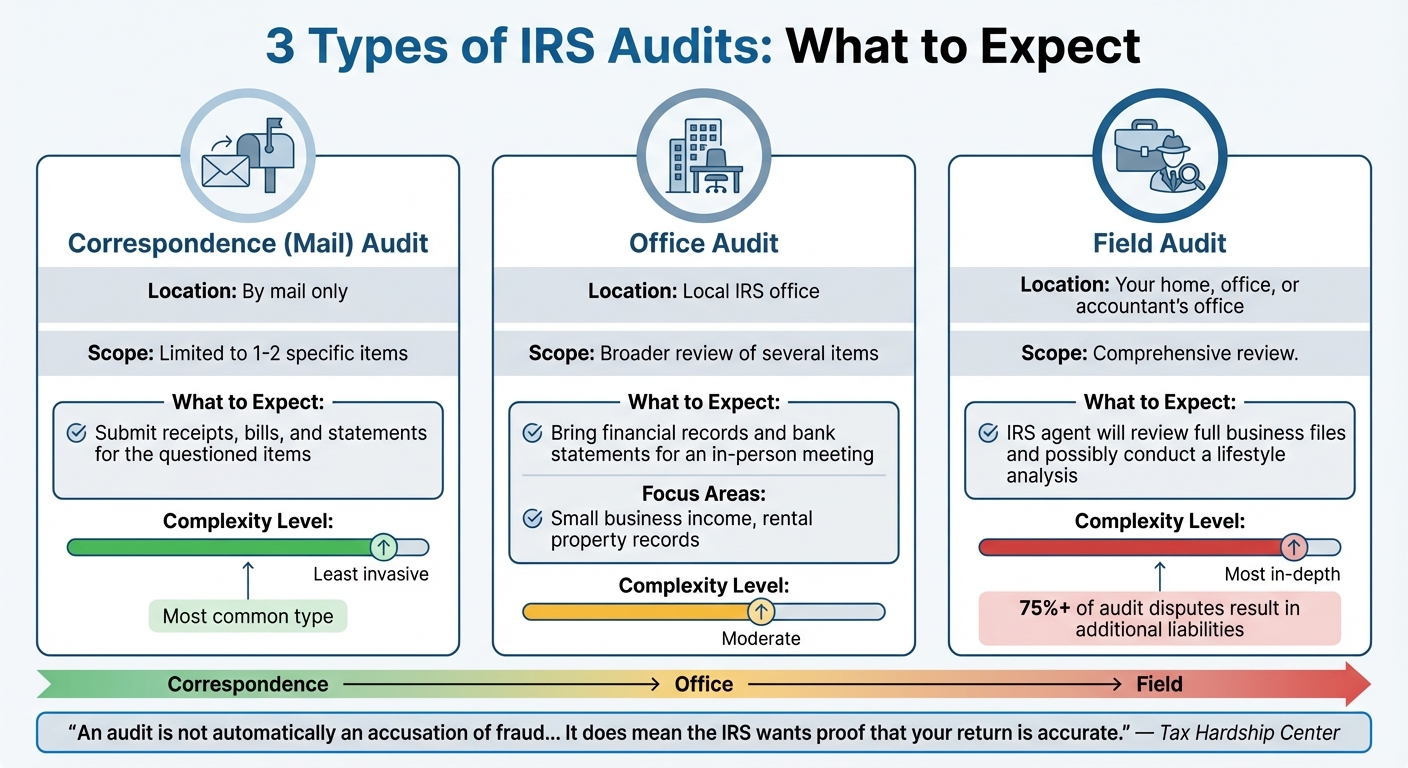
3 Types of IRS Audits: Comparison of Scope, Location, and Requirements
Facing an IRS audit starts with carefully reading and understanding the audit notice. This document holds essential details, like the tax year under review, the specific items in question, and your response deadline. Overlooking these details could lead to unnecessary penalties or complicate the process even further.
"The notice you receive will have specific information about why your return is being examined, what documents if any they need from you, and how you should proceed." – Taxpayer Advocate Service
One of the first things you should do is confirm the notice’s authenticity. The IRS will only contact you about an audit through physical mail – never via email, text, or social media. To ensure the notice is legitimate, cross-check the notice number on the official IRS website.
Finding Key Information in the Notice
Carefully reviewing your audit notice will help you pinpoint the most critical information. Typically, the notice will specify the tax year under review and list the relevant tax forms, such as Form 1040 or Schedule C. It will also highlight the specific items under scrutiny – this could include income discrepancies, business expenses, charitable donations, or tax credits.
Pay close attention to the 30-day response deadline. If you think you’ll need more time, contact the IRS to request an extension before the deadline passes. Missing this deadline could result in deductions or credits being automatically disallowed and may lead to serious consequences like wage garnishments, levies, or liens.
The notice will also include contact information for the IRS examiner handling your case or the address where you should send your records. Some notices may even include a QR code for the Document Upload Tool, which allows you to submit documents online. If you’re mailing records, always send copies instead of originals and use certified mail with a return receipt to ensure you have proof of delivery.
By identifying these key details, you can better understand the scope of the audit and what type of examination you’ll need to prepare for.
3 Types of IRS Audits
The audit notice will also indicate the type of audit you’re facing. Each type comes with different requirements and levels of scrutiny:
| Audit Type | Location | Scope | What to Expect |
|---|---|---|---|
| Correspondence (Mail) | By mail only | Limited to 1–2 specific items | Submit receipts, bills, and statements for the questioned items |
| Office Audit | Local IRS office | Broader review of several items | Bring financial records and bank statements for an in-person meeting |
| Field Audit | Your home, office, or accountant’s office | Comprehensive review | IRS agent will review full business files and possibly conduct a lifestyle analysis |
Correspondence audits are the most common and generally the least invasive. They usually address straightforward issues, like missing forms or minor errors, and don’t require in-person meetings.
Office audits are more detailed and require you to visit a local IRS office. These audits often focus on areas like industry-specific tax guidance or rental property records, so you’ll need to bring relevant financial documents.
Field audits are the most in-depth and are typically reserved for more complicated cases. In these audits, an IRS agent may visit your home, business, or accountant’s office to conduct a full review. They might even perform a lifestyle analysis to ensure your reported income aligns with your spending habits. With over 75% of audit disputes resulting in additional liabilities, thorough preparation is essential.
"An audit is not automatically an accusation of fraud… It does mean the IRS wants proof that your return is accurate." – Tax Hardship Center
Collecting and Organizing Your Financial Documents
Once you’ve determined the type of audit you’re facing, the next step is gathering and organizing all the documents that back up your tax return. The IRS requires proof to verify your reported income and deductions, and presenting everything in an orderly way can make the process smoother.
"Organizing the records you bring or send us will speed the process and prevent errors or misunderstandings." – Internal Revenue Service
Start by pulling together your essential identification and tax documents. This includes a full copy of the tax return being audited (with all schedules and worksheets), a government-issued photo ID, and any prior IRS correspondence. For income verification, gather W-2s, 1099s, Schedule K-1s, and full bank statements from all business accounts – make sure to include complete pages, not just summaries. Add deposit slips and POS reports to show your income sources clearly.
For expenses, collect canceled checks, credit card statements, vendor invoices, and receipts, sorted by category. If you’ve made charitable donations over $250, include written acknowledgments. Business owners should also prepare their general ledger, profit and loss statements, balance sheets, and cash receipts journals. For inventory, include purchase invoices and documentation of your valuation method, whether it’s FIFO or LIFO.
This initial step lays the groundwork for organizing your records in a way that aligns with the IRS’s expectations.
Documents You Need to Collect
The specific documents you’ll need depend on the focus of the audit, but here’s a general guide to what you might need:
- Employment and Payroll: Forms 941 and 940, W-2 summaries, payroll journals, and state tax filings.
- Property or Equipment: Property deeds, closing statements (HUD-1), loan agreements, lease contracts, and depreciation schedules.
- Vehicle and Travel Expenses: A mileage log that includes dates, destinations, business purposes, and miles driven, along with travel itineraries and meal records.
- Home Office Deduction: Floor plans and utility bills to support how you calculated your home office allocation.
Remember to only send copies, not originals. Keep your original documents safe and, if you’re mailing records, use certified mail with a return receipt for added security.
How to Organize Documents by Category
Your records should directly support the details outlined in your audit notice. A smart approach is to link each document to the specific line item it supports on your tax return. Group everything into categories like Income, Expenses, Deductions, Assets, Payroll, and Correspondence to make it easy for the IRS examiner to verify your claims.
"In my 15+ years as a CPA handling examinations, the cases that resolve quickly are the ones where the taxpayer shows up with a clear, organized packet of primary records." – CPA Author, FinHelp
Assign a unique identifier to each document (e.g., 2026-EXP-001 for the first expense receipt) and create an index sheet that matches these IDs to the corresponding line items on your tax return. This index should clearly show the "Return Line" and the "Supporting Document IDs."
When grouping documents, attach related items together. For example, pair a canceled check with the invoice it paid. Adding a one-page summary for each category, which outlines totals and explains your position, can also help build credibility with the auditor.
If you’re missing receipts, don’t worry. You can reconstruct records using bank statements, vendor affidavits, or duplicates. For instance, a freelancer in 2025 successfully substantiated a home-office deduction by presenting bank statements, recurring digital subscription invoices, and a calendar showing business use, even though they lacked physical receipts.
Document Organization Checklist
Here’s a handy checklist to keep track of your primary and supporting documents:
| Category | Primary Required Documents | Supporting/Secondary Documents |
|---|---|---|
| Income | W-2s, 1099 forms, Schedule K-1s | Bank deposit slips, POS reports, sales invoices |
| Expenses | Receipts, vendor invoices | Canceled checks, credit card statements, contracts |
| Travel/Auto | Mileage logs, travel tickets | Itineraries, calendar appointments, meal logs |
| Payroll | Forms 941, 940, W-2 summaries | Payroll journals, state filings, employee time logs |
| Assets | Purchase receipts, bills of sale | Depreciation schedules, closing statements (HUD-1) |
| Home Office | Utility bills, mortgage interest | Floor plans, square footage calculations |
Common IRS Audit Focus Areas for Small Businesses
Knowing where the IRS concentrates its audit efforts can help you stay ahead of potential issues. Audits are not chosen randomly – they target areas where mistakes or underreporting are more likely. By understanding these focus points, you can review your records and address any discrepancies before they become a problem.
Income and Bank Deposits
The IRS closely monitors income by matching reported figures with third-party forms like 1099s and W-2s. They also analyze bank deposits for irregularities, such as structured deposits or amounts that are perfectly rounded, which could raise red flags.
"The IRS uses automated systems to match income reported on tax returns with third-party forms like 1099s and W-2s. If there’s a mismatch, it’ll raise an immediate flag that could lead to a letter from the IRS." – Jeremy A. Johnson, CPA
Businesses that handle a lot of cash – like restaurants, salons, or car washes – often get extra attention because cash is easier to underreport [7,18].
To stay on top of this, reconcile your accounting records with bank statements every month. Clearly document deposits that aren’t business income, such as personal transfers, loan proceeds, or capital contributions. Keep detailed records like sales receipts, daily deposit summaries, and point-of-sale reports. Most importantly, avoid mixing personal and business funds [7,18].
Business Deductions and Expenses
The IRS expects every business expense to be both ordinary (common in your industry) and necessary (helpful for your operations) [19,20]. For deductions, you’ll need to back them up with receipts, canceled checks, invoices, or bills.
"Don’t round down for entries. A lot of round numbers without cents are possible indications that income isn’t being reported accurately." – Jeremy A. Johnson, CPA
For vehicle expenses, keep an updated mileage log with details like dates, destinations, purposes, and miles driven. Claiming 100% business use of a personal vehicle can be a red flag since some personal use is typically expected [20,21].
If you’re claiming a home office deduction, you can choose between the Simplified Method ($5 per square foot for up to 300 square feet) or the Actual Expense Method. Either way, keep supporting documents like floor plans and utility bills. Business meals are generally 50% deductible, but you must save receipts showing who attended and the business purpose. Small equipment purchases under $2,500 can be expensed immediately under the de minimis safe harbor rule. If your records are lost due to theft or disaster, the IRS may accept reconstructed records if they align with other evidence [11,20].
Worker Classification: Employee vs. Independent Contractor
Misclassifying employees as independent contractors can create payroll tax issues. If you control how, when, and where work is done – not just the end result – the worker should likely be classified as an employee [19,22].
"If you misclassify your employees as independent contractors, you’ll be more likely to get an audit. The IRS has an eye out for this issue because it affects payroll taxes." – Jeremy A. Johnson, CPA
Evaluate your level of control over workers. If you provide tools, set specific work hours, require uniforms, or mandate training, they are likely employees. Ensure you have written agreements for all workers. Employees should complete Form I-9 and Form W-4, while independent contractors must receive Form 1099-NEC for payments of $600 or more [19,23]. Regular payroll reviews can help ensure your classifications comply with tax laws. Misclassification can lead to a 20% penalty on any underpaid taxes.
Creating Your Audit Response and Communication Plan
Once your documents are in order, the next step is crafting a clear audit response and maintaining effective communication with the IRS. How you organize and present your materials can significantly influence both the audit timeline and its outcome. Keep in mind that over 75% of audit disputes end with additional taxes, interest, or penalties, so a well-structured approach is essential.
Assembling Your Audit Response Packet
Begin with a cover letter that includes your business name, identifier (last four digits of SSN/TIN), tax year, and the IRS notice number. In the letter, list all attachments and provide a single point of contact for follow-up.
Follow this with a table of contents and exhibit index. This one-page guide should number each exhibit and indicate specific page ranges for easy reference. Include a highlighted copy of your tax return, marking the questioned lines and cross-referencing them to the supporting exhibits. For the supporting documents, submit legible copies only – never originals. These might include receipts, invoices, bank statements, canceled checks, and 1099s. To protect sensitive information, redact full Social Security and bank account numbers, leaving only the last four digits visible.
"A professionally organized packet often shortens the audit timeline and reduces the odds of an unfavorable adjustment." – FinHelp
If your return includes consolidated transactions, such as charitable donations, provide a reconciliation summary sheet that outlines the calculations used to determine the total. For travel, meals, or mileage expenses, attach logs, calendars, or diaries that establish the business purpose. If you’re working with a CPA or tax professional, include IRS Form 2848 to grant them Power of Attorney.
Meeting Deadlines and Requesting Extensions
Once your packet is ready, submit it promptly. Most IRS correspondence audits allow around 30 days for a response. Check the notice immediately to confirm the exact deadline. Submitting your response on time signals cooperation and helps keep the process moving forward.
Send your packet via certified mail with a return receipt to ensure proof of submission. If you’re unable to gather all necessary documents by the deadline, contact the IRS before the due date to request an extension. To avoid missing deadlines, set digital reminders or calendar alerts for all key dates. If you agree to new deadlines during a meeting with an examiner, confirm those dates in writing.
Preparing for Questions from the IRS Examiner
During the audit, the IRS examiner may ask for clarification on specific items or request additional documentation. Answer only what is asked – offering unrelated information could broaden the scope of the audit.
"The cases that resolve quickly are the ones where the taxpayer shows up with a clear, organized packet of primary records." – CPA handling examinations, FinHelp
Keep a record of the examiner’s name, badge number, and the date, time, and location of any meetings. If you’re unsure about what the examiner is requesting, ask clarifying questions to ensure you provide the correct information. For complex or unusual items on your return, prepare written explanations in advance to communicate clearly during the meeting. Taking these steps can make the audit process smoother and reinforce the importance of thorough preparation.
Running an Internal Review Before the Audit
Before you start preparing your audit response packet, take the time to conduct a thorough internal review of your financial records. This step allows you to catch any errors or inconsistencies that could expand the scope of the audit or result in penalties.
"The best time to prepare for an audit is before you ever have one." – The Hartford
Start by carefully comparing your tax return with your accounting records. For instance, if your Schedule C lists gross receipts, ensure this figure matches totals from your 1099 forms and bank deposits. Pay close attention to common issues like mismatched income, unusually large deductions, or personal expenses mistakenly categorized as business costs. For travel and entertainment expenses, confirm that each has proper documentation explaining its business purpose.
Reconciling Your Accounts
Monthly bank reconciliations are a must. Go through your general ledger for the past three to five years and reconcile all income, expenses, fixed assets, and depreciation schedules. Make sure every entry is backed by receipts or invoices. Expenses should meet the IRS’s requirement of being both "ordinary and necessary" for your line of work.
Prepare a summary for key categories. Cross-check the income reported on your return with third-party documents like 1099 forms and bank deposit records. For office supplies or similar deductions, verify that receipts match ledger entries. Review your fixed asset list and depreciation schedules, especially if you’ve claimed Section 179 deductions or bonus depreciation on equipment or vehicles. Keep in mind that legislation passed in July 2025 demands detailed records for 100% bonus depreciation claims. Also, remember that if business use of a vehicle drops below 50%, prior deductions might need to be recaptured.
Once you’ve confirmed your accounts and documentation are in order, shift your focus to payroll and tax payment records.
Verifying Payroll and Estimated Tax Payments
Payroll errors are a frequent red flag for audits. Compare your annual W-2 and W-3 forms with quarterly Form 941 filings to ensure everything matches. Cross-check internal payroll records and wage reports against your EFTPS deposit receipts to confirm all payments are properly recorded.
"The most common of these [audit triggers] is often a discrepancy between what you report on W-2 forms and what appears on Form 941 – especially when wages, withholdings, or Social Security amounts don’t align." – Trevor McCandless, CEO, Fusion Taxes
Review your quarterly estimated tax payments to ensure they align with credits claimed on your return. Double-check that each bank withdrawal corresponds to these payments. If you spot an error, file Form 941-X to resolve it before the IRS catches it. Additionally, verify that Form 940 (federal unemployment tax) matches your state filings and internal records. Ensure all employees have completed Form I-9 and Form W-4, and issue 1099-NEC forms to any eligible independent contractors.
Record Retention for Audits and Future Compliance
Keeping your records organized is a smart move for the long haul. The IRS typically has three years from the date you file to conduct an audit. However, if you omit over 25% of your gross income, that window extends to six years. For fraudulent returns or cases where no return is filed, you’ll need to keep your records indefinitely.
"The responsibility to support entries, deductions, and tax return statements is known as the burden of proof. You must be able to prove certain elements of expenses to deduct them." – IRS
Different records come with different retention timelines. For instance, if you’re claiming deductions for worthless securities or bad debts, hold onto those records for seven years. Property and asset records should be kept for the duration of ownership plus three to seven years after disposal. These documents are essential for verifying depreciation and cost basis. Keeping these records handy not only meets IRS requirements but also makes future audits less stressful.
How Long to Keep Tax Records
Here’s a quick reference table to help you understand how long to retain different types of records. The retention period varies depending on the type of document. Standard tax returns and their supporting documents – like W-2s, 1099s, invoices, receipts, and bank statements – should be kept for at least three years. If you’ve claimed specific deductions, like those for bad debts or worthless securities, you’ll need to extend that to seven years.
| Record Type | Retention Period | Documents |
|---|---|---|
| General Business Records | 3 years | W-2s, 1099s, invoices, receipts, canceled checks, bank statements |
| Employment Taxes | 4 years | Payroll registers, Forms 941/940, W-4s, I-9s, withholding records |
| Substantial Income Omission | 6 years | Records supporting gross income if >25% was omitted |
| Bad Debt / Worthless Securities | 7 years | Documents supporting loss claims or specific deductions |
| Asset & Property Records | Ownership + 3 years | Purchase contracts, closing statements, improvement receipts, depreciation schedules |
| Fraud or Non-Filing | Indefinitely | Any records for years where a return was not filed or was fraudulent |
Digital Tools for Document Storage
Now that you know how long to keep your records, let’s talk about making storage more efficient. The IRS accepts electronic records as long as they’re accurate, readable, and retrievable. Digitizing your documents can cut down on physical clutter and make retrieval easier during audits. Start by scanning your receipts and invoices to create high-quality digital copies, especially for items like thermal receipts that fade over time.
Cloud storage options like Google Drive or Dropbox are great for securely storing your files. To avoid losing important documents, always maintain backups – ideally in at least two locations, such as a secure cloud service and an external hard drive. Use a consistent naming system for your files, like YYYY_Category_Description (e.g., 2025_Expenses_OfficeSupplies.pdf), to make searching easier during an audit.
"Never mail original records. Send us copies." – Internal Revenue Service
Organize your digital files by tax year and category (e.g., Income, Expenses, Assets, Payroll). This structure aligns with the lines on your Schedule C or corporate return, making it easier for both you and an IRS examiner to locate specific documents. If you use accounting software, look for features like Optical Character Recognition (OCR), which allows you to search PDFs for specific transactions quickly.
Working with a CPA During an IRS Audit
An IRS audit can feel like a daunting experience for small business owners, pulling attention away from running the business. A CPA’s expertise can be the deciding factor between resolving the audit efficiently and facing costly outcomes. In fiscal year 2024, the IRS closed over 505,000 audits and recommended more than $29 billion in additional taxes. With over 75% of audit disputes leading to extra taxes, interest, or penalties, having a CPA by your side isn’t just a good idea – it’s a smart move.
What CPAs Do During Audit Preparation
When you work with a CPA, they bring structure and precision to your audit preparation. Their first step is to review your IRS audit notice, identifying the tax years and specific issues under scrutiny. From there, they gather and organize your financial records – everything from receipts to bank statements – and align them with the relevant tax return line items. This creates a clear, easy-to-follow evidence packet that can streamline the audit process and demonstrate transparency.
By filing Form 2848 (Power of Attorney), a CPA takes on the responsibility of representing you in meetings with IRS examiners, sparing you from direct interactions with the IRS. They also handle all correspondence, ensuring that every response is accurate and submitted on time. If receipts or records are missing, CPAs can use alternative methods like bank traces, vendor statements, or the "Cohan Rule" to reconstruct expenses and maintain credibility.
"In my 15+ years as a CPA handling examinations, the cases that resolve quickly are the ones where the taxpayer shows up with a clear, organized packet of primary records." – CPA Author, FinHelp
CPAs also look for overlooked deductions and negotiate adjustments or penalties on your behalf. If the audit results in a disagreement, they can escalate the issue by pursuing "Audit Reconsideration", requesting a manager conference, or representing you before the IRS Independent Office of Appeals. This comprehensive support ensures you have a professional advocate at every step.
How TC Advisors Supports Small Business Audits

TC Advisors builds on these CPA best practices to provide tailored support for small and mid-sized businesses. Their team handles IRS notices, assembles detailed response packets, and files Form 2848, enabling them to communicate directly with IRS examiners on your behalf.
In addition to audit preparation, TC Advisors offers year-round tax planning and compliance services to help you avoid future audits. These services include quarterly reviews, accurate bookkeeping, and strategic tax planning, ensuring your records are always ready for scrutiny. With experience working with startups, entrepreneurs, and real estate investors, TC Advisors understands the unique challenges small businesses face during IRS audits. Whether it’s a correspondence audit or a more in-depth field audit, TC Advisors provides the financial expertise and defense you need to navigate the process with confidence.
Conclusion
An IRS audit doesn’t have to throw your business off track. With the audit rate for small businesses currently sitting below 1%, the odds may be in your favor. However, that’s no excuse to delay getting your financial records in order. Staying on top of accurate monthly bookkeeping and reconciling your bank accounts regularly can significantly reduce the chances of discrepancies that might flag an audit in the first place. If you do face an audit, how you respond matters. Stick to providing only the specific documents the IRS requests. This strategy minimizes the risk of exposing unrelated issues through unnecessary documentation. Make sure your records align with your tax return to avoid any avoidable complications.
"Investing a little time each month to stay organized can save you exponentially when (and if) an audit comes." – Mark J. Kohler, CPA and Attorney
Having professional support can make all the difference. CPAs can handle all communication with IRS examiners on your behalf by filing Form 2848, so you can focus on running your business. They also rely on IRS Audit Techniques Guides to predict the areas auditors are likely to examine. This kind of professional assistance not only simplifies the audit process but also strengthens your overall compliance efforts.
FAQs
What should I do first after an IRS audit notice arrives?
The first thing you need to do is thoroughly read the IRS audit notice. Take note of the specifics, such as the scope of the audit, the documents they’re asking for, and any deadlines mentioned. Understanding these details will help you stay on track and meet all requirements on time.
What if I’m missing receipts or other documents the IRS asks for?
If you can’t locate receipts or documents requested by the IRS, try to collect any other records that could support your case, like bank statements, invoices, or canceled checks. Be ready to explain why the original documents are missing. While the absence of receipts might result in denied deductions, offering alternative evidence and being upfront about the situation can make a difference. It’s also wise to consult a CPA or tax professional – they can help you navigate the process, reduce penalties, and craft a solid response.
When should I hire a CPA (like TC Advisors) to represent me in an audit?
You should think about bringing in a CPA, like TC Advisors, as soon as you get an IRS audit notice. Their expertise can be crucial in making sure your documentation and responses are accurate. This is particularly important if the audit involves complex issues or large discrepancies. A CPA can help safeguard your business, reduce potential penalties, and handle communication with the IRS on your behalf.


