

Keeping accurate records isn’t just a good habit – it’s mandatory for small businesses to comply with IRS rules. Proper documentation ensures your tax returns are accurate, deductions are substantiated, and penalties are avoided. Here’s what you need to know:
- Why It Matters: The IRS requires proof for all income and expenses on your tax return. Good records also help separate personal and business finances, track growth, and simplify tax preparation.
- Who Must Comply: Every business, regardless of size or structure, must maintain records. This includes sole proprietors, LLCs, corporations, gig workers, and side hustlers.
- What to Keep:
- Income Records: Receipts, invoices, and 1099 forms.
- Expense Records: Proof of payment, receipts, and petty cash slips.
- Asset Records: Purchase details, depreciation, and sale information.
- Payroll Records: Forms W-2, W-4, and payroll tax filings.
- Bank Statements: Monthly statements and reconciliations.
- Retention Periods:
- Generally, keep records for 3 years after filing taxes.
- Employment tax records: 4 years.
- Underreported income: 6 years.
- Fraudulent or unfiled returns: Keep indefinitely.
- Avoid Common Mistakes:
- Don’t mix personal and business expenses.
- Keep original receipts.
- Log all app-based income.
- Maintain detailed mileage logs.
- Reconcile accounts regularly.
Whether you use a manual or digital system, consistency and organization are key to staying compliant and making tax season manageable. If it feels overwhelming, consider hiring a professional for personalized CPA support to help set up and maintain your recordkeeping system.
What records do I need to keep for small business taxes? [How to set up a simple accounting system!]
sbb-itb-85dd802
Required Records for Small Businesses
When it comes to keeping records for your business, the IRS gives you some flexibility: "You may choose any recordkeeping system suited to your business that clearly shows your income and expenses". Whether you prefer jotting things down in a notebook or using accounting software, the key is that your records must back up every entry on your tax return.
To meet IRS standards, your system should cover five major categories of business activity. Each category requires specific documentation, which we’ll explore below.
Income and Gross Receipts Records
Gross receipts are the total income your business brings in, and you need to document both the amounts and where they come from. According to the IRS: "Your records can identify the source of your receipts. You need this information to separate business from non-business receipts and taxable from nontaxable income".
To stay compliant, keep items like cash register tapes, deposit slips, invoices, receipt books, and credit card charge slips for all sales. Your business checking account is often the go-to source for recording these transactions. Don’t forget to save copies of any information returns you receive, such as Forms 1099-MISC, 1099-NEC, and 1099-K. If your business involves selling products, track inventory carefully and note any personal use of merchandise, as this affects your taxable income. If original records go missing, you can use secondary sources to estimate your income.
Expense and Purchase Records
For every expense, you need documentation that includes the payee, amount, date, proof of payment, and a description of what was purchased. If you’re buying items for resale or raw materials for manufacturing, keep records like canceled checks, receipts from electronic payments, credit card statements, and invoices. When details are missing from credit card statements, pair them with invoices to fill in the gaps. For small cash payments without formal invoices, petty cash slips can help track those expenditures.
Asset and Depreciation Records
Assets like equipment, furniture, or vehicles require detailed tracking from the moment you purchase them until they’re disposed of. Record the purchase price, acquisition date, any improvement costs, and yearly depreciation. When you sell or dispose of an asset, document the sale price, date, and related expenses to calculate any gain or loss. A depreciation worksheet can help simplify tax preparation. If you need assistance with these complex calculations, you can schedule your consultation with our team. Be sure to separate improvement costs from the original purchase price, as these increase the asset’s value and impact depreciation. Keep these records until the period of limitations expires for the tax year in which the asset was sold or otherwise disposed of.
Employee and Payroll Records
If you have employees, accurate records are a must. Ensure you have each employee’s name and Social Security Number exactly as it appears on their Social Security card. Payroll records should include details on federal income tax withholding, Social Security, Medicare, and Federal Unemployment (FUTA) taxes. Essential documents include Forms W-2 and W-4, Form I-9, timesheets, and Forms 1099-NEC or 1099-MISC for contractors. Additionally, retain payroll tax returns like Forms 940, 941, or 944. Employment tax records should be kept for at least four years after the date of payment.
Bank and Financial Records
Bank and credit card statements are crucial for verifying your business’s financial activity. Keep monthly statements, loan agreements, and records of monthly account reconciliations. Reconciling these statements regularly helps catch errors early and ensures your accounting records are accurate. It’s also essential to maintain separate accounts for business and personal finances. Mixing them not only complicates recordkeeping but could also draw extra attention during an IRS review.
How Long to Keep Your Records
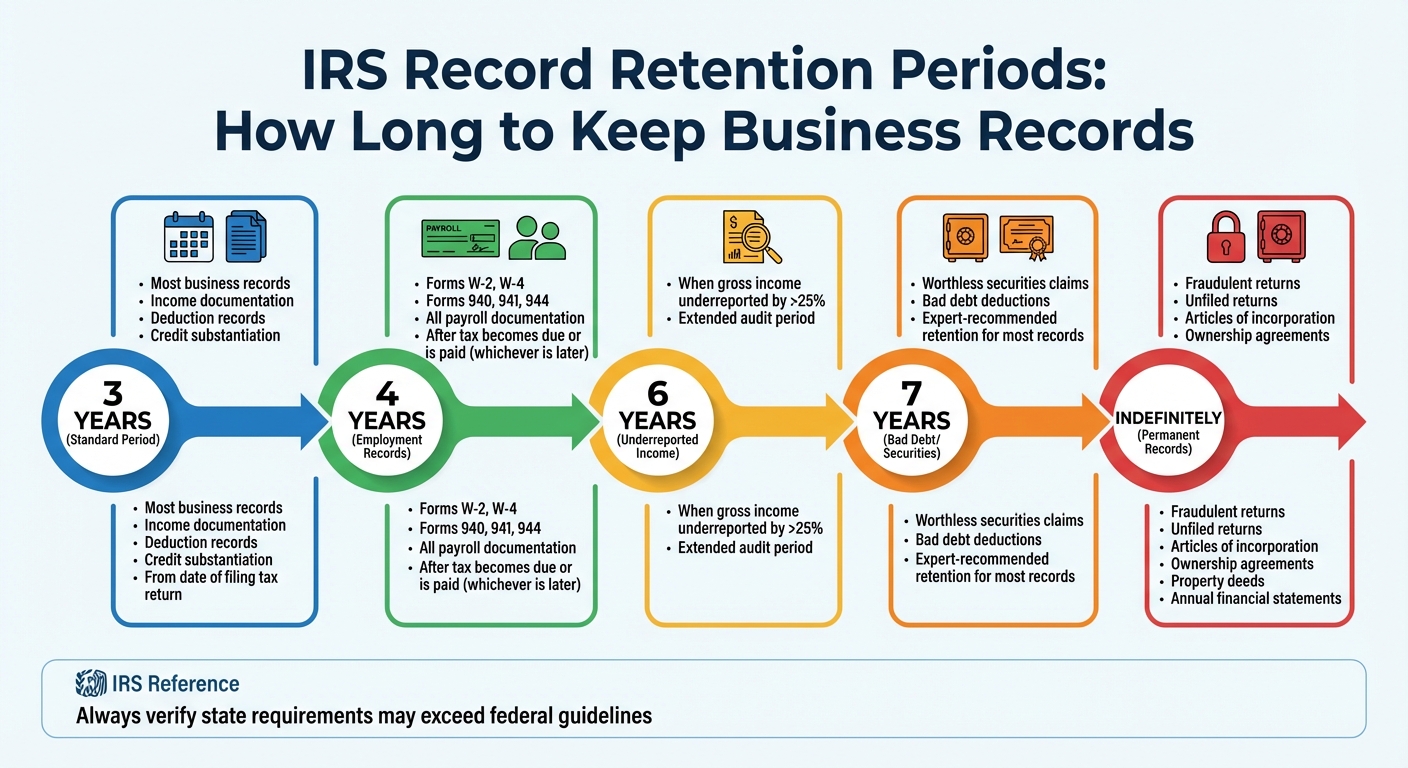
IRS Record Retention Periods for Small Businesses
Once you’ve sorted your records into the required categories, the next step is understanding how long to keep each document to stay compliant.
Standard Retention Periods
The IRS generally requires most records to be kept for three years from the date you file your tax return. This period aligns with the standard audit timeframe and applies to documentation supporting your income, deductions, or credits.
However, some records have different timelines. For example, employment tax records must be kept for four years after the tax becomes due or is paid, whichever is later. The IRS specifically advises:
Keep all records of employment taxes for at least four years.
These records include Forms W-2, W-4, 941, 940, and all payroll-related documentation.
Extended Retention Requirements
Certain circumstances require you to hold onto records longer than the standard periods. If your business underreports more than 25% of its gross income, the IRS extends the retention period to six years.
When dealing with claims for worthless securities or bad debt deductions, the retention period increases to seven years. In cases of fraudulent returns or if no return is filed, there is no statute of limitations, meaning you should keep those records indefinitely.
As the IRS explains:
The length of time you should keep a document depends on the action, expense, or event the document records.
Additionally, some creditors or insurance providers might require you to retain records beyond the IRS’s guidelines.
Recommended Retention Practices
While IRS rules set the minimum, many CPA advisory experts suggest retaining most financial documents for seven years. This approach covers the majority of IRS statutes of limitations and simplifies your overall recordkeeping process. Keeping thorough records not only ensures compliance but also makes audits smoother and provides better insight into your business operations.
Some documents should be kept permanently. These include articles of incorporation, ownership agreements, property deeds, and annual financial statements. These records establish your business’s legal structure and serve as a long-term reference for its financial history.
Once a document’s retention period is over, dispose of it securely to protect sensitive information. Use cross-cut shredders for paper records and data-wiping tools for digital files. Before destroying anything, confirm whether state tax laws or industry-specific rules require holding onto records longer than federal guidelines.
Setting Up Your Recordkeeping System
Now that you know what records to keep and how long to retain them, it’s time to create a system that makes organizing and retrieving them simple. The IRS gives you flexibility in how you manage your business finances. Whether you go old-school with paper ledgers, embrace accounting software, or use a mix of both, the key is to ensure every transaction is clearly documented.
Manual vs. Digital Systems
Paper-based systems involve physical journals, ledgers, and calendars to log transactions. These systems don’t rely on technology, so there’s no risk of software glitches or crashes, and they don’t require technical know-how. However, searching through stacks of paper can be tedious, and these records are at risk of damage from fires, floods, or other disasters. As your business grows, finding space to store all those documents can also become a challenge.
Digital systems, on the other hand, use accounting software to automatically record and organize transactions. They provide real-time access, searchable databases, and are far easier to scale as your business expands. But they do come with their own risks – like hardware failures or potential cyberattacks. It’s worth noting that the IRS holds digital records to the same standards as paper ones.
| Feature | Manual Systems | Digital Systems |
|---|---|---|
| Tools | Journals, ledgers, calendars | Accounting software and electronic capture |
| Accessibility | Limited to physical location | Real-time access from anywhere |
| Scalability | Requires more physical space | Easily expandable storage and functionality |
| Risk Factors | Fire, flood, physical damage | Hardware issues, cybersecurity vulnerabilities |
Once you decide which system works best for your business, the next step is setting up a structure that keeps your records organized and easy to track.
How to Organize Your Records
No matter what system you use, it’s important to organize your records by tax year and category. Categories might include income, expenses, and assets. Create separate folders or digital subfolders for each type of transaction. Attaching receipts and invoices as soon as possible will help you avoid missing deductions and make reviews much easier.
Your business checking account should serve as the main source for your records. Reconcile it regularly to catch any discrepancies early. It’s also crucial to keep your business and personal finances completely separate, as mixing them is one of the most common recordkeeping errors. For physical records, use a secure, locked storage area. For extra protection, back up those documents digitally to guard against unexpected disasters.
IRS Rules for Digital Records
If you’re using a digital system, make sure it allows for easy retrieval, manipulation, and printing when needed. Your records should include a clear audit trail that connects individual transactions to your accounting books and tax return.
When scanning receipts, ensure they’re stored in a secure, searchable format and that the images are sharp and easy to read. Document your processes for protecting records from unauthorized changes. If you switch to a new accounting software, ensure your older records remain accessible. The IRS favors original software backup files over spreadsheet exports because backups help verify the accuracy and integrity of your records.
Common Recordkeeping Mistakes to Avoid
Even with the most organized system, some common recordkeeping mistakes can throw off your financial records. These errors can lead to audits, disallowed deductions, or hefty penalties. Knowing what to watch out for – and how to prevent these missteps – can keep your records accurate and help you stay compliant with IRS requirements.
Mixing Personal and Business Expenses
Using the same account for personal and business transactions is a frequent mistake among small business owners. When personal and business expenses are mixed, it creates a messy financial trail that can be hard to sort out during tax time – or worse, an audit. The IRS might even classify your business as a hobby if they see consistent commingling, which could strip you of the ability to deduct business expenses. In some cases, courts could "pierce the corporate veil", leaving your personal assets exposed.
To avoid this, open separate business accounts right away. Keeping business and personal finances separate ensures a clear audit trail and protects your personal liability.
Not Keeping Original Receipts
Bank or credit card statements only confirm that a payment was made – they don’t explain the purpose behind it. The IRS requires proof of the amount, date, place, business purpose, and relationship for every deductible expense. For example, a $150 charge at an office supply store might be legitimate, but without a receipt, it’s unclear whether it was for printer paper or a personal item.
"The responsibility to prove entries, deductions, and statements made on your tax returns is known as the burden of proof. You must be able to prove (substantiate) certain elements of expenses to deduct them." – IRS
To stay on top of this, digitize receipts as soon as you receive them. Use your phone to photograph or scan each receipt, and attach it to the corresponding transaction in your accounting software. If the receipt doesn’t clearly state the business purpose, add a note before saving it. Digital receipts are acceptable to the IRS as long as they’re legible and securely stored.
Missing App-Based Income
Platforms like PayPal, Venmo, and Stripe report business income over $600 to the IRS using Form 1099-K. Many small business owners overlook income from these platforms, mistakenly thinking small transactions won’t matter. However, the IRS uses data matching to compare what these platforms report with your tax return. Any discrepancies can trigger a review.
To avoid issues, record every transaction from payment apps. Link these platforms to your accounting software or manually log each one. If you use these apps for both personal and business transactions, create separate accounts to avoid confusion. Also, keep in mind that 90% of business owners overpay their taxes because they miss deductions they’re entitled to – but underreporting income can lead to even bigger problems, including penalties and interest.
Incomplete Mileage Logs
Vehicle deductions are a common audit target, especially when a business claims 100% usage without proper documentation. To deduct mileage, you need a detailed log that includes the date, destination, business purpose, and exact miles driven for each trip. Recreating this information months later can raise suspicion and may result in denied deductions.
Use GPS-based apps like QuickBooks Online, Everlance, or MileIQ to automatically track your mileage. For 2026, the standard mileage rate is 72.5 cents per mile through June 30 and 76 cents from July 1. If you lose your logs, you can reconstruct them using appointment books, calendars, or mapping tools, but tracking your mileage in real time is much easier and more reliable.
Delaying Account Reconciliation
Recording transactions is just one part of the equation – timely reconciliation is just as important. If you put off reconciling your bank statements with your internal records, you risk missing errors, duplicate entries, or even signs of fraud. Waiting until the end of the year can distort your financial picture and make it harder to spot problems early. As Greg O’Brien, CPA and Co-CEO of Anomaly, wisely points out:
"Profit doesn’t pay bills. Cash does."
Set a weekly schedule to reconcile your accounts. Compare every transaction to your receipts and accounting records, and investigate any differences right away. Regular reconciliation keeps your financial picture accurate and helps you catch issues before they snowball.
Final Thoughts on IRS Recordkeeping
Stay Organized and Compliant
Keeping your records in order isn’t just about dodging IRS penalties – it’s about running your business more effectively. With around 57 million small businesses and self-employed taxpayers in the U.S., the responsibility of maintaining accurate documentation lies with you. Without proper records, you could lose out on deductions, face higher tax bills, or even incur penalties.
But it’s not just about taxes. Organized records can also guide better business decisions. The Taxpayer Advocate Service emphasizes that "Good records can also assist you in knowing exactly where to target funding and reducing expenditures to optimize profit." When your financial records are up-to-date, tax season becomes less stressful, and you’re better equipped to make informed choices throughout the year.
You don’t need a complicated system to stay on top of things. Whether you opt for a manual or digital setup, the essentials are the same: record daily transactions, reconcile your accounts monthly, and review your finances quarterly. The real secret is consistency – regular maintenance helps you spot and address problems early.
If this feels overwhelming, getting professional assistance can make a big difference.
Get Professional Help
Balancing recordkeeping with running a business is no small task. Professionals can ensure you don’t miss critical deductions and that your records are always audit-ready. If you have missing or incomplete records, they can help reconstruct your financial history using tools like bank statements, appointment books, and other resources.
TC Advisors (https://tcadvisorscpa.com) offers services tailored to small businesses, including bookkeeping, tax preparation and planning, and fractional CFO support. Their team can help you set up efficient recordkeeping systems, perform regular reconciliations, and maintain the documentation needed to back up your deductions. This allows you to focus on what matters most – growing your business.
FAQs
What counts as a valid receipt for IRS purposes?
To meet IRS requirements, a valid receipt must include these key details: purchase date, amount paid, vendor’s name, and a description of the goods or services. If any of this information is missing or unclear, you’ll need to add it manually.
For travel or meal expenses, you should also note the business purpose and the names of individuals involved. Make sure receipts are legible and thorough to avoid any compliance issues with the IRS.
How should I handle shared personal and business expenses?
Mixing personal and business expenses can lead to tax headaches, missed deductions, and even legal trouble. To avoid these issues, set up dedicated accounts for your business:
- Use a separate business bank account and credit card.
- Keep detailed and accurate records of all transactions.
This not only helps you stay organized but also ensures you comply with IRS rules and maintain clear financial boundaries.
What’s the best way to back up digital records for an audit?
The IRS advises keeping your digital records both secure and well-organized. Opt for dependable storage solutions like cloud services or external hard drives, and make sure your backups are encrypted and updated on a regular basis. Save essential documents – such as records of income, expenses, and assets – in accessible formats like PDFs or high-quality scans. Properly managing and safeguarding these records not only ensures compliance but also prepares you with the necessary documentation if you’re ever audited.


