

Struggling to track project expenses and revenue accurately? Here’s a quick breakdown: Job costing and WIP (Work-in-Progress) reporting are two essential tools for managing construction and real estate projects. Job costing focuses on tracking detailed expenses like labor, materials, and overhead for each project. WIP reporting, on the other hand, provides a high-level view of project progress by comparing costs incurred to revenue earned.
Key Takeaways:
- Job Costing: Tracks real-time expenses to control costs and refine future bids.
- WIP Reporting: Measures revenue earned against project progress to manage cash flow and profitability.
- Why Both Matter: Job costing ensures accurate expense tracking, while WIP reporting offers insights into overall financial health. Together, they help prevent profit loss and cash flow surprises.
Quick Comparison:
| Feature | Job Costing | WIP Reporting |
|---|---|---|
| Focus | Expense tracking | Revenue vs. progress |
| Metrics | Labor, materials, overhead | % Complete, earned revenue |
| Users | Project managers | CFOs, lenders, bonding agents |
| Timing | Real-time (daily/weekly) | Periodic (monthly/quarterly) |
| Purpose | Cost control, accurate bidding | Financial health, cash flow |
Both methods are critical for staying profitable and maintaining trust with lenders and bonding companies. Use job costing to track every dollar spent and WIP reporting to ensure your projects stay financially on track.
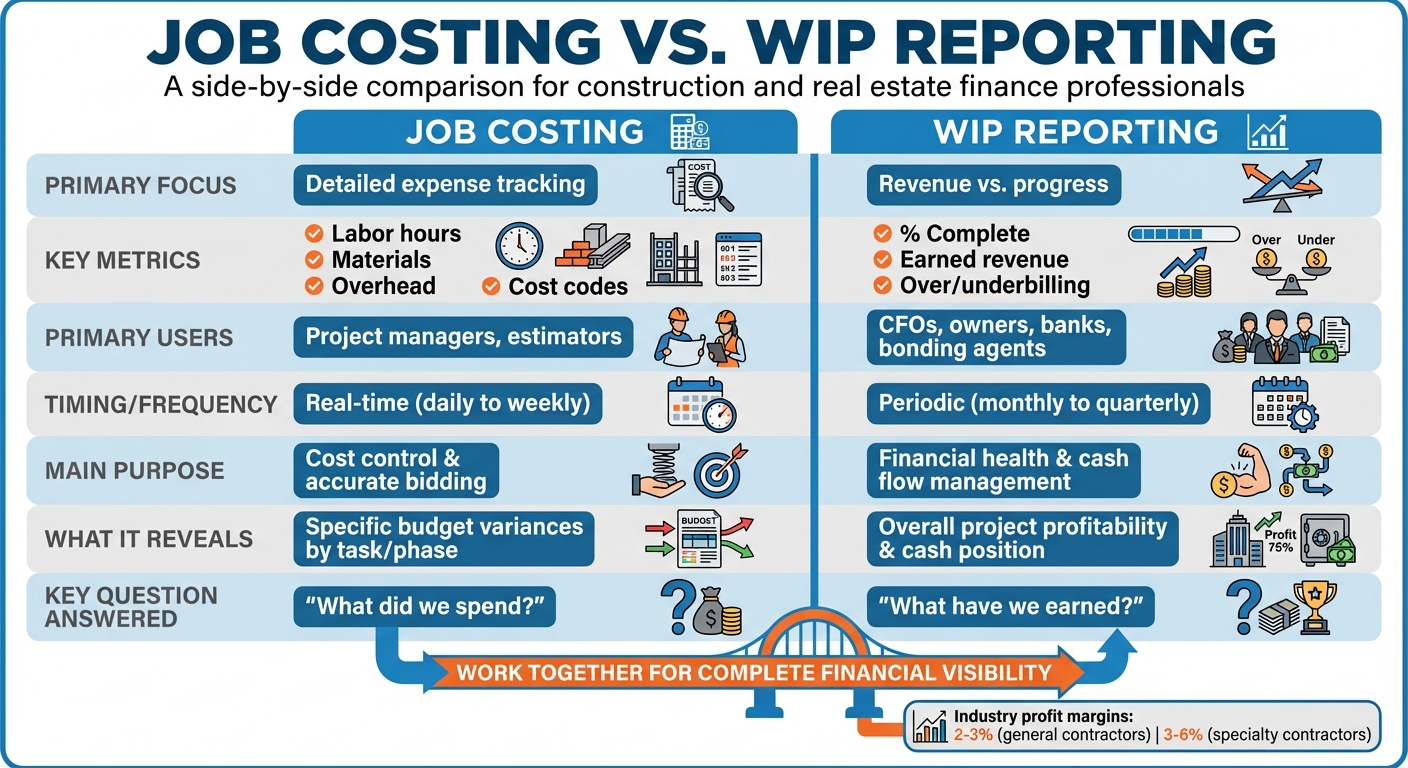
Job Costing vs WIP Reporting: Key Differences Comparison Chart
[Blueprints for Success Webinar Shorts] The Importance of WIP Reports and Job Costing
sbb-itb-85dd802
What is Job Costing?
Job costing is a way to track and assign every expense to a specific project, treating each construction or real estate project as its own financial entity. Instead of just knowing the company spent $500,000 in a month, job costing breaks it down – for instance, showing exactly how much went into renovating a downtown office versus building a residential subdivision.
This system uses unique job numbers or cost codes to tag expenses directly to a project. For example, when a carpenter works eight hours on a specific site or when concrete is purchased for a particular building, those costs are recorded under that project. This allows companies to monitor spending in real time and compare it to the original budget. Let’s dive into the key features that make job costing a powerful tool for managing projects.
"Job costing is your compass in the construction landscape. It allows accurate prediction, recording, and control of each job’s cost." – Bill Keyser, CPA
Main Features of Job Costing
Job costing captures both direct and indirect costs.
- Direct costs include expenses that can be tied directly to a project, such as wages for on-site labor, materials like steel or lumber, subcontractor fees, and equipment rentals.
- Indirect costs (overhead) cover expenses like office rent, utilities, insurance, and administrative salaries. Since calculating exact overhead for each job can be tricky, fractional CFO services can help establish accurate allocation methods, many companies allocate a standard overhead percentage, such as 10%, to each project.
Another key factor is the labor burden, which often adds 40% to 70% to base wages. This accounts for payroll taxes, benefits, workers’ compensation, and paid time off – costs that are easy to underestimate when bidding on jobs.
Job costing also tracks committed costs – expenses that are budgeted but not yet paid, like signed subcontracts or purchase orders. This ensures companies don’t overestimate how much of the budget is still available. By analyzing data from past projects, contractors can refine future bids and identify which types of jobs are most profitable. In an industry where profit margins are razor-thin – 2% to 3% for general contractors and 3% to 6% for specialty contractors – this level of detail can make or break profitability.
Job Costing in Construction and Real Estate
In construction and real estate, job costing tracks labor, materials, equipment, and subcontractor expenses for individual projects. Many companies use standardized cost codes, such as those from the Construction Specifications Institute (CSI) MasterFormat, to organize expenses. For instance, code 03-3000 is used for cast-in-place concrete. These codes create "mini-budgets" for different phases of a project, helping managers spot cost overruns early and take action before they impact overall profitability.
Take Apex Construction Group as an example. In 2025, they implemented a standardized cost coding system using Intuit Enterprise Suite. By requiring every vendor bill and purchase order to include a project name, cost code, and job phase, they eliminated untracked expenses. This system helped them catch a concrete cost overage early, recover lost margins, and improve their bonding capacity with their surety.
Understanding these basics of job costing lays the groundwork for comparing it to WIP reporting in managing complex projects.
What is WIP Reporting?
WIP (Work in Progress) reporting provides a detailed financial overview of a project’s costs and revenues as it progresses. While job costing focuses on tracking expenses, WIP reporting emphasizes earned revenue and project progress. It bridges operational milestones with financial management, offering a comprehensive view of a project’s status at any given time.
A key feature of WIP reporting is its use of the percentage-of-completion (POC) method for revenue recognition. This approach allows companies to recognize income as work is completed, rather than waiting until the project is fully finished. For instance, if a $500,000 project is 60% complete, $300,000 in revenue can be recognized at that stage.
WIP reports also help detect issues like margin fade – when project costs grow faster than progress. By comparing earned revenue to actual billings, these reports highlight two critical cash flow scenarios:
- Underbilling: Work has been performed but not yet invoiced, which can strain cash flow.
- Overbilling: Billings exceed the work completed, which can temporarily boost cash flow but may indicate financial risks if it surpasses 10% of the contract value.
"Your bank balance tells you what cash you have today. Your WIP report tells you what profit you’ve actually earned and whether your billing is keeping pace with your work."
– Martin, WIP Insights
For construction companies generating $9 million or more annually, WIP reports are essential tools. They not only provide critical financial insights but also strengthen relationships with lenders and bonding companies, who rely on accurate WIP schedules to assess a contractor’s ability to manage costs effectively.
Main Features of WIP Reporting
WIP reporting relies on the percentage-of-completion method to measure project progress. The most common calculation approach is the cost-to-cost method, which determines completion by dividing actual costs incurred by the total estimated cost. For example, if $80,000 has been spent on a project with a total estimated cost of $100,000, the project is 80% complete. This completion percentage is then multiplied by the contract value to calculate earned revenue. On a $150,000 contract, 80% completion means $120,000 in earned revenue, even if the client hasn’t been billed in full.
Differences between earned revenue and billings highlight cash flow positions:
- Underbilling: When earned revenue exceeds billings, it appears as "unbilled revenue" on the balance sheet.
- Overbilling: When billings exceed earned revenue, it is recorded as "deferred revenue" (a liability). While overbilling can temporarily improve cash flow, a differential exceeding 10% can signal financial risks.
| WIP Component | What It Measures | Financial Impact |
|---|---|---|
| Contract Value | Total agreed price, including change orders | Sets the revenue ceiling for the project |
| Costs to Date | Actual costs incurred | Basis for calculating percentage of completion |
| Earned Revenue | (Percent Complete) × (Contract Value) | Revenue recognized on the income statement |
| Overbilling | Billings that exceed earned revenue | Recorded as deferred revenue (liability) |
| Underbilling | Earned revenue that exceeds billings | Recorded as unbilled revenue (asset) |
A critical metric in WIP reporting is the Estimated Cost at Completion (EAC), which forecasts the total cost required to finish a project. This figure must be updated monthly to reflect changes in scope, material costs, or labor efficiency. If EAC estimates are inaccurate, the entire WIP report may become unreliable.
"Those estimates drive everything. If they’re off, the whole report is off."
– Vanessa Conlin, CPA, Principal at SVA
These metrics play a key role in forecasting and managing cash flow, especially in industries like construction and real estate.
WIP Reporting in Construction and Real Estate
In construction and real estate, WIP reporting goes beyond tracking costs – it connects project progress with revenue recognition to evaluate financial health. By comparing actual costs and earned revenue to the total contract value, WIP reports provide a clear picture for forecasting and decision-making.
Take Concrete Crew, a concrete subcontractor using monthly WIP reporting in August 2025. For a project (Job A) with a $150,000 contract value and 80% completion, the report showed $120,000 in earned revenue but only $75,000 in billings. This $45,000 underbilling was tied to a pending change order. Early identification of this gap allowed the company to adjust its cash flow management until billing caught up.
Another example involves a $2.1 million medical office project. At 25% completion, the estimated gross profit was 20% (around $420,000). However, by 83.3% completion, the WIP report revealed margin fade – profit estimates dropped to 10% (approximately $210,000) due to unforeseen costs. This insight helped the team refine their future bidding strategies.
To maintain accuracy, contractors should reconcile WIP schedules monthly, ideally aligning with payment cycles. Regular collaboration between accounting and project management teams ensures field data matches financial records. Studies show that manual WIP spreadsheets often contain errors, emphasizing the need for automated accounting systems.
"When you know where your projects stand financially, you can make smarter decisions. It’s not just about the numbers. It’s about managing your business proactively and maintaining trust with lenders, bonding companies, and your own team."
– Vanessa Conlin, CPA, Principal at SVA
Job Costing vs. WIP Reporting: Main Differences
Job costing and WIP reporting both deal with tracking project financials, but they serve very different purposes. Job costing hones in on real-time tracking of actual expenses – monitoring every dollar spent on labor, materials, and equipment as it happens. On the other hand, WIP (Work-in-Progress) reporting takes a broader perspective, evaluating a project’s progress by comparing earned revenue to the work completed. These distinct focuses lead to differences in how data is measured and how often reports are generated. Together, they offer insights into profitability trends and potential cash flow challenges.
Metric Comparison
The metrics tracked by job costing and WIP reporting highlight their unique roles. Job costing zeroes in on operational details, such as labor hours, material usage, and costs assigned to specific tasks or phases. Meanwhile, WIP reporting summarizes financial performance with metrics like percentage complete, earned revenue, and overbilling or underbilling status – key indicators tied to balance sheet accuracy.
| Feature | Job Costing | WIP Reporting |
|---|---|---|
| Primary Focus | Detailed expenses by task or phase | Overall project progress and revenue |
| Key Metrics | Labor hours, material units, cost codes, overhead | Percentage complete, earned revenue, over/underbilling |
| Primary User | Project managers and estimators | CFOs, owners, banks, and sureties |
| Timing | Real-time (daily to weekly) | Periodic (typically monthly or quarterly) |
| Goal | Cost control and accurate bidding | Financial statement accuracy and cash flow |
| Reveals | Specific budget variances in tasks/phases | Overall project profitability and cash flow health |
These differences in metrics clearly reflect the distinct operational and financial goals of each method.
Different Goals and Focus
At its core, job costing asks, “What did we spend?” It’s designed to help project managers spot cost overruns or deviations from budget estimates early. This information not only allows for timely adjustments during the project but also improves the accuracy of future bids.
WIP reporting takes a step back to ask, “What have we earned compared to our progress?” By contextualizing expenditures within the bigger picture of project financial health, WIP reporting can reveal shifts in profit margins due to unexpected costs – insights that are critical for executives making strategic decisions.
"Think of job costing as the foundation. It’s where you track how much money you’re spending. WIP reporting builds on that foundation to show what those costs mean in terms of progress, revenue, and profitability."
– Alliance Solutions Group
While job costing focuses on the day-to-day, WIP reporting offers a high-level appraisal of a project’s financial standing.
When and How Often Each is Used
The timing and frequency of job costing and WIP reporting reflect their differing goals. Job costing is updated daily or weekly to capture ongoing expenses in real time. This allows project managers to quickly identify and address issues, whether that means reallocating resources or renegotiating project scope.
WIP reporting, however, is generally conducted monthly to align with financial statements and billing cycles. For larger or higher-risk projects – especially those exceeding $5 million – more frequent updates, such as weekly, may be necessary. Conversely, quarterly WIP reporting is often the minimum standard for meeting compliance requirements with banks and bonding agents. This difference in timing underscores their distinct audiences: job costing supports operational decision-making, while WIP reporting caters to financial oversight by CFOs, lenders, and bonding agents.
How Job Costing and WIP Reporting Work Together
Job costing and WIP (Work in Progress) reporting are like two sides of the same coin – they serve different roles but are most effective when used together. Job costing focuses on capturing detailed expenses, while WIP reporting transforms those figures into a forward-looking snapshot of project progress and revenue. Together, they ensure that profitability remains clear and measurable. Without precise job costing, WIP reports lose reliability. And without WIP reporting, detailed cost data lacks the broader context needed for strategic financial planning.
Using Job Costing Data in WIP Reports
Job costing plays a critical role in creating accurate WIP reports. Specifically, it provides the "Costs to Date" figure, which is essential for calculating project completion. The formula for determining percentage completion is straightforward:
% Complete = Costs to Date / Estimated Cost at Completion.
By tracking expenses in detail – broken down by labor, materials, equipment, and subcontractors – project managers can refine their "Estimated Cost to Complete" based on what’s actually happening in the field rather than relying on broad assumptions. This level of precision helps prevent common pitfalls like recognizing revenue too early or too late, which can distort profit margins and create financial blind spots.
One major challenge in construction accounting is managing unassigned costs – expenses that aren’t tied to a specific project or cost code. These errors can throw off the entire WIP schedule. To avoid this, it’s essential to enforce system rules that require every vendor bill and purchase order to be linked to a project and cost code. Accurate cost tracking ensures better financial insights and supports smarter decision-making.
Benefits of Using Both Methods
When job costing and WIP reporting work together, they form a powerful financial management system. Job costing shows where money is being spent, while WIP reporting indicates whether that spending aligns with project progress and revenue recognition. This combination helps managers spot issues like margin fade early – when costs rise faster than progress – so they can take corrective actions, such as issuing change orders or adjusting costs, before a project becomes a financial loss. It also flags overbilling (billing ahead of work completed) and underbilling (earning more than billed), both of which are crucial for managing cash flow effectively and avoiding financial surprises.
"When you know where your projects stand financially, you can make smarter decisions. It’s not just about the numbers. It’s about managing your business proactively."
– Vanessa Conlin, CPA, SVA
Take Apex Construction Group as an example. In 2025–2026, this commercial contractor, managing 15 active jobs, implemented a three-level cost code structure and made it mandatory to assign every vendor bill to a project. By eliminating unassigned costs, they significantly improved data accuracy. This led to notable achievements: increasing their bonding capacity, reducing their average Days Sales Outstanding from 52 to 34 days, and generating strong returns from their integrated enterprise system. These improvements not only tightened financial tracking but also strengthened relationships with lenders, bonding agents, and investors by showcasing their control over project finances.
To get the most out of these methods, schedule monthly meetings between accounting teams and project managers to update the "Estimated Cost at Completion" based on real-time field conditions. Project managers bring invaluable on-the-ground insights to ensure that WIP percentages reflect actual progress rather than just financial estimates. Additionally, transitioning from manual spreadsheets to integrated construction accounting software can reduce delays in data entry and improve the accuracy of "Costs to Date".
For professional guidance on incorporating these practices into your financial systems, reach out to TC Advisors for expert advice tailored to your needs.
Conclusion
Main Points to Remember
Job costing breaks down every expense in detail, while WIP reporting provides a high-level overview of project progress and financial health. With job costing, you track labor, materials, equipment, and subcontractor costs, giving project managers the data they need to control expenses and refine future bids. WIP reporting takes this cost information and translates it into a financial snapshot, showing project completion percentage, earned revenue, and whether you’re overbilled or underbilled. Together, these tools give you a complete view: job costing reflects past performance, while WIP reporting helps forecast future outcomes, ensuring projects stay profitable.
Using both methods together helps avoid financial blind spots that could lead to serious issues. They allow you to detect profit fade early, manage cash flow more effectively, and create accurate financial reports – critical for banks and bonding agents evaluating your company’s stability. To make the most of these tools, reconcile WIP schedules with your general ledger monthly, involve project managers in updating cost estimates based on real-time field conditions, and move away from manual spreadsheets to integrated accounting systems for more reliable results.
These steps form the foundation for immediate financial improvements.
What to Do Next
Now’s the time to evaluate your financial management practices. Are you tracking costs in detail? Is your "Estimated Cost at Completion" updated every month? Do your WIP reports match your general ledger? If the answer to any of these is "no", it might be time to seek professional help.
TC Advisors can assist with setting up effective job costing and WIP reporting systems to boost profitability, strengthen bonding capacity, and improve cash flow. Whether you need to standardize cost codes, automate data sharing between the field and accounting, or ensure your financial statements reflect actual performance, their expertise can guide you to success.
FAQs
How do I know if my job costing data is accurate enough for WIP reporting?
To keep your job costing data accurate for WIP reporting, make sure all costs are properly coded and assigned to the right projects and categories. Regular reconciliation of job costs is key, along with updating budgets to account for any change orders. Double-check that every expense is recorded and allocated correctly. These steps are crucial for producing WIP reports that accurately show project status, profitability, and billing progress.
What causes overbilling or underbilling, and when is it a red flag?
When billed revenue doesn’t align with earned revenue, it leads to overbilling or underbilling. This mismatch often stems from inaccurate job costing, misallocated expenses, or delayed reporting. Overbilling can disrupt financial stability, damage client trust, and even attract unwanted attention from sureties. On the other hand, underbilling might point to cash flow challenges or poor project performance. Both issues can hint at deeper accounting or operational problems if not resolved quickly.
How often should we update Estimated Cost at Completion (EAC)?
Keeping the Estimated Cost at Completion (EAC) up-to-date is crucial for reflecting the current state of a project. Regular updates ensure both accurate financial reporting and effective project tracking. Experts suggest updating EAC frequently – especially at the end of the year or whenever major changes impact the project. This approach helps maintain a clear and realistic view of project costs.


