

Starting a business? Here’s what you need to know about Operating Agreements and Bylaws:
- Operating Agreements are for LLCs. They outline ownership, management, and profit-sharing rules. While only legally required in a few states, they’re highly recommended to protect personal assets and avoid default state laws through entity optimization.
- Bylaws are for corporations. They define governance, including board structure, officer roles, and shareholder voting. Most states require bylaws, and they’re essential to maintain legal protections and credibility with banks or investors.
Quick Overview:
- LLCs need Operating Agreements for flexibility in management and financial arrangements.
- Corporations require Bylaws for structured governance and legal compliance.
Both documents are vital for defining how your business operates internally and establishing trust with external stakeholders. Without them, you risk defaulting to state laws, which may not align with your goals. Let’s break it down further.
Corporate Bylaws Vs. Operating Agreements: Which Legal Document Do I Need?
sbb-itb-85dd802
What Are Operating Agreements?
An operating agreement is a binding contract among LLC members that outlines how the company will handle its daily operations and manage its finances. Unlike the Articles of Organization, which are filed with the state, this document is kept internally. It’s a key record that proves the LLC operates separately from its owners, helping protect personal assets – like your home, car, or savings – from business-related liabilities.
Thomson Reuters notes: "An operating agreement is invaluable in laying out how the LLC is arranged and run. Essentially, an operating agreement is a contract; once signed, the LLC members are bound by its terms".
By clearly defining roles and rules, operating agreements help avoid disputes that might arise from informal or verbal arrangements. They’re also important to investors, who often look for this document to confirm the business has a formal structure. Without one, default state laws could apply, which might, for example, split profits equally – even if one member invested far more than others.
Let’s explore the key elements that make up an effective operating agreement.
Key Components of Operating Agreements
A well-crafted operating agreement typically covers several critical areas:
- Organization Details: Includes the LLC’s name, main address, registered agent, and a general business purpose (e.g., “any lawful business activity”).
- Ownership and Capital Contributions: Outlines each member’s ownership percentage and initial contributions, along with procedures for adding future funding.
- Management Structure and Voting Rights: Specifies whether the LLC is member-managed or manager-managed, and establishes voting rules – like using a simple majority for routine decisions but requiring unanimous consent for major changes, such as amending the agreement.
- Profit and Loss Distributions: Explains how profits and losses are divided among members, including provisions for tax distributions to cover individual tax liabilities.
- Transfer Restrictions and Buy-Sell Provisions: Includes clauses like a Right of First Refusal (allowing existing members to match third-party offers) and buy-sell triggers for events such as death, divorce, or bankruptcy.
Additionally, the agreement should address dispute resolution methods (e.g., mediation or arbitration), define fiduciary responsibilities, and set procedures for dissolving the LLC or making other significant changes.
Now that these elements are clear, it’s important to understand the legal requirements surrounding operating agreements.
Legal Requirements for Operating Agreements
Only five states – California, Delaware, Maine, Missouri, and New York – legally require LLCs to have an operating agreement. For example, New York mandates that LLCs adopt a written agreement within 90 days of filing their Articles of Organization. In other states, while not required by law, having an operating agreement is still crucial. It allows business owners to override default state laws, which may not align with their specific goals.
Default rules can sometimes create challenges. For instance, many states require unanimous consent for major decisions, and states like Texas and Florida allow members to withdraw at any time unless a written agreement restricts this. Such actions could destabilize the business financially if left unchecked.
Two legal cases highlight the importance of operating agreements. In the 1999 Delaware Supreme Court case Elf Atochem North America, Inc. v. Jaffari, the court upheld an arbitration clause in an operating agreement, preventing the dispute from going to state court. Similarly, the 2003 Colorado bankruptcy case In re Albright showed how a single-member LLC without a written agreement left its assets exposed, allowing a bankruptcy trustee to seize them to settle the owner’s personal debts.
Creating an operating agreement can be cost-effective or more involved, depending on the business’s needs. Simple single-member LLCs can use free templates, while more complex, multi-member arrangements may require a custom document drafted by an attorney, typically costing between $500 and $2,000.
Although some states permit verbal operating agreements, having a written one is essential. Verbal agreements are difficult to enforce in court. This approach also sets operating agreements apart from corporate bylaws, which we’ll cover in the next section.
What Are Bylaws?
Bylaws are the internal rules and guidelines that dictate how a corporation operates day-to-day. Unlike the Articles of Incorporation – which are filed with the state to officially establish the business – bylaws are kept internally as a guide for management and governance. Together, these documents form the foundation for how decisions are made and actions are taken by owners, directors, and shareholders. While LLCs use operating agreements for similar purposes, bylaws are specifically designed for corporations and their governance structures.
"Bylaws are the internal rules that govern the operations of a corporation", explains Amanda Hayes, Attorney.
Bylaws cover important aspects of corporate governance. For instance, they determine the number of directors on the board, outline term lengths (often ranging from 1 to 5 years), and explain how to handle unexpected board vacancies. They also define the roles and responsibilities of key officers like the CEO, CFO, and Secretary, including the processes for their appointment, removal, and compensation. Additionally, bylaws set the rules for shareholder meetings – covering notice periods, quorum requirements, and voting procedures – and establish protocols for issuing, transferring, and safeguarding stock certificates.
Although many states require corporations to have bylaws, 14 states – including Alaska, California, and Michigan – do not mandate them. Even in these states, bylaws are highly recommended. For example, banks often request to see them when opening corporate accounts, and the Small Business Administration requires them for certifying small, woman-owned, or minority-owned businesses. Without well-maintained bylaws, corporations risk losing their "corporate veil", which could expose shareholders to personal liability for business debts.
Let’s take a closer look at the main elements that make corporate bylaws effective. If you need help drafting these documents, contact our Hackensack team for professional guidance.
Key Components of Bylaws
Bylaws typically address several critical areas to ensure smooth corporate operations. For example, provisions related to the Board of Directors specify the number of members (often an odd number, like three, to avoid voting ties), outline qualifications, and detail election methods and meeting schedules. Some corporations implement "staggered boards", where directors serve overlapping terms to maintain leadership continuity.
The bylaws also define the roles and duties of corporate officers. These include positions like CEO, CFO, Secretary, and Treasurer, along with the procedures for appointing and removing them. Rules for shareholder meetings are another major focus, covering everything from notice periods and quorum requirements (generally requiring more than 50% of stockholders) to proxy voting and the principle of "one share, one vote." Bylaws also address stock and dividend matters, such as defining stock classes, setting issuance rules, restricting transfers, and outlining procedures for declaring dividends.
Other important provisions often include conflict of interest policies, indemnification clauses to protect directors and officers acting in good faith, and amendment procedures, which typically require a supermajority vote (commonly 66% or 75%).
Legal Requirements for Bylaws
In many states, including Delaware and New York, corporations are legally required to adopt bylaws. These are usually established at the first organizational meeting after filing the Articles of Incorporation. While bylaws are not filed with the state, they must be kept on record and made available to shareholders upon request. Properly maintained bylaws not only protect the corporation but also enhance its credibility with lenders and investors.
"Bylaws are fundamental documents for a corporation alongside the articles of incorporation", notes Stripe Atlas.
Bylaws must comply with state and federal laws and cannot restrict shareholder rights or excuse directors from their fiduciary duties of care and loyalty. Ignoring or failing to maintain bylaws can lead to legal disputes, governance problems, and even the loss of limited liability protection.
To avoid these risks, boards should review their bylaws annually and formally amend them as needed, ensuring any changes clearly reference the original provisions. It’s also a good idea to keep separate operational manuals for daily procedures rather than embedding them within the bylaws. This helps keep the bylaws focused on governance while allowing flexibility for day-to-day operations.
Main Differences Between Operating Agreements and Bylaws
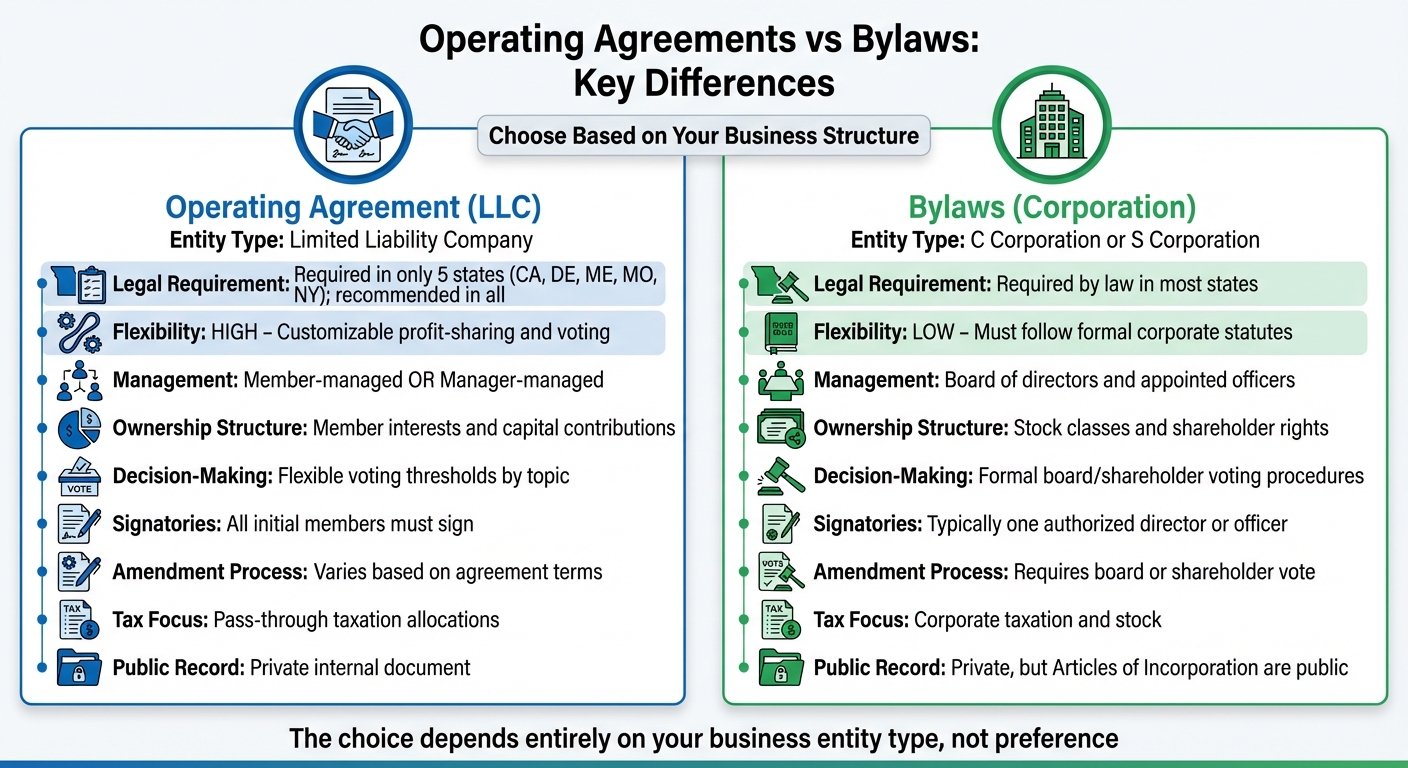
Operating Agreements vs Bylaws: Key Differences for LLCs and Corporations
Operating agreements and bylaws both define how a business operates internally, but they are tailored to different types of entities. The choice between the two isn’t a matter of preference – it depends entirely on your business structure. LLCs use operating agreements, while corporations rely on bylaws for governance. This distinction forms the foundation for understanding how they differ in function and application.
One major difference is flexibility. Operating agreements act as binding contracts between LLC members, allowing owners to customize profit-sharing arrangements beyond their ownership percentages. Bylaws, on the other hand, must stick to formal corporate rules set by state law, with ownership defined by stock classes and shareholder rights.
Management structures also vary significantly. LLCs can choose between a member-managed setup, where all owners participate in decision-making, or a manager-managed model. Corporations, however, follow a more rigid hierarchy: shareholders elect directors, directors appoint officers, and officers handle day-to-day operations.
Legal requirements further set these documents apart. Only five states legally require LLCs to have operating agreements, though having one is highly recommended. For corporations, bylaws are a legal necessity in most states.
Comparison Table: Operating Agreements vs. Bylaws
| Feature | Operating Agreement (LLC) | Bylaws (Corporation) |
|---|---|---|
| Entity Type | Limited Liability Company | C Corporation or S Corporation |
| Legal Requirement | Required in only 5 states; recommended in all | Required by law in most states |
| Flexibility | High; customizable profit-sharing and voting | Low; must follow formal corporate statutes |
| Management | Member-managed or manager-managed | Board of directors and appointed officers |
| Ownership Structure | Member interests and capital contributions | Stock classes and shareholder rights |
| Decision-Making | Flexible voting thresholds by topic | Formal board/shareholder voting procedures |
| Signatories | All initial members must sign | Typically one authorized director or officer |
| Amendment Process | Varies based on agreement terms | Requires board or shareholder vote |
| Tax Focus | Addresses pass-through taxation allocations | Focuses on corporate taxation and stock |
| Public Record | Private internal document | Private, but Articles of Incorporation are public |
These differences highlight how operating agreements and bylaws address the unique needs of LLCs and corporations. Choosing the right document ensures compliance with legal standards while aligning with your business’s operational and governance goals. For personalized guidance on entity selection and long-term strategy, consider fractional CFO services to optimize your corporate structure.
When to Use Operating Agreements
Every LLC should have an operating agreement to outline how it functions, makes decisions, and distributes profits – even if the law doesn’t explicitly require one.
Common Scenarios for LLCs
In certain states like California, Delaware, Maine, Missouri, Nebraska, and New York, having an operating agreement is mandatory. Many banks and lenders also make it a condition for opening business accounts or approving loans. For instance, New York requires LLCs to adopt a written operating agreement within 90 days of filing their articles of organization.
For multi-member LLCs, operating agreements are crucial to avoid conflicts and override default state rules. Without one, state laws may enforce equal profit sharing, regardless of how much each member contributed. The agreement also lets you decide whether the LLC will be member-managed (where all owners participate in daily operations) or manager-managed (where specific individuals handle management duties).
In more complex setups like series LLCs – common in states like Texas – operating agreements play a critical role in succession planning. Provisions addressing events such as departure, disability, death, divorce, or disqualification ensure that liability protections for each series remain intact and prevent operational disruptions when a member’s circumstances change.
These examples show that an operating agreement is more than just a legal formality – it’s a strategic tool that provides structure and safeguards for your business.
Benefits of Operating Agreements
The advantages of having an operating agreement become clear when considering scenarios like those above. First, these agreements help protect your LLC’s limited liability status by establishing formal business practices. For example, the 1999 Delaware Supreme Court case Elf Atochem North America, Inc. v. Jaffari highlighted the importance of operating agreements in preserving limited liability and enforcing dispute resolution clauses.
Another major advantage is the flexibility they offer. Unlike corporate bylaws, operating agreements can be customized to fit your business’s specific needs. You can design profit-sharing arrangements that don’t necessarily match ownership percentages, create "distribution waterfalls" to prioritize payments for certain member classes, and set unique voting thresholds, such as requiring a supermajority for significant decisions.
"The operating agreement is what actually tells everyone how the company works behind the scenes. It is the combination of corporate bylaws and a stockholders’ agreement, all rolled into one flexible document." – Blake Cantrell, Attorney, Cantrell Law Firm
Another practical benefit relates to taxes. Since LLCs are pass-through entities, members are taxed on their share of profits, even if those profits aren’t distributed. By including a “tax distribution” clause, you can ensure members receive enough funds to cover personal tax obligations. This not only simplifies tax planning but also signals professionalism to banks, investors, and the IRS.
When to Use Bylaws
In the United States, most states require corporations to adopt bylaws, although some states leave this as an option. Even when not mandatory, bylaws are crucial for establishing a corporation as a separate legal entity and shielding shareholders from personal liability. They not only fulfill legal requirements but also provide a framework for effective corporate governance.
Common Scenarios for Corporations
Bylaws are often necessary when dealing with banks, lenders, or the Small Business Administration (SBA). These entities typically require bylaws to confirm corporate authority before opening accounts or approving financing. For example, when applying for an SBA loan, lenders review the bylaws to verify who has the authority to sign loan documents.
Bylaws are also essential for defining the structure of your board of directors. While state laws may outline broad minimum standards – like requiring at least one director – bylaws can clarify specifics such as the number of directors, term lengths, and procedures for filling vacancies. Many states also regulate officer roles and set minimum requirements for boards to ensure proper governance.
Additionally, bylaws formalize the procedures for shareholder meetings, including notice periods and quorum requirements. Most states mandate a quorum of at least a majority of directors, with a minimum threshold of one-third, to conduct official board business. Without these clear rules, corporate decisions could face legal challenges. These structured guidelines help ensure smoother operations and support the benefits outlined below.
Benefits of Bylaws
Beyond these practical applications, bylaws offer significant advantages for corporate governance.
"Corporate bylaws serve as your corporation’s internal constitution and establish the fundamental rules and procedures that govern how your business operates." – Fabrienne Bottero, Writer and Journalist
Bylaws act as a corporation’s internal rulebook, helping to protect the corporate veil, simplify decision-making, and reduce the risk of legal disputes. They prove that the business operates as a distinct legal entity, which is essential for shielding shareholders from personal liability during audits or legal challenges. Moreover, bylaws promote transparency by setting clear processes for major corporate actions, such as issuing stock, appointing officers, or declaring dividends.
"Any action that violates [bylaws] could be challenged in court." – Laura Schmidt, Wolters Kluwer
To maintain compliance, store the certified original bylaws in your corporate minute book and review them annually.
For expert guidance on drafting or updating your bylaws to meet legal requirements, visit TC Advisors at https://tcadvisorscpa.com.
Comparing Real-World Applications
Let’s dive into how operating agreements and bylaws play out in actual business scenarios, building on the legal and operational differences already discussed.
Operating agreements shine when businesses need tailored solutions for specific partnership dynamics. Take the example of a multi-partner real estate firm: ownership percentages can be adjusted to reflect varying contributions from each partner. This adaptability is especially helpful when partners bring different levels of capital or expertise to the table. For LLCs, this flexibility extends to creating profit-sharing arrangements that don’t have to align with ownership percentages – a valuable feature in many partnerships.
On the other hand, bylaws are all about structure and predictability. Many jurisdictions require corporations to have bylaws, making them essential for compliance. They also play a critical role in dealings with external parties. For instance, banks and lenders often ask for bylaws to confirm who has the authority to sign contracts or access funds.
"If your business has a clear governance structure documented in its bylaws and operating agreement, it’s a strong indicator to investors and lenders that the company is well-run and worthy of their trust." – WKFK Law
When it comes to resolving disputes, the two documents take different approaches. Operating agreements can include specific mediation clauses or even designate a "tie-breaker" vote to a neutral third party, such as an accountant. Corporations, however, rely on standardized procedures like board voting and formal shareholder meetings, which often come with defined quorum requirements.
Comparison Table: Practical Applications
| Feature | Operating Agreements (LLCs) | Bylaws (Corporations) |
|---|---|---|
| Dispute Resolution | Uses customized methods like mediation clauses or buyout provisions to reduce litigation risk. | Follows formal procedures, including board or shareholder voting and amendment processes. |
| Business Growth | Allows for flexible profit-sharing setups and adaptable management structures as new members join. | Supports growth through stock issuance, transfer restrictions, and committee creation. |
| Banking & Finance | Helps lenders identify authorized managers and confirm the company’s internal stability. | Defines which officers can sign loans, access funds, or oversee payment systems. |
Choosing the Right Document for Your Business
The type of governance document you need depends on your business structure. LLCs require operating agreements, while corporations rely on bylaws – both are tied directly to your legal framework.
When deciding, think about how your business operates. For example, operating agreements offer flexibility in profit distribution, allowing allocations based on actual capital contributions. On the other hand, bylaws suit businesses aiming for a more structured approach, especially when raising funds through stock issuance.
State laws also play a role. Many states, like Delaware and New York, require corporations to have bylaws. Similarly, states such as California, New York, Missouri, and Maine mandate operating agreements for LLCs. Even if you run a single-member LLC, having an operating agreement helps solidify its status as a separate legal entity.
Before seeking financing, ensure your governance documents are complete and signed. Lenders, banks, and investors often expect these documents to confirm your business’s leadership structure and overall stability.
Lastly, align your governance documents with your formation paperwork – Articles of Organization for LLCs or Articles of Incorporation for corporations. Regularly review these documents, especially after major changes, to avoid conflicts. Keep all amendments documented and signed. This proactive approach not only meets legal requirements but also strengthens your business’s operational foundation and credibility.
FAQs
Can an LLC use bylaws instead of an operating agreement?
No, an LLC cannot use bylaws in place of an operating agreement. Bylaws are created for corporations to define their internal rules and governance, while operating agreements are tailored specifically for LLCs. An operating agreement lays out key details like the LLC’s management structure, how profits are divided, and the responsibilities of its members. Unlike corporations, LLCs usually need an operating agreement and cannot replace it with bylaws.
What happens if I don’t have an operating agreement or bylaws?
Without clear documentation like an operating agreement or bylaws, your business could run into serious challenges. These include confusion over management structure, unclear ownership roles, and a lack of defined procedures. Such gaps can lead to internal disputes, legal complications, and even non-compliance with state regulations. This is particularly critical for LLCs, as many states legally require them to have an operating agreement in place. Having these documents ensures clarity and helps keep your business running smoothly.
When should I update my operating agreement or bylaws?
Keeping your operating agreement or bylaws updated is crucial whenever your business undergoes major changes. This includes shifts in ownership, management, structure, or adjustments due to new legal requirements. Regular updates ensure these documents accurately represent your current operations and safeguard your interests effectively.


