

Handling payroll taxes is a legal obligation for U.S. employers. Missing deadlines or filing incorrect forms can lead to penalties and financial strain. To stay compliant, you need to understand these five key payroll tax forms:
- Form W-4: Determines federal income tax withholding for employees.
- Form W-2: Summarizes annual wages and taxes for employees and the SSA.
- Form 941: Reports quarterly federal income tax and FICA taxes.
- Form 940: Covers annual FUTA taxes, paid solely by employers.
- Form 1099-NEC: Reports payments of $600 or more to independent contractors.
These forms ensure proper tax withholding, reporting, and compliance with IRS requirements. Below, we break down each form’s purpose, filing process, and key deadlines.
1. Form W-4: Employee’s Withholding Certificate
Purpose and Use of the Form
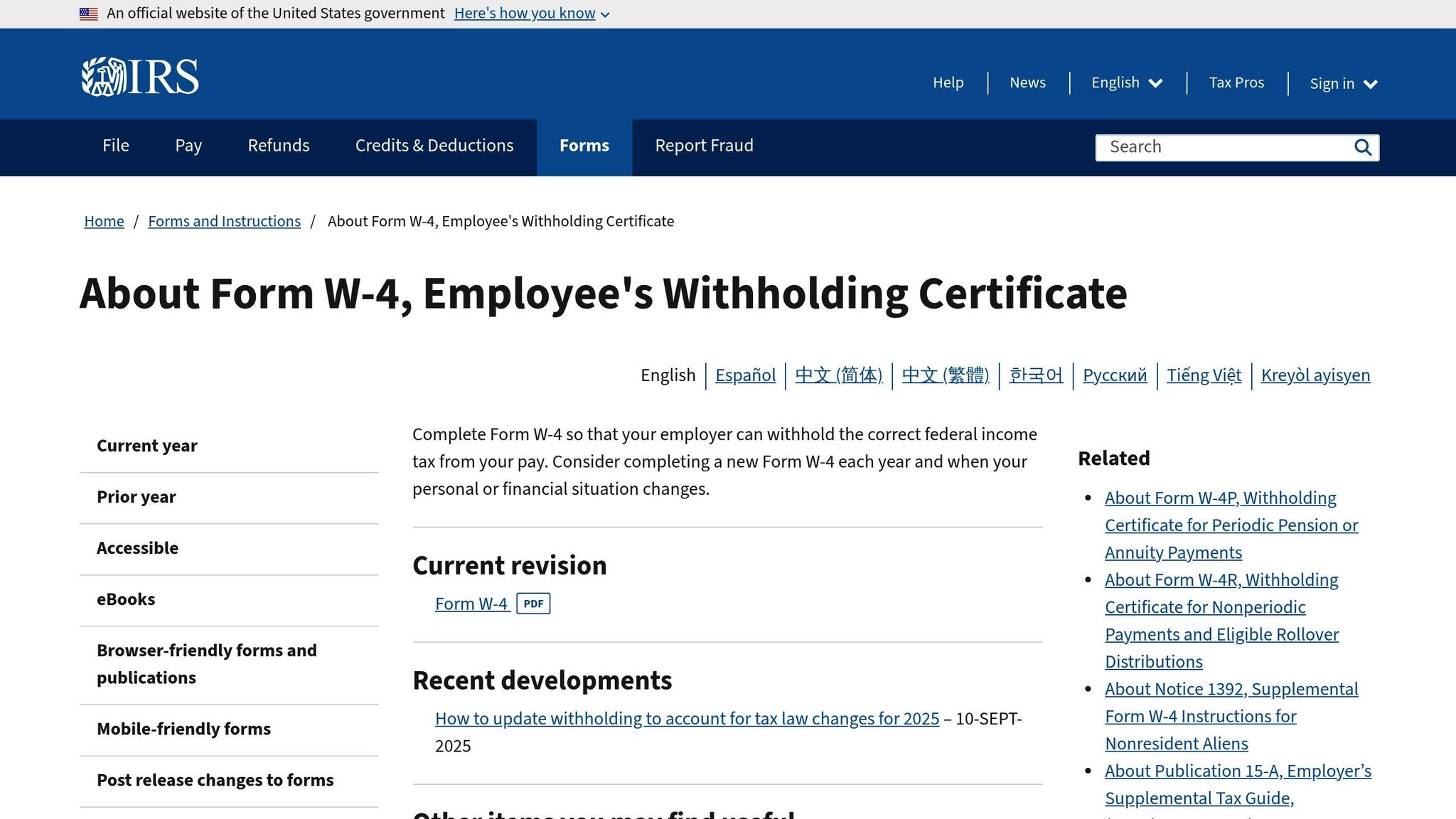
Form W-4 plays a key role in ensuring accurate federal income tax withholding from employee paychecks. It allows employees to provide details such as filing status, dependents, and any additional amounts they want withheld. These details guide your payroll system in calculating the correct amount of federal income tax to withhold. It’s important to note that Form W-4 only affects federal income tax withholding, not other types of taxes.
When employees fill out this form correctly, they’re less likely to face surprises like a big tax bill or an overly large refund at tax time. This also helps streamline payroll processing and minimizes withholding errors.
In 2020, the IRS introduced a redesigned Form W-4, replacing the old system of "withholding allowances." The updated form now asks employees to provide specific dollar amounts for dependents and deductions. It’s organized into five steps that gather essential tax information: personal details and filing status, adjustments for multiple jobs, dependent credits, additional income or deductions, and the employee’s signature. Most employees typically complete Steps 1, 3, and 5, while Steps 2 and 4 are for more complex tax situations.
Who Completes and Files the Form
Employees are responsible for completing and signing their W-4 forms. Employers must collect, store, and use these forms to calculate payroll withholding. However, these forms aren’t filed with the IRS unless specifically requested during an audit or compliance review.
If you work with a payroll provider or a CPA firm like TC Advisors, they can help you manage W-4 data efficiently. This can be especially helpful for small and mid-sized businesses that may not have dedicated HR teams.
Key Deadlines and Filing Requirements
You need to have a completed Form W-4 on file before processing an employee’s first paycheck. If an employee doesn’t submit one, you’ll need to withhold taxes at the default single filer rate. While this default protects your business, it’s always better to ensure the form is completed during onboarding.
When an employee submits a new or updated W-4, you must implement the changes by the start of the first payroll period ending on or after 30 days from the date you received the form. For instance, if you receive a new W-4 on January 15th and your payroll periods end every other Friday, the updated withholding must take effect in the first payroll period ending on or after February 14th.
Keep W-4 forms on file for at least four years after the associated taxes are due or paid. Encourage employees to review and update their W-4 annually, especially during year-end planning or after major life events like marriage, divorce, having a child, or taking on an additional job.
Accurate W-4 management is just one piece of the payroll puzzle. Don’t forget to ensure precision with annual wage reporting, such as on Form W-2.
Common Challenges for Small Businesses
Small businesses often face hurdles when managing Form W-4. Missing or incomplete forms can force you to default to withholding rules that may not match an employee’s actual tax situation. Additionally, employees sometimes misunderstand Step 2 (for multiple jobs) and end up claiming too little withholding, which can lead to underpayment penalties or unexpected tax bills.
Delays in updating payroll systems can also cause incorrect withholding across multiple pay periods, affecting both the employee’s take-home pay and your quarterly tax filings.
Another tricky area is avoiding the temptation to give personalized tax advice. While you can explain how the form works, it’s best to direct employees to tools like the IRS Tax Withholding Estimator and the official W-4 instructions for guidance.
To address these challenges, include W-4 completion as part of your onboarding process and consider using electronic payroll systems that flag missing forms and automatically update data. Train your team to collect forms efficiently and refer employees to IRS resources or their personal tax advisors for specific questions. For more complex payroll needs, partnering with experts like TC Advisors can make W-4 management much smoother.
2. Form W-2: Wage and Tax Statement
Purpose and Use of the Form
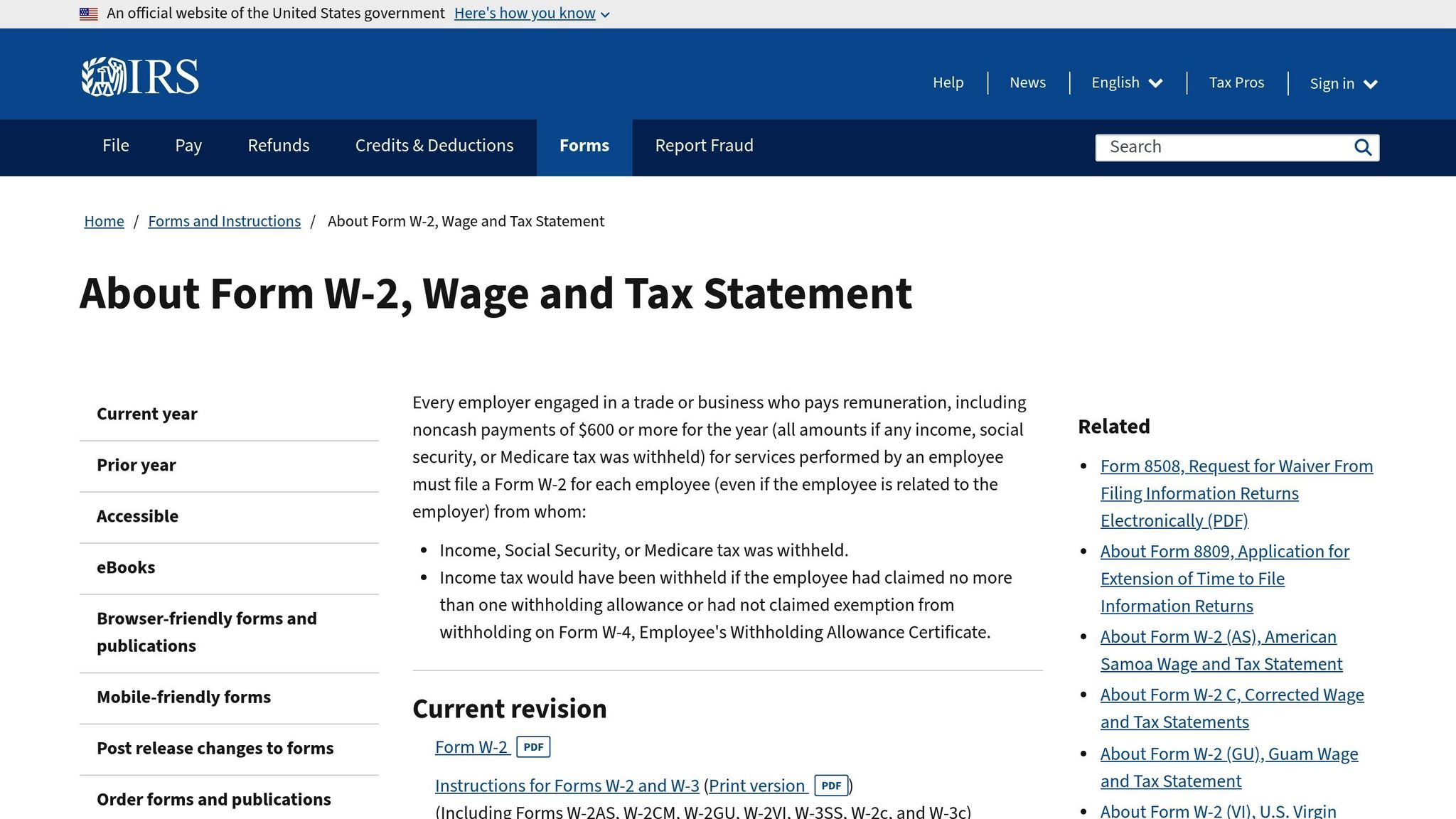
Form W-2 is a critical document for employees and employers alike. It provides a detailed summary of an employee’s annual wages and the taxes withheld during the calendar year. This includes federal income tax, Social Security tax, Medicare tax, and any applicable state and local taxes. It also covers additional compensation details like taxable fringe benefits and retirement contributions, which employees need when filing their taxes.
The IRS and Social Security Administration (SSA) use the W-2 to ensure payroll taxes are correctly reported and withheld. For employees, it serves as the official record of their earnings and tax withholdings. The SSA also relies on this information to calculate future Social Security and Medicare benefits.
Unlike Form W-4, which employees complete to determine how much tax should be withheld, the W-2 is a year-end summary that reflects the actual payroll activity for the year. It aligns payroll data with quarterly filings, ensuring everything adds up correctly.
Who Completes and Files the Form
Employers are responsible for filing a W-2 for each worker paid $600 or more in wages subject to taxes. This applies to employees on payroll who have taxes withheld and are covered by FICA. Many small business owners consult CPAs or payroll advisors to ensure they classify workers correctly under IRS rules.
Employers must submit Copy A of the W-2 to the SSA, along with Form W-3 (the transmittal form), provide employees with copies (B, C, and 2, as needed), and retain a copy for their records. Filing electronically through the SSA’s Business Services Online platform simplifies the process and helps minimize errors.
Key Deadlines and Filing Requirements
The deadlines for Form W-2 are straightforward:
- Provide copies to employees by January 31.
- File W-2s with the SSA by January 31.\
For example, W-2s for the 2025 tax year must be distributed to employees and filed with the SSA by January 31, 2026.
Missing deadlines or filing incorrect W-2s can lead to per-form penalties from the IRS. These fines increase the longer it takes to correct errors and can be more severe for intentional disregard. For small businesses with multiple employees, these penalties can quickly add up, especially if under-withholding issues are discovered.
Employers can file electronically using SSA-approved systems, though paper filing is still an option for smaller volumes. The IRS requires employers to keep employment tax records for at least four years after the tax becomes due or is paid, whichever is later. This includes copies of W-2s, W-3 forms, and payroll records.
To avoid discrepancies with the IRS or SSA, ensure W-2 totals match quarterly filings like Form 941 (or Form 944). Compare year-end payroll reports with filed 941s, adjust for pre-tax benefits, and correct any errors before submitting the W-2s.
Common Challenges for Small Businesses
Preparing W-2s can be tricky for small businesses. Common mistakes include misspelled employee names, incorrect Social Security numbers, wrong addresses, and misreporting taxable versus nontaxable benefits. Errors also occur when amounts are placed in the wrong boxes, such as forgetting to include pre-tax deductions or taxable fringe benefits.
Take, for example, a small retail shop with five employees: four hourly workers and one manager who receives employer-paid group-term life insurance exceeding the tax-free threshold. Throughout the year, the employer tracks wages, overtime, taxes, and the taxable portion of the manager’s life insurance using payroll software. In January, they reconcile payroll reports with the four Forms 941, confirm the taxable life insurance is included in Box 1 wages and the appropriate FICA boxes, and generate W-2s. Copies are provided to employees and filed electronically with the SSA by January 31. This highlights how even small benefit arrangements must be accounted for in W-2 reporting to stay compliant.
To minimize errors, verify employee names and Social Security numbers during onboarding. Regularly reconcile payroll reports with quarterly Form 941 filings throughout the year, not just in December. Use reliable payroll software that automatically maps earnings and deductions to the correct W-2 boxes, and run test reports in December to catch discrepancies early.
Keeping employee records updated throughout the year simplifies W-2 preparation. Set internal deadlines before January 31 to review and fix any issues. Start the process early in January to avoid last-minute stress.
For businesses with employees in multiple states, retirement plans, or complex benefits, partnering with a CPA or payroll specialist can reduce errors. Firms like TC Advisors specialize in helping small and mid-sized businesses streamline payroll processes, coordinate W-2s with other forms like 941 and 940, and implement modern accounting systems. Integrating W-2 preparation into a broader tax and cash-flow strategy can help businesses avoid penalties and last-minute headaches.
What Payroll Forms Need to be Filed at the End of 2024 – Annual Payroll Filings – W2
3. Form 941: Employer’s Quarterly Federal Tax Return
Once employers wrap up summarizing annual wages on Forms W-2 and W-3, the next step is filing Form 941 to reconcile quarterly payroll taxes.
Purpose and Use of the Form
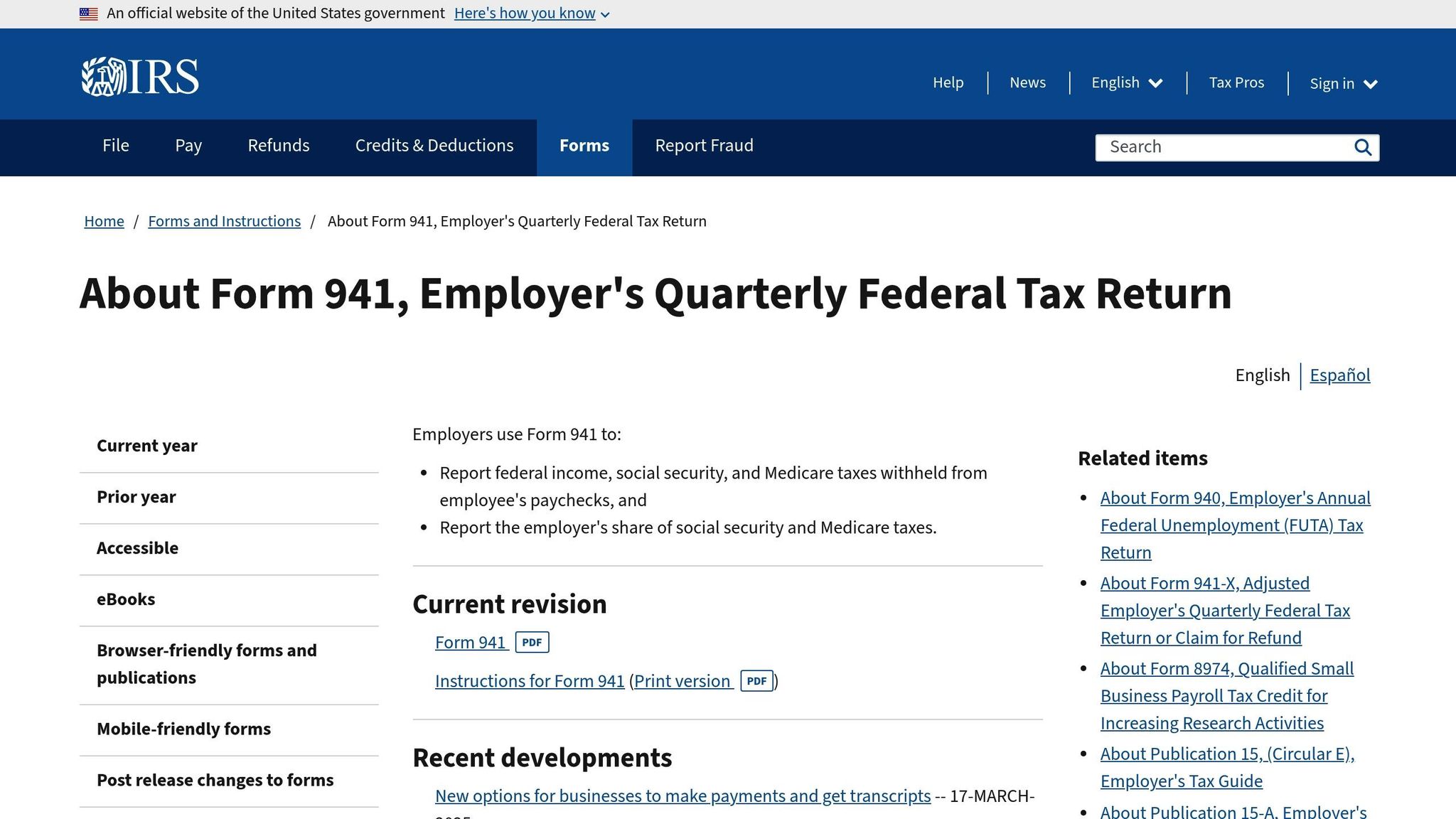
Form 941, also known as the Employer’s Quarterly Federal Tax Return, is used to report and reconcile federal payroll taxes every three months. It accounts for federal income tax withheld from employees’ paychecks, as well as both the employee and employer portions of Social Security and Medicare taxes (together referred to as FICA).
Each quarter, this form summarizes total wages, taxable tips, employee counts, and any adjustments, such as sick pay or tax credits. For businesses claiming the small business payroll tax credit, Form 8974 should be attached. The IRS uses this data to ensure the correct amounts have been withheld and deposited throughout the quarter. By the end of the year, the totals from all four quarterly filings should align with the combined figures on Forms W-2 and W-3.
Who Completes and Files the Form
Any U.S. employer withholding federal income or FICA taxes from employee paychecks is required to file Form 941 quarterly. This obligation covers most small businesses, including restaurants, retail shops, startups, and professional service firms.
However, there are exceptions. Employers with annual employment tax liabilities of $1,000 or less, as determined by the IRS, may file Form 944 annually instead of quarterly. Seasonal employers only file Form 941 for quarters when they pay wages, as specified by the IRS. Additionally, household employers use Schedule H (Form 1040), and agricultural employers file Form 943.
While employers are responsible for filing the form, many small businesses rely on payroll service providers or CPAs to ensure accuracy. Employers must also determine their deposit schedule – monthly or semiweekly – based on their lookback period liability and meet quarterly deadlines to stay compliant.
Key Deadlines and Filing Requirements
Form 941 must be filed quarterly, adhering to the following deadlines:
- 1st quarter (January 1–March 31): due April 30
- 2nd quarter (April 1–June 30): due July 31
- 3rd quarter (July 1–September 30): due October 31
- 4th quarter (October 1–December 31): due January 31 of the following year
These deadlines are separate from tax deposit schedules. Throughout the quarter, employers must deposit withheld federal income tax and FICA taxes according to their assigned schedule – either monthly or semiweekly. Larger employers may also need to file Schedule B (Form 941) to report daily tax liabilities. Missing deposit deadlines can result in penalties, even if the return itself is filed on time.
Form 941 can be filed electronically through IRS-approved e-file providers, and payments are made electronically as well. For many small businesses, the most efficient approach combines e-filing with EFTPS deposits, often automated through a payroll service provider or CPA.
Common Challenges for Small Businesses
Despite the structured process, completing Form 941 can still pose challenges. One frequent issue is misclassifying employees as independent contractors, leading to incorrect reporting via Form 1099-NEC. This mistake can trigger IRS inquiries or result in back taxes.
Calculation errors are another common problem. Businesses may miscalculate Social Security wage bases, overlook the Medicare Additional Tax for higher earners, or fail to report taxable tips and fringe benefits accurately. For example, an employer with three employees earning $60,000 in total wages would need to withhold $3,720 for Social Security (6.2%) and $870 for Medicare (1.45%), with the employer matching these amounts for a total tax of $9,180. These amounts must align with deposits made via EFTPS during the quarter, showing either a balance due or an overpayment.
Late deposits are another pitfall. Even if the paper return is filed on time, failing to deposit taxes on schedule can result in penalties. Additionally, discrepancies between Form 941 totals and year-end Forms W-2 and W-3 can lead to IRS follow-ups. Penalties for these errors might include failure-to-file, failure-to-pay, and failure-to-deposit charges, along with interest on any unpaid amounts.
To avoid these issues, employers should make Form 941 part of their quarterly payroll process. This includes verifying gross wages, taxable wages, and withholdings from payroll records, reconciling these figures with bank records and tax deposits, and ensuring the quarterly filings match year-end totals on Forms W-2 and W-3. Keeping detailed records, such as pay registers and deposit confirmations, can simplify any IRS or Social Security Administration inquiries.
For many businesses, professional assistance is invaluable. Whether hiring employees for the first time, adjusting to changes in deposit schedules due to business growth, or handling complex compensation structures like tips, bonuses, or benefits, a CPA firm can help. Firms like TC Advisors assist with setting up payroll tax processes, preparing and e-filing accurate Forms 941, reconciling quarterly and year-end filings, and planning for payroll tax deposits. This guidance helps small and mid-sized businesses stay compliant, avoid penalties, and integrate payroll tax management into their broader financial strategies.
sbb-itb-85dd802
4. Form 940: Employer’s Annual Federal Unemployment Tax Return
Once quarterly Form 941 filings are done, employers have another crucial year-end task: filing Form 940. This form is essential for reporting and paying the federal unemployment (FUTA) tax, which funds unemployment benefits for workers who lose their jobs.
Purpose and Use of the Form
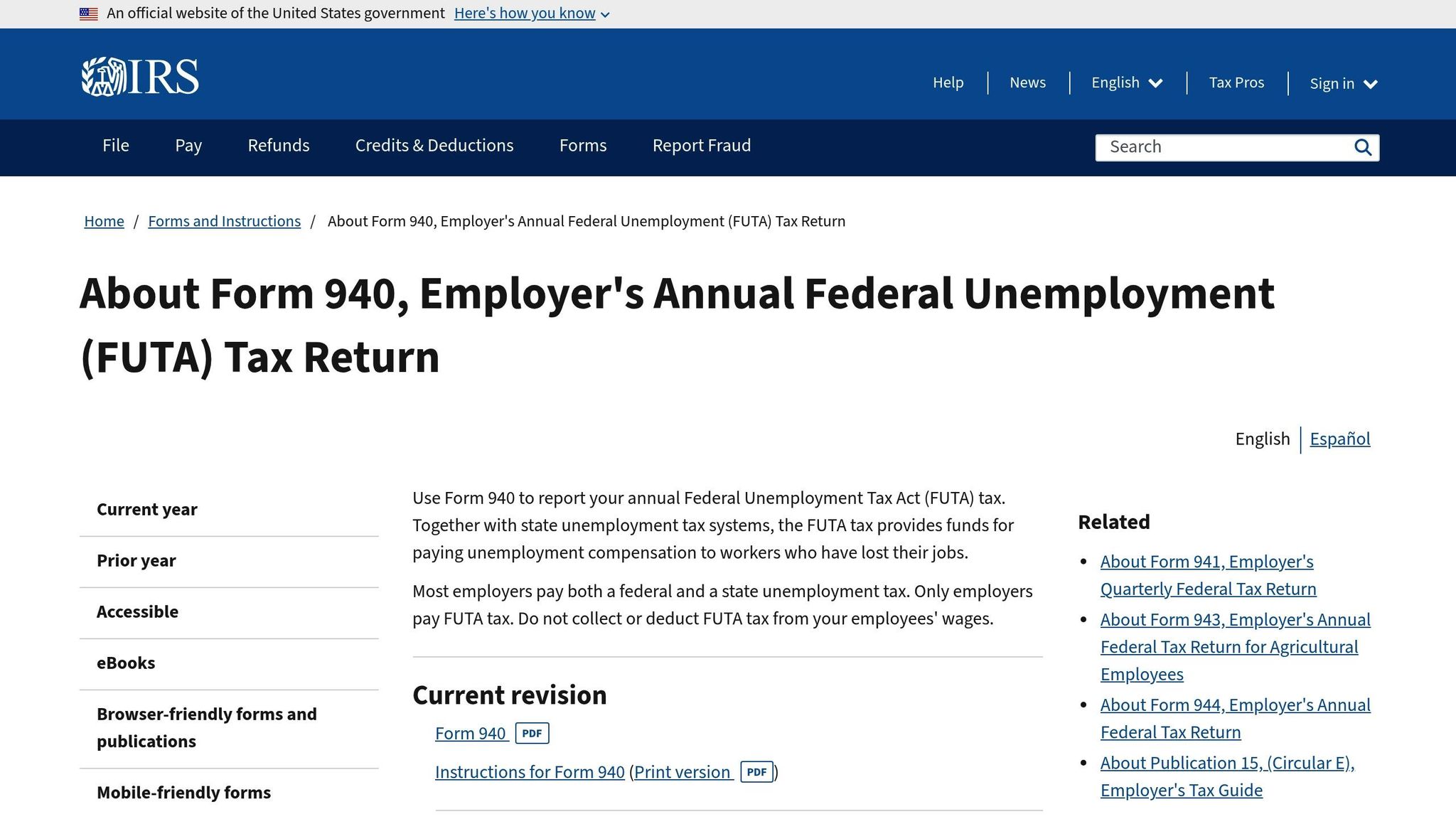
Form 940, also known as the Employer’s Annual Federal Unemployment (FUTA) Tax Return, helps businesses calculate and report their FUTA tax liability. This tax is entirely employer-funded and applies to the first $7,000 of each employee’s wages. While the standard rate is 6.0%, timely state unemployment tax payments usually reduce it to 0.6%, or $42 per employee. However, employers in credit reduction states – states with outstanding federal unemployment loans – may pay a higher effective rate.
Who Completes and Files the Form
Most employers in the U.S. must file Form 940 if they pay $1,500 or more in wages during any calendar quarter or have at least one employee working part of a day in 20 or more weeks of the year. For instance, a small business that hires its first employee and pays $500 per month would hit this threshold by April.
Special rules apply to certain employers. Household employers may use Schedule H with their Form 1040, and agricultural employers follow different filing requirements. Businesses that hire only independent contractors generally don’t owe FUTA tax or need to file Form 940.
Form 940 is typically prepared by the business owner, an in-house bookkeeper, or an external payroll provider. Many small businesses prefer to work with a CPA firm to ensure accurate coordination with state unemployment taxes and alignment with other payroll forms, like W-2s and Forms 941. For companies operating in multiple states or dealing with frequent employee turnover, professional help – such as services from TC Advisors – can streamline FUTA planning and integrate it into broader tax strategies.
Key Deadlines and Filing Requirements
Form 940 is an annual filing, generally due by January 31 for the previous calendar year (e.g., the 2024 form is due January 31, 2025). If all FUTA deposits are made on time throughout the year, the filing deadline extends to February 10.
Unlike quarterly federal tax returns, FUTA deposit rules have specific thresholds. Employers must track their FUTA liability each quarter. If the liability exceeds $500 in a quarter, the excess must be deposited by the end of the following month using the Electronic Federal Tax Payment System (EFTPS). If the liability is $500 or less, it can be carried forward to the next quarter. For example, a business with five employees and $35,000 in FUTA-taxable wages would owe about $210 annually. While these deadlines are clear, calculating FUTA accurately can still pose challenges.
Common Challenges for Small Businesses
Even though Form 940 is an annual requirement, it’s not without its difficulties. One common issue is misclassifying employees as independent contractors, which can result in understated FUTA wages and potential IRS scrutiny.
Errors in calculating FUTA wages are another frequent problem. For example, employers may fail to apply the $7,000 wage base correctly or overlook exemptions for certain fringe benefits. While many payroll systems automatically stop calculating FUTA once an employee exceeds the wage cap, manual payroll processes demand extra attention. Employers in credit reduction states face additional steps, as they must adjust for reduced state credits on Form 940. Missing these adjustments can lead to underpayment and penalties.
Late deposits and inconsistencies between Form 940 and other payroll records, like Forms 941 and W-2s, can also trigger IRS penalties. These include charges for failure-to-file, failure-to-pay, or failure-to-deposit, along with interest on unpaid amounts. To avoid these issues, employers should ensure their payroll systems stop calculating FUTA after the $7,000 cap and conduct thorough year-end reconciliations of payroll records.
For businesses navigating growth, adding remote employees in new states, or managing complex payrolls, working with a CPA firm can provide valuable support. Firms like TC Advisors can assist with state unemployment registrations, credit reduction monitoring, and accurate Form 940 filings. Properly managing Form 940 is a critical step in creating a solid payroll tax strategy that complements other essential filings.
5. Form 1099-NEC: Nonemployee Compensation
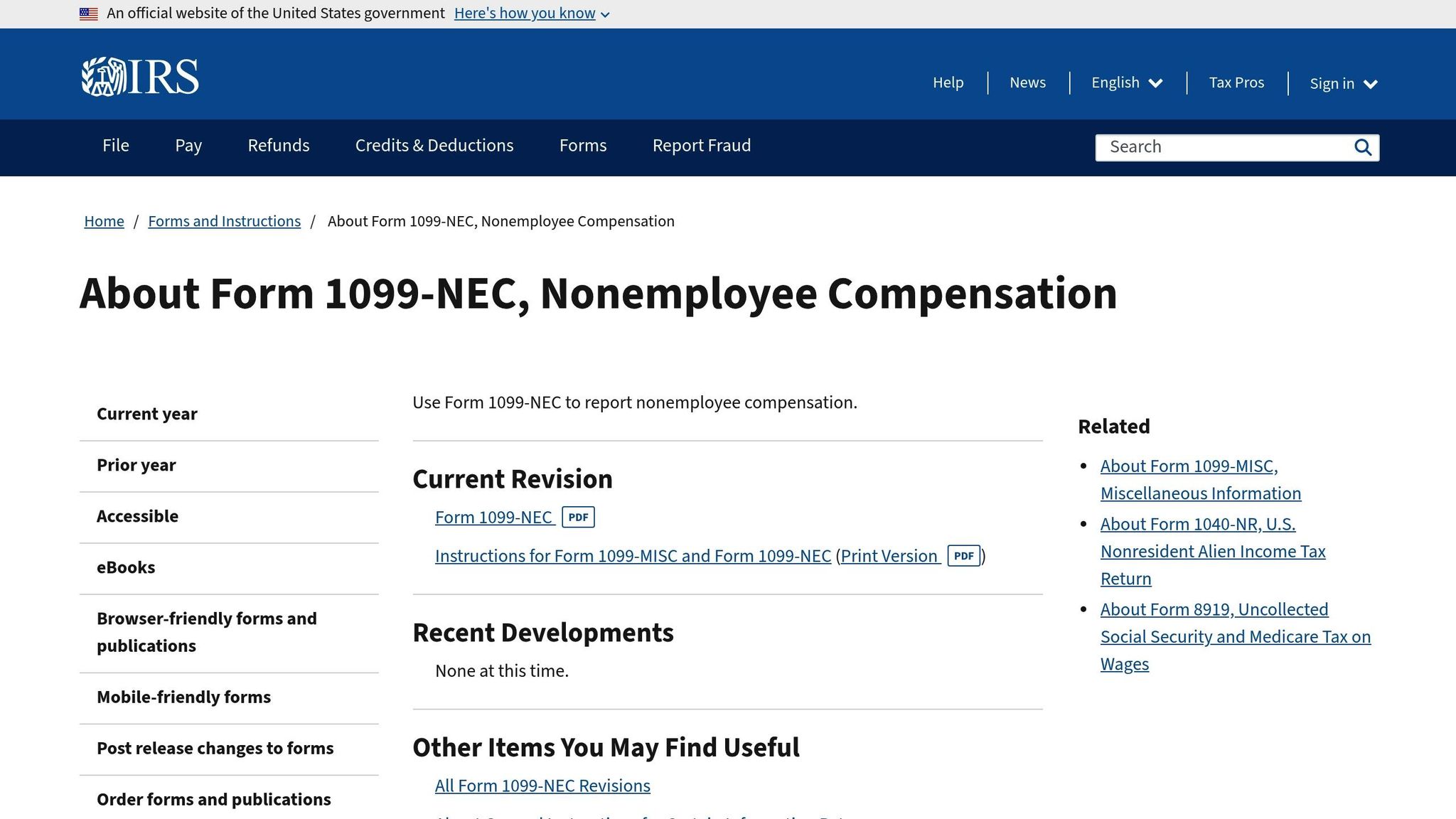
After handling employee payroll forms, many small businesses also need to tackle contractor payments through Form 1099-NEC. This form is essential for reporting payments made to independent contractors, freelancers, and other nonemployees.
Purpose and Use of the Form
Form 1099-NEC is used to report nonemployee compensation totaling $600 or more in a single year. It applies to payments for services, commissions, prizes, and other work-related earnings for individuals who aren’t employees. Introduced in 2020, this form replaced the practice of reporting contractor payments on Form 1099-MISC, which often led to confusion.
For example, if a small marketing agency pays an independent graphic designer $2,500 for several projects in 2025, they must issue a Form 1099-NEC since the total exceeds $600. Unlike employees, contractors receive their full payment without tax withholding, and they use the form to report income and calculate self-employment taxes on their personal returns. Misclassifying employees as contractors can lead to IRS penalties, back taxes, and additional scrutiny.
Who Completes and Files the Form
The payer – typically the business or individual making the payment – is responsible for preparing and filing Form 1099-NEC. This task often falls to business owners, in-house bookkeepers, or external accountants. The process involves sending Copy B to the contractor and filing Copy A with the IRS. If filing on paper, this is usually done alongside Form 1096.
Some states also require a copy for state income tax purposes. Certain states participate in the IRS Combined Federal/State Filing Program, allowing businesses to submit one electronic filing for both federal and state requirements. However, others require direct filing with the state, so businesses should check their specific state regulations to stay compliant.
To streamline the process, businesses should collect a Form W-9 from each contractor before making payments. This form gathers key details like the contractor’s legal name, address, and Taxpayer Identification Number (TIN). Filing without accurate W-9 information can lead to errors, IRS mismatch notices, or even backup withholding requirements.
For businesses managing multiple contractors or operating in different states, professional help can be a game-changer. A CPA, such as TC Advisors, can assist with worker classification, maintaining accurate records, and navigating complex multi-state filing requirements.
Key Deadlines and Filing Requirements
Form 1099-NEC has a strict filing deadline of January 31 following the payment year. This deadline applies to both providing copies to contractors and filing with the IRS, regardless of whether the filing is done electronically or on paper. For the 2025 tax year, all forms must be issued and filed by January 31, 2026.
Given the tight timeline, businesses need to finalize contractor payment totals early in January. Extensions are not available for Form 1099-NEC. Additionally, businesses filing 10 or more information returns in a year (including all 1099s and W-2s) must file electronically to minimize errors and speed up processing.
Failing to file accurate forms on time can result in penalties ranging from $60 per form when corrected within 30 days to $330 per form after August 1 for 2025 returns filed in 2026, rising to $340 for 2026 returns. These penalties can add up quickly if multiple contractors are involved. To avoid issues, businesses should maintain detailed payment records throughout the year, ideally using accounting or payroll software that flags vendors as they approach the $600 threshold.
Common Challenges for Small Businesses
One major challenge is worker misclassification. Misclassifying employees as contractors to avoid payroll taxes is illegal and can lead to back taxes, penalties, and interest. The IRS evaluates factors like behavioral control, financial control, and the overall relationship between the business and the worker to determine proper classification. When unsure, consulting a CPA or employment tax specialist is wise.
Another common issue is inaccurate reporting. Payments made via credit card or third-party networks are reported on Form 1099-K, not 1099-NEC. Additionally, failing to collect accurate TINs and legal names upfront can result in errors and IRS notices. Using Form W-9 before making the first payment helps prevent these problems.
For small and mid-sized businesses, integrating contractor management, payroll, and bookkeeping into one system can simplify compliance. Partnering with a CPA – like TC Advisors – can also help ensure proper classification, accurate year-end reporting, and compliance with both federal and state requirements. Keeping thorough documentation, including copies of 1099-NECs, W-9s, contracts, and payment records, for at least three years is a smart move to protect against audits and disputes.
Managing Form 1099-NEC effectively is a critical part of a business’s overall payroll strategy. While contractors handle their own tax obligations, businesses must ensure proper classification and timely reporting to avoid penalties and maintain compliance. Staying organized and proactive helps ensure all workers are properly documented and all required forms are filed accurately and on time.
Form Comparison Table
Managing payroll tax forms can feel overwhelming, especially with their varied purposes and deadlines. A clear side-by-side comparison makes it easier to understand which form applies to specific payroll scenarios, ensuring nothing gets overlooked.
Here’s a quick breakdown of Forms W-2, 1099-NEC, 941, and 940 to help you stay on top of your payroll obligations:
| Form | Worker Type / Purpose | Taxes or Payments Reported | Who Files | Who Receives Copies | Filing Frequency | Standard IRS Deadline | Common Use Case |
|---|---|---|---|---|---|---|---|
| W-2 | Employees earning wages or salary | Federal income tax, Social Security, and Medicare withheld; employer Social Security and Medicare contributions | Employer | Employee and Social Security Administration (SSA) | Annual | 01/31 | Paying a salaried office assistant |
| 1099-NEC | Independent contractors or nonemployees | Nonemployee compensation of $600 or more; no payroll tax withholding | Employer (payer) | Contractor and IRS | Annual | 01/31 | Hiring a freelancer for a project costing over $600 |
| 941 | Employer’s quarterly federal tax return | Federal income tax withheld, plus employee and employer Social Security and Medicare (FICA) taxes | Employer | IRS only | Quarterly | 04/30 (Q1), 07/31 (Q2), 10/31 (Q3), 01/31 (Q4) | Withholding federal income and FICA taxes from employee paychecks |
| 940 | Employer’s annual federal unemployment tax return | Federal Unemployment Tax Act (FUTA) tax (paid by employer only) | Employer | IRS only | Annual | 01/31 (or 02/10 if FUTA was fully deposited on time) | Reporting FUTA tax after paying $1,500+ in wages during any quarter |
This summary highlights how each form fits into your payroll process, helping you handle tax reporting more effectively.
Key Distinctions Between Employee and Contractor Forms
One of the biggest differences between Form W-2 and Form 1099-NEC lies in how workers are classified. Form W-2 applies to employees, meaning employers must withhold federal income tax, Social Security, and Medicare from each paycheck and also contribute their share of Social Security and Medicare taxes. The form reports these amounts to both the employee and the Social Security Administration.
On the other hand, Form 1099-NEC is for independent contractors or nonemployees who earn $600 or more in a year. No payroll taxes are withheld, and contractors are responsible for handling their own income and self-employment taxes when filing their personal tax returns. Misclassifying workers can result in serious IRS penalties, so if you’re unsure, it’s best to consult a CPA or tax specialist.
Understanding Employer Tax Returns: 941 vs. 940
While Forms W-2 and 1099-NEC focus on worker earnings, Forms 941 and 940 deal with the employer’s tax responsibilities and are filed directly with the IRS.
- Form 941 is filed quarterly and reports federal income tax withheld from employees, along with both the employer and employee portions of Social Security and Medicare taxes. Even if you’re unable to pay the full tax amount owed, filing on time is critical to avoid penalties.
- Form 940 is filed annually and reports only Federal Unemployment Tax Act (FUTA) taxes. FUTA is entirely paid by the employer and isn’t deducted from employee wages. This form is required if you paid $1,500 or more in wages during any quarter or had at least one employee for part of a day in 20 or more weeks during the year.
Avoiding Common Mistakes
Missteps with payroll forms can lead to audits, penalties, and unnecessary stress. Here are a few common pitfalls:
- Using Form 1099-NEC for employees instead of contractors can raise red flags with the IRS.
- Missing quarterly Form 941 deadlines is another frequent issue, as business owners sometimes focus only on annual filings. Keep track of quarterly deadlines to avoid late fees.
- Assuming Form 940 replaces Form 941 is a common misconception. Each form serves a different purpose – Form 940 reports FUTA tax, while Form 941 covers federal income tax withholding and Social Security/Medicare taxes. Both forms are often required for employers with staff.
Failing to file W-2s or 1099-NECs on time – or filing them inaccurately – can also delay workers’ personal tax returns and trigger penalties. Staying organized throughout the year and using payroll software that tracks deadlines can help you avoid these issues.
Getting Professional Help
As your business grows, managing payroll forms and tax filings can become increasingly complex. Many businesses turn to CPA firms or fractional CFO services to handle W-2s, 1099-NECs, and employer tax returns like 941 and 940. These professionals ensure timely, accurate filings and help design payroll tax strategies tailored to your needs. For example, TC Advisors offers services ranging from tax preparation to fractional CFO support, helping U.S. employers stay compliant with confidence.
Understanding these core payroll forms is crucial for staying on track with tax compliance. Knowing which form applies to each worker type and tax scenario simplifies payroll management, letting you focus on growing your business.
Conclusion
Managing payroll tax forms accurately is a must for small businesses in the U.S. These forms play a key role in ensuring compliance and smooth operations:
- Form W-4: Helps determine the correct amount of federal income tax to withhold from employees’ paychecks.
- Form W-2: Summarizes annual wages and taxes for employees and the Social Security Administration, serving as the basis for tax returns and Social Security benefits.
- Form 941: Tracks quarterly federal income tax withholding, along with Social Security and Medicare taxes, for both employees and employers.
- Form 940: Covers annual Federal Unemployment Tax Act (FUTA) taxes, which are paid entirely by the employer.
- Form 1099-NEC: Reports payments to independent contractors, aiding the IRS in monitoring income and reducing underreporting.
Together, these forms address the core of your payroll tax responsibilities.
But filing forms is just the start. Keeping detailed records – like W-4s, payroll registers, deposit confirmations, and past filings – makes responding to IRS inquiries and future filings much easier. Meeting deadlines is equally critical to avoid penalties and interest. With strong documentation and punctual filing, your business can handle tax obligations while staying focused on growth.
For businesses navigating growth, payroll compliance needs to be part of a bigger financial strategy. That’s where TC Advisors comes in. They offer year-round support to streamline payroll management alongside cash-flow forecasting, tax planning, and compensation strategies. By partnering with experts, you can focus on scaling your business while staying compliant and ahead of the curve.
FAQs
What happens if I incorrectly classify an employee as an independent contractor on Form 1099-NEC?
Misclassifying an employee as an independent contractor can bring about some hefty consequences. The IRS may hit you with penalties, charge interest on unpaid payroll taxes, and even demand repayment of wages, including overtime if it applies. On top of that, you might face legal battles and audits, both of which can drain your time and resources.
To steer clear of these headaches, take the time to familiarize yourself with the IRS rules for worker classification. If you’re uncertain about where a worker falls, reaching out to a CPA or tax professional can provide clarity and help safeguard your business from avoidable risks.
What steps can small businesses take to meet payroll tax form deadlines and avoid penalties?
Small businesses can keep up with payroll tax form deadlines by using a few practical strategies. Start by creating a comprehensive calendar that clearly marks all important filing dates, like quarterly and annual deadlines, so you don’t miss anything. Another smart move is to use payroll software. Automating these processes not only helps you track due dates but also reduces the chance of costly mistakes.
For more tailored advice, consider partnering with a trusted CPA firm. They can offer expert guidance, simplify complicated tax rules, and ensure your filings are accurate and submitted on time – helping you avoid penalties and stay compliant.
How can employers ensure employees complete Form W-4 accurately and avoid common withholding mistakes?
To help employees complete Form W-4 accurately and reduce withholding mistakes, employers should offer clear guidance and helpful resources. One valuable tool to recommend is the IRS Tax Withholding Estimator. This online resource assists employees in calculating the correct withholding amount based on their unique financial situation. It’s also important to remind employees to update their Form W-4 whenever they go through significant life changes, like getting married, having a child, or starting a second job.
Employers can play a proactive role by carefully reviewing submitted forms to ensure they’re complete and easy to read before processing payroll. Including a quick overview or a simple FAQ about Form W-4 during onboarding can make the process less intimidating and help employees understand its purpose. Regularly revisiting withholding practices not only ensures compliance with IRS rules but also helps prevent tax-related complications in the future.


