

When a merger concludes, tax compliance becomes a top priority to avoid penalties, protect the deal’s value, and ensure smooth integration. Here’s what you need to know:
Key Steps for Post-Merger Tax Compliance:
- Immediate Actions (First 30 Days):
- File final tax returns for legacy entities (e.g., Forms 1120, 1120S, 1065).
- Notify the IRS of structural changes and obtain new EINs if needed.
- Ensure payroll tax compliance and meet deadlines to avoid penalties.
- Multi-State Tax Compliance (Days 1-60):
- Conduct a nexus study to determine tax obligations in different states.
- Update state registrations for tax collection and payroll purposes.
- Adjust payroll systems to account for multi-state operations.
- Reconciliation and Documentation (Days 30-90):
- Reconcile payroll taxes and review historical tax returns for inconsistencies.
- Identify outstanding tax liens or uncertain tax positions.
- Document and align tax attributes like net operating losses (NOLs).
- Long-Term Compliance (Day 90 and Beyond):
- Create a centralized calendar for tax deadlines across jurisdictions.
- Implement an entity management system for tracking compliance.
- Schedule regular reviews to address changes in tax laws and operations.
Takeaway: Staying on top of tax compliance post-merger is critical. Early planning, accurate filings, and consistent reviews help mitigate risks and set the stage for smooth operations. Partnering with experts can simplify this complex process.
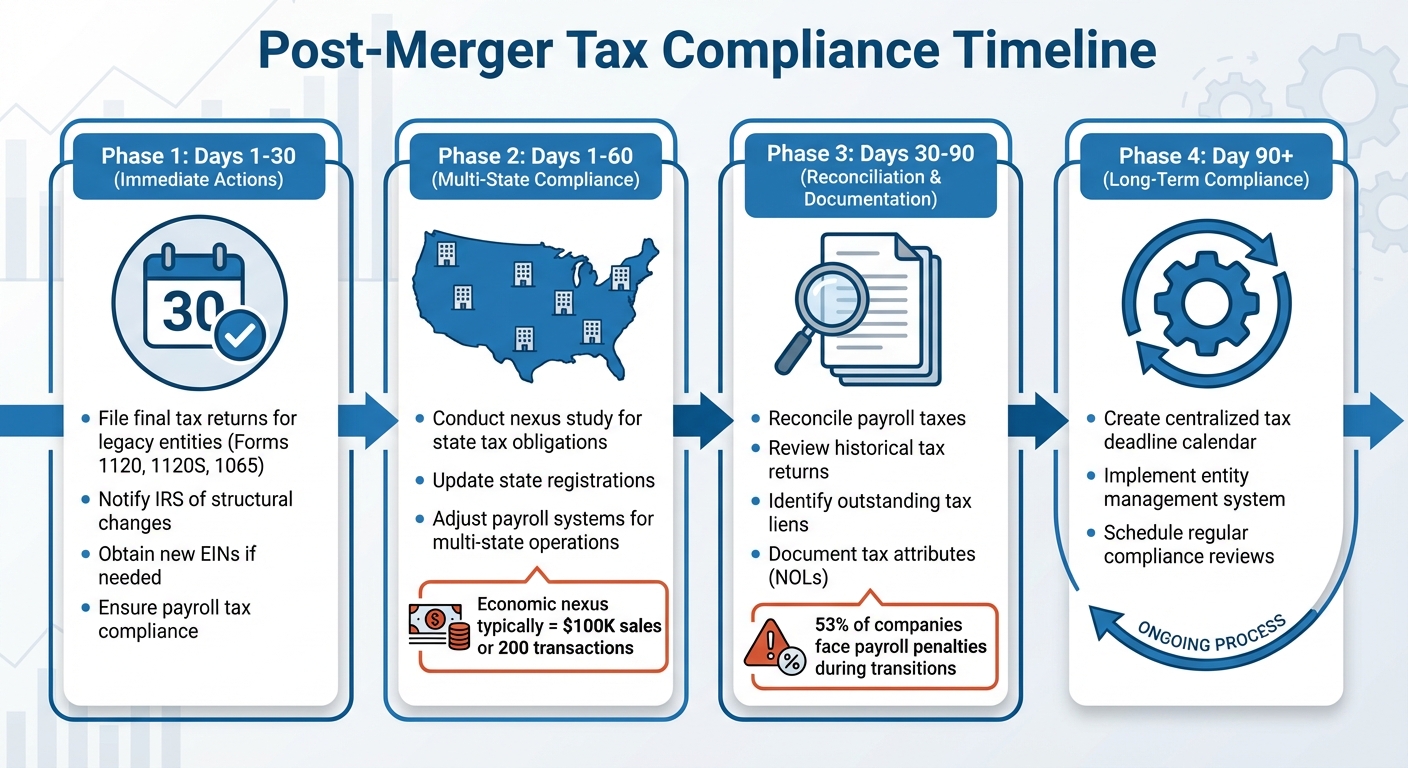
Post-Merger Tax Compliance Timeline: 90-Day Action Plan
Tax Masterclass Mergers & Acquisitions Part 2
sbb-itb-85dd802
First 30 Days: Immediate Tax Actions After Closing
The first month after closing a merger is critical for ensuring compliance with tax obligations. Missing deadlines or filing incorrectly can lead to IRS penalties and prolonged issues. During this time, your top priorities should include filing final returns for legacy entities, notifying the IRS of any structural changes, and staying on top of payroll tax reporting. These steps set the foundation for tackling more complex multi-state tax matters later.
File Final Tax Returns for Legacy Entities
Start by filing final tax returns for any legacy entities that have ceased to exist due to the merger. This includes forms like 1120 (for C-corporations), 1120S (for S-corporations), or 1065 (for partnerships). Be sure to mark "Final Return" clearly at the top of each form to alert the IRS that the entity is no longer operational. If the merger results in a shortened tax period, file a short-period return that covers only the days leading up to the merger date. Don’t forget to include Form 941 (Employer’s Quarterly Federal Tax Return) to officially close the old FEIN for payroll purposes.
Certain mergers may require additional filings. For example:
- Use Form 8594 (Asset Acquisition Statement) to report asset purchases under Section 1060.
- Submit Form 8023 for qualified stock purchases under Section 338.
- If a subsidiary is joining a consolidated group, file Form 1122 (Authorization and Consent) to provide the required authorization.
Notify the IRS and Obtain New EINs
Whether you need a new EIN depends on the type of merger. If the surviving corporation remains the same, it typically keeps its existing EIN, while the non-surviving entities retire theirs. However, if the merger creates a completely new legal entity – such as when two companies combine to form a new corporation – you’ll need to apply for a new EIN using Form SS-4. The fastest way to get a new EIN is through the IRS’s online application, though fax and mail options are available if needed.
If there’s a change in the responsible party, file Form 8822-B within 60 days to notify the IRS. For entity classification changes, such as an LLC electing to be taxed as a corporation, submit Form 8832 to stay compliant. In more complex reorganizations, you might need to draft an EIN retention letter with supporting documentation to request permission from the IRS to retain an existing EIN.
Meet Payroll and Tax Form Deadlines
Payroll tax compliance is a common stumbling block during mergers. In fact, 53% of companies have faced payroll penalties in the past five years due to missteps during transitions. One key decision involves determining whether the new entity qualifies as a "Successor" or "Non-Successor." Successors can carry over year-to-date (YTD) wages for FICA and FUTA limits, while Non-Successors must reset wage bases to zero, often leading to higher tax costs for the rest of the year.
An effective date of January 1 can simplify things by avoiding the need for dual filings. Mid-year mergers, on the other hand, require issuing two separate W-2s for each employee – one under the old FEIN and one under the new one. Before running the first payroll under the new system, conduct one or two test payroll runs to ensure the results match perfectly. Also, remind employees to download their historical pay stubs and W-2s from the old payroll system before the contract with the previous provider ends.
Days 1-60: Multi-State Tax Compliance and Registrations
The first 60 days after closing are crucial for tackling multi-state tax compliance. With the merger, your business likely operates in more jurisdictions than before. Overlooking a registration or misunderstanding tax obligations can lead to audits and penalties. This period provides the chance to address state and local compliance requirements before the first quarterly deadlines hit. Once you’ve identified the relevant tax jurisdictions, the focus shifts to updating registrations and ensuring payroll processes are aligned.
Identify Tax Jurisdictions and Nexus Obligations
Start with a nexus study to determine where the combined entity has tax obligations. Nexus can take several forms:
- Physical nexus arises from having offices, warehouses, inventory stored in third-party facilities (like Amazon FBA), or even one remote employee in a new state.
- Economic nexus kicks in when sales exceed state-specific thresholds – generally $100,000 in sales or 200 transactions within a year. However, some states like Pennsylvania set unique thresholds, such as $500,000 for income tax but $100,000 for sales tax.
- Affiliate nexus applies when related entities share resources, such as facilities, business names, or employees. Post-merger, this could mean new sales tax collection responsibilities if an in-state retailer and out-of-state seller now operate under the same corporate umbrella.
"Nexus evaluation related to acquisition activity can be tricky – not only do you need to evaluate and know each party’s nexus profile but then you have to look at it combined." – Sales Tax Institute
Additionally, review product taxability. For example, 25 states tax SaaS services, but the rules vary based on classifications like "interactive functionality" or "professional service." To support your analysis, compile 12 months of transaction data, including ship-to addresses and zip codes.
Update Business Registrations
Once nexus obligations are clear, update your registrations with state revenue agencies. The process depends on the transaction structure:
- If the target merged into the buyer’s legal entity (common in asset deals), the surviving entity must register as a new vendor in each state.
- If the target remains a separate legal entity (common in stock deals), you may only need to update existing registrations with new ownership details.
Pay close attention to fields like "date of first business" or "date nexus first established" when completing new registrations. Mistakes here can trigger questions about missed filing periods. For businesses operating in multiple states, the Streamlined Sales Tax Registration System simplifies the process by allowing registration across multiple member states with a single application.
Adjust Payroll Tax for Multi-State Operations
After updating registrations, ensure payroll accounts are adjusted for compliance across jurisdictions. Multi-state operations require separate payroll tax registrations for each state where nexus exists. This includes registering for state income tax withholding and unemployment insurance accounts. Even one remote employee working in a state can establish payroll nexus.
"Multi-state payroll usually ‘works’ at first because payroll runs and employees get paid. The failures show up later, when a team expands into new states, remote employees move, or a location change happens mid-year." – hrdecisionguide.com
Acquisitions often involve inheriting the predecessor’s unemployment insurance (UI) tax rate under state successor-in-interest rules, which may be favorable or unfavorable. New employer UI rates vary widely, typically ranging from under 1% to over 4%, depending on the state. Additionally, most states require new hires to be reported within 20 days of their start date.
To avoid payroll issues, establish a system for tracking employee work locations, especially for remote workers. Ensure your payroll system captures the correct state withholding certificates, like New York’s IT-2104. Some states, such as New York, Pennsylvania, and Arkansas, enforce a "convenience of the employer" rule, which taxes wages based on the employer’s location rather than the employee’s physical work location. This can create double-withholding obligations.
Days 30-90: Reconciliation and Documentation Review
After completing the initial compliance steps, the focus shifts to reviewing historical tax data and aligning legacy records with the newly established structure, a process often managed through fractional CFO services. While compliance work continues, this phase is essential for identifying and addressing errors that could trigger audits. The aim is to ensure past filings are accurate, pinpoint tax attributes for future use, and document any uncertain positions that might arise later.
Reconcile Payroll and Employment Taxes
Start by reconciling Forms 941 (quarterly federal payroll tax returns) and Form 940 (annual federal unemployment tax) for legacy entities. Compare these forms with payroll records and bank statements to confirm that withholdings, employer contributions, and deposits align with reported data. Apply the same level of scrutiny to state filings, such as quarterly wage reports and unemployment insurance filings.
In addition, transfer employees from legacy payroll accounts to the new system, updating bank signatories as needed. Since this migration typically occurs during the first 90 days, reconciling payroll in parallel is critical for catching discrepancies early.
"Finance teams operating in multiple jurisdictions face particularly complex compliance landscapes post-merger. Common areas requiring immediate attention include… Payroll tax jurisdiction changes." – Emily Feeley, CPA, MBA, and Richard Weiner, CPA, MST, AAFCPAs
Standardize payroll timing, expense categorization, and personnel reporting across merged entities. Audit IT systems to ensure secure access to payroll data. Coordinate with HR to finalize pending expense reimbursements and ensure the migration accounts for interactions between time/expense systems and invoicing.
Once payroll data is reconciled, move on to reviewing historical tax returns for additional inconsistencies.
Review Historical Tax Returns and Credits
After payroll reconciliation, gather and examine three years of federal and state tax returns, including associated schedules. Review Notices of Assessment and Notices of Reassessment to identify unresolved balances, IRS adjustments, or disputes.
Check for unused tax attributes, such as net operating loss carryforwards, capital cost allowance pools, or federal tax credits, which could reduce future tax liabilities. For R&D credits or other incentives, confirm eligibility by auditing project records, employee time logs, and related expenses. Be mindful of recapture provisions that could apply if project conditions change after the merger.
"Differences in accounting policies between merged entities can create significant reporting inconsistencies if not addressed early." – AAFCPAs
Evaluate employee versus contractor classifications, as misclassification can result in payroll tax penalties. Ignoring unreported foreign income during due diligence can lead to penalties exceeding $10,000 per jurisdiction. Align legacy accounts with the new structure for easier comparisons moving forward.
Identify Tax Liens and Uncertain Tax Positions
After reconciling records and reviewing historical filings, identify any outstanding tax liens or uncertain positions that could pose risks. Conduct searches for federal, state, and local tax liens. In a stock purchase, the buyer assumes all historical tax liabilities and the company’s entire tax history, making thorough lien searches especially important.
Review amended returns and correspondence with tax authorities to clarify past disputes. Assess Deferred Tax Assets (DTAs) and Deferred Tax Liabilities (DTLs), as a high valuation allowance on DTAs might signal doubts about their recoverability. Mergers often trigger recognition of deferred tax liabilities, particularly when there are differences between the book value and tax basis of acquired assets.
Set up tracking systems for contingent considerations, such as escrow releases and working capital settlements, to manage potential disputes and liabilities. Establish documentation and approval processes to support financial reporting and defend tax positions during audits. Additionally, account for state and local tax rules, which can affect the transaction’s overall cost and compliance status. For tax attributes like Net Operating Losses (NOLs) from legacy entities, remember that their use may be restricted under U.S. tax rules, such as Section 382 limitations.
"Buyers typically prefer asset purchases since with a stock purchase, all the history of the company, including any historical tax liabilities, comes along with the stock of the company." – George Batas, Sasserath & Co.
Day 90 and Beyond: Set Up Ongoing Tax Compliance Processes
Once the immediate post-merger tax issues are addressed, the focus shifts to creating a system that ensures long-term compliance. By doing so, you can avoid missed deadlines, overlooked jurisdictions, and unexpected audit risks. These ongoing efforts build on the due diligence and integration tasks, evolving into a sustainable tax management framework.
Track Annual Filings and Deadlines
With the merger complete, the organization now faces a wider range of filing requirements across federal, state, and local jurisdictions. Employment taxes alone demand attention to both annual filings (like Form 940) and periodic submissions (such as Forms 941). Missing even one deadline can result in penalties that escalate quickly, especially when multiple states are involved.
To stay organized, create a centralized calendar that outlines:
- Jurisdiction-specific requirements
- Forms and due dates
- Responsible parties
Include extensions, estimated payment deadlines, and quarterly filing obligations. For businesses with international operations, incorporate foreign income tax return deadlines and any related documentation requirements. Share this calendar with all relevant stakeholders, updating it whenever the company enters new jurisdictions or expands its footprint.
Implement an Entity Management System
As the number of entities and jurisdictions grows, managing compliance manually becomes impractical. An entity management system simplifies this by consolidating tax records, automating reminders, and maintaining audit trails. It’s also critical to standardize your general ledger, chart of accounts, and reporting structures. Align month-end close procedures and financial calendars across all entities to ensure consistent data flow.
"The objective is to select and build an integrated platform that fully aligns with the operational needs and growth ambitions of the combined organization, ensuring it is the most effective solution for the merged entity." – AAFCPAs
Within this system, establish clear approval hierarchies and segregate duties to automate compliance checks. Identify all data sources – such as general ledgers, subledgers, and bank accounts – and automate intercompany reconciliations to minimize errors and cash leakage. Use a RACI matrix (Responsible, Accountable, Consulted, Informed) to define roles for key processes like tax filings, accounts payable, and the monthly close. Aim to have all documentation audit-ready and decommission any outdated systems by Day 90.
Schedule Periodic Compliance Reviews
Once the systems and records are in place, regular compliance reviews become essential. Tax laws and business operations are constantly evolving, making quarterly reviews a practical way to spot and address potential gaps. These reviews should focus on:
- Updating internal controls and process documentation
- Revising control matrices to reflect organizational changes
- Reassigning control ownership and redefining approval limits
Standardize accounting policies across the organization, particularly for areas like revenue recognition, capitalization thresholds, and depreciation methods, to ensure consistent reporting.
"Smart finance leaders know that success hinges on methodical planning, proactive compliance management, and careful attention to the financial and technological details that can make or break the combined entity’s future performance." – AAFCPAs
Each review should also examine multi-jurisdictional risks, including sales and use tax registrations, payroll tax jurisdictions, and property tax reassessments. Test the access and reporting controls in your financial systems. Keep an eye on contingent considerations like earn-out triggers, escrow releases, and performance metrics to ensure proper financial reporting. Address unreconciled items and intercompany aging to close compliance gaps. Finally, hold weekly checkpoints to review risk and issue logs, ensuring the team stays on top of both integration progress and potential compliance challenges.
Conclusion
Post-merger tax compliance demands consistent effort starting from the moment the deal closes and continuing well into the future. Staying compliant not only protects the merger’s value but also helps avoid costly penalties in various jurisdictions. As outlined earlier, each step in this process contributes to building a strong tax management system. Tax considerations touch everything from multi-state registrations to preserving federal tax attributes, making careful planning from the start absolutely essential.
Success in this area relies on proactive planning, detailed documentation, and regular oversight. Early alignment of accounting policies is key to avoiding reporting inconsistencies. Setting up reliable tracking systems for items like earn-outs or escrow releases ensures nothing slips through the cracks. And addressing compliance in multiple jurisdictions right away can help avoid penalties in new areas of operation. This approach not only tackles immediate priorities but also sets the stage for ongoing, effective tax management.
"Smart finance leaders know that success hinges on methodical planning, proactive compliance management, and careful attention to the financial and technological details that can make or break the combined entity’s future performance." – AAFCPAs
Beyond meeting short-term obligations, successful integrations establish financial systems that support long-term growth. Updating internal controls, implementing entity management tools, and scheduling regular compliance reviews transform tax management from a reactive task into a strategic advantage.
Partnering with experts during this transition can make all the difference. Professional advisors can help ensure these systems are built to last. TC Advisors (https://tcadvisorscpa.com) offers in-depth transaction advisory services, guiding small to mid-sized businesses and entrepreneurs through the tax and accounting complexities of mergers and acquisitions with proactive, year-round strategies.
FAQs
Do we need a new EIN after the merger?
When a merger leads to substantial ownership changes or the IRS considers the new entity a different taxpayer, a new EIN is usually necessary. However, if the merger is categorized as a "mere change in place of organization" or a similar type of reorganization, you can often keep the existing EIN. It’s always a good idea to consult a tax professional to clarify your specific circumstances.
How do we confirm which states we must file and register in now?
To determine where to file and register, start with a nexus analysis of all entities involved. This involves reviewing current state registrations to spot any compliance gaps. If the entities will remain separate, check their existing registrations for accuracy. If a merger is planned, look into the filing requirements for the new, combined entity. It’s also crucial to understand each state’s tax obligations to ensure compliance and minimize the risk of audits during the post-merger integration process.
Will the merger limit our ability to use NOLs and other tax credits?
When companies merge, the use of Net Operating Losses (NOLs) and other tax credits can face restrictions. This is primarily due to ownership changes and Section 382 limitations, which may impose an annual cap on how much of the NOLs can be utilized after the merger. To navigate these challenges effectively, careful evaluation of these limitations is essential during post-merger planning. This ensures compliance with tax regulations while making the most of any potential tax benefits.


