

Private equity due diligence is the process of thoroughly analyzing a small business before acquisition to identify risks, validate financials, and ensure the business can operate effectively post-sale. Small businesses pose unique challenges, such as informal accounting, reliance on owners, and concentrated revenue sources, making this process even more critical. Here’s a quick breakdown:
- Financial Review: Analyze 2–5 years of records, verify revenue, and assess liabilities. Tools like Proof of Cash and Quality of Earnings (QoE) reports help ensure accuracy.
- Operational Checks: Evaluate workflows, technology, supply chain, and scalability. Look for inefficiencies or dependencies that could hinder growth.
- Legal and Compliance: Review corporate documents, contracts, and regulatory adherence to avoid post-sale liabilities.
- Tax and Leadership: Check for tax compliance (e.g., sales tax nexus, payroll taxes) and assess the management team’s ability to sustain business growth.
Thorough due diligence reduces risks, ensures accurate valuation, and sets the foundation for a successful acquisition. Partnering with experienced advisors can help address challenges like owner dependency, customer concentration, and cash flow instability.
If a private equity buyer has approached you, our due diligence and transaction advisory page covers sell side preparation and what their team will test first.
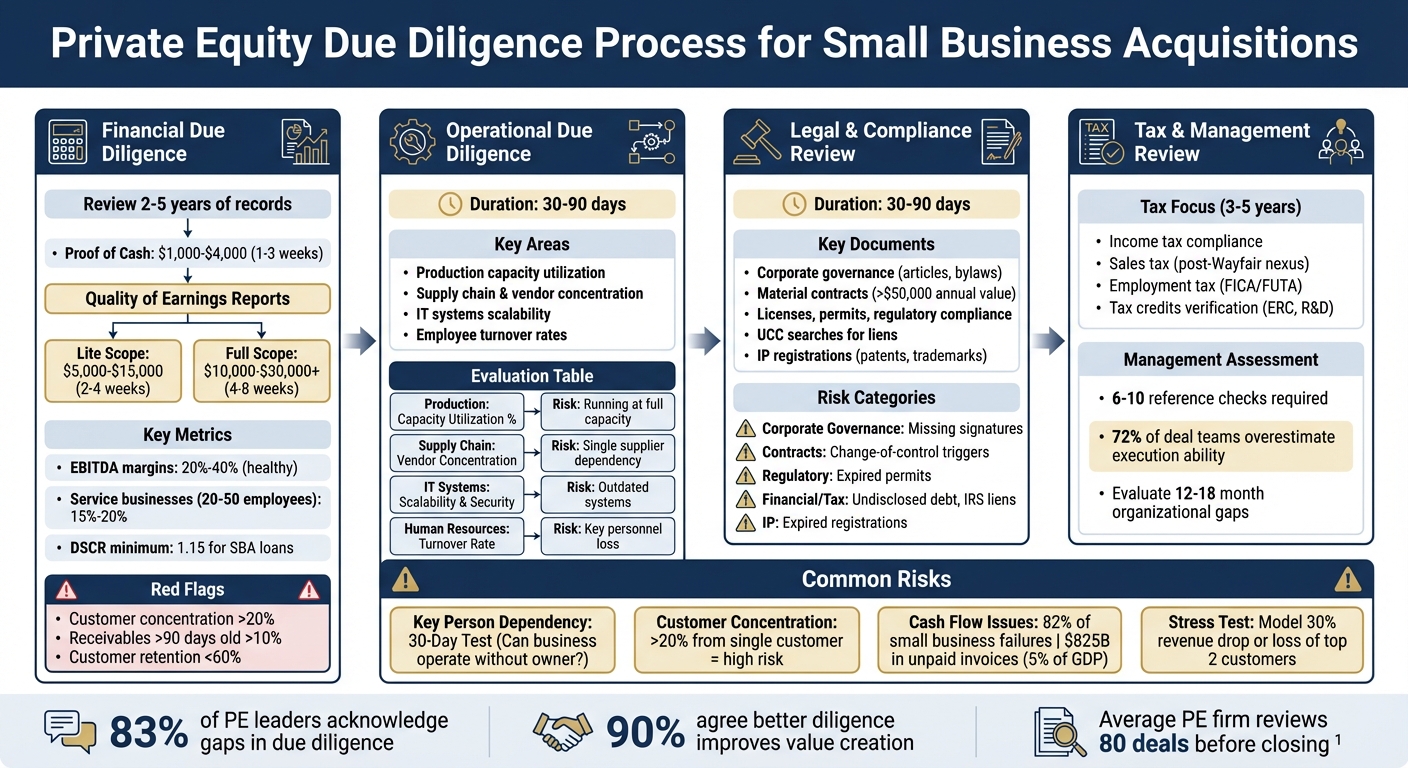
Private Equity Due Diligence Process for Small Business Acquisitions
10 Essential Due Diligence Items for PE Investors
sbb-itb-85dd802
Financial Due Diligence Components
Financial due diligence is a critical step when acquiring a small business. Private equity firms typically analyze 2–5 years of financial records to spot trends, verify the accuracy of reports, and identify potential risks. As Acquire.com explains:
Financial due diligence is a cornerstone of any ‘due diligence checklist for buying a business’. It’s a comprehensive review of the target company’s financial records, statements, and projections.
Small businesses often rely on cash-basis accounting and informal record-keeping, which can blur the lines between personal and business expenses. It’s essential for buyers to validate all claims using independent documentation like bank statements and tax returns.
Analyzing Financial Statements and Records
Start by reviewing key financial documents, including income statements (P&L), balance sheets, and cash flow statements. Monthly statements are particularly useful for uncovering seasonal trends or irregularities that annual summaries might hide. Cross-check these records with tax returns to ensure consistency.
Bank statements play a vital role too. Conducting a "Proof of Cash" analysis over 24 months helps match reported sales to actual bank deposits. This process, which typically costs $1,000–$4,000 and takes 1–3 weeks, is crucial for confirming revenue accuracy. If discrepancies arise, it might be a sign to reconsider the purchase.
Accounts receivable and payable also provide key insights. Aging reports reveal cash flow health – balances over 30–60 days can indicate problems, and if more than 10% of receivables are over 90 days old, it’s a red flag.
Inventory and fixed assets shouldn’t be overlooked. Review how inventory is valued (FIFO, LIFO, or Weighted Average) and check physical count records. Issues like outdated stock or high-mileage equipment could signal future cash flow challenges. Additionally, examining capital expenditures and maintenance records can help forecast potential equipment replacement costs after the deal closes.
Finally, take a close look at all liabilities, including loans, leases, and contingent obligations like lawsuits or unpaid taxes. For example, SBA loans often require a Debt Service Coverage Ratio (DSCR) of at least 1.15, so calculating this ratio is essential to ensure the business can handle its debt.
Once the financial records are verified, the next step is to analyze revenue and expense patterns.
Tracking Revenue and Expense Patterns
Revenue stability is more important than revenue size. Check for customer concentration – if a single client makes up more than 20% of total revenue, it poses a risk. Strong customer retention rates (above 80%) suggest loyalty, while lower rates (below 60%) could signal trouble.
Be wary of inflated results caused by premature or "pulled forward" sales. Review sales pipelines and customer contracts to gauge the sustainability of future revenue.
On the expense side, compare costs to industry benchmarks. For example, top-performing service businesses, like those in HVAC, often achieve gross margins of about 50% and EBITDA margins near 30%. Unexpected expense increases might point to hidden liabilities, supplier issues, or deferred maintenance.
Pay special attention to "add-backs", which are expenses the seller claims are one-time or non-recurring. Valid add-backs might include above-market owner salaries, personal expenses, or one-time legal fees. However, overly optimistic growth projections or undocumented family salaries should raise concerns. As David Deeds, Schulze Professor of Entrepreneurship, advises:
A useful rule of thumb is that normalization should make the deal harder to justify, not easier.
Also, be cautious of practices that artificially boost cash flow, as they can misrepresent the business’s true working capital needs after the acquisition.
Understanding these revenue and expense trends lays the groundwork for determining the business’s value.
Determining Business Value from Financial Data
Valuation starts by normalizing earnings. Calculate Seller’s Discretionary Earnings (SDE) by adding back the owner’s compensation and non-cash expenses to net income. For larger businesses, EBITDA (Earnings Before Interest, Taxes, Depreciation, and Amortization) is the preferred metric.
A Quality of Earnings (QoE) report provides a deeper dive than a standard audit, focusing on the sustainability of earnings. It adjusts for one-time gains, non-recurring expenses, and unusual revenue sources to give a clearer picture of the business’s earning potential. A Lite Scope QoE typically costs $5,000–$15,000 and takes 2–4 weeks, while a Full Scope QoE ranges from $10,000 to over $30,000 and may take 4–8 weeks.
Next, apply industry-specific multiples to the normalized EBITDA or SDE to calculate enterprise value. Healthy small businesses often have EBITDA margins between 20% and 40%. However, for service businesses with 20–50 employees, margins may drop to 15%–20% due to the added costs of a formal management structure.
Key financial ratios, such as Gross Margin, Operating Margin, Net Profit Margin, and DSCR, provide additional insights into the company’s financial health and efficiency.
It’s also important to establish a working capital peg – this baseline for net working capital (current assets minus current liabilities) ensures the business has enough liquidity after the deal closes. Analyzing the cash conversion cycle can show how quickly the business turns investments in inventory and receivables into cash.
Finally, stress test the valuation by modeling scenarios like losing the top two customers or experiencing a 30% revenue drop during a recession. If the business can’t withstand these challenges, it might suggest the asking price is too high or that additional safeguards, such as earnouts or holdbacks, are needed. With the financial data verified and patterns identified, this valuation process sets the stage for assessing operational and legal factors in the broader due diligence process.
Operational Due Diligence
Once financial validation is complete, it’s time to dig into the day-to-day workings of the business. Operational due diligence focuses on whether the business’s operations can sustain growth and deliver on expected returns. While financial due diligence looks backward at what has happened, operational due diligence dives into the "how" and "why" behind those results – and whether they can continue. Together, these reviews provide a complete picture of the business’s past performance and future potential.
On-site visits are a key part of this process. These visits help verify if the documented procedures align with actual practices. Talking to middle managers and frontline staff – not just the owner – offers a clearer view of how work really gets done. Keith Crawford, Global Head of Corporate Development at State Street Corporation, highlights the importance of involving operational experts in the process:
You need to include in the deal team those individuals that maybe don’t know so much about deal tactics or valuation, but know the underlying business.
The goal here is twofold: uncover inefficiencies or risks that could derail your plans and identify "quick wins" that might improve EBITDA soon after the deal closes.
Reviewing Daily Operations and Workflows
Building on financial findings, a deep dive into daily workflows can reveal hidden bottlenecks and areas for growth. Map out key processes – from hiring and production to quality control, supply chain, and procurement. Look for inefficiencies like backlogs or manual workarounds that could lead to errors or slow operations.
Consider whether the business operates with documented Standard Operating Procedures (SOPs) or relies heavily on informal, ad hoc methods. If operations depend too much on a few key individuals, the business could face disruptions if those people leave after the acquisition.
Technology is another critical area. Evaluate the current tech stack – software, hardware, and data systems – to determine if it can handle higher volumes without requiring a major investment. Outdated systems that can’t scale may hide future costs.
The supply chain also deserves close scrutiny. Assess vendor concentration and supplier stability. If the business relies on a single supplier for essential materials, that’s a potential vulnerability. Check whether alternative suppliers are available and how quickly they could be brought on board if needed.
Finally, review physical assets like equipment and facilities. Look at capacity utilization rates – if the business is already operating at full capacity, growth will require additional investment. Maintenance records and the condition of machinery can also provide insight into future replacement costs.
These operational reviews help determine if the business is ready to scale efficiently.
Measuring Growth Capacity
Can the business handle a 20%–50% increase in volume without a matching increase in overhead? This question is critical and ties together insights from earlier assessments.
Begin with production capacity. Are there physical constraints like limited floor space, outdated machinery, or inefficient workflows? Efficiency improvements – like reducing cycle times or optimizing inventory – could unlock growth without heavy spending.
Next, consider human resources. Can the business hire and train staff quickly enough to meet rising demand? High turnover, especially among key technical or supervisory staff, might signal deeper management or workplace issues. Evaluate whether losing key personnel would disrupt operations.
IT systems also play a big role. Assess whether the current software and data infrastructure can handle increased volumes or if costly upgrades will be necessary. Stress-test these systems by simulating scenarios like sudden volume spikes or supplier disruptions to gauge their resilience.
| Operational Area | Key Evaluation Metric | Risk to Watch For |
|---|---|---|
| Production | Capacity Utilization % | Running at full capacity (limits growth potential) |
| Supply Chain | Vendor Concentration | Dependency on a single critical supplier |
| IT Systems | Scalability & Security | Outdated or inflexible systems |
| Human Resources | Employee Turnover Rate | Key personnel or cultural challenges |
These evaluations provide a clearer picture of whether the business has the capacity to scale effectively.
Legal and Compliance Review
Once operational aspects are confirmed, it’s time to examine the business’s legal framework to avoid potential risks after acquisition. This phase of legal due diligence complements earlier financial and operational reviews, offering a more comprehensive understanding of the business’s overall stability. Roman Beylin, Founder of DueDilio, explains:
Legal due diligence acts as an inspection of the target company, uncovering potential problems that could financially or operationally impact the acquiring company post-acquisition.
The process focuses on identifying issues that could later disrupt operations or finances. Typically, this phase lasts between 30 and 90 days, starting from the signing of the Letter of Intent through to closing. Completing this review ensures all legal, financial, and operational aspects align smoothly.
Reviewing Corporate Governance Documents
Start with a deep dive into corporate governance materials like articles of incorporation, bylaws, operating agreements, and board resolutions. These documents confirm the seller’s legal authority to finalize the sale and verify ownership records. Missing signatures or discrepancies in equity records are warning signs that require immediate resolution.
Examining Contracts and Agreements
Pay close attention to material contracts, typically those exceeding $50,000 in annual value. This includes agreements with major customers, suppliers, and distributors. Be on the lookout for change-of-control clauses or assignment restrictions that could delay the transfer. For example, if a vendor contract mandates a 90-day notice for assignment but your closing is in 45 days, renegotiation or exclusion of that contract may be necessary.
Additionally, review financial and debt agreements, including loan documents, credit facilities, and promissory notes. Conduct UCC searches to uncover any security interests, mortgages, or tax liens that could complicate the transfer of ownership. Watch for vague termination terms, unfavorable payment schedules, or automatic renewal clauses that might lead to unexpected financial obligations. Summaries of key contracts – covering their purpose, fees, payment schedules, and renewal or termination terms – can streamline your review.
After contracts are addressed, shift focus to ensuring the business complies with all relevant regulations.
Verifying Regulatory Compliance
Confirm the business’s "Good Standing" by obtaining a current Certificate from its state and all operating jurisdictions. Gather and review all federal, state, and local licenses, permits, and consents necessary for the business to operate. Some permits require prior notification or consent before ownership changes, and expired permits or missing licenses could halt operations immediately after acquisition.
Labor and employment compliance is another critical area. Review wage and hour records, workplace safety compliance, and adherence to anti-discrimination laws. Ensure workers are correctly classified as employees or independent contractors, as misclassification can lead to hefty back-tax and benefits liabilities.
Tax compliance is equally important. Examine federal, state, and local tax returns for at least the past three to five years to uncover unpaid taxes or ongoing audits. Keep in mind that private equity firms may inherit liability for unpaid taxes. For businesses with physical locations, conduct Phase I environmental site assessments and review waste disposal practices and permits. As noted by Quadros, Migl & Crosby PLLC:
Environmental due diligence protects against significant liability risks.
Identifying Legal Risks
Search for any pending or past lawsuits that might reveal recurring issues, such as labor disputes or customer complaints. Request correspondence with regulatory agencies, including demand letters, citations, or compliance orders. Public record searches can help identify liens, judgments, or regulatory violations not disclosed internally. Additionally, review online sources for negative publicity or customer feedback that could indicate reputational risks.
Intellectual property (IP) is another key area. Verify registrations for patents, trademarks, and copyrights, as well as any inbound or outbound licensing agreements. Expired registrations or unresolved infringement claims could undermine the business’s competitive edge.
Michael Lamb, Attorney at Lamb Law, LLC, offers this advice:
Legal due diligence isn’t about finding every issue. It’s about finding the issues that matter and putting them in context.
To stay organized, use a diligence tracker to avoid duplicating efforts. Focus on material risks rather than minor historical issues. Address identified risks through seller representations and warranties, indemnification clauses, price adjustments, or escrow holdbacks in the final purchase agreement.
| Legal Risk Category | Documents | Red Flags |
|---|---|---|
| Corporate Governance | Articles of Incorporation, Bylaws, Minutes | Missing signatures, inconsistent equity records |
| Contracts | Customer/Vendor Agreements, Leases | Change-of-control triggers, vague termination terms |
| Regulatory | Permits, Licenses, Labor Records | Expired permits, history of HR/wage disputes |
| Financial/Tax | UCC Filings, Tax Returns, Liens | Undisclosed debt, active IRS liens, pending audits |
| Intellectual Property | Trademark/Patent filings, IP Licenses | Expired registrations, infringement claims |
Tax and Management Team Review
When it comes to mergers and acquisitions, two aspects can make or break the deal: tax compliance and the quality of the management team. These factors don’t just influence the price you pay – they also shape the overall success of the acquisition. Pete Miller, Shareholder at Clark Nuber P.S., puts it plainly:
Understanding the tax position of the targeted business is not just a formality, it is a cornerstone of sound deal-making.
Tax missteps can lead to unexpected liabilities long after the deal closes, while weak leadership can derail even the best-laid growth plans. Together, these areas determine whether you’re buying a well-oiled machine or stepping into a minefield of risks.
Reviewing Tax Compliance and Planning
Start by diving into the target company’s federal, state, and local tax returns from the past three to five years. Look for issues like aggressive tax positions, underreported income, or irregularities in reporting. Pay close attention to employment taxes – make sure payroll taxes like FICA and FUTA have been properly withheld and paid.
Since the South Dakota v. Wayfair ruling, sales tax compliance has become a hot-button issue. Check whether the target has exceeded nexus thresholds in states where it hasn’t filed or collected sales tax. If you uncover significant exposure, voluntary disclosure agreements could help limit the financial fallout by reducing the look-back period for unpaid taxes.
Specialized tax credits also deserve scrutiny. The Employee Retention Credit (ERC), for example, has been flagged as high-risk by the IRS, even making its "Dirty Dozen" list for 2023. The IRS has extended the statute of limitations in some cases to five years, allowing them to recover improperly claimed credits. It’s essential to verify documentation for credits like the ERC or Research and Development (§41) to avoid disallowances after the transaction.
Review any correspondence with tax authorities, including audits or examinations from the past five years. Also, confirm the validity of critical elections, such as S corporation status, as they can significantly impact the deal structure and liabilities.
Anthony Bakale, CPA and Tax Partner at Cohen & Company Ltd., cautions:
Buyers are more willing to walk away from a messy transaction where their diligence turns up risks not contemplated in their initial investigation of the target company.
Here’s a quick breakdown of key tax areas to focus on:
| Tax Risk Area | Key Focus for Due Diligence |
|---|---|
| Income Tax | Review 3–5 years of filings for aggressive positions or underreported income. |
| Sales Tax | Check for "Wayfair" nexus and missing exemption certificates for B2B sales. |
| Employment Tax | Audit worker classification (contractor vs. employee) and FICA/FUTA compliance. |
| Tax Credits | Verify substantiation for R&D and Employee Retention Credits (ERC). |
| Related Parties | Ensure transactions between related entities are performed at arm’s length. |
Once you’ve tackled tax risks, it’s time to shift your focus to the leadership team.
Assessing Leadership Team Quality
Tax compliance might ensure financial stability, but it’s the management team that drives the business forward. Evaluating leadership is critical, especially since 72% of deal teams tend to overestimate a target’s ability to execute. In smaller businesses, dependency on key individuals can pose a major risk to post-sale continuity.
Conduct six to ten reference checks with a mix of former managers, direct reports, peers, and investors to get a full picture of the leadership team’s performance and reliability.
Paul Doyle, Operating Partner at Blackford Capital, explains:
Neither spreadsheets nor value stream maps create any value on their own. The ideal people-focused due diligence would be to conduct an audit and assessment of both the leadership and entire employee base, but we can learn 90% of what we need to know simply by talking to the leadership team.
Assess whether the current leadership has the skills to scale the business and handle major changes. Compare the existing organizational chart to a 12–18 month projection to identify gaps in key areas like finance or sales leadership. It’s also important to determine whether the team aligns with your vision and is open to shifting strategies when necessary.
Operational discipline is another area to evaluate. Review board minutes to understand decision-making processes, and check for strong internal controls like segregation of duties, dual-signature payment thresholds, and consistent monthly close dates. Gauge whether the team is committed to the business beyond earn-out milestones.
Finally, don’t overlook the dynamics within the leadership team. A group of individually talented leaders won’t succeed if they can’t work together effectively. Their ability to collaborate and align with your approach is just as important as their technical expertise. As MDC Advisory notes:
The nub is to endorse (or not) investor trust in the management team to execute the investor’s value creation plan towards exit.
Common Risks in Small Business Acquisitions
Even with thorough reviews of financials, operations, and leadership, some risks in small business acquisitions can slip through the cracks. These businesses often have vulnerabilities that don’t show up on balance sheets, such as reliance on key individuals, concentrated revenue sources, or unstable cash flow. Steve Vivian, Principal and Founder at Kestrel Capital Group, sums it up perfectly:
If you can’t move that relationship from the individual to the institution, you don’t really own a business – you own a temporary income stream.
Here’s a closer look at three common pitfalls and how to address them.
Checking for Key Person Dependency
Small businesses often rely heavily on their owners or a few key employees. If the business’s revenue depends on personal relationships rather than institutional processes, losing those individuals could lead to a rapid decline in revenue. Owners in these businesses frequently manage critical functions like onboarding, technical support, and sales. Their departure can leave a void that’s hard to fill.
To evaluate this risk, try the "30-Day Test." Ask the seller: What would happen if the owner disappeared for 30 days? and Can employees operate independently of the owner? Reviewing CRM records can also reveal who handles key client interactions. If the owner dominates communications, it’s a red flag. Additionally, find out how major clients were acquired. If most were secured through the owner’s personal network, there’s a higher chance of client churn post-sale.
To mitigate this, consider strategies like offering stay bonuses or retention packages to key employees. Structuring the deal with earn-outs, seller notes, or retention bonuses can also tie the seller’s compensation to a successful transition. A phased transition plan, where the seller gradually steps back over 7 to 12 months, can help ensure a smoother handover.
Analyzing Customer and Supplier Concentration
A small business with a few clients or suppliers dominating its revenue or operations faces serious risks. For example, if a single customer accounts for more than 20% of revenue, the business is vulnerable. In many small B2B companies, just 3 to 5 customers can contribute over half of the total revenue, which can lead to valuation discounts and financing hurdles.
To assess customer concentration, cross-check the customer list with bank statements, invoices, and tax filings to confirm the reported revenue is genuine and sustainable. Ask the seller for a list of major customers lost in the past two years to identify potential patterns of dissatisfaction. With the seller’s approval, contact a sample of the top 12 customers to gauge their satisfaction and likelihood of staying post-sale. Also, examine contracts for "change-of-control" clauses that might allow customers or suppliers to terminate agreements after the sale.
Sidharth Ramsinghaney, Director of Corporate Strategy and Operations at Twilio, cautions:
If too much revenue comes from a few key clients, losing just one could severely affect profitability.
Supplier concentration poses similar risks. Calculate how much of the procurement spend is tied to the top 5–10 suppliers. If 80% of components come from a single region or vendor, it’s a red flag. Evaluate the financial health of key suppliers to ensure they can meet future demands.
| Risk Factor | Customer Concentration | Supplier Concentration |
|---|---|---|
| Primary Risk | Revenue loss if a key client leaves. | Operational disruptions if a supplier fails. |
| Key Metric | % of revenue from top 5 clients. | % of spend from top 5–10 suppliers. |
| Mitigation | Diversify clients and secure long-term contracts. | Dual-sourcing and geographic diversification. |
| Red Flag | Single customer > 20% of revenue. | 80% reliance on one region or supplier. |
Evaluating Cash Flow Stability
Cash flow is the lifeline of any business, and managing it poorly is a leading cause of small business failures – accounting for 82% of them. In fact, unpaid invoices for small businesses in the U.S. total around $825 billion, roughly 5% of GDP. Richard Branson puts it plainly:
Never take your eyes off of the cash flow because it’s the life blood of the business.
To ensure cash flow stability, conduct a focused Proof of Cash audit by comparing 24 months of bank deposits with reported sales and tax returns. Use Form 4506-C to verify that tax returns match IRS filings.
Pay close attention to the Cash Flow to Net Income Ratio. A healthy ratio should hover around 1:1. If it’s lower, it may signal issues like uncollected receivables or excess inventory. Calculate Free Cash Flow (FCF) by subtracting capital expenditures from operating cash flow to see how much cash is available for reinvestment or debt payments.
Aging reports can also reveal trouble – if more than 10% of receivables are over 90 days old, it’s a warning sign. Establish a baseline for net working capital using a 12-month average to account for seasonal fluctuations. Finally, stress-test the business model by simulating scenarios like a 30% revenue drop or the loss of two top customers. Ensure there’s enough liquidity to cover two to six months of expenses.
Working with TC Advisors for Transaction Support

After thoroughly reviewing the financial, operational, and legal aspects of a deal, having specialized advisory support can make all the difference in ensuring a smooth transition. TC Advisors steps in with their expertise in CPA and transaction advisory services, uncovering hidden risks in small business acquisitions. Led by founders Nick Termine, CPA, and Stephen Calvo, CPA, the team focuses on small to mid-sized businesses, offering proactive financial strategies tailored to the unique details of each transaction. Their services complement the foundational reviews by adding targeted transaction support.
Financial and Tax Analysis Services
TC Advisors customizes their financial reviews based on a deal’s complexity. For intricate transactions, they provide Full Scope Quality of Earnings (QoE) reports, while simpler deals may only require Lite Scope analyses. These services start at around $6,000. For industries like retail or food service, they perform Proof of Cash audits – priced between $3,000 and $5,000 – to confirm cash flow accuracy. Additionally, they use IC Diagnostics to address the growing issue of independent contractor (IC) misclassification. This is especially relevant given the 12% rise in the U.S. independent contractor workforce between 2017 and 2023, now totaling 11.9 million.
Their tax analysis dives deep into state, local, and federal returns, while also modeling scenarios like the loss of a major customer. This approach helps identify vulnerabilities that could impact the deal.
Financial Leadership Through Fractional CFO Services
Beyond analysis, TC Advisors offers strategic leadership through their fractional CFO services, ensuring deals are executed smoothly. These CFOs provide oversight for securing debt, arranging bridge financing, and structuring leverage. They also ensure back-office systems are robust enough to support future growth.
A key part of their service includes conducting QoE reports that adjust for non-recurring items, unusual expenses, or personal costs paid through the business. This process uncovers the company’s actual, sustainable profitability, giving buyers a clearer picture of the business’s financial health.
M&A Transaction Support
The financial leadership provided by TC Advisors lays the groundwork for their broader M&A advisory services. They guide clients through every phase of due diligence, validating the financials, operational systems, and overall commercial viability of a business. This thorough approach minimizes risks. With over 19% of new funding rounds in Q1 2025 classified as down rounds, this level of diligence has become critical to avoid overvaluation.
For deals involving independent contractor models, TC Advisors takes additional steps post-closing. They implement compliance measures to restructure and document IC relationships, reducing legal risks. This is essential, as IC misclassification claims often lead to settlements in the seven- or eight-figure range. Their comprehensive support ensures private equity firms can move forward with confidence, knowing that potential liabilities have been thoroughly addressed.
Conclusion
Acquiring small businesses presents numerous challenges for private equity firms, making thorough due diligence a cornerstone of successful transactions. This process extends well beyond analyzing financial statements; it involves evaluating operational workflows, legal agreements, tax compliance, management effectiveness, and potential risks like customer concentration or reliance on key individuals.
Interestingly, 83% of private equity leaders acknowledge significant gaps in their current due diligence practices, and 90% agree that improving diligence quality consistently enhances value creation strategies. Considering that the average private equity firm reviews 80 deals before finalizing just one investment, the ability to swiftly identify solid opportunities is crucial. This underscores the importance of leveraging professional advisory services to navigate the complexities of small business acquisitions.
Partnering with experienced advisors, such as TC Advisors, can make a substantial difference. Their expertise – ranging from Quality of Earnings reports to fractional CFO services – helps uncover risks that internal teams might overlook. For example, Marriott’s $123 million fine after acquiring Starwood highlights the potential liabilities of inadequate diligence. A meticulous approach ensures buyers fully understand the financial and operational realities of their target businesses, reducing the likelihood of costly surprises.
The ultimate objective isn’t just closing a deal but acquiring a business that’s primed for long-term success. By prioritizing comprehensive due diligence and working with trusted advisors, private equity firms can confidently address risks, negotiate effectively, and lay the groundwork for sustainable value creation from the start.
FAQs
What are the biggest due diligence red flags in a small business deal?
When evaluating a small business, there are several warning signs to watch out for. These can fall into a few main categories:
- Financial Issues: Look out for unexplained "add-backs" (adjustments to earnings), inflated profit claims, or a pattern of declining sales without a clear recovery strategy. These could signal deeper problems with the business’s financial health.
- Legal Concerns: Pending lawsuits or hidden liabilities can pose serious risks. These issues might not only affect the business’s current operations but also its future profitability.
- Operational Risks: Watch for signs like over-reliance on a single owner, a customer base where one client accounts for more than 40% of revenue, high employee turnover, or outdated systems and processes. These factors can make the business less stable and harder to scale.
Spotting these red flags early allows potential buyers to renegotiate terms, restructure the deal, or even back out entirely if the risks outweigh the rewards.
How do I verify revenue when the seller’s books are informal or cash-based?
Verifying revenue for businesses that rely on informal or cash-based records can be tricky. A good starting point is to request at least 24 months of bank statements. By reconciling deposits from these statements with the sales figures reported, you can spot any inconsistencies.
Another helpful step is comparing these deposits with the business’s tax returns to get a clearer picture of their income. For cash-heavy businesses, it’s also worth observing their operations – look at customer traffic, sales patterns, or other day-to-day activities to gauge their revenue flow.
Using these approaches together, along with a thorough review of tax returns, can provide a much more reliable assessment of the business’s actual revenue.
When should I order a QoE report versus a Proof of Cash?
When you’re conducting in-depth due diligence for an acquisition, ordering a Quality of Earnings (QoE) report can provide a thorough breakdown of a company’s sustainable earnings and cash flow. This analysis helps you understand the true financial health of the business. On the other hand, a Proof of Cash is typically used later in the process, closer to closing, to verify actual cash transactions and balances, ensuring the company’s liquidity is as reported.


