

The R&D Tax Credit in 2025 offers startups direct tax savings for research activities, with new benefits under the One Big Beautiful Bill Act (OBBBA). Signed on July 4, 2025, the OBBBA allows businesses to fully deduct domestic R&D costs immediately, reversing the five-year amortization rule from 2017. Startups can now claim retroactive deductions for 2022–2024, boosting cash flow. Key updates include:
- Immediate Expensing: Full deduction of domestic R&D costs in the same year.
- Payroll Tax Offset: Startups with gross receipts under $5M can apply up to $250,000 annually against payroll taxes.
- Expanded Eligibility: Includes AI, machine learning, clean energy, and other emerging fields.
- Retroactive Claims: Amend 2022–2024 tax returns to reclaim previously amortized costs.
- State-Level Credits: 37 states offer additional R&D credits, often stackable with federal benefits.
These changes simplify claiming credits, improve cash flow, and support startups during growth phases. Proper documentation, especially for claims exceeding $1.5M, is critical under updated IRS rules. Consult tax professionals to maximize benefits and ensure compliance.
How Tech Startups Can Offset Payroll Costs With the R&D Tax Credit
Immediate Expensing Under the One Big Beautiful Bill Act (OBBBA)
The One Big Beautiful Bill Act (OBBBA) marks a significant shift in how research and development (R&D) investments affect cash flow. It reverses a key provision of the 2017 Tax Cuts and Jobs Act, allowing businesses to fully expense R&D costs in the same year they are incurred.
What Changed Under the OBBBA
Before the OBBBA, businesses were required to spread R&D expenses over five years through amortization, as mandated by the 2017 Tax Cuts and Jobs Act. For example, a $500,000 R&D investment only allowed for $100,000 in annual deductions over five years, creating a delay in tax relief.
Signed into law on July 4, 2025, the OBBBA eliminates this amortization requirement for domestic R&D expenses. Now, companies can deduct the full amount of their qualifying R&D costs in the year they occur. However, foreign R&D expenses must still be amortized over five years.
This change has a major impact on cash flow. At the current 21% tax rate, a $500,000 R&D spend now generates $105,000 in tax savings immediately, compared to the previous $21,000 per year over five years. This accelerated benefit frees up funds that businesses can reinvest in hiring, product development, or extending their operational runway.
The updated rules also work in tandem with the R&D tax credit. Companies can deduct their full R&D expenses to lower taxable income while also claiming the R&D tax credit for a dollar-for-dollar reduction in tax liability. For startups operating at a loss, the payroll tax offset provision allows these credits to be applied against payroll taxes, offering immediate relief without waiting for profitability.
The timing of this change is particularly advantageous for startups in cutting-edge fields. New definitions of R&D now explicitly include advancements in areas like artificial intelligence, machine learning, cybersecurity, clean energy, advanced data analytics, and process automation. Expenses related to cloud computing and software development – such as hosting AI models or creating custom tools – also qualify as R&D activities.
These updates not only modernize R&D guidelines but also open up retroactive benefits for prior investments.
Recovering Past Amortized Expenses (2022-2024)
In addition to immediate expensing, the OBBBA allows businesses to retroactively amend their 2022–2024 tax returns to claim full deductions for R&D expenses incurred during those years.
This retroactive provision offers a valuable opportunity for companies that heavily invested in R&D during that period. If those expenses were originally amortized over five years, filing amended returns can accelerate those deductions and potentially result in tax refunds for overpayments.
To take advantage of this, companies need to work closely with tax professionals to ensure amended returns are accurate and filed within the statute of limitations. Taxable income must be recalculated to reflect full R&D deductions rather than phased amortization. The resulting difference could translate into immediate cash refunds, providing much-needed financial flexibility for startups aiming to extend their runway.
The documentation requirements for these amended returns are the same as for current-year claims. Businesses must prove their expenses qualify as R&D under IRS Section 41. This involves demonstrating that the work addressed technical uncertainties, followed a process of experimentation, and aimed to develop or improve a business component. Starting with 2024 tax filings, the IRS requires enhanced project-level documentation on Form 6765 for claims exceeding $1.5 million in Qualified Research Expenses.
Expanded Eligibility for Emerging Technology Startups
The 2025 R&D tax credit updates have clarified what qualifies as research for startups in fields like artificial intelligence, machine learning, cybersecurity, clean energy, data analytics, and process automation. This removes much of the uncertainty that previously discouraged some startups from claiming credits for their work.
Building on the cash flow benefits introduced under the OBBBA, these updates expand the scope of what startups can claim as R&D. For instance, companies working on AI-driven analytics, blockchain security, synthetic biology, or clean energy solutions can now confidently apply for these credits. This directly offsets development costs, giving startups more room to grow. With the Alternative Simplified Credit offering 7–10% of qualified research expenses [8], startups can use these savings to extend their runway or fund new hires. These clearer guidelines also help startups navigate the four-part test that determines eligibility.
Qualifying Activities and the Four-Part Test
To take advantage of these benefits, your startup’s activities must meet the four-part test. This test ensures that your work:
- Aims to resolve technical uncertainty.
- Involves experimentation to address that uncertainty.
- Relies on principles from physical or biological sciences, engineering, or computer science.
- Seeks to create or improve a business component.
The first criterion, addressing technical uncertainty, applies when you’re tackling a challenge with no obvious solution. For example, developing a new machine learning model to improve customer interactions qualifies as R&D because it involves solving a technical problem.
The second criterion, experimentation, requires testing different approaches to solve your challenge. This could mean running multiple iterations of an AI model, experimenting with data preprocessing techniques, or prototyping hardware for a quantum computing application.
The third requirement, technological nature, is met when your work is grounded in the hard sciences or computer science. Whether you’re designing new quantum algorithms, building hardware prototypes, or running simulations, these activities align with the test.
Finally, the fourth requirement, qualified purpose, ensures your research is aimed at creating something new or improving an existing business component. For instance, a fintech startup using blockchain for secure transactions or an AI company enhancing CRM tools with predictive analytics would meet this requirement, provided they document their improvements thoroughly.
Keeping detailed records of your hypothesis testing, iterative improvements, and technical methods is crucial for supporting your claim.
Key Emerging Technology Sectors
Several industries stand to benefit from these expanded eligibility rules:
- Artificial Intelligence: Startups working on model training, algorithm design, or infrastructure to support experimentation can qualify. Projects like conversational AI platforms or predictive analytics tools in areas like natural language processing and computer vision often meet the criteria for R&D.
- Quantum Computing: Whether it’s developing quantum algorithms, prototyping hardware, or running simulations, companies in this space face unique technical challenges that make their R&D activities eligible.
- Synthetic Biology: Research in areas like medical advancements, agricultural innovations, or industrial applications often involves eliminating technical uncertainty through biological experimentation, making these activities eligible for credits.
- Cybersecurity: Startups creating new threat detection algorithms, encryption systems, or security protocols can benefit. For example, a fintech company focused on blockchain security can strengthen its claim with precise documentation of its R&D activities.
- Clean Energy and Renewables: Companies working on projects such as improving battery efficiency or developing better solar panel materials often face significant technical challenges, qualifying their work as R&D.
- Advanced Data Analytics: Startups creating new algorithms for processing large datasets, developing unique visualization techniques, or building predictive models for business intelligence can meet the requirements by demonstrating technical uncertainty and experimentation.
- Process Automation: Companies designing new robotics systems, AI-powered workflow tools, or custom automation platforms for specific industries can qualify. For instance, a medical device company using AI-driven prototyping to reduce development cycles highlights how these activities align with the four-part test.
Documentation is critical, especially for claims exceeding $1.5 million, where enhanced project-level records on Form 6765 are required. Collaborating with technical experts like engineers and scientists can strengthen your claim by clearly outlining the technical uncertainties and experimental processes involved.
Additionally, partnerships with universities, research institutions, and industry groups can add weight to your claim. For example, an AI startup working with a university on machine learning research or a clean energy company partnering with an industry group on carbon-neutral supply chains can document these collaborations to demonstrate their reliance on scientific principles and experimental methods. These partnerships not only bolster your R&D claims but also align with broader financial strategies.
Payroll Tax Offset Benefits for Startups
The payroll tax offset provision offers a practical way for startups to gain immediate financial relief. It allows companies to use R&D credits to offset federal Social Security and Medicare taxes, effectively turning what would normally be a future tax benefit into instant cash savings.
For startups, especially those in the early stages or operating at a loss, this can be a game changer. Many such companies face regular payroll expenses for roles like engineers, data scientists, and product developers. The payroll offset helps reduce these tax payments or even claim refunds, freeing up cash when it’s needed most during growth phases.
In 2021, U.S. businesses contributed to 68% of total R&D spending. Research also shows that every $1 of R&D tax credit can spur more than $1 in additional R&D investment. Unlike standard R&D credits, which require taxable income to be useful, the payroll offset works even without income tax liability. This makes it especially helpful for companies with high payroll costs but limited taxable income. Combined with earlier cash flow benefits from immediate expensing under the OBBBA, the payroll offset becomes a key part of a broader R&D tax strategy.
Eligibility and Annual Offset Limits
To qualify for the payroll tax offset, startups must meet two key criteria: gross receipts under $5 million and an annual offset cap of $500,000. While this cap limits how much can be applied against payroll taxes in a single year, any unused credits can be carried forward or applied to other tax liabilities.
Planning is crucial here. If your R&D expenses are likely to exceed the $500,000 cap, consider spreading projects over multiple fiscal years to fully utilize the benefit. Proposed legislation, such as the American Innovation and R&D Competitiveness Act of 2025, seeks to raise the gross receipts threshold to $15 million. If passed, this would expand access to the payroll offset for growing companies that are still operating at a loss.
This benefit is particularly well-suited for pre-revenue and early-revenue startups. For example, a biotech company with substantial payroll costs due to intensive R&D could claim up to $500,000 in payroll tax offsets annually. Similarly, an AI startup might use the offset to manage payroll tax liabilities while building its product. This is especially valuable during high-growth periods when conserving cash is critical, as traditional income tax credits provide little help without taxable income.
Planning to Maximize Payroll Tax Benefits
To make the most of payroll tax benefits, startups need a solid strategy. Here are some key steps:
- Project your R&D spending: If your credits are likely to exceed the $500,000 cap, phase major projects across fiscal years.
- Time your hiring strategically: Align R&D hiring with peak spending periods to ensure wages qualify as research expenses.
- Monitor gross receipts: Keep an eye on your revenue, especially as you approach the $5 million limit – or the proposed $15 million threshold if the new legislation passes.
Expert advice can be invaluable here. Professionals can help model different scenarios, optimize the timing of R&D investments, and ensure you’re maximizing benefits without disrupting operations.
It’s also important to consider how the payroll offset interacts with other tax credits. For example, while you can use R&D credits to offset payroll taxes, you might also claim credits like the Work Opportunity Tax Credit (WOTC) or the Employee Retention Credit (ERC) against income taxes. Just remember, the same expenses can’t be used to claim multiple credits.
Proper documentation is essential for claiming the payroll offset. Be sure to indicate this election on Form 6765 and maintain thorough records, such as project descriptions, timesheets, details of technical challenges, and documentation of supplies or outsourced research costs. For a full breakdown of documentation requirements, refer to the Documentation and Compliance Requirements section.
With the potential retroactive provisions in the American Innovation and R&D Competitiveness Act of 2025, it might also be worth revisiting previously filed returns for 2022–2024 to unlock additional payroll tax offsets.
For startups navigating these complexities, consulting with seasoned advisors, such as the team at TC Advisors (https://tcadvisorscpa.com), can help refine your R&D tax credit strategy and ensure you’re taking full advantage of these benefits.
sbb-itb-85dd802
Documentation and Compliance Requirements
Keeping accurate records does more than just support your R&D tax credit claim – it can also help you maximize the financial benefits. As the IRS has tightened its rules around documentation in recent years, startups that fail to maintain proper records risk losing these valuable credits during audits. To protect your claim, make sure you’re keeping ongoing, detailed records that align with IRS expectations.
Documentation Best Practices
Start with detailed project timelines that outline when each project began, key milestones, and its completion. These timelines should directly connect to your qualified research expenditures (QREs), making it easier to trace costs back to specific R&D activities.
Your records should also demonstrate that each project meets the IRS’s four-part test. This means documenting technical uncertainties at the project’s start, detailing the challenges faced, and explaining why a solution wasn’t readily available. Keep logs of iterative testing and prototyping to show how you addressed these uncertainties.
For QREs, maintain detailed records by category. For wages, use timesheets or project tracking systems to show how much time each employee spent on R&D versus other tasks. This level of detail is especially critical if you’re using the payroll tax offset provision, as the IRS closely examines the connection between wages and R&D activities.
Avoid common mistakes like failing to provide evidence of technical challenges, unclear allocation of wages, or insufficient documentation of a project’s purpose. Assemble thorough project files that include proposals, design documents, technical specs, testing results, and completion reports. Keep contemporaneous records such as meeting notes, email exchanges about technical hurdles, and development logs. For cloud computing or software development, document hosting costs for AI models, track development iterations, and note the technical challenges addressed during the process.
Finally, familiarize yourself with the updated Form 6765 requirements to ensure your reporting meets IRS standards.
Revised Form 6765 Reporting Standards
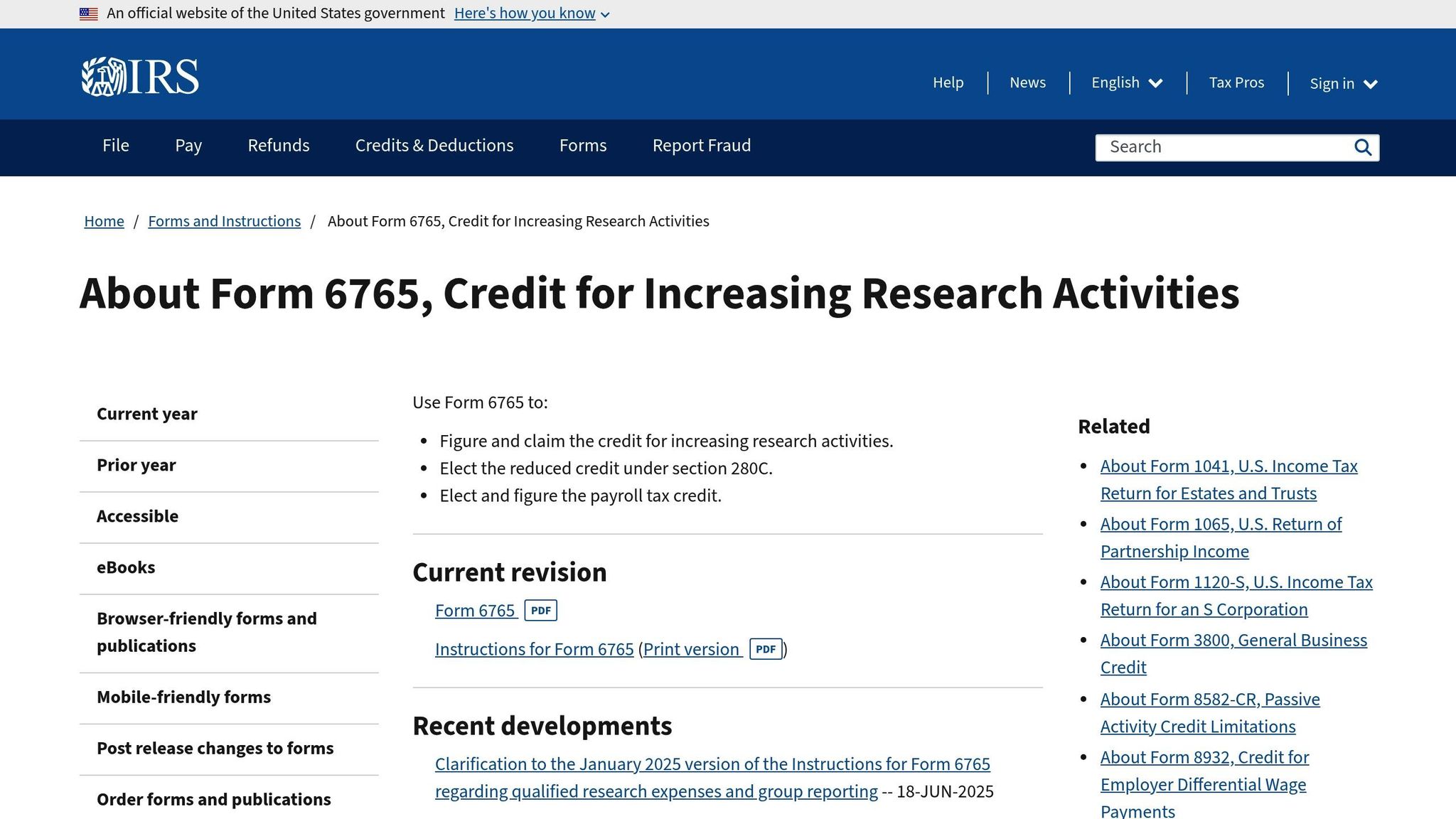
The IRS now requires more detailed qualitative data in Form 6765, which includes disclosing the number of business components used in credit calculations and providing a comprehensive breakdown of QREs by type. This is a shift from previous years when aggregated reporting sufficed.
For instance, if you’re a fintech startup claiming credits for blockchain security R&D, you’ll need to separately track wages for developers working on security protocols, software licenses used during development, and payments to external consultants. Each expense category must be linked to its respective business component. To prepare, set up an accounting system that categorizes expenses by business component from the start of the tax year. Make sure to separate R&D costs from other expenses and keep thorough documentation for all contract research costs.
Document the technical challenges, experimental approaches, and business purposes for each project. For cutting-edge work in areas like AI, machine learning, cybersecurity, clean energy, advanced analytics, or process automation, this level of detail is essential to demonstrate compliance with the IRS’s modern R&D definitions.
When working with your tax advisor or CPA, provide comprehensive details on your R&D projects, including technical objectives, challenges faced, and solutions developed. Ensure your wage and payroll records clearly identify employees involved in R&D. The better organized your records, the easier it will be to prepare an accurate Form 6765 that meets the new standards. Recent updates, including those from the Consolidated Appropriations Act of 2021, highlight the importance of detailed documentation to substantiate claims.
If you need expert help with audit-ready and compliant documentation, reach out to TC Advisors.
State-Level R&D Tax Credit Opportunities in 2025
In addition to federal incentives, 37 states offer their own R&D tax credits, providing startups an opportunity to enhance their savings even further [8]. These state programs operate independently, meaning you can combine federal and state credits within the same tax year. This combination can significantly improve cash flow and extend your financial runway, making these credits a valuable tool for growing businesses.
Claiming Federal and State Credits Together
You can claim both federal and state R&D credits simultaneously, maximizing your tax savings. This approach is especially helpful for startups that are not yet highly profitable. For instance, if your federal tax liability is minimal, you can still take advantage of the federal payroll tax offset – up to $500,000 annually for startups with less than $5 million in gross receipts – while also claiming state credits. Many state credits are refundable or can be carried forward to future years, which adds flexibility to your financial planning.
Take California as an example. The state offers a 15–24% corporate tax reduction for businesses focused on R&D, with particular benefits for tech startups and clean energy companies. Texas, on the other hand, provides a 5% franchise tax credit for in-state research, while New York offers a 9% refundable credit targeted at small businesses with fewer than 100 employees. Refundable credits are especially advantageous because they can result in cash refunds even if no taxes are owed – an immediate benefit for startups that are not yet profitable.
When planning your R&D activities, it’s essential to align state credit claims with where your qualifying research actually takes place [8]. For example, if your engineers are in California, developers in New York, and operations in Texas, you could potentially qualify for credits in all three states. This geographic factor should influence hiring and team distribution as your business grows.
Differences in State Credit Programs
State R&D credit programs offer unique benefits that can align with your company’s specific needs. These programs vary widely in terms of credit percentages, refundability, eligibility criteria, and qualifying activities. Credit rates range from 5% to 24%, and some states tailor their programs to specific industries. For instance, California’s higher rates cater to tech and clean energy companies, while Texas focuses on energy and manufacturing sectors.
Refundability is a key feature to consider. States like New York offer refundable credits, which can provide cash back even when no taxes are owed. This is particularly beneficial for early-stage startups that need immediate cash flow. By contrast, non-refundable credits only reduce existing tax liabilities, limiting their utility for companies without significant profits.
Eligibility requirements also differ by state. Some require that R&D activities occur within state borders, while others impose thresholds based on gross receipts or employee numbers. For example, New York’s 9% refundable credit is designed for small businesses with fewer than 100 employees, making it an excellent option for early-stage startups but potentially unavailable as your company grows.
Filing and documentation processes also vary. While most states align with federal standards for defining qualifying R&D, they typically require additional state-specific forms beyond the federal Form 6765.
When assessing a state’s program, pay attention to the credit percentage available for your industry, whether the credit is refundable, and any thresholds that might affect your eligibility. Also, review the documentation requirements carefully. This evaluation is especially important if you’re considering relocating or expanding into multiple states, as the combined benefits of federal and state credits can have a significant impact on your cash flow and profitability.
For startups with teams spread across different states, coordinating your state R&D credit strategy with hiring, fundraising, and expansion plans is critical [8]. Be diligent about tracking which team members are performing qualifying R&D activities in each state and allocate related expenses accurately. Keep detailed records of costs, such as cloud computing and other expenses tied to experiments, to support your claims.
Make R&D credit tracking a regular part of your quarterly tax and financial reviews [8]. As your company grows and expands, monitor your eligibility in each state and adjust your strategy as needed. Working with a tax advisor experienced in startup R&D credits – like the professionals at TC Advisors – can help you identify opportunities and refine your approach to maximize savings [8].
Long-Term Planning for R&D Tax Credit Optimization
While short-term cash flow improvements from R&D tax credits are valuable, long-term planning can amplify these advantages significantly. By taking a strategic, multi-year approach and involving technical teams early in the process, startups can unlock far greater benefits than by handling these credits as a last-minute tax season task.
Multi-Year Planning for Sustained Benefits
Creating a multi-year R&D strategy aligned with your business growth and cash flow projections can ensure consistent eligibility for credits while supporting incremental infrastructure development. This forward-thinking approach builds on earlier efforts, helping maintain steady cash flow from both current and prior R&D investments.
Take, for example, a fintech startup planning blockchain security R&D from 2025 to 2027. Instead of completing all development in a single year, spreading the work across multiple years allows the company to claim credits annually while maintaining steady progress. Thanks to the One Big Beautiful Bill Act (OBBBA), domestic R&D expenses are now deductible in the year they’re incurred. This enables businesses to lower their tax liability sooner and reinvest those savings into future projects. Companies that reinvest savings in this way tend to grow 2.5 times faster than industry averages.
It’s also worth reviewing past R&D spending from 2022 to 2024. By amending prior tax returns, startups can capture missed credits. For startups with gross receipts under $5 million, retroactive credits can even be applied against payroll taxes – up to $500,000 annually.
To maximize savings, coordinate your R&D spending with other tax incentives. For instance, engineering initiatives like adding new features, improving performance, or enhancing security can qualify for federal R&D credits. At the same time, favorable treatment of U.S. Research and Experimentation (R&E) expenses can boost deductions. By carefully timing R&D efforts and leveraging both federal and state-level benefits, you can achieve compounded savings over multiple years.
The savings from R&D credits can also fuel further innovation. Use those funds to invest in automation for faster product launches, attract top technical talent, or implement energy-efficient processes that may bring additional tax benefits.
Engaging Technical Teams to Strengthen Claims
Involving engineers, developers, and product managers in documenting R&D activities is vital. These team members are best equipped to identify qualifying activities and articulate the experimentation and technical uncertainty involved. Without their input, you risk overlooking eligible projects or failing to meet the IRS’s documentation standards.
Encourage real-time documentation using project management tools and logs that track experimental processes. This is far more effective than trying to piece together information months later during tax preparation. For cloud and compute expenses, technical staff should maintain detailed records showing how these costs supported experimentation, such as feature flags, A/B testing, or staging environments.
When claiming credits for tasks like algorithm design, model training, or infrastructure work – common in AI startups – technical documentation becomes especially critical. Your technical team should be familiar with the four-part test for qualifying activities: identifying the business component, demonstrating technological uncertainty, showing experimentation to resolve the uncertainty, and relying on technical knowledge.
Starting with 2024 tax filings (submitted in 2025), companies claiming over $1.5 million in Qualified Research Expenses must meet stricter documentation requirements on Form 6765. This includes detailed descriptions of each project, the business components involved, specific R&D activities, objectives, and an itemized breakdown of expenses. This is a significant shift from previous years, where general descriptions were often sufficient.
To streamline compliance and reduce audit risk, establish a centralized repository for project descriptions, expense allocations, and activity logs. Don’t forget to document failed experiments – even unsuccessful projects qualify if they aimed to resolve technical uncertainty. Also, include records of supervisory labor and supplies used during testing. This level of detail not only strengthens your claims but also ensures you’re prepared for evolving IRS requirements.
Conclusion
The 2025 R&D tax credit landscape offers startups a valuable opportunity to reduce tax burdens and fund their growth efforts. Thanks to the OBBBA, startups can fully expense domestic R&D costs starting in 2025, providing immediate tax relief. For example, a $1 million investment in qualifying research could cut tax liability by $70,000 to $100,000 [8].
The payroll tax offset remains a vital tool for early-stage and pre-revenue companies. Businesses with gross receipts under $5 million can apply up to $500,000 annually toward payroll taxes, with this benefit available for up to five years, significantly improving cash flow.
The expanded recognition of industries like AI, cybersecurity, clean energy, and advanced data analytics has clarified what qualifies as R&D. Activities such as training AI models, designing algorithms, enhancing blockchain security, and implementing zero-waste manufacturing now have clearer paths to eligibility. These updates align with broader federal incentives, helping companies stay compliant while planning for the future.
New IRS rules also introduce stricter reporting requirements. For claims exceeding $1.5 million in qualified research expenses, detailed project-level documentation is now required on Form 6765.
State-level R&D credits add another layer of financial support, offering additional percentages and, in some cases, refundable options to complement federal benefits.
Startups can also take advantage of a retroactive window for expenses incurred between 2022 and 2024, allowing them to amend prior returns and recover missed credits [8].
Beyond the immediate tax savings, R&D credits can serve as a long-term growth engine. Companies that reinvest these savings into areas like automation, hiring, and sustainability often see growth rates 2.5 times higher than their industry peers. Additionally, the 20-year carryforward period for unused credits ensures these benefits can extend well into the future.
For startups looking to maximize these opportunities, working with specialized tax advisors is key. TC Advisors provides tailored tax planning and preparation services for startups and entrepreneurs, offering proactive, year-round support to help businesses fully leverage R&D credits while staying compliant with IRS requirements.
FAQs
How can startups maximize retroactive R&D tax credits for expenses from 2022 to 2024?
Startups have a valuable opportunity to claim retroactive R&D tax credits by thoroughly reviewing their research and development expenses from 2022 to 2024. Eligible costs can include employee wages, R&D-related supplies, and even specific payments to third-party contractors. Keeping detailed records is crucial – not only does it simplify the filing process, but it also minimizes the likelihood of facing an audit.
Given the complexity of retroactive claims, working with a tax professional who specializes in R&D tax credits can be a smart move. These experts can help pinpoint overlooked expenses and ensure that every qualifying cost is properly documented, helping you get the most out of your credit.
What documentation is needed to meet the updated IRS requirements for claiming R&D tax credits over $1.5 million in 2025?
To meet the updated IRS requirements for claiming R&D tax credits over $1.5 million in 2025, businesses must ensure their documentation is both detailed and precise. Here’s what you’ll need to have on hand:
- Project descriptions that clearly explain the qualified research activities conducted.
- Employee time tracking or payroll records to verify the time spent on R&D efforts.
- Expense records covering supplies, contract research, and other eligible costs.
- Supporting evidence like technical reports, lab notes, or design documents to substantiate claims.
Maintaining well-organized and thorough records is crucial to staying compliant and avoiding potential delays or complications during the review process. It’s also a good idea to work with a qualified CPA who can guide you through these specific requirements efficiently.
How can startups benefit from combining state and federal R&D tax credits, and what should they keep in mind?
State R&D tax credits can add to the advantages of federal credits, offering startups extra savings that can make a real difference. But here’s the catch: every state has its own set of rules and eligibility requirements. That means startups need to pay close attention to how these credits work together to stay compliant and get the most out of their tax savings.
To navigate this complex process, it’s a smart move to collaborate with seasoned professionals. They can help streamline the steps and make sure no potential savings slip through the cracks.


