

When deciding between a revocable and irrevocable trust, the key difference lies in control and tax impact. Revocable trusts allow you to retain control and flexibility, but their assets remain part of your taxable estate. Irrevocable trusts, on the other hand, remove assets from your taxable estate, offering estate tax advantages but with reduced control. Here’s a quick breakdown:
- Revocable Trusts:
- Assets are taxed as part of your estate.
- Income is reported on your personal tax return.
- Offers a step-up in basis, reducing capital gains taxes for heirs.
- Irrevocable Trusts:
- Assets are excluded from your taxable estate.
- Trust files its own tax return and pays taxes at compressed rates.
- No step-up in basis, leading to potential capital gains taxes for beneficiaries.
Choosing the right trust depends on your goals, like minimizing estate taxes, protecting assets, or maintaining control. Work with a financial advisor to align your trust structure with your tax and estate planning needs.
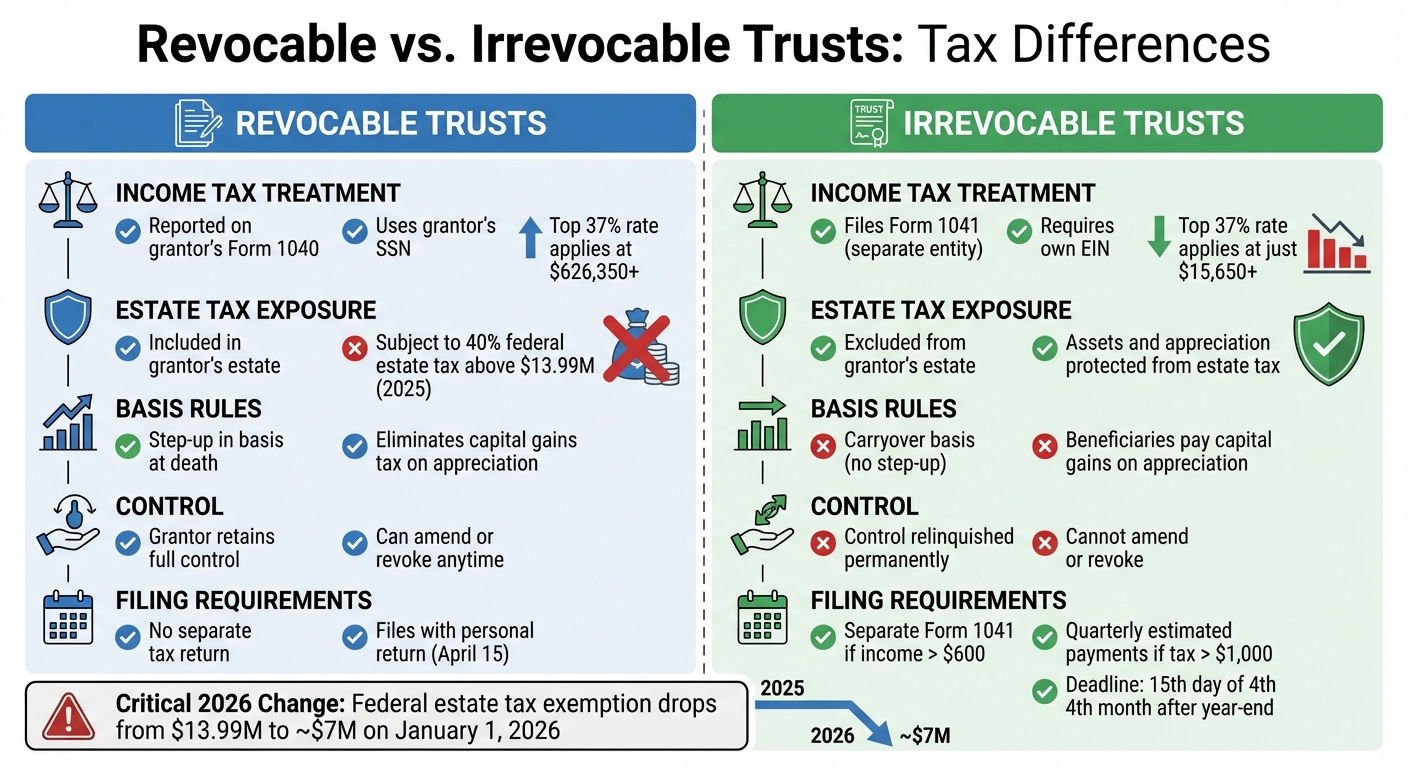
Revocable vs Irrevocable Trusts Tax Comparison Chart
How Trusts Are Taxed: Revocable vs Irrevocable Explained Simply
sbb-itb-85dd802
Income Tax Treatment: Revocable vs. Irrevocable Trusts
When it comes to income tax, the IRS handles revocable and irrevocable trusts very differently. These distinctions play a big role in crafting an effective tax strategy. Here’s how income is reported for each type of trust and what that means for taxes.
Revocable Trusts: Grantor Tax Reporting
For tax purposes, the IRS essentially ignores the existence of a revocable trust. All income – whether from rent, interest, dividends, or capital gains – is reported directly on the grantor’s personal tax return (Form 1040) using their Social Security Number (SSN). This setup allows the grantor to claim deductions such as depreciation, mortgage interest, and property taxes, while income is taxed at individual rates. For instance, the highest tax rate of 37% applies only when income exceeds about $590,000 for single filers.
"The IRS looks right through the revocable trust as if it isn’t there when assessing taxes. In other words, a revocable trust is invisible to the IRS during your life." – TaxShark
Irrevocable Trusts: Separate Tax Entity
Irrevocable trusts, on the other hand, are treated as distinct tax entities. They require their own Employer Identification Number (EIN) and must file a fiduciary income tax return (Form 1041). Taxes on income retained by the trust are paid by the trust itself, while any distributed income is reported on beneficiaries’ Schedule K-1 forms.
Irrevocable trusts are subject to compressed tax brackets, meaning they hit the 37% tax rate with just about $15,000 of taxable income in 2025. Because of this, trustees often distribute income to beneficiaries who may fall into lower tax brackets, helping to ease the overall tax burden.
Estate Tax Differences
The type of trust you choose doesn’t just affect income taxes – it also plays a big role in estate tax outcomes. While both revocable and irrevocable trusts help avoid probate, only one type offers protection against estate taxes.
Revocable Trusts: Assets Are Included in Your Estate
With a revocable trust, you maintain full control over the assets. You can change, amend, or even revoke the trust entirely. Because of this control, the IRS counts these assets as part of your taxable estate under sections §2036 and §2038.
"A revocable trust avoids probate, not estate taxes." – TaxShark
For example, in 2025, the federal estate tax exemption is $13.99 million per person. If your revocable trust holds $20 million in assets, anything over the $13.99 million exemption – $6.01 million in this case – would be taxed at a 40% federal rate.
State-level estate taxes complicate things further. Twelve states and Washington, D.C., impose their own estate taxes, often with much lower exemption thresholds. In states like Massachusetts and Oregon, the exemption is just $1 million. This means even middle-class families with appreciated real estate could face state "death taxes" despite being well below the federal limit.
In contrast, irrevocable trusts offer a way to keep assets out of your taxable estate.
Irrevocable Trusts: Assets Are Excluded from Your Estate
When you place assets into an irrevocable trust, you give up control over them permanently. You can’t change the beneficiaries, reclaim the assets, or receive income from them – unless specific exceptions apply. This loss of control ensures that the assets are no longer part of your taxable estate.
"Properly structured irrevocable trusts permanently exclude assets from your estate, safeguarding both current value and future appreciation." – Gentreo
This exclusion applies to both the current value of the assets and any future growth. For instance, if you transfer a rental property worth $500,000 into an irrevocable trust, and its value grows to $2 million by the time of your death, the entire $2 million remains outside your taxable estate. This is especially beneficial for assets like real estate or business interests, which tend to appreciate significantly over time.
The importance of planning cannot be overstated, especially as federal estate tax rules are set to change. Starting January 1, 2026, the federal exemption will drop to around $7 million (adjusted for inflation from a $5 million base). This upcoming reduction is pushing many estate planners to act now, using irrevocable trusts to lock in today’s higher exemptions. For those navigating these changes, industry-specific tax guidance can help ensure your strategy remains compliant and effective. Currently, only about 2 out of every 1,000 estates in the U.S. are subject to federal estate tax, but that number is expected to rise sharply after 2026.
Tax Effects of Transferring Real Estate into Trusts
When transferring real estate into a trust, the type of trust plays a crucial role in determining how the IRS calculates the basis for capital gains – a key factor in tax liability.
Step-Up in Basis: Revocable Trusts
Real estate in a revocable trust is eligible for a step-up in basis, meaning its basis adjusts to the fair market value at the time of your death. This happens because the property remains part of your taxable estate, as outlined in IRC Section 1014. For instance, if you purchased a rental property for $200,000 and it’s worth $1 million at your death, your heirs won’t owe capital gains tax on the $800,000 appreciation.
This step-up benefit also extends to your primary residence. The capital gains exclusion – $250,000 for individuals or $500,000 for married couples – typically remains intact when the home is held in a revocable trust. Additionally, in community property states like California, Texas, and Washington, the surviving spouse may receive a "double step-up." This means both spouses’ portions of the property adjust to the fair market value upon the first spouse’s death.
However, irrevocable trusts follow a different set of rules when it comes to basis adjustments.
Basis Rules: Irrevocable Trusts
For real estate in an irrevocable trust, the basis follows a carryover rule. Once you transfer the property into the trust, it’s removed from your taxable estate. This means the property does not qualify for a step-up in basis. Instead, the basis remains the same as it was when you originally purchased the property, adjusted only for capital improvements.
"This ruling forces a choice between asset protection with estate tax savings and retaining a step-up in basis. You cannot have both with a standard irrevocable trust." – TaxShark
Under Revenue Ruling 2023-2, assets excluded from your estate lose the step-up benefit. For example, if you bought a property for $200,000 and its value grows to $1 million while in an irrevocable trust, the original $200,000 basis remains. Beneficiaries would then face capital gains tax on the $800,000 appreciation – potentially exceeding 30% in high-tax states like California.
To address these tax challenges, strategies exist to minimize the impact. For example, grantors with a power of substitution can swap low-basis real estate for higher-basis assets like cash shortly before death. This effectively moves the appreciated property back into the taxable estate, allowing it to benefit from a step-up in basis. Other options include using a general power of appointment or decanting the trust to adjust the basis. These techniques can help navigate the trade-offs between asset protection and tax efficiency.
Tax Filing Requirements and Rates
When it comes to taxes, the filing requirements and rates for revocable and irrevocable trusts highlight important differences. For real estate investors, understanding these distinctions is essential when planning trust strategies.
Revocable Trust Filing Requirements
Revocable trusts don’t file separate tax returns. As long as the grantor is alive, the trust operates under the grantor’s Social Security Number (SSN) for all accounts and investments. This means any income – whether from rentals, dividends, or capital gains – is reported directly on the grantor’s personal tax return (Form 1040) using their SSN. The IRS essentially disregards the trust for tax purposes.
"A revocable trust is a ‘grantor trust,’ so all income and gains are taxed directly to you, not the trust." – BetterWealth
It’s important not to obtain an Employer Identification Number (EIN) for the trust until it becomes irrevocable, which typically happens upon the grantor’s death. Getting an EIN too early could lead to reporting errors with the IRS. Next, let’s explore how the tax process changes for irrevocable trusts.
Irrevocable Trust Filing Requirements
Irrevocable trusts are treated as separate tax entities. They require their own EIN and must file Form 1041 annually if their gross income exceeds $600. Additionally, if the trust owes more than $1,000 in taxes, quarterly estimated tax payments are required.
One major distinction is how quickly irrevocable trusts reach the top tax bracket. By 2025, the 37% tax rate applies to irrevocable trusts with taxable income above just $15,650 – far below the $626,350 threshold for individual filers.
"This compressed schedule is designed to prevent people from using trusts solely to avoid paying higher personal income taxes." – LegalClarity Team
To reduce the impact of these higher tax rates, trustees often distribute income to beneficiaries. This income is then reported on the beneficiaries’ personal tax returns via Schedule K-1, allowing it to be taxed at their individual rates, which are often lower. The table below breaks down the key differences between these two types of trusts.
| Feature | Revocable Trust | Irrevocable Trust |
|---|---|---|
| Identifier Used | Grantor’s SSN | Trust’s own EIN |
| Tax Form Filed | Form 1040 (Personal) | Form 1041 (Trust) |
| Top 37% Rate Applies At | $626,350+ (Individual rates) | $15,650+ |
| Filing Deadline | April 15 (with personal return) | 15th day of 4th month after year-end |
| Beneficiary Reporting | None (Taxed to Grantor) | Schedule K-1 (Form 1041) |
Tax Differences Summary: Revocable vs. Irrevocable Trusts
When it comes to tax planning, the differences between revocable and irrevocable trusts can play a major role in shaping your strategy. Revocable trusts give you flexibility and the advantage of a step-up in basis at death, which can eliminate capital gains taxes. On the other hand, irrevocable trusts remove assets from your taxable estate, but this comes at the cost of control and losing the step-up benefit.
The key distinction lies in estate tax exposure. For estates exceeding $12.92 million (as of 2023), transferring assets to an irrevocable trust can reduce estate tax liability by removing those assets from your taxable estate. This makes irrevocable trusts particularly useful for high-net-worth individuals looking to manage their estate taxes more effectively.
"Between revocable vs. irrevocable trusts, only irrevocable trusts offer meaningful estate tax benefits." – Tully Rinckey
Revocable trusts also provide the step-up in basis at death, which can be a significant tax advantage. In contrast, assets in an irrevocable trust retain their original cost basis, which could lead to capital gains taxes if the assets are sold.
Comparison Table
| Tax Aspect | Revocable Trusts | Irrevocable Trusts |
|---|---|---|
| Income Tax Treatment | Reported on the grantor’s Form 1040 | Treated as a separate tax entity; files Form 1041 |
| Estate Tax Exposure | Included in the grantor’s estate | Excluded from the grantor’s estate |
| Gift Tax | None (considered an incomplete gift) | Treated as a completed gift |
| Filing Requirements | No separate filing; uses grantor’s SSN | Requires an EIN and a separate tax return |
| Basis Rules | Step-up in basis at the grantor’s death | Retains the original (carryover) basis |
| Control | Grantor retains full control | Control is relinquished |
This comparison highlights how each trust type aligns with different tax and control priorities. Choosing the right trust structure depends on your financial goals and tax considerations.
Conclusion: Selecting the Right Trust Structure
The differences in tax treatment outlined earlier highlight how crucial it is to choose the right trust structure. This decision isn’t simple – trust taxation and its implications can be intricate. That’s why working with a specialized CPA or financial advisor is essential. They can help you evaluate the long-term financial impact of various trust options, taking into account your unique real estate portfolio and estate planning goals.
An experienced advisor can guide you through key decisions that influence your tax liability. For instance, they can help determine whether an irrevocable trust should be set up as a "grantor" or "non-grantor" entity to optimize income tax efficiency. Additionally, they can assess state tax nexus to ensure the trust’s legal residency aligns with jurisdictions that offer tax advantages. As discussed earlier, understanding compressed tax brackets is critical, especially since irrevocable trusts hit the top federal rate of 37% at just $13,450 of taxable income.
"Trust taxation is a complex but very important topic. Families and trustees need to work with a practitioner who has both knowledge and experience." – Special Needs Alliance
Firms like TC Advisors (https://tcadvisorscpa.com) specialize in assisting real estate investors and high-net-worth individuals with these challenges. Their team can model the potential tax implications of different trust structures, balancing income tax objectives with estate tax considerations. For example, they might recommend options like Qualified Personal Residence Trusts (QPRTs) based on your specific goals. This personalized approach ensures your trust structure aligns with both tax efficiency and estate planning priorities.
Ultimately, the best trust structure depends on factors like the size of your estate, your income levels, how much control you want, and your long-term objectives. By seeking professional guidance, you can ensure your trust is set up to maximize tax advantages and avoid costly mistakes that could jeopardize your planning goals.
FAQs
Can an irrevocable trust still be taxed to me as a grantor trust?
Yes, an irrevocable trust can be taxed as a grantor trust if it is designed to let the grantor keep certain powers or interests. These retained powers must comply with IRS guidelines to meet the requirements for grantor trust status.
How can I keep estate tax savings and still get a step-up in basis?
When aiming for estate tax savings and a step-up in basis, it’s essential to transfer assets into a carefully structured irrevocable trust. If the trust is not classified as a grantor trust at the time of the owner’s passing, the assets might be eligible for a step-up in basis. This can significantly lower the capital gains taxes for heirs. On the other hand, assets held in a revocable trust remain part of the estate and usually don’t come with the same tax advantage.
Will transferring real estate into a trust trigger gift or property taxes?
When transferring real estate into a trust, tax implications can vary based on the type of trust. For revocable trusts, the IRS generally views the property as still belonging to the grantor. This means no gift tax applies, and property taxes usually remain unaffected. On the other hand, transferring property into an irrevocable trust is often considered a gift since ownership is permanently given up, which could lead to potential gift tax obligations.


