

Rising interest rates have reshaped the M&A market, making deals harder to close and valuations more challenging to agree on. Since 2021, rates have jumped from near-zero to over 5%, driving up borrowing costs and reducing transaction volumes by over 36%. Buyers are offering lower prices due to higher financing costs, while sellers cling to past high valuations, leading to stalled negotiations.
Key Takeaways:
- Valuation Impact: Higher interest rates increase the cost of capital, reducing the present value of future cash flows and compressing EBITDA multiples.
- Buyer-Seller Gap: Sellers expect peak-era valuations, but buyers face tighter lending and higher costs.
- Deal Structures: Earnouts, seller financing, and equity rollovers are becoming more common to bridge valuation gaps.
- Private Equity: Firms are reducing reliance on debt, using cash reserves, and adopting flexible deal terms to close transactions.
- Industry Variance: Debt-heavy sectors like real estate face sharper declines, while high-growth areas like AI and healthcare remain more resilient.
For M&A participants, focusing on strong cash flows, reducing debt, and negotiating flexible payment terms are critical strategies in today’s high-rate environment.
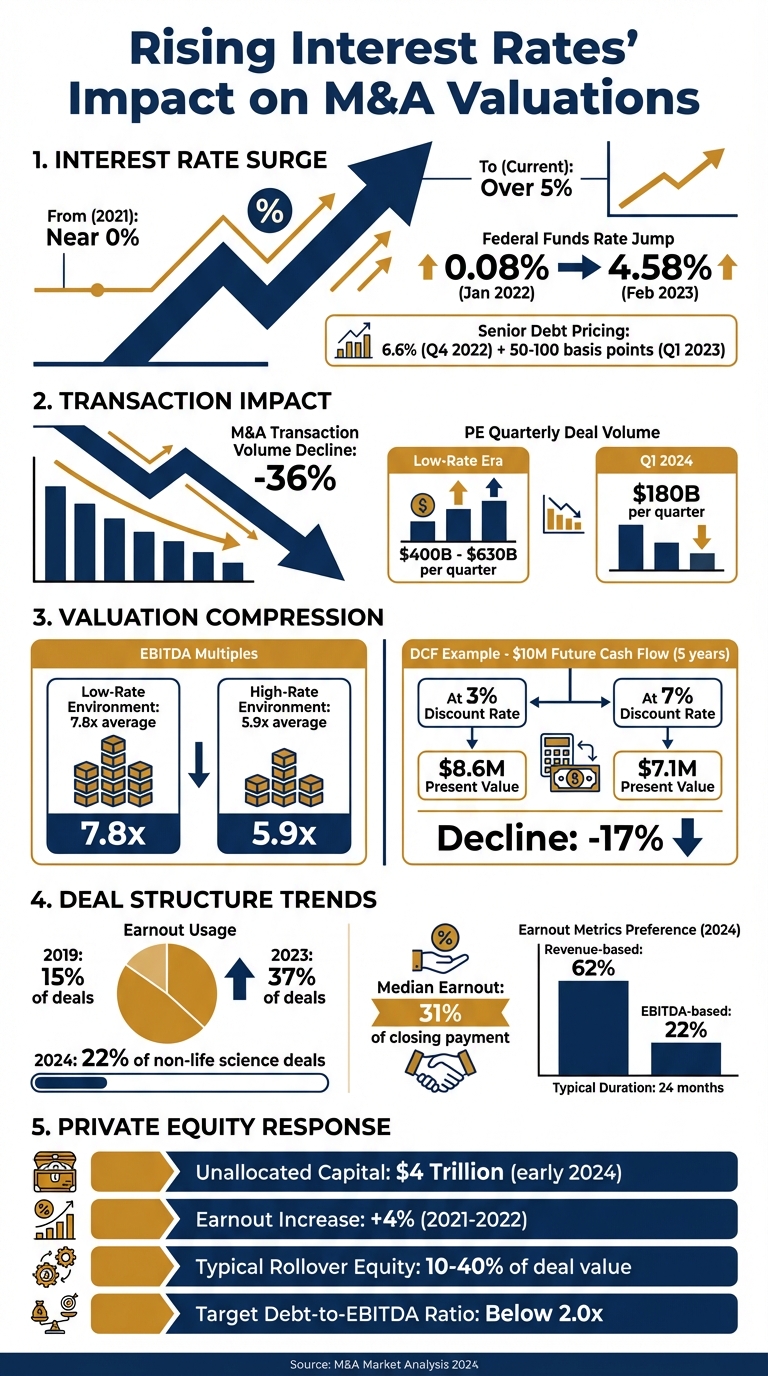
How Rising Interest Rates Impact M&A Valuations: Key Statistics and Trends
#478: Q1 2026 Economic & M&A Update
How Rising Interest Rates Affect M&A Valuations
Rising interest rates reshape M&A valuations by increasing the discount rate and compressing EBITDA multiples. As rates climb, the cost of capital rises, which reduces the present value of future cash flows. This shift impacts both detailed cash flow models and market-based multiples, ultimately influencing how buyers assess company value.
Discounted Cash Flow (DCF) Analysis and Interest Rates
The DCF method calculates a company’s value by projecting its future cash flows and discounting them to today’s value using a discount rate. When interest rates rise, the Weighted Average Cost of Capital (WACC) increases because both debt and equity become more expensive. This higher cost of capital reduces the present value of future cash flows. Lenders charge more for loans, and investors demand higher returns to compensate for safer alternatives.
"Rising interest rates directly impact the discount rate used in valuation models. As interest rates climb, the cost of borrowing for businesses increases. This higher cost of capital makes future cash flows less valuable in today’s dollars." – BradyWare
Here’s an example: Imagine a company expected to generate $10 million in cash flow five years from now. With a 3% discount rate (common in low-rate environments), that future cash flow is worth about $8.6 million today. But at a 7% discount rate, reflecting a higher-rate environment, the same $10 million drops to roughly $7.1 million in present value – a 17% decline. Even if a target company’s performance remains strong, this mathematical shift forces buyers to lower their offers.
While DCF focuses on future cash flows, EBITDA multiples provide a quicker valuation snapshot, and these too are influenced by rising rates.
EBITDA Multiples and Valuation Compression
EBITDA multiples, often used as a shorthand valuation tool, also come under pressure when interest rates rise. These multiples, particularly in leveraged transactions, shrink as borrowing costs increase. Private equity buyers, who typically finance 40%-60% of deals with debt, face reduced returns due to higher interest expenses. For example, senior debt pricing for acquisitions surged to 6.6% in Q4 2022, dramatically altering deal economics.
The effect of rising rates isn’t uniform across industries. Sectors like real estate and manufacturing, which rely heavily on debt financing, have seen sharper valuation declines. Meanwhile, high-growth areas such as healthcare and artificial intelligence have shown more resilience, though they aren’t entirely immune to broader market pressures. This disparity has widened the valuation gap between what sellers expect and what buyers are willing to pay.
In this challenging environment, advisory firms like TC Advisors can help refine valuation strategies to better reflect these shifting market dynamics. Their expertise can bridge the gap between buyer and seller expectations, ensuring that valuations remain grounded in current financial realities.
Bridging Buyer-Seller Valuation Gaps
Rising interest rates are creating a noticeable divide between what sellers expect and what buyers can afford. Sellers still hold onto the sky-high valuations seen in 2021, while buyers are grappling with higher borrowing costs. To put this into perspective, the federal funds rate soared from 0.08% in January 2022 to 4.58% by February 2023. This shift is largely due to the mathematical effects of increased discount rates and stricter lending requirements.
Seller Expectations vs. Buyer Financing Costs
At the heart of the issue is the contrast between sellers reminiscing about the days of cheap capital and buyers navigating a world of expensive debt. For example, the cost of senior debt for acquisitions climbed to 6.6% in Q4 2022, with an additional rise of 50–100 basis points in Q1 2023. These higher borrowing costs naturally push buyers to lower their offers, especially in leveraged deals. At the same time, banks have tightened their lending criteria, demanding more rigorous due diligence and reduced leverage levels.
"Buyers stop buying the future and start underwriting the present." – Kris Jones, Author of The Entrepreneur’s Exit Playbook
This shift means buyers are focusing more on immediate profitability and dependable cash flow rather than betting on long-term growth. Sellers who can prove strong pricing power, steady margins, and efficient cash conversion are better positioned to justify higher valuations. However, enterprise value-to-EBITDA multiples have shrunk, dropping from an average of 7.8x during the low-rate era to about 5.9x in today’s high-rate environment.
Private Equity’s Role in Closing Valuation Gaps
Private equity firms, armed with $4 trillion in unallocated capital as of early 2024, are finding ways to reduce their reliance on debt. They’re turning to strategies like larger equity contributions, earn-outs, and rollover equity. Earn-outs – where sellers receive additional payments if the business hits specific performance goals after the sale – rose by 4% between 2021 and 2022. Meanwhile, rollover equity, which allows sellers to retain a stake in the business (typically 10% to 40%), minimizes upfront cash requirements while giving sellers a chance to benefit from future resale profits.
"When rates rise, PE gets cautious – and structure gets creative." – Ed Button, Jr., Legacy Advisors
Despite these creative approaches, overall deal activity remains sluggish. Financial investors executed $180 billion in M&A transactions in Q1 2024, a steep drop from the $400 billion to $630 billion quarterly volumes seen during lower-rate periods. On the other hand, strategic buyers with significant cash reserves are gaining an edge. These buyers can sidestep costly debt financing and take advantage of reduced valuations. Such innovative deal structures are setting the stage for alternative solutions to valuation challenges, which will be discussed in the next section.
sbb-itb-85dd802
Deal Structures That Reduce Valuation Pressures
When buyers and sellers struggle to agree on a company’s valuation, creative deal structures can help bridge the gap. These structures ease the immediate financial burden on buyers while allowing sellers to reach their valuation goals by deferring part of the payment and tying it to future performance.
Earnouts and Contingent Payment Structures
Earnouts delay part of the purchase price, linking payments to specific milestones achieved after the deal closes. Sellers often push for these arrangements to account for anticipated growth, while buyers prefer basing valuations on proven historical performance, especially with high financing costs. This approach reduces the buyer’s upfront capital needs and minimizes reliance on expensive borrowing.
In 2024, earnouts featured in 22% of non-life science M&A deals, with the median earnout making up 31% of the closing payment. These agreements generally represent 10% to 50% of the total deal value and typically last about 24 months. Their popularity has grown significantly, with usage outside the life sciences sector rising from 15% in 2019 to as high as 37% in 2023.
Revenue-based earnouts have become the preferred option, appearing in 62% of 2024 deals, as they are less susceptible to manipulation compared to EBITDA-based metrics, which were used in only 22% of deals. Sellers favor revenue targets because buyers cannot easily reduce payouts through adjustments or reallocation of costs. A notable example is the Delaware Court of Chancery‘s 2024 ruling in Fortis Advisors LLC v. Johnson & Johnson. In this case, Johnson & Johnson faced over $1 billion in damages for failing to meet earnout milestones tied to robotic surgery advancements, marking the largest earnout award in Delaware’s history.
"An earn-out often converts today’s disagreement over price into tomorrow’s litigation over the outcome."
– J. Travis Laster, Vice Chancellor, Delaware Court of Chancery
To minimize disputes, sellers should advocate for clear, third-party milestones – like customer retention numbers or regulatory approvals – rather than relying on internal financial metrics. Agreeing upfront on consistent accounting methods (e.g., GAAP) can further reduce the risk of disputes. Buyers, meanwhile, should cap earnout exposure, typically at 25% to 100% of the initial payment, to manage financial risk.
These deferred payment strategies naturally lead to other financing methods that address valuation challenges.
Seller Financing and Risk-Sharing Mechanisms
Seller financing is another way to ease valuation pressures. This approach allows buyers to spread payments over time, often with interest, reducing the need for expensive bank loans and preserving working capital. For sellers, it’s an opportunity to earn interest on deferred payments – benchmarked to rates like SOFR or Prime – and potentially benefit from tax deferral by receiving payments over several years instead of a lump sum.
As interest rates rose from 0.08% in January 2022 to 4.58% by February 2023, interest-bearing structures regained popularity. Venture capital investors, for instance, shifted away from SAFEs (Simple Agreements for Future Equity) and returned to interest-bearing convertible promissory notes. Sellers now seek to capitalize on the time value of money, which was less significant in a near-zero rate environment.
"Seller financing is more than a creative payment mechanism; it’s a strategic tool for closing deals."
– Agile Legal
Sellers should protect their interests by securing promissory notes with collateral, personal guarantees, or UCC filings to guard against buyer default. Conducting thorough financial due diligence on the buyer’s repayment ability – examining cash flow and debt levels – is also crucial. Buyers, on the other hand, should negotiate offset provisions to reduce deferred payments if indemnification claims arise. Clearly defining performance metrics and dispute resolution methods can help both parties avoid future litigation.
Fixed-Price vs. Rate-Adjusted Structures
The choice between fixed-price and rate-adjusted deal structures determines how interest rate risks are shared between buyers and sellers.
- Fixed-Price (Locked-Box): This model sets the purchase price based on historical financials (e.g., year-end statements). Buyers pay interest on this locked price from the agreed date to closing, encouraging a faster closing process and protecting sellers from value declines during the interim.
- Rate-Adjusted (Post-Closing): Here, the price is initially based on estimated financials at closing, with adjustments made later if needed. This approach protects buyers from overpaying if the company underperforms before closing but introduces uncertainty for sellers. Given today’s higher interest rates, sellers often demand interest on adjustment payments to account for the time value of money.
| Feature | Fixed-Price (Locked-Box) | Rate-Adjusted (Post-Closing) |
|---|---|---|
| Price Determination | Based on historical financials (e.g., year-end) | Based on estimated financials at closing, adjusted later |
| Rate Sensitivity | Buyer pays interest on locked price from lock date to closing | Adjustments may include interest payments |
| Risk Allocation | Buyer assumes post-lock date risks/rewards | Seller retains risks/rewards until closing |
| M&A Suitability | Best in stable markets or for quick closings | Common in the U.S.; protects buyers from pre-closing value drops |
For deals facing long regulatory delays, rate-adjusted structures allow parties to update valuations closer to closing, avoiding outdated numbers that could lead to goodwill adjustments. However, if the seller’s financial stability is in question, fixed-price models or escrow-heavy setups might be safer, as buyers could struggle to recover funds if valuations fall short.
These strategies offer practical ways to align seller expectations with buyer constraints in today’s high-interest-rate market. For guidance on navigating these complex deal structures, consider working with TC Advisors, experts in M&A valuation and transaction advisory services.
Adapting Business Valuations for High Interest Rates
As interest rates climb, businesses must rethink how they value opportunities and secure financing. This means revisiting valuation models, shifting acquisition strategies, and exploring new funding options to keep deals moving forward despite higher borrowing costs.
Stress-Test Valuation Models
Adjusting valuation models to handle fluctuating interest rates is critical. Businesses should use sensitivity analysis to test multiple interest rate scenarios within their discounted cash flow (DCF) models. This helps assess how rate hikes might impact valuations and debt serviceability. For instance, rising rates increase the Weighted Average Cost of Capital (WACC), which lowers present values and forces businesses to rethink assumptions.
Between March 2020 and May 2023, the Federal Reserve raised rates from 0.25% to 5.00%–5.25%. This led to senior debt pricing exceeding 6.6% by early 2023. Such shifts demand models that factor in higher interest expenses, which directly reduce earnings and cash flow coverage.
Terminal values also need a reality check. Higher discount rates mean businesses must adopt more conservative exit multiples. Instead of banking on aggressive growth projections, the focus should shift to stable, current cash flows – a strategy Kris Jones, author of The Entrepreneur’s Exit Playbook, calls "underwriting the present".
"Buyers stop buying the future and start underwriting the present."
– Kris Jones
In this environment, solid cash flows are the anchor that keeps valuations steady.
Focus on Cash-Generating Assets
With valuation multiples under pressure, buyers are prioritizing businesses with proven revenue streams and efficient operations. For example, EBITDA multiples have compressed from an average of 7.8x during low-rate periods to around 5.9x in today’s high-rate climate. Growing EBITDA has become a key strategy for maintaining transaction value.
Take the case of a roofing business documented by GaP Transaction Advisors in May 2025. In 2024, the company earned $23 million in revenue and $3 million in EBITDA, valued at a 5.0x multiple ($15 million). By optimizing operations and improving working capital, it projected a $3.6 million EBITDA by 2026. Despite ongoing market pressures, the adjusted multiple of 5.9x boosted its valuation to $21.2 million – a $6.2 million increase.
Another example involves a marine logistics company that restructured in 2025. With $34 million in revenue, $4 million in EBITDA, and $10 million in debt in 2024, its valuation stood at $20 million (5.0x EBITDA). By 2026, after reducing its debt to $8 million and improving liquidity, its valuation climbed to $23.6 million at a 5.9x EBITDA multiple.
Investors are increasingly drawn to businesses with low debt-to-equity ratios or substantial cash reserves, as these companies benefit more from rising rates. Keeping debt-to-EBITDA ratios below 2.0x also appeals to cautious lenders and buyers. Additionally, businesses in steady, recession-resistant sectors – like beauty, wellness, or essential services – offer a safety net against market volatility.
Use Private Credit Options
When traditional financing becomes too restrictive or costly, private credit can fill the gap. Direct lenders and private credit funds offer alternative capital sources, albeit at higher interest rates, to bridge valuation gaps between buyers and sellers.
Banks have tightened lending standards and extended due diligence timelines due to heightened default risks. In response, private equity firms are increasingly turning to private credit as a flexible alternative to traditional bank loans. While private credit comes with a premium, it often provides the agility needed to close deals.
"PE firms use cash to fund growth, service debt, or distribute cash to shareholders. With lower rates, [PE firms] can borrow more and pay more (for assets). That should help bridge valuation gaps with sellers."
– Benjamin Clinger, Private Equity Partner, Kirkland & Ellis
A manufacturing business in 2026 showcased how to navigate these challenges. With $59 million in revenue and $8 million in EBITDA, it was valued at $52 million (6.5x multiple). The deal was structured with $40 million upfront, a $7 million earnout tied to EBITDA growth, and a $5 million equity rollover. This creative approach, leveraging private credit, allowed the company to secure competitive financing despite high borrowing costs.
For businesses grappling with these headwinds, TC Advisors offers transaction advisory services tailored to thrive in high-interest-rate scenarios.
Conclusion
Rising interest rates have reshaped how buyers and sellers evaluate mergers and acquisitions (M&A). With higher borrowing costs squeezing multiples and reducing cash flow coverage, the focus has shifted from chasing aggressive growth to prioritizing proven profitability. Buyers are now paying closer attention to current cash flows instead of relying on optimistic future projections. For sellers, this means setting realistic expectations and demonstrating strong operational performance.
Alongside these valuation changes, deal structures have taken center stage in addressing market challenges. Tools like earnouts, seller financing, equity rollovers, and mixed transactions have become critical. These mechanisms offer flexibility and help bridge the gap between sellers’ expectations and buyers’ constraints, especially as traditional bank financing becomes more expensive and harder to secure.
Adapting to this environment requires thorough preparation. Sellers who focus on improving EBITDA, reducing debt, and presenting clear, reliable financials stand out as attractive, low-risk opportunities. On the other hand, buyers who stress-test financial models and explore private credit options can keep deals progressing, even in tighter conditions.
Expert guidance has never been more important. TC Advisors provides transaction advisory services to help businesses tackle complex valuations, design deal structures suited to high-rate environments, and explore financing options that ensure transactions stay on track. With proper planning and support, businesses can still achieve successful outcomes – even in this challenging market.
While the market has become more selective, it hasn’t disappeared. Quality businesses with strong cash flows and flexible sellers will continue to find buyers willing to pay reasonable prices. Success depends on both parties approaching negotiations with practical expectations and creative solutions.
FAQs
How much can higher rates lower my company’s valuation?
Higher interest rates can directly impact your company’s valuation by driving up the cost of capital and increasing discount rates. As a result, the present value of future cash flows decreases, making it harder to secure attractive valuations during mergers and acquisitions.
What deal terms can bridge a buyer-seller price gap?
When buyers and sellers can’t agree on a price, certain deal terms can help close the gap. Options like cash and stock offerings, structured transactions, or tools such as earn-outs and escrows can make a big difference. These strategies are particularly useful for tackling challenges like financing limitations or valuation disagreements – issues that often become more pronounced when interest rates are on the rise.
Which industries perform best when rates rise?
Industries that tend to thrive during periods of rising interest rates are those with steady demand and reliable cash flow. Sectors like technology, healthcare, and consumer staples often stand out because they are typically less sensitive to changes in interest rates. These industries provide essential products or services, ensuring their performance remains more stable even as borrowing costs increase.


