

The Rule of 40 is a simple formula that combines a SaaS company’s revenue growth rate and profit margin. If the total equals or exceeds 40%, the company is considered efficient and attractive to investors. For example, a company with 30% growth and a 10% margin scores 40%, meeting the benchmark.
Why does this matter? Companies scoring above 40% often achieve higher valuations – with revenue multiples ranging from 8× to 15×. Meanwhile, those below 20% typically see lower multiples around 1× to 3×. Investors use this metric to assess whether a business is scaling effectively or burning through cash.
Key insights:
- Formula: Revenue Growth (%) + Profit Margin (%) ≥ 40%.
- Valuation Impact: Higher Rule of 40 scores = higher revenue multiples.
- Market Trends: Only 16% of SaaS companies consistently meet this benchmark.
Improving your Rule of 40 score often involves lowering customer acquisition costs, growing recurring revenue, or improving operational efficiency. Understanding this metric is crucial for SaaS businesses aiming to attract premium valuations or secure funding.
The SaaS “Rule of 40”: Valuation Indicator or Online Echo Chamber?
sbb-itb-85dd802
What is the Rule of 40?
The Rule of 40 is a simple formula used to evaluate the health and efficiency of SaaS companies by combining their revenue growth rate and profit margin. If the sum of these two metrics equals or exceeds 40%, the company is considered to be in good shape. Here’s the formula:
Revenue Growth Rate (%) + Profit Margin (%) ≥ 40%.
This metric highlights the balance between growth and profitability. A company might prioritize rapid growth at the expense of profitability or focus on profits with slower growth, as long as the combined total hits 40%. For example, a startup growing at 60% but with a –20% profit margin (totaling 40%) is seen as just as healthy as a more mature business growing at 10% with a 30% margin.
Consistency in calculation is key. Many companies use EBITDA margin for profitability because it excludes non-cash expenses like depreciation, offering a clearer picture of operational performance. On the growth side, Annual Recurring Revenue (ARR) is often used, as it focuses on recurring subscription revenue, leaving out one-time fees.
Although originally designed for companies with $50 million or more in revenue, the Rule of 40 is now applied to smaller SaaS businesses, even those starting at $1 million in ARR. That said, for companies still searching for product-market fit or operating below $1 million in ARR, the metric can be unreliable due to volatile data.
Understanding how to calculate this metric provides insight into its evolution and relevance today. Its straightforward nature has made it a key tool for evaluating SaaS companies, influencing everything from valuations to growth strategies.
Where the Rule of 40 Came From
The concept was popularized in 2015 by Brad Feld of Foundry Group through his blog post, "The Rule of 40% For a Healthy SaaS Company." Feld introduced it as a simple way for investors and boards to compare SaaS businesses at various stages of maturity. It helped address the challenge of evaluating fast-growing startups that burn cash versus mature, profit-generating companies. Quickly dubbed a "golden ratio" in venture capital and private equity, the metric became a standard for assessing whether a company is scaling efficiently or simply burning through resources.
Its impact has been significant, shaping benchmarks across the SaaS industry. By 2024, some investors began raising the bar with thresholds like the "Rule of 50" or "Rule of 60" to identify standout performers in increasingly competitive markets.
Why the Rule of 40 Matters
Think of the Rule of 40 as a credit score for SaaS companies. It signals to investors that a business is balancing growth and profitability effectively, demonstrating operational efficiency worthy of premium valuations. A high score reassures investors that the company isn’t just chasing growth but is doing so sustainably.
Industry experts emphasize its importance in today’s market:
"Score above 40. Suddenly, you’re fielding multiple offers, often with premium valuations attached. Score below that mark and you might spend months explaining why your business deserves a second look."
– Warfield Alexandre, Bookman Capital
The Rule of 40 also reflects a broader shift in investor priorities. In recent years, the focus has moved from "growth at all costs" to "efficient growth." Investors now favor companies that maintain strong Rule of 40 scores through improved margins rather than relying solely on rapid revenue growth. This metric has evolved into more than just a historical performance indicator – it’s a forward-looking tool that guides strategic decisions in areas like pricing, customer acquisition, and operational efficiency.
How to Calculate the Rule of 40
Calculating the Rule of 40 is straightforward, but consistency in metric selection is crucial. The basic formula provides a quick snapshot of a company’s health, while the weighted version reflects how investors assess SaaS businesses.
Basic Formula
The standard method combines your revenue growth rate and profit margin. If the total reaches or surpasses 40%, your company is considered to be in good shape. For instance, a SaaS company growing at 25% with a 20% profit margin would score 45%, clearing the benchmark.
- Revenue growth is typically measured year-over-year using ARR (Annual Recurring Revenue), excluding any one-time fees. While public companies may use GAAP revenue, ARR remains the preferred metric for private SaaS businesses.
- Profit margin offers some flexibility. Many private equity firms rely on the EBITDA margin, which excludes non-cash expenses like depreciation and omits interest and taxes. Others may use Free Cash Flow (FCF) margin for a clearer view of cash available for reinvestment. Some opt for Operating Margin (EBIT) for simplicity. Whichever metric you choose, stick with it to ensure consistent trend analysis.
Here’s how two strategies can both meet the benchmark:
| Metric | High Growth Strategy | Efficient Growth Strategy |
|---|---|---|
| Revenue Growth | 60% | 30% |
| Profit Margin (EBITDA) | -15% | 15% |
| Rule of 40 Score | 45% (Pass) | 45% (Pass) |
In the first example, the company prioritizes aggressive growth, burning cash to expand. The second approach focuses on scaling more sustainably. For investors who weigh growth more heavily, the weighted version offers additional insight.
Weighted Rule of 40
The weighted formula adjusts for a key reality: growth often holds more value than profitability. The calculation is (1.33 × Growth) + (0.67 × Margin), giving growth about twice the weight of profit. This reflects how markets typically evaluate SaaS companies.
This method is particularly relevant for smaller or early-stage businesses that emphasize revenue growth over immediate profitability. As Byron Deeter and Sam Bondy from Bessemer Venture Partners explain:
"Long-term models show that even in tight markets, growth should be valued at least ~2x-3x more than FCF margin."
For example, if your business grows at 40% with a 5% EBITDA margin, the basic Rule of 40 score would be 45%. Using the weighted formula? (1.33 × 40) + (0.67 × 5) = 53.2 + 3.35 = 56.55%. This higher score aligns with the market’s emphasis on growth.
Companies scoring above 40% often enjoy revenue multiples of 8-15×, while those below 20% may trade at just 1-3×. Knowing when to use each calculation can help you better articulate your company’s value to investors or potential buyers.
How the Rule of 40 Affects SaaS Valuation
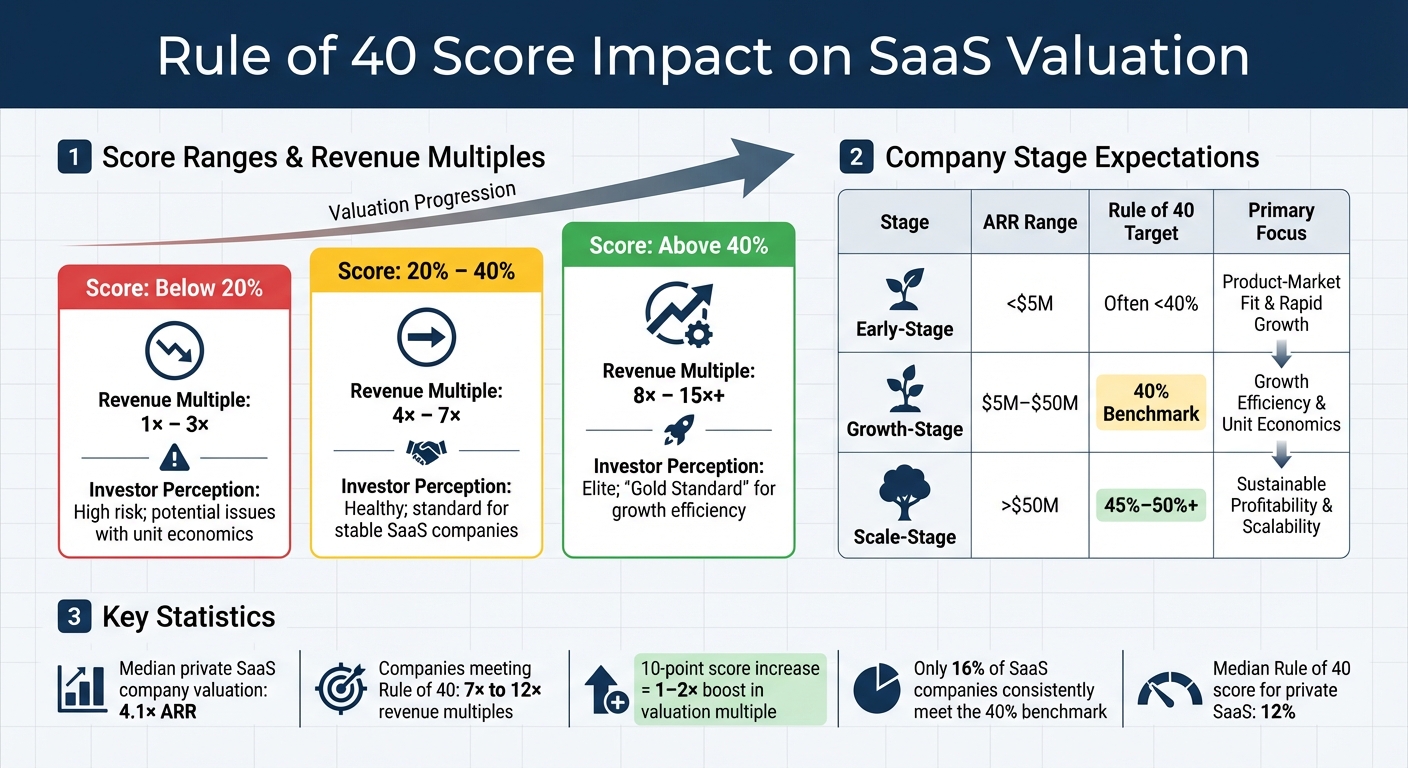
Rule of 40 Score Impact on SaaS Valuation Multiples
The Rule of 40 is more than just a performance metric – it directly influences how investors value SaaS companies. Businesses that exceed the 40% benchmark often achieve significantly higher revenue multiples, with valuations 2–3× greater than those that fall short. For context, the median private SaaS company typically sells for around 4.1× ARR. However, those meeting or surpassing the Rule of 40 can see multiples ranging from 7× to as high as 12× revenue.
Interestingly, even a modest 10-point increase in a Rule of 40 score can lead to a boost of 1–2× in an enterprise’s value-to-revenue multiple. Here’s a breakdown of how Rule of 40 scores correlate with revenue multiples:
- Below 20%: Valuations tend to fall between 1× and 3× revenue.
- 20–40%: Companies in this range often command 4× to 7× revenue.
- Above 40%: Businesses achieving this level can see multiples of 8× to 15× or more.
"The Rule of 40 determines whether investors will even take a meeting with you. Score above 40 and suddenly you’re fielding multiple offers."
- Warfield Alexandre, Bookman Capital
Rule of 40 and Revenue Multiples
Growth is often valued more highly than profitability, with a premium of about 18%. This creates a multiplier effect that directly impacts revenue multiples. Some investors even use the "Rule of X", which applies a 2× to 3× multiplier to a company’s growth rate. Interestingly, the Rule of X shows a stronger correlation to revenue multiples (0.62) than the traditional Rule of 40 (0.50).
The investment focus has shifted in recent years, particularly in 2024–2025, as the market moves away from prioritizing "growth at all costs." Instead, investors now favor companies demonstrating "efficient growth" – businesses growing at a steady 25–35% annually while maintaining profitability. For example, a company growing at 50% with a –10% margin and another growing at 10% with a 30% margin may both meet the Rule of 40. However, they appeal to different investor types, such as venture capitalists (favoring high growth) versus private equity firms (favoring profitability).
| Rule of 40 Score | Typical Revenue Multiple | Investor Perception |
|---|---|---|
| < 20% | 1× – 3× | High risk; potential issues with unit economics |
| 20% – 40% | 4× – 7× | Healthy; standard for stable SaaS companies |
| > 40% | 8× – 15×+ | Elite; seen as the "Gold Standard" for growth efficiency |
How Different Company Stages Use the Rule of 40
The importance of the Rule of 40 evolves with a company’s maturity. For early-stage startups (under $5 million ARR), the focus is on achieving product-market fit and rapid growth, often sidelining the 40% benchmark. However, as companies grow into the $15 million to $50 million ARR range, the Rule of 40 becomes a critical measure of growth efficiency.
For more mature businesses (above $50 million ARR), expectations rise further. These companies are generally expected to exceed the 40% threshold, often aiming for scores between 45% and 50% or higher. Sustaining a score above 45% for at least three consecutive quarters can unlock premium valuation multiples.
| Company Stage | ARR Range | Rule of 40 Expectation | Primary Investor Focus |
|---|---|---|---|
| Early-Stage | <$5M | Often <40% | Product-Market Fit & Rapid Growth |
| Growth-Stage | $5M–$50M | 40% Benchmark | Growth Efficiency & Unit Economics |
| Scale-Stage | >$50M | 45% – 50%+ | Sustainable Profitability & Scalability |
Currently, the median Rule of 40 score for private SaaS companies is only 12%, indicating that most businesses fall well short of the benchmark. However, companies with Net Revenue Retention exceeding 120% often achieve median valuations of 11.7× revenue, compared to just 5.6× for those below that retention level. This highlights the critical role retention metrics play in driving valuations.
Limitations of the Rule of 40
The Rule of 40 provides a useful benchmark for SaaS companies, but it comes with certain limitations that can mislead founders and investors if applied rigidly or without context. Recognizing these shortcomings is essential for interpreting valuation multiples and investor expectations accurately.
Favors Mature Companies
The Rule of 40 tends to favor established SaaS companies over early-stage startups. For instance, only 9% of SaaS companies with less than $30 million in revenue meet the Rule of 40, compared to 26% of companies with over $80 million in revenue. This gap exists because mature companies benefit from steady recurring revenue, streamlined operations, strategic financial leadership, and economies of scale, making it easier to balance growth with profitability.
Startups, especially those under $5 million in Annual Recurring Revenue (ARR), are in a very different position. In these early stages, the focus is often on capturing market share and achieving product-market fit, which typically involves high burn rates and negative margins. Even rapid growth often isn’t enough to hit the 40% threshold. For companies with less than $1 million ARR, the metric becomes even less reliable due to volatile data. Founders are generally advised to wait until their company reaches $1 million in Monthly Recurring Revenue (MRR) or $5 million in ARR before using the Rule of 40 as a key performance indicator.
This dynamic is sometimes referred to as the "Harvest Mode" trap. For sub-scale companies (those under $100 million ARR), focusing on significant net profit instead of reinvesting in growth can send a negative message to potential acquirers.
"A significant net profit at a sub-scale company in this sector is an adverse signal to an acquirer that you’re stuck in a niche without attractive reinvestment opportunities." – Randall Lucas, Managing Director at SaaS Capital
While the Rule of 40 inherently favors larger, more mature companies, its reliability is further undermined by the volatility of growth and margin figures.
Volatility in Metrics
Another challenge with the Rule of 40 is how easily the metric can be manipulated or distorted by short-term decisions. Companies might boost their scores temporarily by cutting R&D budgets, scaling back marketing, or freezing hiring. These actions can improve EBITDA margins in the short term but often lead to long-term issues like a weakened sales pipeline or reduced competitiveness.
This phenomenon reflects Goodhart’s Law, which states:
"When a measure becomes a target, it ceases to be a good measure"
The Rule of 40 assumes growth and profitability are interchangeable, but they reflect very different business strategies. A company achieving 40% growth with 0% margin is fundamentally different from one with 0% growth and a 40% margin. The former might be aggressively expanding, while the latter could be a stagnant cash generator.
Market conditions also play a significant role in how the Rule of 40 is evaluated. During periods of low interest rates, investors tend to prioritize growth. However, in tighter financial conditions, such as those seen in 2023–2025, the focus shifts toward efficiency and profitability. Sustaining a Rule of 40 score consistently is rare – according to a McKinsey study of over 200 software companies, the threshold was exceeded only about 16% of the time across all company-years. Moreover, as of August 2024, the median Rule of 40 score for public SaaS companies was just 34%, indicating that even many mature public companies fall short of this benchmark.
How to Improve Your Rule of 40 Score
Boosting your Rule of 40 score requires a careful mix of strategies. Whether you’re focusing on accelerating revenue growth, enhancing profitability, or finding the right balance between the two, the approach you choose will depend on factors like your company’s stage, cash reserves, and what investors expect. Below are three impactful ways SaaS companies can improve their scores.
Reduce Customer Acquisition Costs
Cutting customer acquisition costs (CAC) is a quick way to improve profit margins without slowing growth. Start by calculating your fully loaded CAC, which includes ad spend, salaries for marketing and sales teams, tools, content creation, and overhead costs.
One effective method to lower CAC is funnel optimization. Use tools like heatmaps and session recordings to identify where potential customers drop off, then run A/B tests to fix those problem areas. AI-driven targeting and automated bidding can slash acquisition costs by up to 50%, while referral and partner programs may lower costs per lead by 30–40%. To fine-tune further, analyze CAC by channel to find your most cost-effective sources. Aiming for a payback period under 12 months and maintaining an LTV-to-CAC ratio of at least 3:1 can help stabilize your Rule of 40 score.
Grow Recurring Revenue Streams
Expanding revenue from your existing customer base is often more cost-efficient than acquiring new customers. For instance, achieving a Net Revenue Retention (NRR) of 120% or more allows a company to grow by 20% annually without needing new clients. Upselling, cross-selling, and introducing usage-based add-ons are great ways to increase Annual Recurring Revenue (ARR) without the higher costs tied to new customer acquisition.
Switching to usage-based or value-based pricing models can also help your revenue grow alongside customer adoption, potentially improving your Rule of 40 score by 5–15%. Offering annual or multi-year contracts can reduce churn volatility and ensure steady cash flow. Additionally, churn analysis and automated onboarding can further protect recurring revenue.
Take the example of a bootstrapped analytics company in early 2026. With $700,000 in ARR, they raised their Rule of 40 score from 38 to 47 by introducing localized pricing and annual prepay options. This boosted their year-over-year growth from 18% to 24% and profit margins from 20% to 23%, resulting in a valuation multiple increase of 0.7×. Similarly, a venture-backed workflow platform with $6 million in ARR improved its score to over 50 by automating onboarding and refreshing pricing, which increased gross margins by 6 points and ARPU by 8%.
Work with Fractional CFO Services
Bringing in expert financial leadership can also make a big difference. Fractional CFO services provide strategic financial oversight at a fraction of the cost of a full-time hire. In 2025–2026, rates typically range from $200 to $350 per hour, with monthly retainers between $2,000 and $17,500, depending on the scope of work. For Series B startups, this can mean savings of 80–90% compared to hiring a full-time CFO, translating to annual savings between $415,000 and $634,250.
A fractional CFO focuses on the key metrics that drive your Rule of 40 score, such as MRR/ARR recognition, CAC versus LTV optimization, churn analysis, and unit economics. They create integrated financial models covering the profit and loss statement, balance sheet, and cash flow to assess how growth investments affect your cash runway. Weekly forecasting is often used to catch anomalies and churn risks early.
For example, TC Advisors offers fractional CFO services specifically tailored to SaaS companies. Their team helps optimize financial performance through customized modeling, cash flow management, and growth planning. In one case, a Series B startup working with them discovered over $400,000 in tax savings and recovered $50,000 in misbilled vendor payments, delivering a 10× return on their investment. This kind of financial expertise can help you maintain the balance between growth and profitability that the Rule of 40 measures.
Conclusion
The Rule of 40 serves as a key benchmark for investors to distinguish thriving SaaS companies from those struggling to find their footing. Companies scoring above 40% often enjoy revenue multiples between 8-15×, while those below 20% may see valuations drop to just 1-3× revenue. By understanding this metric, SaaS leaders gain a practical framework for making decisions about resource allocation, pricing strategies, and growth investments. As David Skok from Matrix Partners explains:
"The Rule of 40 gives founders and executives a flexible framework to make strategic decisions appropriate to their company’s maturity".
A strong Rule of 40 score signals to investors that your team understands unit economics and can balance growth with efficiency, avoiding the pitfalls of overspending.
While the approach to improving this score may differ depending on a company’s stage, the core principles remain the same: prioritize profitability alongside growth, emphasize customer retention over acquisition, and maintain disciplined operations. Interestingly, companies moving upward from a score of 25% to 35% often attract more investor interest than those with higher but declining scores. Public SaaS companies exceeding the 40% mark have even outperformed the S&P 500 by an average of 3% annually.
For SaaS businesses generating $5 million to $20 million in ARR, improving the Rule of 40 score can lead to higher valuations and less reliance on external funding. A strong score demonstrates a company’s ability to grow sustainably, reducing perceived risks for investors and acting as a financial "credit score".
To achieve these improvements, expert financial guidance can make a significant difference. TC Advisors specializes in fractional CFO services designed to help SaaS companies optimize the metrics that drive Rule of 40 performance. Their team builds integrated financial models that clearly show how growth investments impact cash flow and profitability, empowering you to make informed, data-backed decisions that enhance both your score and your valuation.
FAQs
Which profit metric should I use for the Rule of 40 (EBITDA, EBIT, or free cash flow)?
EBITDA and free cash flow are frequently used profit metrics for the Rule of 40 because they align with standard practices in the industry. These metrics offer a more transparent view of a SaaS company’s financial health and operational performance, making them well-suited for this calculation.
When is my SaaS company “too early” to rely on the Rule of 40?
When your SaaS company is in its early growth phase, the Rule of 40 isn’t the most practical metric to focus on. At this stage, your primary goal is scaling – growing your customer base, expanding your market presence, and building momentum. The Rule of 40 becomes more relevant later, once your company reaches a stable financial position with consistent revenue and profit margins.
How can I improve my Rule of 40 without hurting long-term growth?
To strengthen your Rule of 40 metric while ensuring sustained growth, aim for a balanced approach to revenue growth and profitability. Start by improving unit economics to increase margins and reduce inefficiencies. Streamline costs strategically, focusing on areas where efficiency can be improved without compromising the business’s ability to scale.
On the revenue side, consider initiatives like enhancing your product, acquiring new customers, or upselling to your existing base. However, be cautious about cutting costs too aggressively – it can jeopardize future growth opportunities. Instead, prioritize adjustments that align with long-term success.


