

Sell-side tax diligence flips the script on traditional M&A tax reviews by allowing sellers to address potential tax issues before buyers uncover them. This process involves reviewing 3–5 years of tax records, identifying risks like unpaid taxes or misclassified workers, and quantifying exposures. By resolving these issues early, sellers can avoid price reductions, escrow holdbacks, or deal cancellations. Additionally, showcasing tax benefits like Net Operating Losses (NOLs) or tax credits can increase the business’s appeal and transaction value. Starting months or years before a sale ensures a smoother negotiation and closing process.
Key steps include:
Sell side tax diligence is a core part of what we do. Our transaction advisory page sets out the full scope and the deliverables.
- Organizing tax records with personalized CPA support: Gather federal, state, and local returns, audit histories, and supporting documents.
- Reviewing compliance: Check for risks in sales tax nexus, contractor classifications, and tax credits.
- Quantifying exposures: Calculate liabilities and decide on remediation steps like Voluntary Disclosure Agreements (VDAs).
- Highlighting benefits: Identify and market tax attributes that buyers find attractive.
- Preparing a tax report: Summarize findings to streamline buyer due diligence.
The earlier you begin, the better your chances of avoiding surprises and maximizing your sale value.
M&A Financial & Tax Due Diligence Interview
sbb-itb-85dd802
Key Steps in the Sell-Side Tax Diligence Process
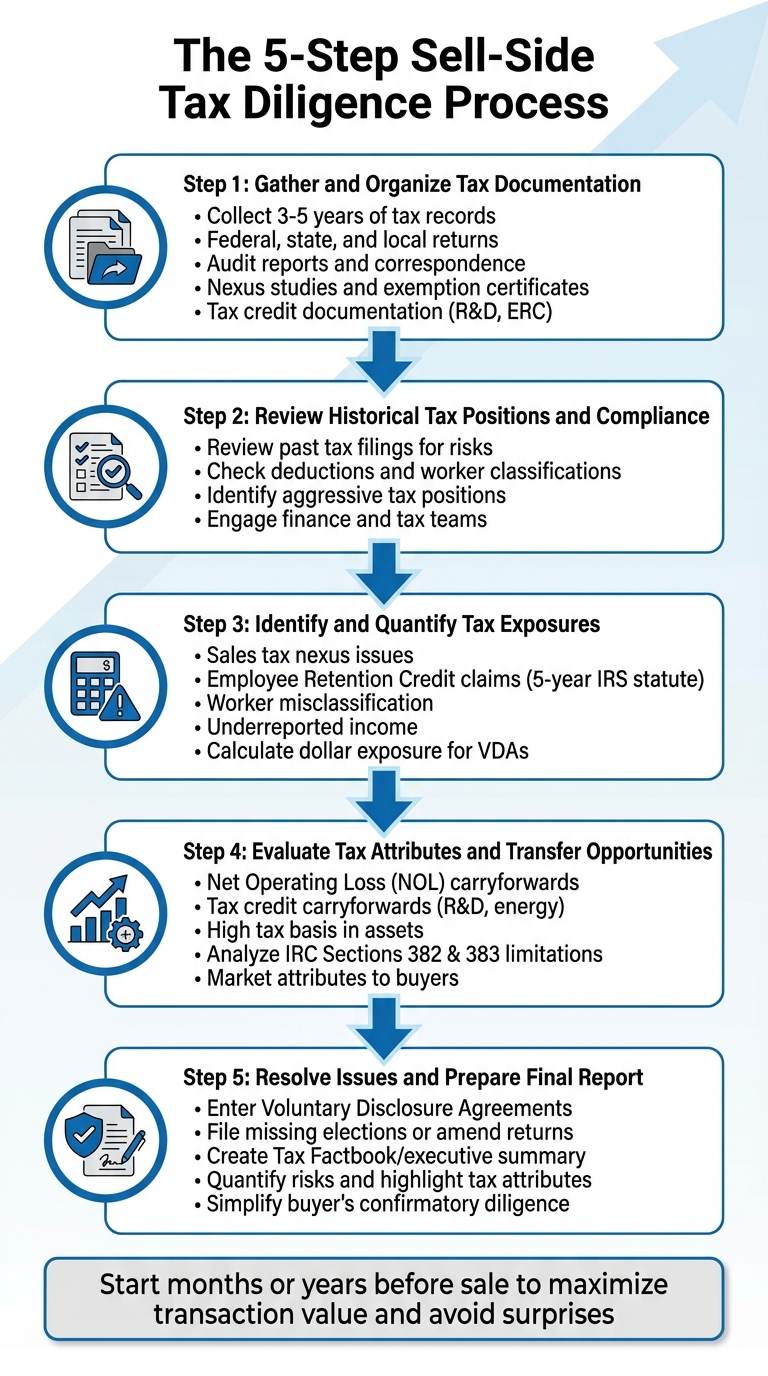
5-Step Sell-Side Tax Diligence Process for M&A Transactions
Step 1: Gather and Organize Tax Documentation
Start by collecting 3–5 years of tax records, including federal, state, and local income tax returns, as well as sales and use tax filings, payroll tax records, and international tax documents. Don’t forget audit reports, settlement agreements, and any correspondence with tax authorities to identify unresolved disputes or recurring compliance challenges.
For businesses operating in multiple states, include nexus studies, sales tax collection reports, and customer exemption certificates. If your company has claimed tax credits, such as the Research & Development Credit or the Employee Retention Credit, gather all supporting documentation. Be sure to include workpapers for tax provisions, deferred tax calculations, and legal documents like S-Corp election forms. Creating a checklist tailored to your business type and the expected deal structure ensures nothing is missed. Once your documents are in order, you can move on to reviewing historical compliance.
Step 2: Review Historical Tax Positions and Compliance
Dive into your past tax filings to uncover potential risks. This involves checking how deductions were handled, confirming accurate worker classifications, and ensuring all required jurisdictions were covered. As Shaun Hunley, Tax and Accounting Executive Editor at Thomson Reuters, points out:
"The one buying the company could be on the hook, legally, for taxes that are due when they are buying stock. So, they do due diligence a little bit more and it’s more in depth."
Engage with your finance and tax teams to identify any hidden risks. Pay special attention to aggressive tax positions taken in prior years, as these will likely be closely examined by potential buyers. Once you’ve identified the risks, the next step is to quantify them and plan for any necessary remediation.
Step 3: Identify and Quantify Tax Exposures
Pinpoint areas of potential tax liability and quantify the risks. Focus on high-risk areas like sales tax nexus in states where gross receipt thresholds have been exceeded, Employee Retention Credit claims, and worker misclassification. Also, review for underreported income, disallowed deductions (e.g., capital improvements incorrectly expensed), and insufficient documentation for tax credits claimed.
Keep in mind that the IRS has a five-year statute in some cases for Employee Retention Credits. In jurisdictions where required returns weren’t filed, the statute of limitations may never begin, leaving you exposed to long-term liabilities. Calculating these exposures in dollar terms is crucial to determine whether remediation, such as a Voluntary Disclosure Agreement, is necessary. Once liabilities are accounted for, shift focus to identifying potential tax benefits.
Step 4: Evaluate Tax Attributes and Transfer Opportunities
Identify tax attributes that could appeal to buyers, such as Net Operating Loss carryforwards, tax credit carryforwards (like R&D or energy credits), and high tax basis in assets. These attributes can represent future benefits for buyers, increasing your business’s attractiveness and potentially boosting its transaction value.
Evaluate whether these attributes will survive an ownership change by analyzing limitations under Internal Revenue Code Sections 382 (for NOLs) and 383 (for credits). Conducting a Section 382 study ahead of time helps demonstrate the exact value buyers can expect. As BDO USA notes:
"Through a sell-side tax due diligence process, sellers can identify and value tax attributes within the business… and market those tax attributes to prospective buyers during the sale process."
With tax attributes identified, it’s time to address any remaining issues and finalize your findings.
Step 5: Resolve Issues and Prepare the Final Report
Address any outstanding issues and compile your findings into a clear, concise report. If you’ve uncovered significant liabilities, such as unpaid sales tax across multiple states, consider entering into Voluntary Disclosure Agreements to limit lookback periods and reduce penalties. File any missing elections or amend returns as required.
Summarize everything in a "Tax Factbook" or executive summary that outlines your tax profile, quantifies risks, and highlights key tax attributes. This organized approach simplifies the buyer’s confirmatory due diligence process and builds trust. As Bob Houston, Tax and M&A Leader at BPM, explains:
"Tax due diligence serves as a critical lens through which we discover and quantify potential tax risks in M&A transactions. These findings often impact the deal structure, escrow holdbacks, indemnification, and determine what conditions are needed to resolve tax issues."
Common Pitfalls in Sell-Side Tax Diligence
Delaying Tax Diligence Until Late in the Process
Putting off tax diligence until the last minute can be an expensive mistake. When buyers uncover tax risks first, they often use them as leverage to negotiate price reductions, escrow holdbacks, or special indemnifications – cutting into your final payout. Anthony Bakale, CPA at Cohen & Company Ltd., highlights the contrasting goals between sellers and buyers:
"A seller’s goal is to identify issues and eliminate them or minimize risk before it is discovered by the buyer’s advisers. This is not the same goal as that of a buy-side adviser, who often determines the maximum potential exposure."
The financial impact isn’t the only concern. Delayed diligence can lead to "transaction erosion", where the final payout shrinks significantly, or even cause deals to collapse entirely. In 2023, economic challenges like inflation and banking instability made buyers more cautious, increasing the likelihood of walking away from deals with surprise tax issues. Worse, late discoveries leave you with little room to address problems on your terms. For instance, finding unpaid sales taxes just before closing means you can’t take proactive measures like entering Voluntary Disclosure Agreements or amending returns – you’re stuck accepting the buyer’s worst-case assessment. This delay also adds to management stress, increasing the risk of poor decisions or deal failure.
Taking proactive steps early in the process helps avoid these pitfalls and ensures a smoother transaction.
Overlooking Multi-Jurisdictional Compliance
Navigating state and local tax rules can be tricky, especially for sellers relying on outdated standards. The Wayfair decision redefined nexus rules, meaning businesses with over $100,000 in annual sales in a state may need to file taxes there – even without a physical location. Ignoring these requirements can lead to penalties and interest that significantly inflate liabilities, sometimes reaching up to 10% of revenue.
One major issue is that when required returns aren’t filed, the statute of limitations doesn’t start, allowing liabilities to pile up indefinitely. Buyers may inherit these obligations through successor liability clauses, even in asset-only transactions, making compliance a key focus during due diligence. Experts Tony Israels, Ron Cook, and Chris Smyke from Plante Moran stress the importance of early analysis:
"In order to identify potential outstanding state and local tax obligations… buyers and sellers should conduct a thorough and careful analysis of nexus during the transaction planning phase and work to limit any state and local tax burden and eliminate surprises."
To address this, conduct a nexus study early to identify filing requirements across all jurisdictions. Use Voluntary Disclosure Agreements to limit the lookback period to three or four years and secure penalty waivers. Additionally, review exemption certificates to ensure non-taxed sales are properly documented. You might also issue "XYZ letters" to past customers to confirm they’ve paid the tax or qualify for exemptions.
Proactive planning in this area can save both time and money.
Failure to Quantify Tax Exposures and Opportunities
Not quantifying tax risks and benefits can weaken your position in a deal. Sell-side diligence should focus on refining exposure estimates and showcasing valuable tax attributes, like Net Operating Losses or tax credits, that can enhance the deal’s value. Without this effort, you miss the chance to highlight assets that could increase the purchase price.
Key risk areas include sales tax nexus in states where you’ve exceeded thresholds, employee misclassification, and questionable Employee Retention Credit (ERC) claims. The IRS flagged ERC claims as a top concern in 2023 due to widespread improper advice and now has a five-year statute of limitations to reclaim refunds issued in error. David Anders from Riveron explains the importance of preparation:
"It is a question of whether a team wishes to be prepared and deal with these issues on their terms, or wait for a last-minute value trade based on a worst-case, buyer-driven scenario."
Engaging tax advisors well in advance – months or even years before going to market – allows you to mirror the buyer’s diligence process and maintain control over the narrative. Creating a Tax Factbook that outlines your tax profile, risks, and opportunities can help you present a clean, well-documented position. This approach builds buyer confidence and safeguards the value of your transaction.
Sell-Side vs. Buy-Side Tax Diligence Objectives
This section highlights the different goals of sell-side and buy-side tax diligence, building on earlier insights into proactive seller strategies.
While both sides review the same tax records, their approaches diverge. Buyers focus on historical issues, aiming to uncover risks that might impact their investment. Sellers, however, take a forward-looking approach, working to address or resolve these issues before buyers identify them. The difference in timing and focus shapes each side’s strategy.
Timing plays a pivotal role. Sell-side diligence begins well in advance – sometimes years before a transaction – allowing sellers to resolve issues like missed filings or to pursue Voluntary Disclosure Agreements. Buy-side diligence, by contrast, typically starts only after a Letter of Intent (LOI) is signed. At that point, buyers operate within a limited exclusivity period to complete their review.
In a U.S. M&A market valued at over $1 trillion, unresolved tax issues can have a major financial impact on sellers. If buyers uncover these issues, they may negotiate price reductions, escrow holdbacks, or special indemnifications, all of which reduce the seller’s net proceeds. By addressing potential risks early, sellers can safeguard – and even improve – their transaction value.
Comparison Table: Sell-Side vs. Buy-Side Tax Diligence
The table below outlines the key differences between the two approaches:
| Objective | Buy-Side Focus | Sell-Side Focus |
|---|---|---|
| Primary Goal | Identify and quantify risks to protect the investment. | Resolve or mitigate risks to maximize transaction value. |
| Timing | Begins after the LOI is signed during a limited exclusivity period. | Starts months or years before going to market. |
| Perspective | Retrospective – investigating past non-compliance. | Proactive – remediating issues before they are discovered. |
| Risk Approach | Assessing maximum potential exposure. | Aiming to eliminate or minimize exposure. |
| Tax Attributes | Evaluating transferability and limitations (e.g., Section 382). | Identifying and marketing value-add assets, such as NOLs. |
| Outcome | May result in price adjustments, escrows, or even deal termination. | Can lead to a higher purchase price, faster closing, and reduced holdbacks. |
| Process Nature | Investigative – building a case from scratch. | Confirmatory – verifying existing documentation. |
The Role of Transaction Advisors in Sell-Side Tax Diligence
Handling sell-side tax diligence without expert help is like trying to navigate a maze blindfolded. The layers of complexity – multi-state tax compliance, federal regulations, and deal structuring – are often beyond the scope of internal teams. That’s where transaction advisors step in. They uncover hidden tax liabilities, address potential exposures, and position businesses to secure the best possible deal.
In today’s M&A market, the stakes are massive. With projections suggesting the U.S. M&A market will hit $1.09 trillion in 2024, even minor tax issues can lead to huge financial setbacks. Buyers are more cautious than ever, driven by rising interest rates and economic uncertainty. They’re quick to walk away from transactions riddled with surprises or demand steep discounts when problems arise during diligence. A skilled advisor helps sellers take control of the tax narrative early, ensuring they’re prepared before buyers start digging. This proactive approach can make all the difference.
How TC Advisors Supports Sell-Side Tax Diligence

TC Advisors specializes in guiding small to mid-sized businesses through the tax complexities of M&A. Their strategy is built around pre-market remediation – pinpointing potential tax exposures like sales tax nexus issues or questionable Employee Retention Credit (ERC) claims. They then address these risks through tools like Voluntary Disclosure Agreements (VDAs) or amended returns, ensuring these issues are resolved before buyers uncover them.
Beyond remediation, TC Advisors prepares business owners and management teams to handle buyer inquiries with confidence. As Anthony Bakale, CPA and Tax Partner at Cohen & Company, puts it:
"The sell-side tax adviser assists the seller’s management to ‘get the company’s house in order’ to prepare for the sale of the business".
This preparation minimizes follow-up questions from buyers and signals a commitment to closing the deal efficiently.
Another key offering is their third-party tax diligence reports. These reports allow buyers to focus on confirmatory diligence rather than starting from scratch, speeding up the transaction and reducing the strain on management. By combining tax analysis with Quality of Earnings (QofE) reports, TC Advisors provides buyers with a clear picture of both normalized earnings and tax liabilities. This comprehensive approach not only simplifies the due diligence process but also helps maximize the value of the transaction.
Benefits of Working with Tax Diligence Experts
Engaging tax diligence experts can protect and even enhance the value of a deal. These professionals identify risks that internal teams might miss, such as invalid S-corporation elections, contractor misclassification, or improper ERC claims – issues that could trigger IRS audits with a five-year statute of limitations. The IRS has flagged ERC as a top tax scam risk, making it a particularly sensitive area for sellers.
Advisors also develop strategies to address these risks. For example, if sales tax returns were never filed in certain states, the statute of limitations may not apply, exposing sellers to liabilities dating back to their first sale in that state. VDAs can resolve these issues by limiting the lookback period and reducing penalties, ensuring buyers can’t use them as leverage during negotiations.
On the flip side, advisors can uncover and monetize valuable tax attributes like Net Operating Loss (NOL) carryforwards or interest expense carryforwards. These attributes can justify a higher purchase price, adding value to the transaction. Joel Wukelic, Director at Stout, explains:
"Sell-side tax due diligence allows sellers to wield both a defensive shield to mitigate tax uncertainties and a tactical sword that empowers sellers to maximize transaction value".
Perhaps most crucially, these experts provide the technical support needed to push back against buyer demands for escrows, holdbacks, or price reductions. They help negotiate favorable terms in purchase agreements, including tax indemnification clauses and allocations that minimize ordinary income recapture for sellers. This kind of expertise not only smooths the closing process but also ensures sellers walk away with higher net proceeds.
Conclusion
Key Takeaways for Sell-Side Tax Diligence
Sell-side tax diligence can significantly influence the outcome of your M&A process. The most important lesson? Timing is everything. Starting months – or even years – before going to market gives you the chance to address potential issues like invalid S-corp elections, unpaid sales taxes, or questionable Employee Retention Credit claims. This proactive approach ensures you’re prepared to present your business in the best light, rather than scrambling to fix problems after buyers uncover them.
The process isn’t just about avoiding pitfalls; it’s also about finding opportunities. On one side, you’re mitigating risks using tools like Voluntary Disclosure Agreements (VDAs). On the other, you’re identifying hidden value – Net Operating Losses, tax credits, or other attributes that can justify a higher purchase price. This balanced approach helps protect you from tax-related surprises while boosting the overall value of the transaction.
In short, thorough tax diligence builds trust and keeps deals moving forward. With these insights in hand, you’re better equipped to take practical steps to strengthen your tax position.
Next Steps for Business Owners Preparing for M&A
To position your business for a successful sale, start preparing well before you receive a Letter of Intent. Early engagement with advisors is key – it gives you the time to address potential exposures, refine tax elections, and organize documentation to make the buyer’s diligence process smoother.
Here’s how to get started:
- Assess your tax compliance across all jurisdictions, paying close attention to sales tax nexus after the Wayfair decision and employee classifications.
- Gather historical tax returns and create a concise summary of your tax profile. This will help reduce the back-and-forth during negotiations.
- If issues surface, resolve them proactively using tools like VDAs or by amending returns.
For small to mid-sized businesses, TC Advisors offers tailored guidance throughout this process. From pre-market cleanup to navigating final negotiations, their transaction advisory services can help you identify risks, quantify tax benefits, and confidently answer buyer questions. Taking these steps now ensures you’ll enter negotiations from a strong position – and ultimately secure more value when the deal closes.
FAQs
When should I start sell-side tax diligence before an M&A sale?
Sell-side tax diligence should kick off well before the sale process gets underway – preferably several months ahead of negotiations. Starting early gives sellers the chance to pinpoint and resolve tax concerns, ensure compliance is in order, and get all necessary documentation organized. Taking this proactive route can simplify negotiations, reduce unexpected hurdles, and open the door for strategic deal structuring. The result? A smoother transaction process and potentially more favorable results for sellers.
What tax issues most often reduce the purchase price or trigger escrows?
Sales tax liabilities often rank high among the challenges that can shrink a purchase price or lead to escrow requirements. These issues can pose notable risks during the due diligence process, prompting buyers to push for lower offers, insist on larger escrow reserves, or request extended indemnification periods. Tackling these potential liabilities early in the process can help reduce their effect on the overall transaction.
How do I prove my NOLs or tax credits will transfer to a buyer?
To show that your net operating losses (NOLs) or tax credits can be transferred to a buyer, you’ll need to perform an IRC Section 382 study. This analysis determines their availability and identifies any restrictions following a change in ownership. It also calculates the Section 382 limitation, which is based on the value of the loss corporation’s stock prior to the ownership change.


