

Small businesses face constant challenges in deciding where to allocate limited resources. Balancing immediate needs like staffing or equipment upgrades with long-term investments such as marketing or automation is tough, especially when cash flow is tight. Here are the key takeaways from the article:
- 53% of businesses fail to fully fund strategic priorities, risking growth opportunities.
- 82% of small business failures are linked to poor cash flow management, not sales issues.
- CFOs play a key role in helping businesses prioritize spending, avoid common mistakes like overfunding failing projects, and focus on areas with the highest returns.
- Zero-based budgeting (ZBB) and cash flow forecasting are practical tools for better financial control.
- Technology like AI-powered financial analysis and automation reduces errors, saves time, and improves decision-making accuracy.
- Fractional CFOs offer small businesses high-level financial expertise at a fraction of the cost of a full-time CFO, helping reallocate resources effectively.
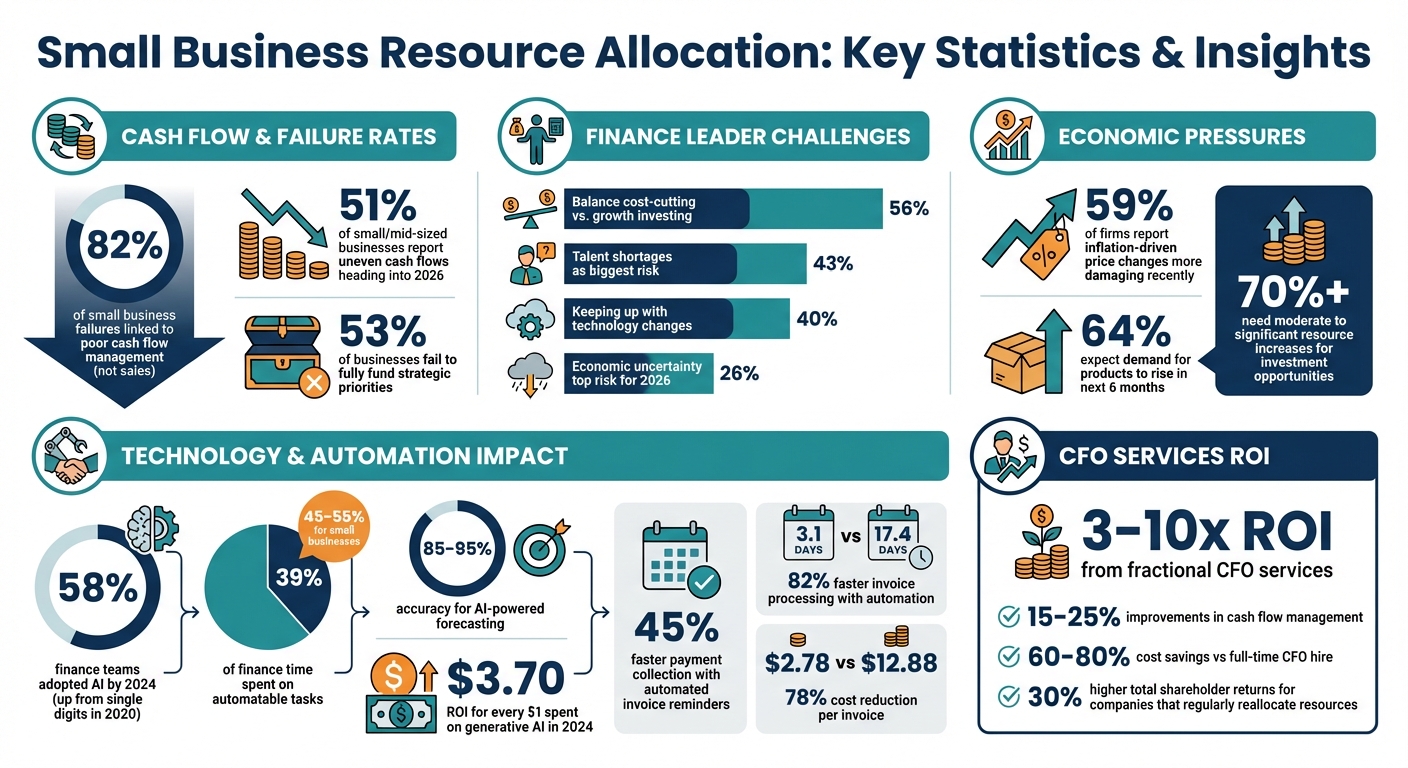
Small Business Resource Allocation Statistics and Key Financial Metrics
Allocation decisions are exactly what a fractional CFO engagement is for, and they are only as good as the reporting underneath them.
Why You Need to Tie Resource Allocation to Strategy Implementation
sbb-itb-85dd802
Common Resource Allocation Challenges for Small Businesses
Small business owners often face tough decisions when it comes to managing their resources. Surprisingly, 82% of small business failures are linked to poor cash flow management, rather than a lack of sales. This means that even businesses with steady customers and revenue can falter if their resources aren’t handled wisely.
One of the biggest challenges is visibility. Many small businesses don’t have a clear picture of their expenses, making it hard to understand where the money is actually going. Without this clarity, decisions often rely on gut feelings instead of hard data, which can lead to costly mistakes. This lack of insight becomes even more critical when paired with the fact that 51% of small and mid-sized businesses report uneven cash flows heading into 2026. The result? A cycle of financial uncertainty and stress.
Another common trap is what’s known as the "egalitarian trap." This happens when businesses allocate resources evenly across all departments, based on past budgets, rather than focusing on areas with the most growth potential. While this approach might seem fair, it often ignores shifting market demands. At the same time, 56% of finance leaders struggle to balance cutting costs with investing in future growth. It’s a delicate juggling act – tightening budgets to stay afloat while still planning for long-term competitiveness.
Managing Operating Costs vs. Growth Investments
The problem of visibility feeds into a larger challenge: balancing everyday operating costs with investments aimed at growth. This tension has become even sharper in today’s economic climate. As Stephen Philipson, Head of Global Markets and Specialized Finance at U.S. Bank, points out:
"CFOs have positioned themselves decisively in defense mode. With the end of the low-cost capital era and inflation still uncomfortably high in some parts of the economy, finance leaders are taking control by driving efficiencies in their organizations".
This cautious stance poses tough choices. Businesses must decide whether to invest in expensive, hard-to-find talent or shift their focus toward AI and automation for long-term efficiency. These decisions are complicated further by the fact that 43% of finance leaders see talent shortages as their biggest risk, while 40% are most concerned about keeping up with technology changes. On top of that, tighter lending standards and rising interest rates mean small businesses often have to rely solely on their own cash flow to fund growth, making every dollar count.
Inaccurate forecasting only adds to the difficulty. The SAP Concur Report highlights four key issues with cost control: inaccurate forecasting, difficulty predicting price increases, software usability, and software capabilities. Without reliable forecasts, businesses are forced to react to financial shortfalls by slashing budgets in a panic, only to scramble for funds when new opportunities arise. This reactive cycle makes it nearly impossible to allocate resources in a way that supports steady, sustainable growth.
Dealing with Economic Uncertainty
External pressures have made resource allocation even more challenging. 26% of finance leaders rank economic uncertainty as their top risk for 2026. Inflation, fluctuating interest rates, and supply chain disruptions can all drive up operating costs unexpectedly, throwing even the best-laid budgets into disarray.
For example, 59% of firms report that inflation-driven price changes have been more damaging recently than in the past. At the same time, 64% of businesses expect demand for their products to rise over the next six months. This creates a tricky paradox: businesses need to invest in growth just as rising costs are eating into their profit margins.
Some companies are adapting to this uncertainty with more frequent scenario planning. In October 2025, Walmart’s Corporate Controller and Chief Accounting Officer, David Chojnowski, explained how his team shifted from monthly to near-daily scenario planning. By using AI to analyze pricing, inventory, and competitor trends, Walmart was able to respond more quickly to market changes. While small businesses might not have access to Walmart-level resources, the takeaway is clear: staying agile and precise in resource allocation is critical.
On top of these economic pressures, regulatory changes add another layer of complexity. From new tax laws to evolving data privacy requirements, compliance demands significant resources. Over 70% of organizations report needing moderate to significant increases in resources to make the most of investment opportunities. However, these resources often come at the expense of growth-focused initiatives, creating yet another balancing act for small businesses trying to navigate today’s challenges.
Practical Methods for Better Resource Allocation
CFOs rely on structured approaches to make resource allocation more effective, balancing discipline with practicality. These methods build on earlier concepts, offering clear strategies to tackle common challenges.
Zero-Based Budgeting for Cost Control
Zero-based budgeting (ZBB) flips traditional budgeting on its head. Instead of assuming past expenses are justified, every cost starts at zero and must be explained. Department heads outline why funds are needed, how the expense supports business goals, and what alternatives exist. Michael Slyderink, CTO at Bennett Financials, puts it this way:
"ZBB doesn’t mean ‘cut everything.’ It means ‘fund what matters.’ Some costs will stay, some will shrink, and some will increase – because the point is prioritization, not austerity."
The results can be transformative. For instance, after the Kraft and Heinz merger in 2015, ZBB reduced overhead costs from 18% to 11% in just over a year. For smaller businesses, starting small is key – try applying ZBB to areas like SaaS subscriptions or travel expenses before scaling it across the company. Use a tiered spending plan: "Minimum" for essentials, "Target" for core operations, and "Stretch" for growth initiatives. This flexibility helps businesses adapt quickly if revenue changes.
Another critical step is establishing clear financial targets upfront – think gross margin, EBITDA, or cash runway. These "North Star" metrics guide spending decisions and keep budgets aligned with financial realities. Instead of treating budgeting as a once-a-year task, make it a continuous process. Monthly reviews and quarterly updates ensure spending reflects current conditions, not outdated assumptions.
Cash Flow Forecasting and Management
Knowing how much cash you have today isn’t enough – you need to know where it’s headed. Cash flow forecasting provides that visibility, helping businesses avoid reactive decisions. A 13-week rolling forecast, updated weekly, offers a detailed view of cash inflows (like customer payments) and outflows (like payroll and rent).
Brooke S., a Fractional CFO at Paro, explains:
"Forecasting isn’t about predicting the future with perfect accuracy. It’s about understanding the key drivers of your cash position so you can make smarter, faster decisions under pressure."
This approach can act as an early warning system. Spotting a cash shortfall weeks in advance gives you time to take action, whether that means securing financing, renegotiating vendor terms, or delaying non-essential expenses. Practical steps include integrating accounting software (like QuickBooks) with payment systems (such as Stripe) to reduce manual errors. Offering early-payment discounts – like "2% off if paid within 10 days" – can also accelerate collections and boost working capital.
Building a reserve fund by setting aside a portion of profits each month adds another layer of security for unexpected costs. Testing your cash flow resilience with different scenarios – like a 25% drop in demand – can prepare you for worst-case situations.
Focusing on High-Return Investments
Cost control and cash flow management are essential, but growth requires smart investments. The rule is simple: commit funds only to projects where the Return on Invested Capital (ROIC) exceeds the Weighted Average Cost of Capital (WACC).
"A company creates value only when ROIC exceeds its WACC. This comparison determines if your allocation strategy actually works." – AdaptCFO
Data backs this up. Companies in the top third of market valuation invested 50% more in capital expenditures than their peers, achieving 55% higher returns on assets and 65% higher sales growth.
For small businesses, technology and automation often offer the best returns. Tools like AI-driven financial analysis, advanced accounting software, and automated systems for accounts payable and receivable can cut costs and boost efficiency. Marketing is another high-potential area, but only if you track metrics like Customer Acquisition Cost (CAC) and Customer Lifetime Value (CLTV) to ensure spending drives sustainable growth.
Paying down high-interest debt is another overlooked strategy. If your debt carries a 6% interest rate or higher, eliminating it can deliver better returns than many investments. Similarly, using excess cash for strategic acquisitions or partnerships can unlock new markets or technologies faster than developing them in-house.
Avoid falling into "allocation inertia", where spending mirrors last year’s patterns. Instead, classify business units by their growth potential. High-growth areas should receive more resources than mature, stable ones, ensuring funds are directed toward future opportunities rather than past performance.
Using Technology to Improve Allocation Decisions
Technology is transforming how CFOs make allocation decisions, building on structured budgeting and forecasting methods. These advancements are enabling faster, more precise decision-making, helping finance leaders balance cost control with growth-focused investments.
The finance function has evolved from being purely reactive to becoming a hub for strategic planning, and technology is the driving force behind this shift. By 2024, 58% of finance teams adopted AI, a sharp rise from single-digit adoption rates in 2020. For small businesses, this means gaining access to tools that were once reserved for large enterprises, without the hefty price tag.
The benefits are clear. Finance professionals currently spend about 39% of their time on tasks that could be automated, with small businesses shouldering an even heavier load at 45-55%. That’s nearly half the workweek lost to repetitive data management. Technology not only speeds up these tasks but also eliminates them, freeing up time for strategic initiatives.
AI-Powered Financial Analysis
AI tools integrate seamlessly with accounting software and bank accounts, processing transactions in real time. This provides up-to-the-minute insights, so allocation decisions are based on current cash flow rather than outdated reports. Machine learning models also analyze historical data to predict future cash positions, identifying trends like seasonal fluctuations that manual methods often miss.
The numbers speak for themselves. AI-powered forecasting achieves 85-95% accuracy for businesses with at least a year of consistent historical data. Traditional forecasting methods, by contrast, can take 3-6 hours per cycle, whereas AI completes the same task in just 5-15 minutes. Scenario modeling becomes almost instantaneous, whether you’re evaluating the cost of hiring new employees or adjusting pricing strategies.
AI also excels at expense management. It reviews 100% of transactions, catching issues like duplicate invoices, rising subscription costs, or unusual payment patterns that might otherwise go unnoticed. These tools ensure no resources are wasted on errors or inefficiencies. Steven Krueger, EY Global Finance Technology Services Leader, highlights the broader impact:
"Through the automation of routine tasks and the improvement of analytical insights, these technologies can facilitate the smooth execution of financial processes, all the while optimizing costs to maximize value…"
The return on investment (ROI) is impressive. IDC research shows that every dollar spent on generative AI in 2024 yielded an average return of $3.70. For small businesses, AI-powered tools typically cost between $50 and $500 per month, a fraction of the $150,000 to $400,000+ annual salary for a full-time CFO. Beyond improving forecast accuracy, automation significantly reduces the administrative workload on finance teams.
Reducing Administrative Work with Automation
Automation is a game-changer for finance teams, eliminating time-consuming tasks that often bog them down. Small business owners, for instance, lose 10-12 hours per week to financial admin tasks like expense categorization and bank reconciliation. This translates to $26,000–$39,000 annually in lost productivity.
The time savings are tangible. Automated invoice reminders help businesses get paid 45% faster, shaving an average of 5 days off per invoice. Automated accounts payable processes invoices 82% faster than manual methods (3.1 days compared to 17.4 days) and cut costs by 78% ($2.78 versus $12.88 per invoice).
Consider Sarah, who runs a 15-person marketing agency. After implementing tools like QuickBooks Online and Ramp, she slashed her weekly financial admin time from 9.5 hours to just 0.9 hours. That’s 430 hours saved annually, valued at $32,250. Similarly, Guillaume Schaeffer from GPG Granit automated bank balance reporting, saving 30 minutes daily. He used the extra time to manage unpaid invoices, directly reducing Days Sales Outstanding.
The adoption of AI is accelerating, with the percentage of finance leaders using these tools jumping from 34% in 2024 to 72% in 2025. Cloud-based automation is particularly effective, enabling finance teams to handle growing transaction volumes without needing to scale their workforce proportionally. Benoit de Angelis from Agicap offers a practical guideline:
"CFOs should allocate 10% of their resources to automation and AI"
To see quick results, start with high-volume, rule-based tasks like expense categorization, receipt tracking, and invoice generation. Most businesses report a positive ROI within 60-90 days based on time savings alone. The key is to choose tools that integrate directly with accounting software like QuickBooks or Xero via real-time sync, rather than relying on manual file uploads. While automation handles routine work, human oversight remains essential for strategic decisions and judgment calls. This balanced approach aligns with the evolving role of CFOs in driving efficiency and growth.
How Fractional CFO Services Improve Resource Allocation
Strategic leadership plays a critical role in effective resource allocation. While technology can handle repetitive tasks, it takes financial expertise to make informed decisions about where resources should be directed. Fractional CFO services fill this need by offering high-level financial guidance without the costs of a full-time CFO. This makes enterprise-level financial leadership accessible to smaller businesses.
Fractional CFOs use tools like KPI dashboards and data analysis to distinguish between profit-generating activities and areas that drain cash. They conduct thorough audits to uncover hidden expenses – such as overpriced vendor agreements, redundant subscriptions, and operational inefficiencies – and redirect funds toward investments with higher returns. As Greg Gens, Area President at FocusCFO, puts it:
"Fractional CFOs bring the benefit of decades of experience to businesses that would normally never have had access to that level of expertise."
The financial impact of these services can be substantial. Jared Sorensen, CFO at Preferred CFO, highlights that "a fractional CFO can sometimes save enough money in the first few months to pay for their own service many times over". This is achieved through strategies like expense optimization, refining unit economics, and adjusting pricing to prevent profit leaks. Working with multiple clients across industries, fractional CFOs gain insights that help them make smarter allocation decisions. Their expertise complements automated tools, creating a comprehensive approach to resource management and financial planning.
Financial Leadership and Planning
Fractional CFOs excel at reshaping budgets by identifying which areas of the business generate returns and which do not. They rely on key metrics – like customer acquisition, churn rates, and pricing trends – to guide their planning.
TC Advisors exemplifies this approach with a structured four-step process: an initial consultation to understand business goals, a tailored financial plan, ongoing support with quarterly reviews, and assistance with filings. Their services give small and mid-sized businesses access to experienced CPAs with backgrounds in top-tier firms, empowering business owners to make informed financial decisions.
Fractional CFOs go beyond trimming costs. They dive into unit economics – examining metrics like Customer Acquisition Cost (CAC), Lifetime Value (LTV), and gross margins – to ensure growth is both profitable and sustainable. They also build scalable financial systems, including internal controls and automation, to prevent declining margins as businesses grow. With the right analytics tools, they achieve up to 98% accuracy in revenue forecasting.
Ongoing Financial Planning
Financial planning doesn’t stop after the initial strategy is set. Continuous oversight is essential to keep pace with changing market conditions. Unlike traditional accounting, which primarily looks at past data, fractional CFOs focus on forward-looking strategies throughout the year. They conduct weekly or biweekly reviews of short-term, annual, and multi-year forecasts, enabling businesses to adapt in real time.
Rolling forecasts replace static annual budgets, offering 12–18 months of projections that are updated monthly or quarterly to reflect current trends. Michael Stier from FocusCFO describes their role as follows:
"A CFO is the in-house trusted adviser who helps navigate where the business should be going, tying overall goals and strategies to a financial roadmap."
This includes scenario planning to prepare for best, base, and worst-case outcomes, helping businesses understand how variables like inflation or revenue changes could affect liquidity. Fractional CFOs also address risks related to market shifts and compliance, ensuring businesses are ready for economic challenges before they arise. The result is a financial framework that scales with the business, avoiding bottlenecks as operations become more complex.
Measuring the Impact of Resource Allocation Decisions
For small businesses aiming to maximize efficiency, it’s essential to measure the outcomes of resource allocation accurately. One way to do this is by calculating the Return on Investment (ROI) for financial leadership using the formula: (Gains – Cost) ÷ Cost × 100. Gains can include tax savings, improved gross margins, better cash flow, and revenue growth. On the other hand, costs factor in service fees, software expenses, and the time spent on internal implementation.
Fractional CFO services often deliver impressive returns, with an ROI ranging from 3× to 10× and a payback period of 6 to 12 months. Strategic financial leadership also contributes to 15% to 25% improvements in cash flow management and forecasting accuracy. When attributing gains, it’s wise to stay conservative. For instance, if gross margins improve by 8% during favorable conditions, you might only credit 5% of that improvement to targeted pricing strategies.
This ROI analysis provides a foundation for comparing the costs of full-time CFOs and fractional CFO services.
Cost Comparison: Full-Time vs. Fractional CFO
Hiring a full-time CFO can cost anywhere from $250,000 to over $600,000 annually when you include salary, benefits, bonuses, and recruitment expenses. Fractional CFO services, however, are far more affordable, typically costing $3,000 to $15,000 per month (or $36,000 to $180,000 annually) without the added burden of benefits or recruitment costs. This translates into a 60% to 80% cost saving compared to a full-time hire.
| CFO Type | Annual Cost Range | Key Benefits | Limitations |
|---|---|---|---|
| Full-Time CFO | $250,000 – $600,000+ | Dedicated expertise and availability | High fixed costs; better suited for companies with revenues above $20M–$25M |
| Fractional CFO | $36,000 – $180,000 | Cost-effective and scalable | Limited availability (10–40 hours per month) |
For a company with a monthly burn rate of $200,000, switching to a fractional CFO instead of a full-time hire could extend its cash runway by approximately 17%. Beyond cost savings, professional financial systems and reporting can also enhance a company’s valuation multiple by 1× to 2× at exit.
While cost is a major factor, tracking key financial metrics is equally important to validate the success of resource allocation decisions.
Tracking Key Financial Metrics
Small businesses should keep an eye on critical financial metrics to assess the effectiveness of their strategies. These metrics are directly tied to the CFO’s strategic influence:
- Working Capital Optimization: Better management of receivables and inventory can increase revenue by 5–15%.
- Gross Margin: Improved pricing strategies and cost controls can raise gross margins by 1–5 percentage points.
- Operating Expenses: Spend audits and process automation often cut operating expenses by 3–8%.
Using a 13-week rolling cash flow forecast is a practical way to monitor planning accuracy. A variance of 10–15% indicates reliable forecasting. Tracking the effective tax rate (total tax paid divided by pre-tax income) can also highlight cash savings, as seen in cases where rates drop from 35% to 22%. Regular spend audits can uncover annual savings of $20,000 to $100,000, often by eliminating redundant software subscriptions or renegotiating overpriced vendor contracts. Lastly, monitoring the Customer Acquisition Cost (CAC) to Lifetime Value (LTV) ratio ensures that investments in growth remain financially sound.
Conclusion: CFO Guidance for Better Resource Allocation
Navigating the challenges of resource allocation demands both strategic thinking and the use of modern technology. The goal is simple: align every dollar spent with measurable growth objectives. Companies that regularly reassess and reallocate resources tend to see a 30% higher total return to shareholders annually. The secret lies in reframing budget meetings as opportunities for reallocation rather than sticking to the status quo.
As highlighted, the combination of advanced technology and skilled financial leadership can transform how small businesses manage resources. Tools like AI-powered analytics and automated workflows not only improve revenue forecasting accuracy – up to 98% – but also free up team members to focus on strategic, high-value tasks. This shift enables leaders to make decisions based on reliable data instead of manual bookkeeping.
Fractional CFO services offer small businesses access to executive-level financial expertise without the cost of a full-time hire. This approach shifts the focus from simply recording transactions to interpreting how they impact future growth. Within just a few months, businesses can see tangible improvements in working capital and operational efficiency.
TC Advisors (https://tcadvisorscpa.com) exemplifies how fractional CFO services provide the insights and oversight businesses need. From identifying tax savings and optimizing cash flow to implementing financial models that drive growth, their team of experienced CPAs and cutting-edge tools empowers small businesses to allocate resources more effectively and scale with confidence.
FAQs
How do I start zero-based budgeting without slowing my team down?
To kick off zero-based budgeting, the first step is to clearly communicate the process to your team. Make sure everyone understands that, unlike traditional budgeting, every expense needs to be justified from the ground up for each period – nothing is carried over automatically.
Here’s a simple approach to get started:
- Review all current expenses: Look at where the money is going and identify areas that need scrutiny.
- Align spending with current priorities: Evaluate which expenses directly support your team’s or organization’s goals.
- Rebuild the budget from scratch: Assign funds only to expenses that are necessary and aligned with your objectives.
To stay organized and efficient, consider using collaboration tools that allow for real-time updates and tracking. These tools can streamline the process, especially when multiple people are involved. Additionally, hold regular check-ins to answer questions, address concerns, and ensure everyone remains on the same page throughout the budgeting cycle.
What should I include in a 13-week cash flow forecast?
A 13-week cash flow forecast maps out weekly predictions of cash inflows and outflows. It covers key areas like receivables, payables, payroll, inventory purchases, and financing obligations. The purpose is to project the ending cash balance for each of the next 13 weeks, giving businesses a clearer picture to plan and manage their cash flow efficiently.
When does it make sense to hire a fractional CFO?
A fractional CFO can be a game-changer for small to mid-sized businesses that need high-level financial guidance but aren’t quite ready to bring on a full-time executive. This often applies to companies with annual revenues ranging from $500,000 to $1 million. It’s particularly useful when businesses face cash flow challenges despite being profitable or when they need expert advice on significant financial decisions.
Additionally, a fractional CFO becomes invaluable when a business has outgrown its bookkeeper’s capabilities or is gearing up for fundraising, mergers, or providing detailed reports to investors. Their expertise helps bridge the gap between day-to-day financial management and long-term strategic planning.


