

Special Needs Trusts (SNTs) are powerful tools for managing real estate while ensuring individuals with disabilities retain access to government benefits like SSI and Medicaid. These trusts can own property, pay related expenses, and offer various tax savings. Here’s the key takeaway:
- Tax Benefits: SNTs can reduce property tax liability through state-specific exemptions and manage capital gains taxes via strategies like stepped-up basis and income distributions.
- Types of SNTs: First-party (funded by the beneficiary), third-party (funded by others), and pooled trusts (managed by nonprofits).
- Real Estate Ownership: SNTs can own homes, allowing beneficiaries to live there without impacting benefits.
- Trust Taxation: Non-grantor trusts face steep tax brackets, but strategies like Qualified Disability Trust (QDT) status and income shifting can minimize taxes.
Navigating these rules requires careful planning, as mistakes can jeopardize benefits or lead to higher taxes. Professional guidance is essential to maximize savings and maintain compliance.
Qualified Disability Trust: What Is It? Special Needs Trust
sbb-itb-85dd802
How to Reduce Real Estate Tax Liability with Special Needs Trusts
Special Needs Trust Tax Brackets and Exemptions Comparison 2025
Property Tax Exemptions for SNT-Owned Real Estate
Certain states offer property tax relief for homes owned by or benefiting individuals with disabilities. For instance, New Jersey provides local property tax reduction programs that can lower annual tax bills for properties held in Special Needs Trusts (SNTs). These exemptions are typically managed at the local level.
"Ask about state property tax relief if the beneficiary owns a home in New Jersey. Local programs can reduce the bill." – Benjamin D. Eckman, Esq., Elder Law Attorney
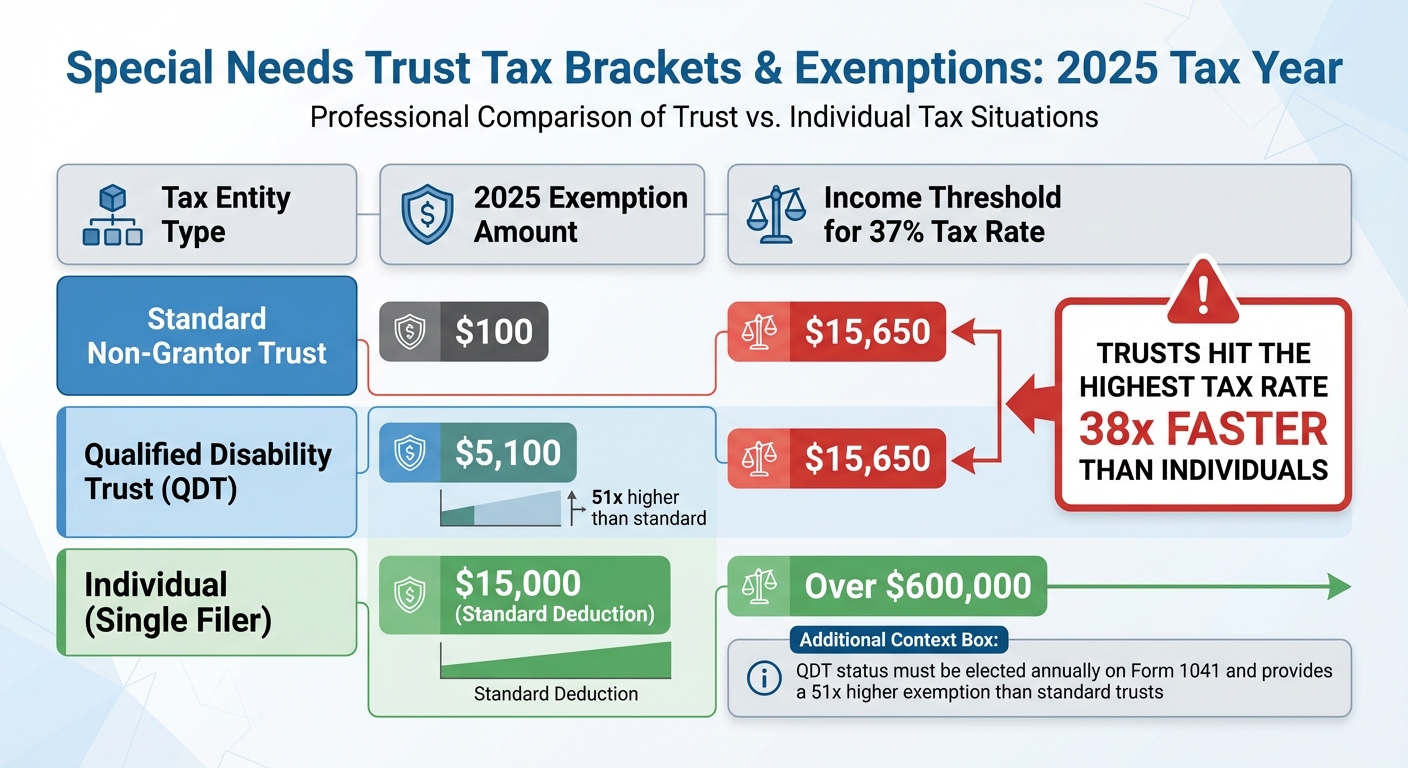
To take advantage of these programs, trustees should get in touch with their local tax assessor’s office or consult an elder law attorney to check eligibility and handle the application process. Additionally, non-grantor SNTs can elect Qualified Disability Trust (QDT) status. This status provides a $5,100 personal exemption for the 2025 tax year – far higher than the standard $100 exemption available to complex trusts.
Beyond property tax relief, SNTs also offer tools to manage capital gains taxes more efficiently.
Reducing Capital Gains Tax Through SNTs
Selling real estate held in an SNT can trigger capital gains taxes, but there are ways to reduce the impact. One key strategy is the stepped-up basis rule, which resets the cost basis of real estate to its market value at the time of the settlor’s death. This adjustment can effectively eliminate taxable gains from appreciation during the settlor’s lifetime.
Here’s an example: If a property was purchased for $200,000 in 2000 and is worth $500,000 at the time of the settlor’s death, the new cost basis becomes $500,000. If the property is later sold for $510,000, only the $10,000 gain is taxable. Trustees should arrange for a professional appraisal within 60 to 90 days of the settlor’s death to document the stepped-up basis for IRS purposes.
Another approach involves distributing capital gains to the beneficiary. Since individual tax brackets are generally wider than trust tax brackets, this can significantly reduce the tax liability. For example, in 2025, trusts hit the 37% tax rate at incomes as low as $15,650, while individuals don’t reach that rate until their income exceeds approximately $609,351.
"A well-timed distribution can shift income from the trust’s 37% bracket to the beneficiary’s 10% or 12% bracket." – Randy Smith, Special Needs Parent and Researcher
Additionally, any capital improvements made after the settlor’s death – like installing a new roof – can increase the property’s adjusted basis, further reducing taxable gains. Trustees should keep detailed receipts for these expenses to ensure they qualify.
Depreciation and Cost Basis Benefits
When SNTs hold rental properties, managing deductions can help lower overall tax liability. Property taxes, maintenance costs, and other expenses related to rental properties can be deducted against rental income, reducing the trust’s taxable income. For properties occupied by the beneficiary, disability-related modifications – such as adding wheelchair ramps or widening doorways – may qualify as deductible medical expenses.
The rules for these deductions are specific. If a modification doesn’t increase the home’s value, the full cost is deductible. However, if it does add value, only the portion of the cost exceeding the added value qualifies for a deduction. A doctor’s written recommendation can strengthen the case for these deductions.
Non-grantor SNTs can also elect QDT status to claim the enhanced $5,100 exemption. It’s important to note that this election must be made annually using Form 1041 – it isn’t automatic.
| Tax Entity Type | 2025 Exemption Amount | Income Threshold for 37% Rate |
|---|---|---|
| Standard Non-Grantor Trust | $100 | $15,650 |
| Qualified Disability Trust | $5,100 | $15,650 |
| Individual (Single Filer) | $15,000 (Standard Deduction) | Over $600,000 |
For first-party SNTs, which are generally treated as grantor trusts, deductions and credits pass through to the beneficiary’s personal tax return. This allows the beneficiary to claim the standard deduction – $15,000 for single filers in 2025 – which can offset modest rental income. Working with personalized CPA support to coordinate distributions can help minimize taxes while ensuring the beneficiary remains eligible for programs like SSI and Medicaid.
Legal and Compliance Requirements for Real Estate in SNTs
IRS Rules for Real Estate in SNTs
The IRS categorizes Special Needs Trusts (SNTs) as either grantor or non-grantor trusts, which directly impacts how taxes are reported. For first-party SNTs – funded with the beneficiary’s own assets – income is reported on the beneficiary’s personal tax return since these are treated as grantor trusts. On the other hand, third-party SNTs, funded by relatives, can be structured as either grantor or non-grantor trusts.
This classification is particularly important when managing real estate. Grantor trusts allow beneficiaries to personally deduct mortgage interest and real estate taxes. In contrast, non-grantor trusts must claim these deductions through the trust’s tax filings. Non-grantor trusts also require a separate Employer Identification Number (EIN) and must file Form 1041 if the trust generates over $600 in income annually.
Another key tax consideration is the Section 121 exclusion, which permits individuals to exclude up to $250,000 in capital gains from selling their primary residence – or $500,000 for married couples. However, irrevocable trusts generally don’t qualify unless they are structured as grantor trusts or the beneficiary is deemed the owner for tax purposes. Structuring the trust as a grantor trust can help retain eligibility for this exclusion.
When income is distributed from a non-grantor trust to the beneficiary, the trustee must issue a Schedule K-1. This shifts the income to the beneficiary’s personal tax return, potentially avoiding the trust’s steep tax brackets, which hit the highest rate of 37% once income exceeds $15,650 in 2025.
These federal guidelines provide a framework for navigating additional state-level requirements.
State-Specific Real Estate Tax Laws
State laws add another layer of complexity to managing real estate within SNTs. For example, in California, transferring property into a trust requires filing a Preliminary Change of Ownership Report (PCOR) with the county recorder to prevent property tax reassessment. California’s Proposition 13 also limits annual property tax increases to 2%, making it crucial to document any exclusions for parent-child or grandparent-grandchild transfers.
"A property is typically reassessed at its current market value when ownership changes, which can lead to a significant tax increase. However, California provides an exclusion for transfers of real property into a revocable living trust." – The Elder and Disability Law Firm, APC
Additionally, most states require trusts that generate income to file a separate state income tax return. While states like Texas don’t impose a state income tax, others do. For the 2025 tax year, a Qualified Disability Trust (QDT) is eligible for a federal exemption of $5,100, compared to the $100–$300 range for standard non-grantor trusts. Trustees can elect QDT status annually by filing Form 1041.
"In states where trusts are also subject to a separate state income tax, there is typically a state form on which estate and trust income needs to be reported. These forms differ from state to state." – W. Seth Todd, Member, Special Needs Alliance
Understanding these state-specific rules can help maximize tax benefits within an SNT structure.
Common Compliance Mistakes to Avoid
Staying compliant with IRS and state regulations is crucial to avoid common errors. One frequent mistake is paying for the beneficiary’s rent, mortgage, or utilities directly from the SNT. The Social Security Administration (SSA) treats such payments as "in-kind income", which can reduce Supplemental Security Income (SSI) benefits by up to one-third. To prevent this, beneficiaries should use their own SSI funds to pay these expenses directly to landlords or service providers.
"Receiving cash – whether distributed by the trustee of the SNT or given by a loved one – can put benefits at risk." – Kevin Urbatsch, Attorney, The Urbatsch Law Firm P.C.
Another critical issue is commingling trust funds with personal accounts or providing cash directly to the beneficiary. This can jeopardize SSI benefits, especially if the beneficiary’s resources exceed the $2,000 limit, and may trigger tax penalties. Instead, trustees should make payments directly to service providers, as cash distributions are counted as income.
"Small filing mistakes can threaten disability benefits and years of planning." – Benjamin D. Eckman, Esq., New Jersey Elder Law Attorney
Regularly reviewing trust income, deductions, and distributions – such as conducting a mid-year review – can help trustees fine-tune tax strategies before year-end. For third-party SNTs, timely issuance of Schedule K-1 forms ensures beneficiaries correctly report distributed income on their personal tax returns.
Case Studies: Real Estate Tax Savings with Special Needs Trusts
Case Study 1: Property Tax Reduction Through State Exemptions
In New Jersey, trustees managing special needs trusts (SNTs) can take advantage of state property tax relief programs when the trust owns a home. For non-grantor trusts, these property tax deductions help reduce taxable income reported on Form 1041. On the other hand, first-party SNTs – considered grantor trusts – report these deductions on the beneficiary’s personal tax return. This often results in a lower overall tax bill since individual tax brackets tend to be broader. This example highlights how state-level exemptions can directly reduce property tax burdens for real estate held in SNTs.
Case Study 2: Capital Gains Tax Savings on a Property Sale
This case focuses on saving capital gains taxes through proper trust structuring.
When a trust retains its grantor trust status, the beneficiary may qualify for the Section 121 exclusion, provided they meet the two-year primary residence requirement. According to regulatory guidance, a properly structured trust allows the beneficiary to claim this exclusion, which can exempt up to $250,000 in capital gains from the sale of a primary residence.
"If a residence is owned by a trust, for the period that a taxpayer is treated… as the owner of the trust… the sale or exchange by the trust will be treated as if made by the taxpayer."
Without this structure, the trust would face compressed tax brackets, where income exceeding $15,201 is taxed at a steep 37% rate. For high-value property sales, this exclusion can lead to significant federal tax savings – potentially tens of thousands of dollars. This example showcases how the right SNT setup can help minimize tax burdens effectively.
Case Study 3: Estate Tax Benefits for Real Estate in SNTs
Beyond immediate tax savings, the proper structuring of an SNT can provide long-term estate tax advantages.
Third-party SNTs exclude real estate from both the grantor’s and the beneficiary’s taxable estates, helping to preserve wealth and avoid double taxation. If a grantor funds an irrevocable SNT during their lifetime and relinquishes control over the trust, the property – and any future appreciation – will no longer count toward the grantor’s taxable estate. After the beneficiary’s death, the property remains within the trust, keeping it out of the beneficiary’s taxable estate as well. For families with significant real estate holdings, this approach offers a way to protect wealth across generations while ensuring continued eligibility for government benefits.
Tax Planning with Special Needs Trusts
Why Professional Guidance Matters
Handling real estate within a special needs trust is no small task. It requires expertise that goes beyond typical tax preparation. Trusts are subject to compressed income thresholds, meaning even a modest amount of rental income can result in hefty tax bills if not managed properly.
"Lacking expert guidance can lead to costly tax missteps." – Lawrence A. Friedman, Esq.
State-specific tax rules add another layer of complexity. Trustees must navigate property tax relief programs, make the most of Qualified Disability Trust (QDT) benefits, and decide whether to retain or distribute income for tax efficiency. A CPA with experience in fiduciary income taxation is essential for interpreting Form 1041 requirements and structuring distributions in a way that reduces the overall tax burden. Firms like TC Advisors specialize in translating these intricate tax regulations into actionable strategies.
How TC Advisors Can Help Real Estate Investors

TC Advisors provides tailored tax planning services for real estate investors managing special needs trusts. They focus on optimizing trust classifications, designing income distribution plans to ease the impact of high tax brackets, and managing deductions for real estate taxes and disability-related improvements.
For those looking to sell property, TC Advisors can guide investors toward tax-efficient options, such as using a 1031 exchange to defer capital gains taxes. They also handle the administrative details, like retitling property into the trust’s name and filing state-specific forms – such as California’s Preliminary Change of Ownership Report (PCOR) – to avoid unexpected property tax reassessments.
Building a Long-Term Tax Strategy
Case studies show that proactive tax planning can lead to meaningful long-term savings. Special needs trusts require consistent attention, not just during tax season. Midyear reviews can help adjust income distributions, shifting tax liability to beneficiaries who may fall into lower tax brackets. Keeping detailed records of disability-related expenses – such as accessibility upgrades, advisor fees, and property taxes – is also crucial.
Another strategy to consider is pairing the trust with an ABLE account. This approach allows investments to grow tax-free while staying under resource limits for government benefits. For high-value properties, trustees should evaluate whether maintaining grantor trust status would be more advantageous for tax purposes or if converting to QDT status is a better fit. Timing property sales during lower-income years can also significantly reduce tax burdens.
Conclusion: Using Special Needs Trusts for Real Estate Tax Efficiency
Special needs trusts offer an effective way to manage tax responsibilities while safeguarding government benefits for beneficiaries. With trust tax brackets hitting 37% at just $15,650 in 2025, these trusts provide avenues to reduce tax burdens through strategies like income distributions, Qualified Disability Trust (QDT) status, or 1031 exchanges. These tools not only preserve wealth but also ensure compliance with tax laws.
However, navigating the complexities of real estate law, IRS regulations, and state-specific tax rules demands specialized knowledge. Key steps like properly titling property, timing income distributions strategically, and maintaining thorough documentation of disability-related expenses are essential to avoid compliance pitfalls and maximize savings.
"Preparing an SNT without fully understanding its tax consequences practically invites a malpractice claim." – Lawrence A. Friedman, Esq., Elder Law Attorney
Managing real estate within a special needs trust requires consistent effort. Tasks such as aligning income distributions with the beneficiary’s tax bracket, keeping detailed records for deductions, and ensuring SSI and Medicaid eligibility demand ongoing attention. This level of diligence can lead to reduced property taxes, minimized capital gains, and efficient estate tax planning. As explored in earlier sections, effectively managing these trusts is central to achieving long-term tax efficiency and financial stability.
FAQs
Will putting a home in an SNT affect SSI or Medicaid?
Placing a home in a Special Needs Trust (SNT) can affect Supplemental Security Income (SSI) or Medicaid benefits if the trust pays for certain expenses like rent or a mortgage. These payments might lead to a reduction in benefits. On the other hand, covering costs such as property taxes, utilities, or home modifications generally doesn’t interfere with eligibility. It’s essential to consult a professional to ensure all actions align with benefit regulations.
How can an SNT cut capital gains tax when selling real estate?
A Special Needs Trust (SNT) can help lower capital gains tax on real estate sales, but only if it qualifies for tax-exempt status. To achieve this, the trust must meet certain conditions, such as being irrevocable and dedicated solely to addressing the beneficiary’s needs. Meeting these requirements can significantly reduce the tax burden tied to the sale.
When should an SNT elect Qualified Disability Trust (QDT) status?
A Qualified Disability Trust (QDT) election can be a smart move for certain Special Needs Trusts (SNTs). To qualify, the trust must meet a few key conditions: it has to be a testamentary trust set up after someone’s death, be based in the U.S., and have a beneficiary who meets the criteria for the disability tax credit. By making this election, the trust can take advantage of graduated tax rates, which can help lower its overall tax burden.


