

Intellectual property (IP) is often the most critical asset for startups, especially in industries like tech and media. Properly valuing your IP can help you secure funding, negotiate better deals, and allocate resources effectively. Here’s what you need to know:
- Why IP Matters: Protects your innovations, strengthens your market position, and attracts investors.
- Types of IP: Includes patents, trademarks, copyrights, and trade secrets – each serving different purposes.
- Valuation Methods:
- Cost Approach: Calculates the expense of creating the IP.
- Market Approach: Compares to similar IP transactions.
- Income Approach: Projects future financial benefits.
- Key Challenges: Linking IP to revenue, lack of comparable data, and ownership issues.
Startups with strong IP often enjoy higher valuations and better funding opportunities. Regularly updating your IP valuation ensures it reflects your business’s growth and potential.
What Every Startup must know about Intellectual Property | CSUF Startup Talk

sbb-itb-85dd802
Main Types of Intellectual Property for Startups
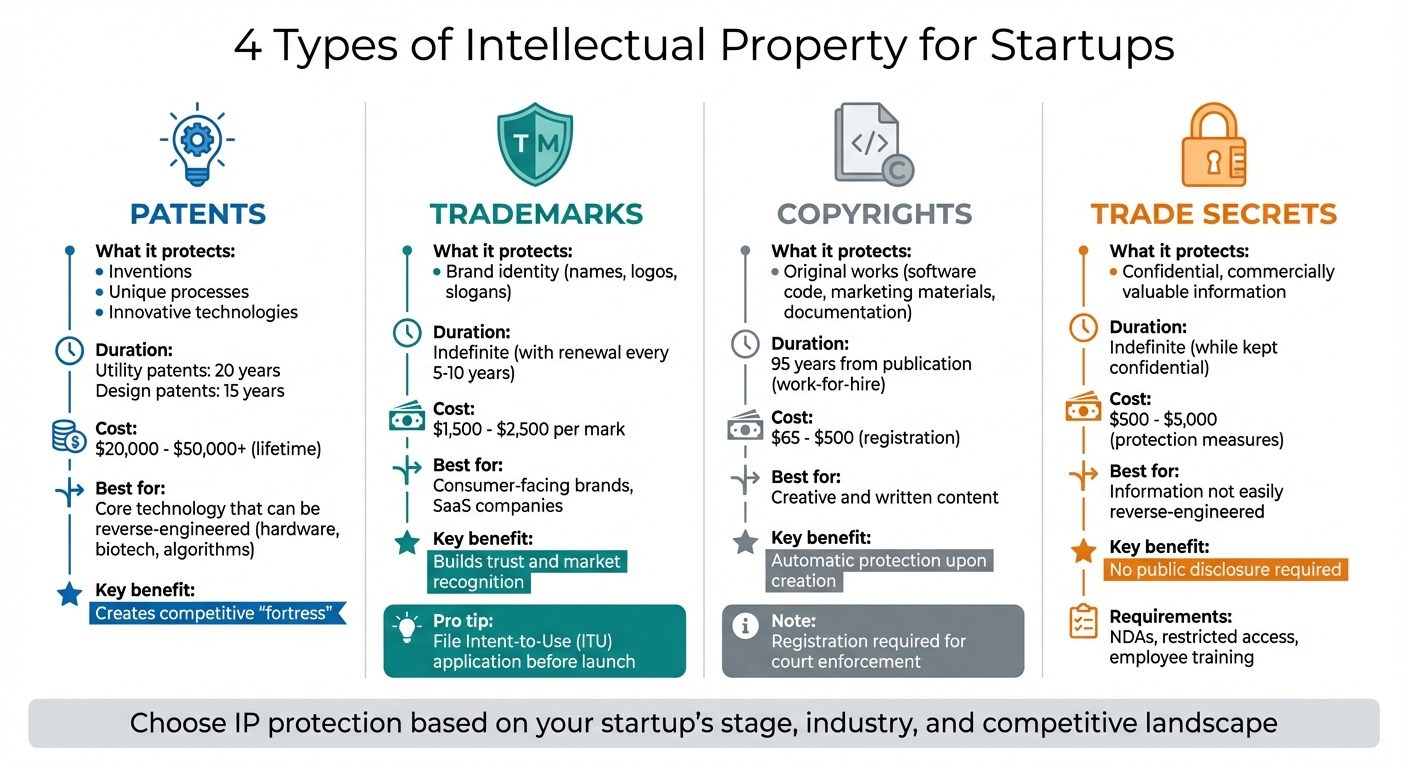
Startup IP Types: Protection Duration and Costs Comparison
Your startup’s intellectual property (IP) portfolio is a mix of assets that need protection. Understanding the different types of IP can help you allocate your legal budget wisely while strengthening your position for fundraising and negotiations. Below, we break down patents, trademarks, copyrights, and trade secrets – what they protect and why they matter.
Patents
Patents safeguard inventions, unique processes, and innovative technologies, granting exclusive rights to produce, use, or sell the invention. Utility patents last 20 years, while design patents extend for 15 years. They’re particularly crucial when your core technology – like hardware, biotech formulas, or algorithms – can be reverse-engineered once released.
However, patents come with a hefty price tag. From provisional filing to grant and maintenance, expect to spend $20,000 to $50,000 or more over their lifetime. This investment creates what investors refer to as a "fortress" around your competitive edge. If your invention is difficult to reverse-engineer, trade secrets might be a better route to avoid disclosure and ongoing patent fees.
Trademarks
Trademarks protect your brand identity – names, logos, slogans – and shift the focus from technology to how customers recognize and trust your brand. Unlike patents, trademarks can last indefinitely, provided you continue using them and renew every 5 to 10 years. For consumer-facing brands and SaaS companies, trademarks are essential for building trust and market recognition, which can justify premium pricing.
"A trademark becomes valuable when it builds trust and moves product." – PatentPC
To secure your brand early, file an Intent-to-Use (ITU) application before launching. This locks in your priority date and prevents others from claiming your brand name while you’re still in development. Registering a trademark with an attorney typically costs $1,500 to $2,500 per mark.
Copyrights and Trade Secrets
Copyrights automatically protect original works like software code, marketing materials, or documentation as soon as you create them. In work-for-hire situations common in startups, copyright protection lasts 95 years from publication. While automatic, you’ll need to register with the U.S. Copyright Office to enforce your rights in court. Registration fees range from $65 to $500.
Trade secrets protect confidential, commercially valuable information. They remain protected indefinitely, provided you keep them confidential and implement measures like NDAs, restricted access, and employee training. Costs for securing trade secrets typically range from $500 to $5,000. This option works best for assets that aren’t easily reverse-engineered and for cases where you’d prefer to avoid the public disclosure patents require.
Each type of IP plays a unique role in protecting your startup’s assets. Understanding these distinctions is essential as you move forward with valuation strategies discussed next.
3 Methods for Valuing Startup IP
When it comes to valuing a startup’s intellectual property (IP), three main methods are commonly used: Cost, Market, and Income. The choice of method often depends on the startup’s stage, the type of IP, and what investors are looking for. Many startups use a mix of these approaches to account for both the investment already made and the potential future returns. Here’s a closer look at each method.
The Cost Approach focuses on the total expense of creating the IP. This includes research and development, labor, testing, and legal fees. Essentially, it calculates what it would cost to recreate the IP today. Adjustments are typically made for factors like technological obsolescence – older IP may lose value as technology evolves. This method is especially helpful for early-stage startups that don’t yet have revenue or comparable market data to work with.
The Market Approach values IP by comparing it to similar assets that have recently been sold or licensed. This involves examining public transaction data, such as licensing deals, royalty rates, or asset sales, and then adjusting for differences in legal status, geography, or deal specifics. This method works particularly well in fast-moving industries like AI or biotech, where there’s often transparent and recent data available.
The Income Approach estimates the value of IP based on the future financial benefits it’s expected to generate. This involves projecting cash flows from sales, licensing, or cost savings and then discounting them to their present value. The calculations account for operating costs, maintenance fees, and taxes (typically around 25%). A discount rate of 10–20% is often applied to reflect industry risks. Venture capitalists tend to prefer this method because it ties the IP’s value directly to its future earnings potential. As PatentPC explains:
"Valuation is part number, part narrative. Make both easy to understand." – PatentPC
Using these methods together can create a more comprehensive valuation. For example, the Cost method sets a baseline, the Market method defines a range, and the Income method highlights future potential. To stay current, valuations should be updated every 12–18 months or after major milestones.
Common Challenges and Examples in Startup IP Valuation
Common Challenges
Valuing intellectual property (IP) in startups is no easy task. One of the biggest hurdles is figuring out how much of your revenue comes directly from a specific patent versus other factors like customer service or brand strength. For early-stage companies, this gets even trickier when products aren’t fully developed yet – think of a drug still in clinical trials. Predicting whether the market will embrace such products is often a guessing game.
Another major issue is the lack of comparable market data. Unlike selling something like a used car, where recent sales data is easy to find, IP is inherently one-of-a-kind. Public records of similar tech sales or licensing deals are rare, leaving founders to rely on the Cost Approach. This method adds up research, development, and legal costs to estimate value, but it doesn’t always capture the potential for future earnings. As PatentPC aptly warns:
"One of the most damaging mistakes founders make is confusing ambition with valuation." – PatentPC
Ownership issues can also derail valuations. If contractors don’t sign IP assignment agreements or if a co-founder holds personal rights to critical technology, investors might slash the company’s valuation – or avoid investing altogether. On top of this, the rapid pace of technological change can quickly render IP less valuable. A competitor might launch a better solution, or the technology itself could become outdated.
These challenges aren’t just theoretical – they show up in real-world cases.
Startup IP Valuation Example
Real-world examples show just how much these challenges can shape startup outcomes. Take Nortel Networks, for instance. In 2011, the company auctioned off around 6,000 patents and patent applications for a staggering $4.5 billion. What drove the high valuation? The patents had broad applications in telecommunications and had already proven effective in defending against infringement claims.
That same year, Google made headlines with its $12.5 billion acquisition of Motorola Mobility. The primary motivation? Motorola’s extensive patent portfolio, which bolstered Google’s competitive position in the global mobile market.
On a smaller scale, consider the case of a data center cooling startup, CoolData (name changed for confidentiality). The company needed $25 million in Series A funding but faced the tough task of valuing its assets: mature software tools and a 20-patent portfolio that wasn’t yet generating revenue. By using a dual-valuation method – estimating the immediate "Liquidation Value" of the software and the "Growth/Pivot Value" of the patents – CoolData secured the full $25 million through a mix of debt and equity funding.
These examples highlight how strategic approaches to valuation can help startups overcome the inherent challenges of valuing IP.
Working with Professional Advisors for IP Valuation
Benefits of Working with Specialists
Valuing intellectual property (IP) is a complex process, and it’s not something most founders can handle on their own. Professional advisors bring expertise by employing various valuation methods – like Cost, Market, and Income approaches – while ensuring that all IP assignments and filings are up-to-date. This thorough approach results in clear, defensible valuations, which are critical for avoiding "trust gaps." These gaps, often caused by unclear ownership or documentation, can lead to reduced valuations or even jeopardize deals entirely.
Advisors also create risk-adjusted financial models that incorporate discount rates and probabilistic scenarios. This step is especially important for early-stage IP that hasn’t yet generated revenue. In today’s tighter funding environment, investors are digging deeper into IP defensibility during due diligence, no longer relying on unsupported claims. A formal valuation – typically costing a few thousand dollars – can transform intangible assets into credible figures that stand up to scrutiny during fundraising or mergers and acquisitions (M&A). For instance, startups with patented technologies that effectively block competitors can often justify valuations that are 20% to 30% higher than those without such protections. This process not only strengthens credibility during negotiations but also ensures startups benefit from expert guidance.
How TC Advisors Can Help Startups

TC Advisors extends these benefits by offering fractional CFO services tailored to meet the unique challenges of IP valuation for startups. Their services provide strategic financial leadership and advanced modeling at a fraction of the cost of hiring a full-time CFO. For IP-heavy startups, TC Advisors develops models that directly link specific patents or trademarks to revenue streams – exactly the type of data investors look for. This approach aligns seamlessly with the valuation methods mentioned earlier, ensuring that the full potential of your IP is captured.
Recent success stories highlight their impact: TC Advisors helped a healthcare startup near Hackensack secure $2 million in funding by refining cash flow models, assisted a manufacturing startup in structuring a $3 million acquisition while cutting tax liabilities by 22%, and enabled a tech founder to save 25% on taxes through AI-driven forecasting and QuickBooks integration. Co-founders Nick Termine and Stephen Calvo bring extensive experience from Big Four accounting firms and private equity, delivering what clients describe as "Big Four standards with direct access to senior CPAs".
In addition to valuation services, TC Advisors offers proactive, year-round financial planning. Through quarterly check-ins, they help businesses anticipate risks and adapt strategies as IP portfolios evolve. As the co-founders explain:
"We recognized a gap: smaller businesses and entrepreneurs rarely had access to the same caliber of strategic financial guidance as larger corporations." – Nick Termine, CPA and Stephen Calvo, CPA, Co-Founders, TC Advisors
Conclusion
IP valuation plays a crucial role in helping startups grow and earn the trust of investors. By turning patents, trademarks, and trade secrets into measurable assets, you provide the hard evidence investors need to evaluate your competitive edge. Bold claims about innovation aren’t enough – investors want proof that your intellectual property (IP) gives you an advantage. Beyond attracting investment, this framework also helps guide critical internal decisions.
For example, startups with at least one patent often enjoy a 30% valuation premium compared to those without. Add to that the fact that U.S. venture capital activity has exploded nearly 11 times since 2010, reaching $345.3 billion in 2021. But IP valuation isn’t just about securing funding – it’s also a tool for shaping internal strategies. Identifying your most valuable assets allows you to streamline research and development efforts and focus legal resources where they matter most. This ensures your company stays aligned with market trends and demands.
Bill Gurley, a leading venture capitalist, captures this perfectly:
"Valuation is not a reward for past behavior, it’s a hurdle for future behavior".
This perspective is key. Your IP valuation should reflect your future potential, not just past achievements. Regular updates – especially after milestones like product launches or new funding rounds – ensure your valuation remains accurate and relevant.
Ultimately, IP valuation transforms your innovation into measurable capital. Whether you’re preparing for Series A funding, negotiating licensing agreements, or planning an exit, having a clear and defensible valuation ensures you’re not leaving opportunities – or money – on the table. Start by building a thorough inventory, linking your IP to revenue outcomes, and addressing risks head-on. As PatentPC wisely puts it:
"Once you know what your ideas are worth, you stop defending them – and start leading with them".
FAQs
Which IP valuation method should my startup use?
The most suitable method for valuing intellectual property (IP) depends on your objectives, the nature of the IP, and the specific context of the valuation. Here are three widely used approaches:
- Income approach: This method estimates the value of your IP by analyzing its potential to generate future income or cash flow.
- Market approach: This involves comparing your IP to similar assets that have been sold or licensed, providing a value based on market trends.
- Cost approach: This calculates the value by considering the costs required to develop or replace the IP.
Startups often use a mix of these methods to improve accuracy. Working with an expert can help ensure the valuation is customized to your needs and stands up to scrutiny.
How do investors verify that our IP really drives revenue?
Investors evaluate how your intellectual property (IP) contributes to revenue by examining financial records, customer contracts, and licensing agreements. They look for clear evidence of income generation, such as royalties or direct sales. Beyond financials, they may analyze the strategic value of your IP – whether it helps differentiate your product or provides cost-saving advantages. In some cases, technical validation, like performance testing, is conducted to confirm that the IP not only supports consistent revenue streams but also aligns with the company’s overall financial health.
What documents are required to prove IP ownership during diligence?
To establish IP ownership during diligence, you’ll generally need key documents like patent or trademark registration certificates, assignment agreements, licensing agreements, and development records. These materials serve as proof of legal ownership and help prevent potential disputes.


