

Valuing your startup correctly is critical when seeking funding. Yet, many founders make avoidable mistakes that can undermine their efforts. Here’s a quick rundown of the five most common errors and how to steer clear of them:
- Overestimating Market Size: Claiming a huge market share without realistic customer acquisition plans can hurt credibility. Use bottom-up analysis and validate with multiple sources.
- Ignoring Liabilities and Debts: Overlooking liabilities like debts or pending lawsuits can scare off investors during due diligence. Conduct a thorough liability audit and maintain transparent financial records.
- Using Only One Valuation Method: Relying on a single method, like DCF, can lead to inaccuracies. Combine multiple approaches to create a valuation range.
- Neglecting Market Comparables: Skipping peer analysis can result in unrealistic valuations. Research similar startups in your industry and stage to set a fair range.
- Focusing Too Much on Financial Metrics for Pre-Revenue Startups: Early-stage investors care more about your team, traction, and potential than detailed financial projections. Highlight qualitative factors like prototypes or early user engagement.
Bottom line: Avoid these pitfalls by preparing thoroughly, using multiple valuation methods, and presenting a clear, honest picture to investors. A realistic valuation not only builds trust but also sets the stage for long-term success.
Most of these mistakes surface when a buyer tests the numbers. Our due diligence and transaction advisory page covers how earnings are rebuilt the way an acquirer sees them.
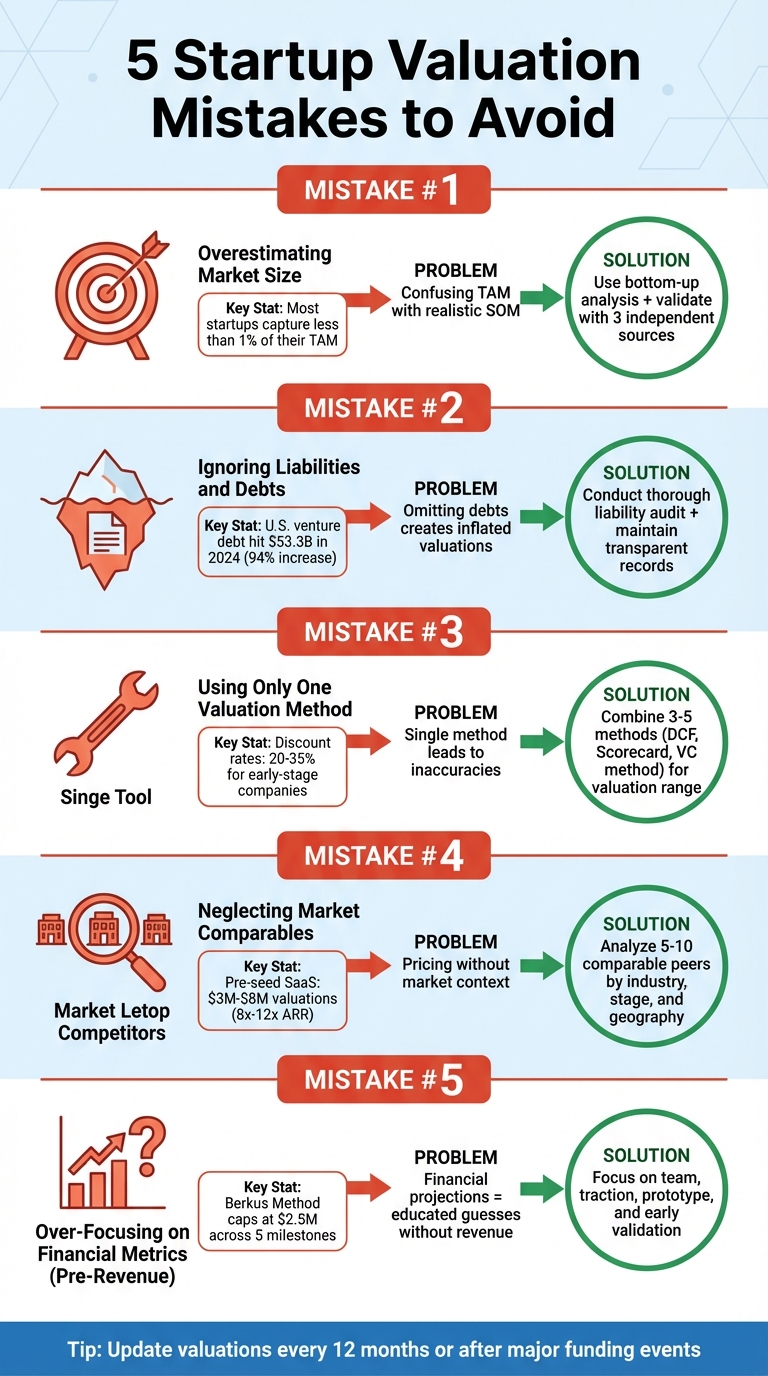
5 Common Startup Valuation Mistakes and How to Avoid Them
Private Company Valuation Mistakes & Case Studies
sbb-itb-85dd802
1. Overestimating Market Size
A common mistake among founders is confusing Total Addressable Market (TAM) – the largest possible market size – with Serviceable Obtainable Market (SOM), which reflects the revenue realistically achievable within 3–5 years. Claiming, “We only need 1% of a $100 billion market,” often signals inexperience. Investors can spot this error quickly by comparing your projections to industry benchmarks.
Here’s the reality: most startups capture less than 1% of their TAM, and even established companies rarely surpass 20% market share in their niche.
"If you project a revenue growth that is completely out of sync with other startups in the industry, it brings out your lack of understanding of the space." – TD Shepherd
Many founders rely on "top-down" analysis – starting with a massive industry figure and claiming a small share – without explaining how they’ll acquire customers. This approach can seriously hurt your credibility with investors, who’ve seen this shortcut used far too often.
A better approach is bottom-up analysis. Start with your actual target customers and calculate potential revenue based on realistic assumptions. For example, if you’re selling compliance software to regional banks, estimate your market size by considering the number of banks in your target area, expected conversion rates based on your sales capacity, and your Average Revenue Per User (ARPU). This is far more credible than citing a global market figure. Don’t forget to account for real-world constraints, like the size of your sales team and the typical 9–12 month sales cycle for enterprise deals in 2025.
To strengthen your market size claims, validate them using three independent sources: bottom-up analysis, top-down industry reports, and data from comparable public companies. This triangulated approach helps differentiate between a broad industry estimate and your specific, achievable niche.
2. Ignoring Liabilities and Debts
When founders present their startup valuation, they often focus on assets, revenue projections, and growth potential. But here’s the catch – many omit liabilities entirely. This oversight creates an overly optimistic picture that can unravel during investor due diligence.
"Valuing your business without factoring in debts and other liabilities will result in an inaccurate and overshot valuation that doesn’t reflect the true state of affairs." – Chris Nash, Vestd
Hidden liabilities – like undisclosed debt, pending lawsuits, or missing intellectual property assignments – can raise red flags for investors. These discoveries may lead them to question a founder’s transparency and, in some cases, walk away from the deal altogether. Even if the deal goes through, unresolved liabilities can cause major headaches, such as cash flow issues, breaches of venture debt agreements (which hit $53.3 billion in the U.S. in 2024, a 94% jump from the year before), or unexpected tax penalties.
To avoid these risks, it’s critical to adopt accounting and advisory services early on. Start by conducting a thorough liability audit that covers everything – long-term debt, contingent liabilities, asset retirement obligations, and supplier contracts. Keep personal and business finances separate by using dedicated business credit cards. Also, use accrual-based accounting to record liabilities as they occur, rather than relying solely on cash flow.
"Poor expense controls suggest weak financial discipline that doesn’t inspire confidence in your ability to manage investor capital effectively." – Igor Tutelman, CPA, Iota Finance
Keep in mind that the fair value of liabilities, especially long-term debt, may not always match what’s recorded in your books. A proper valuation subtracts all obligations to reveal the true fair market value. By centralizing documentation – like contracts, intellectual property assignments, and financial commitments – startups can sidestep due diligence surprises and showcase the operational discipline investors are looking for.
3. Using Only One Valuation Method
Relying on just one valuation method can be a risky move, as it narrows your perspective and leaves room for errors. Each method has its strengths and weaknesses, and depending on a single approach can lead to misleading conclusions.
Take the Discounted Cash Flow (DCF) model, for example. While it’s grounded in solid theory, it’s also highly sensitive to assumptions. A slight tweak in your growth rate or discount rate can drastically shift the valuation. For early-stage companies, discount rates often fall between 20% and 35% to account for high failure risks. If these assumptions are off even a little, the resulting valuation can be far from accurate.
"No single method tells the whole story, and this is especially true for early valuations." – Vestd
Other methods, like market comparables and asset-based approaches, come with their own set of challenges. Market comparables, for instance, are influenced by market conditions. They tend to overvalue during booms and undervalue during downturns. Plus, finding truly comparable private companies is tough, which makes these benchmarks less reliable on their own. Asset-based methods, such as Book Value, often overlook intangible assets like intellectual property, team expertise, or network effects – key drivers of startup value.
The best way to avoid these pitfalls is through triangulation. Instead of sticking to one method, combine three to five approaches – like DCF, Scorecard, and Venture Capital – to create a valuation range rather than a single figure. The weight you give to each method should align with your company’s stage. For pre-revenue startups, qualitative methods carry more weight, while quantitative models like DCF become more useful as revenue streams stabilize. This multi-method approach not only strengthens your valuation strategy but also builds credibility with investors, helping you sidestep overly simplistic valuations.
4. Neglecting Market Comparables
Skipping market comparables when setting your valuation is like trying to price a house without checking recent sales in the neighborhood. Sure, you might believe your startup is worth $15 million, but if similar companies at your stage are raising at $8 million, you’ve effectively priced yourself out of the game.
Market comparables give investors a reality check. By analyzing 5–10 peers that align with your industry, stage, business model, and geography, you can identify a realistic valuation range. For instance, pre-seed SaaS startups generating $0 to $20,000 in monthly recurring revenue often see valuations between $3 million and $8 million, with revenue multiples ranging from 8x to 12x ARR. If you’re asking for $12 million at the pre-seed stage without substantial traction, you’ll need to justify that premium with standout factors like a unique strategy or significant competitive advantages.
"Comparables are Context, Not Command: Use comps strategically to benchmark your startup against the market… They support the story; they don’t write it." – Dan Gray, Equidam
The trick is to treat comparables as a guide, not a strict formula. Blindly applying a competitor’s revenue multiple to your own numbers ignores the nuances that make your startup distinct, such as a strong team, proprietary tech, or better unit economics. Startups that perform detailed competitive analyses are 30% more likely to secure funding because they show they understand their market and can present a credible case to investors.
To find meaningful comparables, focus on companies that match your specific criteria – industry, stage, business model, and geography. Don’t just rely on public company data; dig into private funding rounds through tools like PitchBook or Crunchbase to get a clearer picture of early-stage trends. This approach ensures you’re not walking into investor meetings with an inflated valuation that could turn them off.
Once your comparables are in place, the next step is to align your financial metrics with your startup’s growth stage.
5. Focusing Too Much on Financial Metrics for Pre-Revenue Startups
For pre-revenue startups, putting too much weight on financial metrics can be a major misstep. Without actual revenue, detailed financial models are essentially educated guesses. These startups lack the historical data – like revenue, EBITDA, or net profit – that traditional valuation methods rely on. Instead, what you have is a "stack of assumptions" about market demand, product–solution fit, and scalability. If those assumptions are misrepresented, it can seriously damage your credibility.
This highlights a fundamental shift in focus: from past performance to future potential.
"People act like [valuation is] an award for past behavior. It’s not. It’s a hurdle for future behavior." – Bill Gurley, General Partner, Benchmark
At this stage, investors prioritize qualitative factors over financial projections. They’re more interested in the founding team’s expertise and track record, as well as early signs of traction – like user sign-ups, letters of intent, active engagement, or completed pilot programs. Even a working prototype can elevate a startup’s valuation to the $2 million to $5 million range using the valuation-by-stage method. Meanwhile, a strong minimum viable product (MVP) with early adopters typically attracts investments between $500,000 and $1.5 million.
The Berkus Method is a great example of how pre-revenue valuations are approached differently. It caps valuations at $2.5 million and assigns up to $500,000 across five key milestones: a solid idea, a prototype, a strong management team, strategic relationships, and a product rollout. Notably, only one of these milestones involves actual sales. This method emphasizes that, in the early stages, it’s all about mapping out the future rather than reporting on the past.
When meeting with investors, focus on proving your ability to execute. Show evidence of demand through early validation and explain why your team is uniquely positioned to deliver results. It’s this proof of execution – not just optimistic projections – that will win their confidence.
Conclusion
Getting your valuation right is crucial for building trust with investors and safeguarding your team. The five common pitfalls – overestimating market size, overlooking liabilities, sticking to a single valuation method, ignoring comparable companies, and focusing too much on financial metrics for pre-revenue startups – can derail your fundraising efforts before they even begin.
Beyond losing investor confidence, these mistakes can lead to regulatory issues. For example, valuation errors can result in IRS Section 409A penalties. If stock options are granted below fair market value, employees may face immediate income recognition, a 20% federal penalty tax, and interest charges.
Avoiding these errors requires thorough preparation, realistic evaluations, and professional expertise. Make it a habit to update your valuations at least every 12 months or after major events like new funding rounds. Use multiple valuation methods – such as market comparisons, asset-based approaches, and discounted cash flow – to cross-check your numbers. Keep detailed records of contracts, IP assignments, and financial data. Most importantly, work with qualified professionals holding certifications like ASA, AICPA, or NACVA to ensure your valuation meets IRS standards.
For startups looking to streamline this process, TC Advisors offers a range of valuation services, including certified 409A valuations, financial planning, and transaction advisory. Their services start at $500 and include a free consultation. Using advanced techniques like Option Pricing Models and the Backsolve Method, they handle even the most complex capital structures. Most valuations are completed within 2–5 business days, and audit support is included at no extra charge.
Think of valuation as more than just a number – it’s a strategic tool that can provide the financial clarity and operational discipline investors expect. With expert guidance, you can showcase your startup’s true potential and confidently move forward with fundraising, hiring, and growth.
FAQs
How do I estimate my SOM instead of just citing TAM?
To figure out your SOM (Serviceable Obtainable Market), start by estimating the market share you can realistically capture from your SAM (Serviceable Addressable Market) within the next 3–5 years. Use bottom-up approaches like analyzing sales data or gathering customer feedback. Alternatively, rely on top-down methods, such as insights from industry reports, to validate your potential market share. This approach keeps your valuation grounded in realistic goals rather than overly optimistic market assumptions.
What liabilities do investors usually find in due diligence?
During the due diligence process, investors frequently identify liabilities like unpaid debts, unresolved legal matters, accrued expenses, and other financial obligations. These issues can have a major effect on a startup’s valuation, making it crucial to tackle them head-on before they become stumbling blocks.
Which valuation methods work best for a pre-revenue startup?
For startups that haven’t yet generated revenue, valuation often relies on approaches like the cost approach, market approach, income approach, discounted cash flow (DCF) method, and the scorecard valuation method. These techniques provide a framework for evaluating early-stage businesses without depending on substantial revenue data.


