

Hybrid financing, blending characteristics of debt and equity, plays a critical role in mergers and acquisitions (M&A). However, its tax treatment can be complex and requires careful planning. Here’s what you need to know:
- Classification Matters: Instruments must be classified as either debt or equity under U.S. tax law. This determines whether payments are treated as deductible interest (debt) or non-deductible dividends (equity).
- Key Tax Benefits: Debt classification allows interest deductions, creating tax savings. Equity classification may lead to capital gains treatment, benefiting non-U.S. investors by reducing withholding tax exposure.
- IRS Scrutiny: The IRS evaluates these instruments based on their economic substance, not just their labels. Poor documentation or weak repayment practices can lead to reclassification, resulting in lost deductions and higher taxes.
- Industries and Use Cases: Hybrid financing is common in capital-intensive sectors like utilities and real estate, as well as in leveraged buyouts and large acquisitions.
To avoid tax risks, work with tax advisors early in the deal process to ensure compliance and maximize benefits. Proper structuring and documentation are essential to maintaining the intended tax treatment and avoiding costly surprises.
Tax Benefits of Hybrid Financing in M&A
Interest Deductions and Tax Savings
When a hybrid instrument is treated as debt for U.S. federal income tax purposes, the acquiring company can deduct interest payments from its taxable income. This creates a "tax shield", reducing the portion of operating profits subject to corporate tax. With the U.S. corporate tax rate at 21%, these deductions can significantly lower the overall cost of an acquisition.
This deduction applies to various types of interest, including paid-in-kind (PIK) and original issue discount (OID), which accrue regardless of immediate cash payment. This means companies can spread out interest deductions over the life of the loan, even if cash payments are deferred until maturity.
"Returns to fund investors on successful investments are multiplied by financing the acquisition using external debt. Deductibility of interest has therefore been of key importance."
- Brenda Coleman, Andrew Howard, and Leo Arnaboldi III, Ropes & Gray
For partnership or flow-through structures, while preferred equity returns aren’t deductible, the allocated income can reduce taxable income for other owners. Additionally, non-U.S. investors have the option to optimize their tax position through the "portfolio interest exemption." This exemption allows interest earned on debt-classified hybrids to be free from U.S. withholding tax, provided their ownership in the issuer is less than 10%.
The distinction between interest and principal repayments also plays a key role in shaping the tax impact of these instruments.
Tax Treatment of Principal Repayments
The tax classification of a hybrid instrument – whether as debt or equity – determines how principal repayments are treated, which can have a major impact on the economics of a deal.
For debt-classified instruments, principal repayments are not taxable since they simply return the investor’s basis. This stands in contrast to dividend payments, which are taxed as ordinary income and do not offer the issuer any tax deduction.
For equity-classified instruments, a full redemption may qualify for capital gains treatment instead of being taxed as an ordinary dividend. This distinction is especially advantageous for non-U.S. investors. While they may face steep withholding taxes on dividend income, they can often avoid U.S. withholding tax on capital gains. By effectively converting high-withholding dividend payments into lower- or zero-withholding capital gains, the overall after-tax cost of the M&A transaction can be substantially reduced.
sbb-itb-85dd802
Structuring Requirements for Tax Compliance
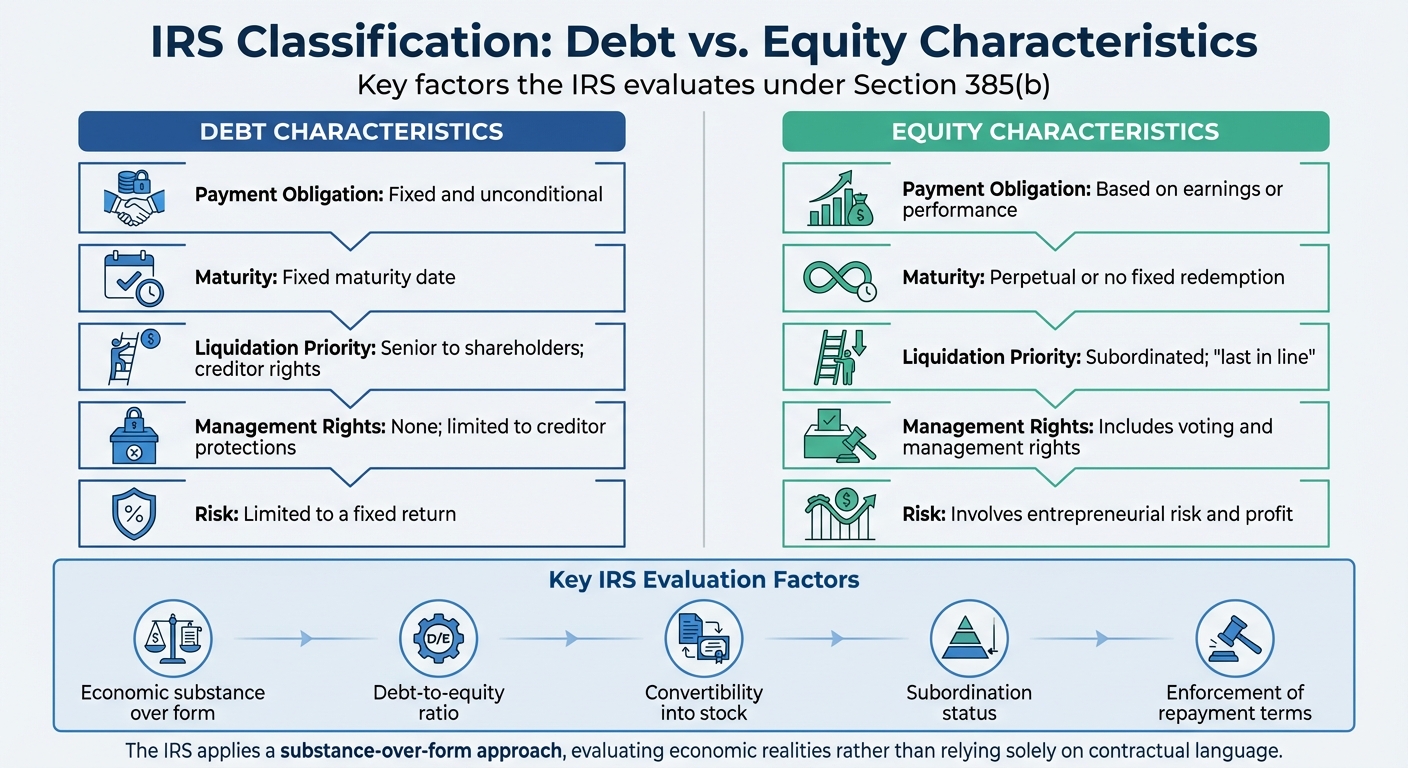
IRS Debt vs Equity Classification Criteria for Hybrid Instruments
IRS Classification: Debt vs. Equity
When it comes to hybrid financial instruments, the IRS looks beyond the surface. Under Section 385(b), the IRS evaluates these instruments based on their economic substance rather than just their labels. Key factors include whether there’s a fixed, unconditional promise to pay, the instrument’s subordination status, the debt-to-equity ratio, and whether it’s convertible into stock or tied to stock ownership proportions.
The IRS applies a substance-over-form approach, evaluating economic realities rather than relying solely on contractual language. – AccountingInsights Team
A good example of this is the Gray v. Commissioner case. Here, the Tax Court reclassified $1,827,198 in what were called "loans" from a C corporation to its sole shareholder as taxable dividends. Even though promissory notes were in place, the court flagged several issues: inadequate collateral, no effort by the corporation to collect $816,000 of overdue debt, and the fact that only $103,000 had been repaid during the period in question.
The IRS adds further scrutiny through Notice 94-47, particularly for instruments treated as debt for tax purposes but seen as equity for accounting or regulatory purposes. In such cases, the IRS considers whether:
- The holder has a genuine right to enforce payment.
- The instrument grants rights to participate in management.
- The maturity date is excessively long (e.g., 50 years or perpetual).
To better understand these distinctions, here’s how debt and equity typically differ:
| Feature | Debt Characteristics | Equity Characteristics |
|---|---|---|
| Payment Obligation | Fixed and unconditional | Based on earnings or performance |
| Maturity | Fixed maturity date | Perpetual or no fixed redemption |
| Liquidation Priority | Senior to shareholders; creditor rights | Subordinated; "last in line" |
| Management Rights | None; limited to creditor protections | Includes voting and management rights |
| Risk | Limited to a fixed return | Involves entrepreneurial risk and profit |
With these criteria in mind, it’s clear that precise documentation and clearly defined payment terms are critical to support a debt classification.
Documentation and Payment Terms
Strong documentation is the foundation for maintaining the intended tax treatment of debt. Transactions must reflect arm’s-length principles, meaning they should mirror how unrelated parties would deal with each other.
No paperwork will outweigh the actions of related parties if they fail to conduct themselves as they would in dealing with unrelated parties.
- Shannon Christensen, Executive Editor, Thomson Reuters Checkpoint
When structuring shareholder debt, it’s important to align it with realistic market ratios. For example, if a shareholder owns 75% of the company’s stock, having them hold 90% of the debt could strengthen the case for treating it as debt. However, deeply subordinating this debt to other creditors might suggest an equity-like arrangement, as being "last in line" is a common equity trait.
Timely and accurate records of interest and principal payments are equally essential. If payments are missed, loan documents and corporate minutes should be updated without delay.
To further reduce reclassification risks, the instrument should specify a fixed repayment amount (a ‘sum certain’) at maturity. Instruments requiring repayment solely in stock can increase the likelihood of being classified as equity. Under Section 385, documentation is considered timely if it’s completed by the time the issuer files their federal income tax return (including extensions). This is especially critical for related groups with assets exceeding $100 million or annual revenue over $50 million, as they face stricter rules.
Tax Risks of Hybrid Financing
Reclassification Risks and Lost Deductions
When the IRS reclassifies hybrid financing from debt to equity, the consequences can be severe. Interest expenses, which are typically deductible, are transformed into non-deductible dividends. For cross-border transactions, this change can be even more costly. Non-U.S. investors lose the "portfolio interest" exemption, and payments become subject to dividend withholding taxes, which can climb as high as 37% if the dividends are unqualified.
"Such a reclassification can transform a modest interest receipt into a complicated and expensive dispute with the tax authorities." – Virginia Jeker, US International Tax Specialist
The ripple effects don’t stop there. Companies may find themselves burdened with additional filing requirements, such as Form 5471 for controlled foreign corporations, Form 8621 for Passive Foreign Investment Companies (PFICs), or Form 8938 for foreign assets. If a foreign issuer is deemed a PFIC, U.S. investors face harsh tax treatment. Distributions are taxed as ordinary income at the highest rates, and compounded interest penalties can apply. To make matters worse, failing to file these forms leaves the statute of limitations open indefinitely, giving the IRS the power to revisit and challenge tax returns years – or even decades – later.
For partnerships, reclassification can create even more complications. Investors are forced to recognize their share of the entity’s income, gains, and losses annually, regardless of whether they receive any cash distributions. This "phantom income" creates unexpected tax liabilities, which can strain relationships with investors and disrupt the financial dynamics of a deal.
These risks are not just theoretical – they’re backed by real-world enforcement and legal precedents.
Court Cases and IRS Enforcement
The IRS has taken a firm stance on hybrid instruments, successfully challenging their classification in several prominent cases. These cases serve as a reminder that strong documentation alone isn’t enough to shield transactions from reclassification.
In the case of Illinois Tool Works Inc. & Subsidiaries v. Commissioner, the Tax Court ruled in favor of the taxpayer. The company demonstrated that its cross-border related-party loan had genuine debt characteristics, including enforceable repayment rights, a market-rate interest, and a clear business purpose aligned with economic substance.
On the other hand, the Gray v. Commissioner case illustrates the dangers of weak repayment practices. Minimal repayments and a lack of enforcement can lead to reclassification, as the IRS scrutinizes the economic reality of a transaction rather than relying solely on its legal labels.
"The label matters not just for income tax, but for information returns, penalties and foreign reporting responsibilities as well." – Virginia La Torre Jeker, US International Tax Specialist
The takeaway? Companies that fail to actively enforce repayment terms or that structure instruments too closely to equity are essentially inviting IRS scrutiny. The agency’s focus on the substance over the form of transactions makes it critical for businesses to ensure their arrangements can withstand such challenges.
Industries and Deal Types Best Suited for Hybrid Financing
Once tax risks are addressed, the next step is identifying industries and deal types where hybrid financing fits seamlessly with financial goals and operational requirements.
Capital-Intensive Industries
Hybrid financing thrives in industries that require significant capital investment. Sectors like utilities, real estate, and energy often dominate this market due to their ongoing need for substantial funding without diluting shareholder value.
"Corporate utility companies represent the primary issuers of corporate hybrid bonds on account of current significant capital expenditure needs, and, looking forward, the need to raise capital to increase energy capacity in order to accommodate AI and data center development." – Vishal Mawkin, Partner, BCLP
One key advantage is how credit rating agencies classify hybrid bonds: typically, 50% as equity and 50% as senior debt. This classification allows only half of the issuance amount to impact debt-to-capital ratios, enabling companies to raise large sums while protecting their investment-grade ratings. For utilities, this is especially crucial as they face escalating energy demands driven by technological advancements.
Manufacturing companies, particularly those with substantial tangible assets, also benefit from hybrid structures. Properly structured deals in this sector can provide buyers with a stepped-up tax basis, enhancing future cash flow through increased depreciation and amortization deductions. In such cases, the tax structure plays a pivotal role in shaping the overall value of the transaction.
Leveraged Buyouts and Large Acquisitions
Hybrid financing is particularly effective in leveraged buyouts (LBOs) and large acquisitions where traditional senior debt falls short of covering the purchase price. In these scenarios, hybrid instruments occupy a middle ground between senior debt and equity, offering additional leverage without the full dilution associated with issuing new equity.
A notable example occurred in April 2025 when CVC Credit provided around €200 million in second-lien financing to American Heart of Poland. This healthcare leader, operating over 100 facilities with 6,000 employees, used the funding to acquire a local hospital network and upgrade public facilities. The deal featured a leverage ratio of approximately 5.6x and a loan-to-value ratio of 46%, enabling the owner to optimize the capital structure while maintaining a public credit rating.
Hybrid instruments in such transactions often include features like deferred interest payments – commonly referred to as pay-in-kind (PIK) structures. These features ease cash flow constraints during the critical integration phase following a major acquisition, providing financial flexibility when it matters most.
Working with Tax Advisors on Hybrid Financing
When it comes to hybrid financing, having specialized tax expertise from the start is critical. The debt/equity classification tied to these instruments can be tricky, and even small changes might lead to reclassification and unexpected tax bills. Proactive planning with tax advisors can save you from costly surprises.
Structuring and Compliance Guidance
Tax advisors play a key role in analyzing factors like economic substance, payment conditions, and the tax status of participants to ensure the instrument gets the desired IRS classification.
"Tax analysis at the earliest stages of structuring such an instrument is essential to ensuring that Hybrid Capital achieves its intended economic objectives while minimizing unintended and potentially significant negative tax consequences." – Proskauer Rose LLP
They also help navigate the intricate anti-hybrid rules under Internal Revenue Code Section 267A. These rules disallow deductions for interest payments in "deduction/no-inclusion" situations. For deductions to remain valid, the recipient must include the payment in their foreign income within 36 months after the end of the payor’s tax year. In cross-border transactions, advisors manage international tax rules, including Dual Consolidated Loss (DCL) regulations. With this structured approach, tax advisors ensure compliance and tax efficiency over time.
Continuous Tax Planning and Risk Management
Strong structuring practices are just the beginning. Continuous tax planning ensures hybrid instruments maintain their intended classification and benefits as tax laws and economic conditions evolve. Advisors stay on top of regulatory changes and help file necessary certification statements under Treasury Regulations Section 1.1503-2(g)(28) to protect domestic deductions.
For M&A transactions involving hybrid financing, TC Advisors provides services like due diligence, risk management, and deal optimization. Their team specializes in structuring arrangements that meet IRS requirements while maximizing tax benefits throughout the financing lifecycle. This proactive strategy helps avoid reclassification issues and ensures hybrid instruments achieve their economic goals without triggering unexpected tax liabilities.
Conclusion
The tax aspects of hybrid financing come with both opportunities and challenges that shape how deals are structured. On the upside, interest deductions and precise classification are crucial for achieving tax efficiency. Hybrid financing also offers the ability to adjust withholding taxes for non-U.S. investors and, in some cases, provides corporate shareholders access to dividends-received deductions – making it an appealing choice for various transaction types.
However, these benefits are not without risks. Even minor changes to payment terms or maturity dates could lead to a reclassification from debt to equity. This shift would turn deductible interest payments into non-deductible dividends, potentially undermining the tax advantages.
Poor structuring can result in missed deductions, exposure to 30% withholding taxes for investors, and unexpected tax liabilities. The IRS has also ramped up scrutiny of hybrid arrangements, especially those aiming for double deductions across jurisdictions, adding another layer of complexity to compliance.
To navigate these challenges, it’s essential to bring tax advisors into the process early. Tax analysis should begin during the initial stages of deal structuring, before any terms are finalized. Advisors can help address debt-versus-equity classifications, manage anti-hybrid rules, and ensure that documentation supports the intended tax outcomes. For M&A deals involving hybrid financing, working with specialists providing industry-specific tax guidance can help optimize tax benefits while ensuring compliance with IRS requirements.
When handled with care and expertise, hybrid financing offers a powerful combination of tax savings and flexibility. Proper planning and guidance are key to unlocking its full potential.
FAQs
How does the IRS decide if a hybrid instrument is debt or equity?
The IRS determines whether a hybrid instrument should be treated as debt or equity by examining several key factors. These include the intent of the involved parties, the enforceability of the instrument’s terms, whether there is a fixed maturity date, the rights to payment, and the quality of the documentation. It’s important to note that no single factor carries more weight than the others. Instead, the classification is based on a thorough review of the facts and relevant court decisions.
When can hybrid financing interest be disallowed under Section 267A?
Hybrid financing interest is not deductible under Section 267A if it qualifies as a specified payment made to a related party. This happens when the payment is classified as interest or a royalty in a hybrid transaction or involves a hybrid entity, provided it meets the disallowance conditions set by the regulations. Determining whether this applies requires a detailed review of the transaction.
What documentation best protects interest deductions in an M&A deal?
Proper structuring and thorough documentation of hybrid debt instruments play a key role in safeguarding interest deductions during an M&A transaction. To ensure maximum tax benefits and avoid penalties, these instruments must be clearly defined and classified as debt in accordance with IRS guidelines.


