

When businesses merge or acquire others, their tax obligations often change dramatically. Nexus – your connection to a state that triggers tax responsibilities – can expand due to new sales, employees, or assets in different states. Ignoring these changes can result in unpaid taxes, penalties, and even deal disruptions. Here’s what you need to know:
- Nexus Types: Physical (e.g., property, employees) and Economic (e.g., $100,000 in sales).
- Successor Liability: Buyers may inherit unpaid taxes from sellers, even in asset-only deals.
- Key Taxes Affected: Sales tax, income tax, franchise tax, and gross receipts tax.
- Due Diligence: Map nexus triggers, review state registrations, and secure tax clearance certificates.
- Post-Closing Compliance: Update registrations, align systems, and monitor new nexus triggers.
Proper planning, including nexus reviews and voluntary disclosure agreements, can minimize risks and ensure smoother transactions. Always consult tax experts to navigate these complexities effectively.
Nexus is one of the exposures that surfaces most often in diligence. Our due diligence and transaction advisory page covers the others and how they are tested.
State & Local Tax: Discover smart SALT planning and nexus strategies
What is Nexus and Why Does it Matter in M&A?
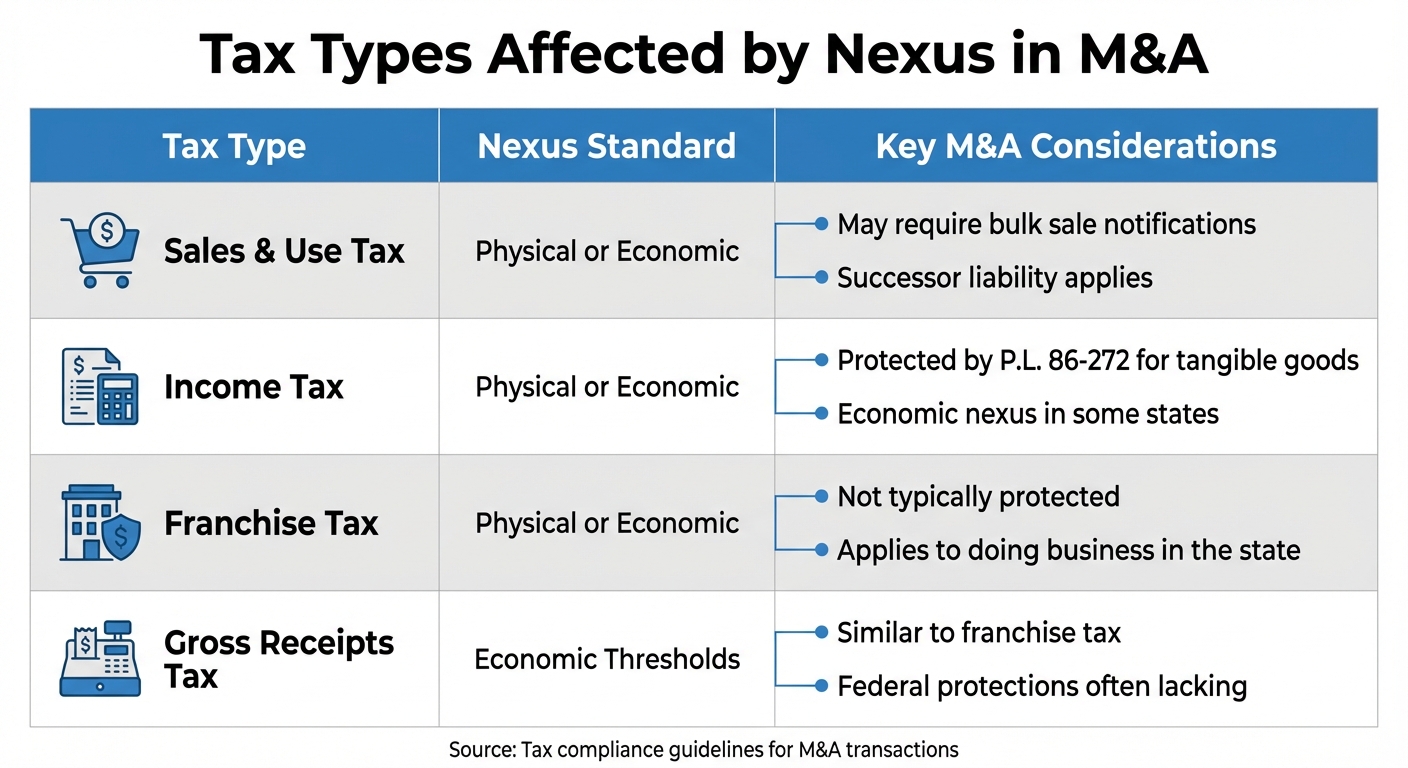
Tax Types Affected by Nexus in M&A Transactions
Nexus refers to the minimum connection a business must have with a state to trigger tax obligations. It determines where a company must file tax returns and pay taxes – an issue that takes on added importance during mergers and acquisitions (M&A).
There are two main types of nexus. Physical nexus is established through tangible connections to a state, such as owning or leasing property, storing inventory (even in third-party warehouses), or having employees in the state. Economic nexus, on the other hand, arises when a business exceeds certain state-defined thresholds, like $100,000 in sales or 200 transactions within a 12-month period. Since the 2018 Wayfair decision, all states with sales tax have adopted economic nexus rules.
During M&A, nexus becomes a critical factor due to successor liability. Even in asset-only transactions, many states hold the buyer responsible for unpaid sales taxes. If the target company had nexus but failed to file necessary tax returns, the statute of limitations never starts running, allowing liabilities to grow indefinitely. For instance, in December 2024, a manufacturing company discovered it had sales tax nexus in 27 states due to nationwide shipments. The deal nearly fell apart until Monika Miles of Miles Consulting Group used Voluntary Disclosure Agreements to address the issue across all 27 states.
Types of Taxes Affected by Nexus
Nexus influences various tax obligations, each with its own set of rules and potential consequences.
Sales and Use Tax: Both physical and economic nexus can trigger filing requirements. Additionally, many states require bulk sale notifications. Failing to comply with these rules can leave buyers personally responsible for unpaid taxes.
Income Tax: Nexus for income tax can arise from physical presence or economic activity. However, businesses selling only tangible goods may be protected under Public Law 86-272, provided their in-state activities are limited to soliciting sales. This protection is shrinking, though, as states like New York, New Jersey, and California argue that digital activities – such as placing cookies or using marketplace facilitators – fall outside of these protections. About 16 states have implemented economic nexus thresholds for income tax, like Pennsylvania’s $500,000 threshold.
Franchise Tax and Gross Receipts Tax: These taxes are generally not covered by Public Law 86-272 and are imposed based on the privilege of doing business in a state. They often follow economic thresholds similar to sales tax but vary by state.
| Tax Type | Nexus Standard | Key M&A Considerations |
|---|---|---|
| Sales & Use Tax | Physical or Economic | May require bulk sale notifications; successor liability applies |
| Income Tax | Physical or Economic | Protected by P.L. 86-272 for tangible goods; economic nexus in some states |
| Franchise Tax | Physical or Economic | Not typically protected; applies to doing business in the state |
| Gross Receipts Tax | Economic Thresholds | Similar to franchise tax; federal protections often lacking |
Nexus Implications for Buyers and Sellers
For buyers, conducting a thorough nexus review is essential to avoid inheriting unexpected tax liabilities. Successor liability can transfer unpaid taxes, interest, and penalties from the seller to the buyer, even in asset-only deals. The longer nexus issues go unnoticed, the greater the financial risk. Securing tax clearance certificates from state agencies before finalizing the deal can offer critical protection.
For sellers, addressing nexus issues early can prevent last-minute deal disruptions. If a buyer uncovers unresolved nexus problems during due diligence, it could lead to reduced purchase prices, large escrow holdbacks, extended indemnification periods, or even a collapsed transaction.
"State tax issues do not derail deals because they are large. They derail deals by raising unanswered questions at the worst possible time." – Zaid Butt, Partner, Evolved, LLC
Sellers who identify and address non-compliance early can often resolve these issues through Voluntary Disclosure Agreements. These agreements typically limit the lookback period to 3-4 years and waive penalties, turning a potential deal-breaker into a manageable cost that can be accounted for during negotiations.
These challenges highlight the importance of thorough due diligence and strategic planning when navigating nexus in M&A transactions.
Conducting Nexus Due Diligence During M&A
A careful nexus review during due diligence can be the difference between a seamless acquisition and one bogged down by unexpected tax issues. This process involves analyzing the target company’s current tax obligations and uncovering any hidden liabilities that could transfer to the buyer.
Steps to Evaluate Nexus Status
Here’s how to systematically assess the target’s nexus profile:
- Map the target’s physical and economic presence. Start by identifying all locations where the company owns or leases property, stores inventory (including third-party warehouses), or has employees or independent contractors. Compare this physical footprint to the company’s state tax registrations. Many businesses only register in their home state, unintentionally creating nexus elsewhere through remote employees or consigned inventory stored in customer warehouses.
- Analyze state-by-state economic activity. Review the past 12 months of sales data, comparing revenue and transaction counts against each state’s thresholds. While $100,000 in annual sales is a common benchmark, some states set different thresholds. For instance, Pennsylvania requires registration at $100,000 for sales tax but $500,000 for income tax. Also, check whether the target’s products or services are taxable in each jurisdiction – SaaS and digital goods, for example, often face varied tax treatment.
- Review registration and filing history. Determine when nexus was established versus when the company first registered. If there’s a gap, the statute of limitations may not apply, potentially leaving the buyer exposed to several years of back taxes.
"If the seller hasn’t been filing and paying taxes in required states, state and local tax liabilities can be particularly significant because liabilities compound over multiple years and the statute of limitations never tolls when a taxpayer fails to file required returns." – Plante Moran
- Examine Public Law 86-272 protections. For income tax purposes, this federal law shields companies from state income tax if their activities are limited to soliciting orders for tangible personal property. However, its protections are narrowing. States like California, New Jersey, and New York now argue that actions such as placing internet cookies on customer devices go beyond "mere solicitation" and create nexus.
- Assess affiliate and agency relationships. Investigate whether related entities or affiliate marketing programs – such as those where content creators earn commissions for driving sales – might establish nexus through attribution.
- Request tax clearance certificates. Before closing the deal, buyers should obtain these certificates from state Departments of Revenue. They confirm that the seller has no outstanding tax debts and help protect against successor liability.
Once all nexus triggers are evaluated, carefully examine any compliance gaps that could result in additional liabilities.
Common Nexus Compliance Gaps
After mapping nexus triggers, it’s essential to identify common compliance gaps that could reveal hidden risks:
- Unfiled returns in "home rule" jurisdictions. States like Colorado, Alabama, and Louisiana allow local governments to administer sales taxes independently. A company might register at the state level but miss numerous local filing obligations.
- Missing or invalid exemption certificates. If the target sells to nonprofits, resellers, or manufacturers without collecting tax, valid exemption certificates are required to prove the transactions were tax-exempt. Buyers could inherit liability for uncollected taxes if these certificates are missing, expired, or improperly completed. Sending XYZ letters to past customers can help verify whether tax was paid or exemptions were valid.
- Outdated apportionment methodologies. During income tax reviews, companies often discover they’ve been using incorrect methods for allocating revenue. Many states have shifted from "cost of performance" sourcing to "market-based sourcing", leading to years of potential misfiling.
"Sales tax risk might be considered immaterial to a merger or acquisition, but when you consider that up to 10% of a business’s overall revenue could be exposed… sales tax risk can become a deal killer." – Robert Dumas, Founder of TaxConnex
- Deregistration risks. When target entities are dissolved or merged, failing to file final returns (even for $0) can leave the company in delinquent status. States won’t close registrations until all outstanding filing periods are resolved, potentially causing administrative delays.
Engaging seasoned advisors during this phase can provide invaluable support. For expert guidance on navigating nexus due diligence and minimizing tax risks during M&A transactions, consider reaching out to TC Advisors.
sbb-itb-85dd802
Reducing Nexus Risks Through Deal Structuring
After identifying potential nexus liabilities during due diligence, the next step is structuring the deal to limit tax exposure. The goal is to choose a transaction structure that minimizes both historical and future nexus liabilities.
Choosing the Right Transaction Structure
The choice between an asset purchase and a stock purchase plays a key role in managing nexus risk. In an asset acquisition, the target company is often merged into the buyer’s existing legal entity. While this structure might seem like a way to avoid liability, many states enforce successor liability rules. This means the buyer could still be held accountable for the seller’s unpaid sales and use taxes. States like California, Florida, and New York are particularly strict in this regard.
A stock purchase, on the other hand, keeps the target company as a separate legal entity. However, this arrangement transfers the target’s entire historical tax profile and liabilities to the buyer. Additionally, stock purchases can create affiliate nexus if the relationship between the buyer’s existing entities and the newly acquired company introduces tax obligations in states where only one of them previously had a presence.
The structure of the transaction also impacts registration requirements. For instance, merging the target into the buyer’s entity may require assessing whether the target’s physical or economic presence triggers new nexus obligations. Similarly, changing the business structure – such as converting from a partnership to a corporation – often requires new sales tax registrations.
Buyers should also approach Section 338(h)(10) elections with care. While these elections can be advantageous for income tax purposes, they may shift state tax liabilities onto the buyer.
To limit successor liability in asset deals, buyers should obtain tax clearance certificates from state Departments of Revenue to confirm that all taxes have been paid. In states like New York, filing bulk sale notifications can help prevent the buyer from inheriting the seller’s unpaid sales taxes.
These structural decisions often lead to negotiating tax indemnities to protect against unexpected liabilities after closing.
Negotiating Tax Indemnities
Even with thoughtful structuring, nexus liabilities can emerge after the deal closes. Including tax indemnity clauses in the purchase agreement provides a layer of protection, but their effectiveness depends on the buyer’s ability to recover funds from the seller.
Escrow accounts are a common tool for addressing identified nexus risks. Buyers often hold escrow funds for 12 to 24 months to cover potential audit-related exposures.
"The buyer’s side due diligence… tends to be ultra-conservative about successor liability… But we are often able to reduce the exposure significantly for the seller." – Monika Miles, President, Miles Consulting Group
Sellers can improve their position by addressing nexus concerns before closing. Voluntary Disclosure Agreements (VDAs) are particularly helpful, as they typically limit the look-back period to three to four years and waive penalties, making the seller’s tax profile more attractive to buyers. Sellers should also conduct their own nexus studies to validate their tax positions and push back on excessive escrow demands.
For transactions involving multi-state nexus issues, working with skilled advisors is essential. Firms like TC Advisors specialize in M&A tax planning, risk management, and deal optimization to help navigate these complex scenarios.
Post-Closing Tax Compliance and Integration
Closing the deal is just the beginning of a critical compliance phase. The first 100 days are crucial to avoid potential penalties or audits.
Updating Tax Registrations
The structure of your transaction will determine how you handle tax registrations. For asset deals where the target merges into your legal entity, ensure tax registrations are updated using the acquisition date. If the transaction involves a legal structure change, such as transitioning from a partnership to a corporation, you’ll need new registrations.
Before registering, secure tax clearance certificates and file bulk sale notifications where necessary. These steps help protect against successor liability.
In stock purchases, where the target remains a separate legal entity, make sure to formally close old registrations. Continue filing $0 returns until you receive confirmation of closure.
"A state can’t close a registration with outstanding periods. Be sure to keep filing these returns until the account is closed." – Sales Tax Institute
Additionally, coordinate with your payroll team when registering in new states. This avoids duplicate filings and ensures consistency across different tax types.
Once registrations are sorted, your focus should shift to integrating back-office systems to streamline tax compliance.
Aligning Tax Systems and Processes
Updating billing and accounting systems is a must. Apply accurate tax codes across jurisdictions and verify that product classifications are correct. This is especially important in acquisitions involving SaaS, as many states impose taxes on software services.
Centralize critical documents like exemption certificates, past returns, and nexus documentation into one organized system. This prevents administrative headaches months down the line.
"Cleanup is only effective if the same problems don’t resurface at a later date." – Kristina Simonson, TaxCloud
Consider using tax automation software. These tools provide real-time alerts when your business approaches economic nexus thresholds in new states, helping you stay proactive.
Once systems are aligned, ongoing monitoring of nexus becomes essential for managing new tax obligations effectively.
Monitoring Nexus on an Ongoing Basis
Nexus is ever-changing. Any operational shift – whether it’s expanding your team, introducing new products, or entering new markets – can create new tax obligations.
"Nexus is not a static fact about your business. It is a moving target that shifts every time your operations change, your team grows, your product evolves, or your customer base expands into new geographies." – Hugh Alexander, Escalon
Conduct a post-closing nexus study within the first few months after the deal is finalized. This analysis evaluates whether your combined physical footprint – like inventory locations, employee presence, or aggregated sales – has triggered new obligations that may have been overlooked during due diligence.
"A study performed after the transaction can help determine whether nexus has been established in new states, identify where nexus no longer exists, and confirm conclusions derived from the previous study." – Plante Moran
If historical liabilities come to light post-close, Voluntary Disclosure Agreements (VDAs) can be a lifesaver. These agreements often limit look-back periods to three to five years and waive penalties, but you must approach the state before an audit begins. For example, in December 2024, a family-owned manufacturing company discovered it had unknowingly established nexus in 27 states. By filing VDAs and retroactive returns across all jurisdictions, they addressed successor liability concerns and preserved their deal.
For businesses grappling with multi-state nexus complexities after M&A, TC Advisors provides transaction advisory services. Their offerings include post-closing compliance support, risk management, and ongoing nexus monitoring, helping you navigate evolving state tax requirements with confidence.
Conclusion
Mergers and acquisitions (M&As) can significantly alter your tax obligations. When companies combine, changes in physical presence, employee locations, and sales activities can create new nexus obligations across multiple states – often catching businesses off guard. With thousands of sales tax jurisdictions and many states now taxing SaaS, navigating compliance has become increasingly complex. This shifting landscape requires a well-planned, forward-thinking tax approach.
Taking proactive steps – such as conducting pre- and post-transaction nexus studies, obtaining tax clearance certificates, and leveraging Voluntary Disclosure Agreements (VDAs) – is essential to preserving deal value and avoiding unexpected financial setbacks. As highlighted earlier, thorough nexus evaluations and strategic structuring of deals are critical components of a sound tax strategy.
"Nexus standards are often complicated, applied differently by tax authorities, and can vary depending on the type of tax" – Tony Israels, Ron Cook, and Chris Smyke, Plante Moran
Given the complexities involved, expert guidance is crucial at every stage, from due diligence to post-closing integration. Ignoring nexus changes can lead to significant financial consequences. Successor liability, for example, can leave buyers responsible for unpaid tax debts that grow over time when tax returns aren’t filed.
"The consequences of neglect are no longer speculative – they’re real, material, and increasingly frequent" – Karen A. Lake, Director of Tax Services, Berkowitz Pollack Brant
TC Advisors offers transaction advisory services tailored to help businesses address these challenges. Their team provides support with pre-transaction nexus assessments, post-closing compliance, risk management strategies, and ongoing monitoring to ensure the combined entity stays compliant as operations evolve. Partnering with experts like TC Advisors can turn nexus-related hurdles into manageable aspects of your M&A strategy.
Don’t let state tax issues disrupt your transaction. Engaging experienced professionals early can protect your investment and shield you from hidden liabilities.
FAQs
How do I figure out which states my combined company has nexus in after a deal?
To figure out which states your merged company has tax obligations in, start with a nexus analysis. This involves examining your business activities in each state. Look at factors like physical presence, sales, employees, property, and any other economic activities that might create tax responsibilities. Don’t overlook new connections introduced by the merger or acquisition, such as remote employees or added inventory. Staying on top of these details is key to staying compliant and steering clear of surprise tax issues.
What’s the fastest way to reduce successor sales tax liability before closing?
Performing detailed pre-closing sales tax due diligence is the fastest way to lower successor sales tax liability. This means carefully examining nexus and registration issues, identifying any unpaid or unfiled sales tax liabilities, and addressing them. Solutions like voluntary disclosure agreements or compliance remediation can resolve these issues, helping to reduce risks and avoid surprise liabilities after closing.
When should we use a Voluntary Disclosure Agreement (VDA) after an acquisition?
A Voluntary Disclosure Agreement (VDA) is designed for use before a state begins an audit. It gives businesses the opportunity to voluntarily address past sales and use tax obligations. By doing so, companies can limit their back tax liability and gain audit protection for previous years. Taking this step early can also minimize penalties and offer a clearer financial picture, especially after an acquisition.


