

Time is a deal in real estate investing. Without effective time management, investors risk losing opportunities, income, and scalability. This guide focuses on actionable strategies to help real estate investors reclaim their time, streamline operations, and focus on growth.
Key Takeaways:
- Track Your Time: Audit your daily activities to identify low-priority tasks stealing valuable hours.
- Time Blocking: Dedicate specific hours to high-impact activities like prospecting and lead follow-ups.
- Prioritize Tasks: Use tools like the Eisenhower Matrix to focus on important, not just urgent, tasks.
- Leverage Delegation and Automation: Outsource repetitive tasks and use tools like CRMs, property management software, and AI chatbots to save time.
- Build a Support Team: Partner with professionals (e.g., property managers, contractors, financial advisors) to handle routine operations.
- Maintain Accurate Records: Log hours for tax benefits like Real Estate Professional Status and streamline financial record-keeping.
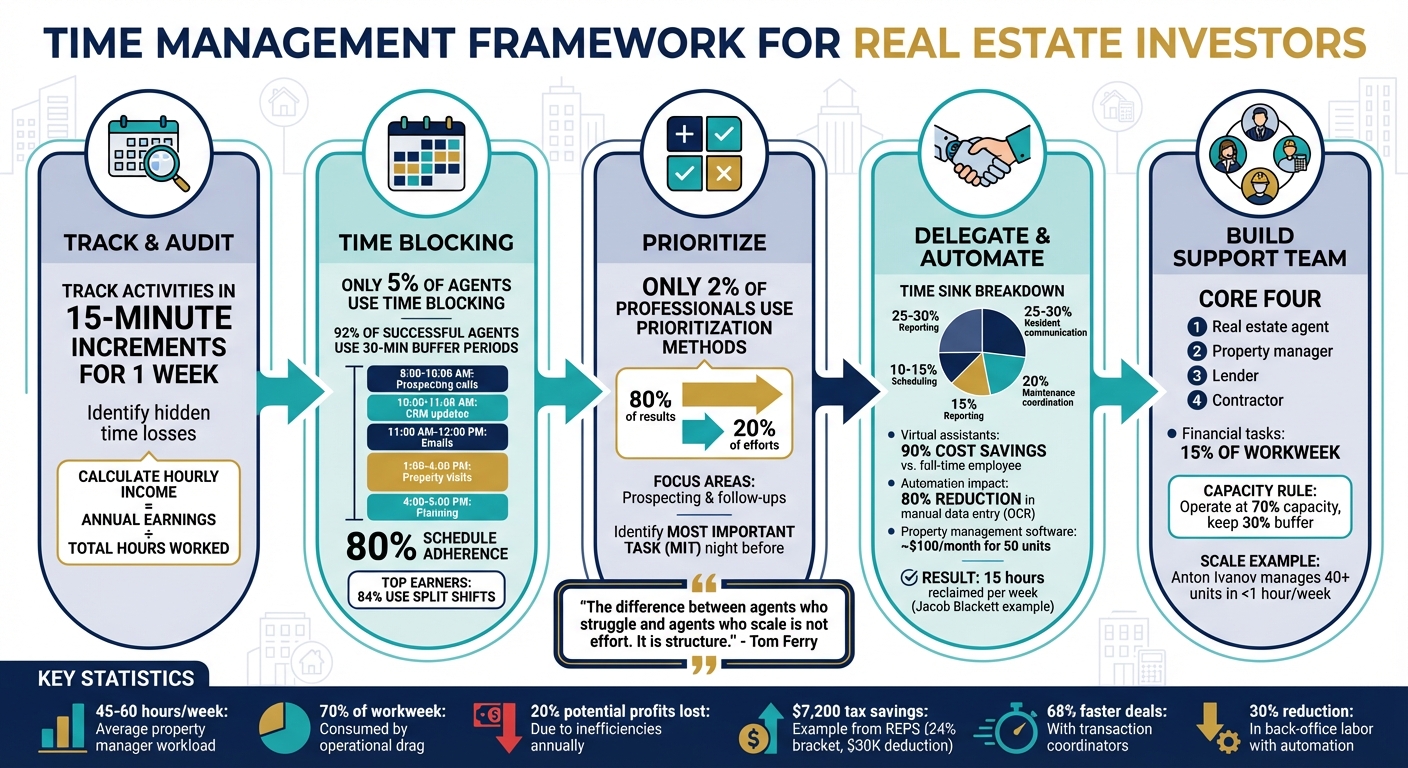
Time Management Framework for Real Estate Investors: 5-Step System
The 5 Hour Investor: A Strategy for People with Little Time
sbb-itb-85dd802
Creating a Time Management Framework
Taking control of your time starts with figuring out where it’s actually going. For one week, track every activity in 15-minute increments. It might feel tedious, but you’ll likely uncover hidden hours lost to low-priority tasks. This simple audit sheds light on patterns you can’t address without seeing them clearly.
Time Blocking for Real Estate Tasks
Time blocking transforms your calendar into a productivity tool. Instead of juggling an endless to-do list, you assign specific time slots for different tasks – treating those blocks like unmissable appointments with yourself. Many top investors dedicate the first 90 minutes of their day solely to lead follow-ups and prospecting, leaving emails untouched during this critical window.
Interestingly, only about 5% of real estate agents use time blocking, yet those who do report far better outcomes. A typical schedule might look like this:
- 8:00–10:00 AM: Prospecting calls
- 10:00–11:00 AM: CRM updates
- 11:00 AM–12:00 PM: Responding to emails
- 1:00–4:00 PM: Property visits
- 4:00–5:00 PM: Wrapping up tasks and planning the next day
Grouping similar tasks – like returning calls or handling paperwork – into dedicated blocks reduces the mental drain of constantly switching contexts.
To keep things flexible, build 30-minute buffer periods between major blocks. These allow you to handle unexpected issues without throwing your entire day off course. In fact, 92% of successful agents use these floating buffers to stay on track. Aim for about 80% adherence to your schedule – real estate can be unpredictable, and overly rigid plans often crumble under the pressure. With time blocks in place, you can focus on the activities that truly move the needle.
Focusing on High-Value Activities
Not every task deserves your attention. The Eisenhower Matrix is a handy tool to sort your work into four categories based on urgency and importance. Many investors get bogged down by urgent but low-value tasks, like unscheduled calls or excessive emails, while neglecting the "Important but Not Urgent" work – things like building your database, conducting market research, or nurturing relationships – that drive lasting success. Despite its effectiveness, only 2% of real estate professionals actively use this prioritization method.
To stay ahead, identify your Most Important Task (MIT) the night before. This eliminates the mental drain of deciding what to tackle first thing in the morning. Save high-focus tasks like deal analysis or contract negotiations for your peak energy hours – usually in the morning – and reserve the afternoon for lower-energy activities like filing or updating listings. Keep the 80/20 rule in mind: in real estate, 80% of your results typically stem from just 20% of your efforts, particularly prospecting and follow-ups. Prioritizing these key activities directly impacts your portfolio’s growth and profitability.
Establishing Daily and Weekly Routines
Once you’ve nailed down the high-impact activities, routines help you stay consistent without overthinking. Structured habits eliminate the need for constant decision-making. As Tom Ferry puts it:
"The difference between agents who struggle and agents who scale is not effort. It is structure."
End each day with a quick 5-minute review to prep for tomorrow. On Fridays, set aside 30 minutes for a Weekly Review Ritual. Use this time to evaluate your lead flow, offers sent, and deals progressing through the pipeline. This regular check-in lets you adjust your upcoming schedule based on what’s working.
During peak seasons, stick to your core blocks and streamline where possible. Use slower periods to refine your systems and strengthen relationships. Some top agents adopt split shifts – for example, an early morning block for admin tasks, a midday personal break, and an evening block for client meetings. This approach, used by 84% of top earners, helps balance the around-the-clock demands of real estate while maintaining personal boundaries. These routines provide the structure needed to grow your business while staying organized and focused.
Delegation and Automation Strategies
Once you’ve established a solid time management framework, the next step is to free up even more of your schedule through delegation and automation. Property managers often find themselves working 45–60 hours a week, much of it consumed by repetitive tasks. By offloading some of these responsibilities, you can shift your focus to activities that drive portfolio growth and long-term success.
Hiring Help for Day-to-Day Operations
Spending your time on tasks like fixing toilets or chasing late rent payments isn’t just frustrating – it’s costly. As Than Merrill, Founder of FortuneBuilders, explains:
"Instead of fixing a toilet, you could be generating more leads. Never underestimate how valuable your time is."
One way to reclaim that time is by hiring virtual assistants. They can handle scheduling, emails, research, and customer relationship management (CRM) tasks at a fraction of the cost of a full-time employee – up to 90% less, in fact. For property-specific tasks like tenant communication, maintenance requests, and inspections, consider hiring a property manager or contracting skilled technicians. A hybrid approach can work wonders: use property management software like Buildium (around $100/month for up to 50 units) to manage routine tasks, while local contractors handle physical maintenance.
Marketing and lead generation also benefit from delegation. Specialists can take over social media management, paid advertising campaigns, and lead follow-ups. With 32% of customers leaving after a single poor experience, professional handling of these touchpoints is essential. Virtual assistant services like Time etc are particularly selective, with only the top 2% of applicants passing their rigorous screening process.
Automating Routine Processes
Automation is a game-changer when it comes to reducing "operational drag" – the hours spent on repetitive tasks. These can consume up to 70% of your workweek, with resident communication (25–30%), maintenance coordination (20%), reporting (15%), and scheduling (10–15%) being the biggest time sinks. Automation tools can take over many of these tasks, allowing you to focus on growth.
For example, when a tenant signs a lease, automated systems can send move-in instructions, schedule rent payments, and add them to your communication list. Tenant screening can also be automated using tools like Google Forms to filter out unqualified applicants. Platforms like UpKeep streamline maintenance by handling requests, assigning vendors, and updating tenants on repair progress. Financial tools like Stessa can link directly to your accounts, automatically categorizing transactions and generating tax-ready reports. Optical Character Recognition (OCR) tools further reduce manual data entry by over 80%.
Communication automation is equally powerful. AI chatbots can answer common tenant questions – like pet policies or rent due dates – around the clock. Automated email or SMS sequences ensure that new leads receive follow-ups within minutes of their inquiry. Scheduling tools like Calendly (free with premium options starting at $8/month) simplify appointment booking by syncing with your availability in real time.
Working with Financial Professionals
To truly transition from day-to-day operations to strategic growth, consider partnering with financial professionals. Tasks like bookkeeping, payroll, invoice processing, and tax preparation can eat up around 15% of a property manager’s workweek. Outsourcing these responsibilities to experts, such as TC Advisors (https://tcadvisorscpa.com), frees up your time for high-level decision-making.
This approach not only saves time but also creates a stronger foundation for scaling your business. One investor reported doubling their property inventory in just a year after implementing delegation and automation strategies. Instead of getting bogged down in data entry, you can focus on reviewing financial reports to identify savings and growth opportunities. This shift – from working in the business to working on the business – sets apart small-scale operators from those who build expansive portfolios.
Outsourcing payroll is another smart move, as it helps prevent delays and provides real-time dashboards of key metrics like occupancy rates, rent roll, and maintenance costs. These insights are invaluable for making informed strategic decisions. Before outsourcing, ensure your records are digitized – scan receipts and documents into cloud storage platforms like Google Drive so your financial team can access them remotely.
Time Management for Portfolio Growth
When your portfolio grows, the time management methods that worked for a few properties can quickly become roadblocks. Shifting from managing 10 units to 100 isn’t just about doing more – it requires rethinking and restructuring your approach. On average, investors lose 20% of potential profits each year due to inefficiencies. Adjusting your time management strategies as you scale is essential to avoid this and maintain profitability.
Managing Multifamily Properties Efficiently
Scaling up means reworking your systems to stay efficient. Multifamily properties, for example, offer a clear advantage over scattered single-family homes. With multiple units under one roof, you can streamline processes and save time. The goal is to create systems that allow you to manage by exception – focusing on outliers – rather than micromanaging every detail.
Take real estate investor Anton Ivanov as an example. He manages over 40 rental units with less than an hour of work per week by outsourcing tasks to a reliable team. His success lies in creating Standard Operating Procedures (SOPs) for everything from acquisitions to bookkeeping. By documenting these processes – whether through screen recordings or written guides – his team can handle tasks independently.
To scale effectively, focus on what’s important but not urgent. The Eisenhower Matrix can help you prioritize tasks like strategic planning, relationship building, and improving systems – activities that drive long-term growth. Pair this with the 80/20 Rule: identify the 20% of tasks, like deal sourcing and investor relations, that generate the majority of your results. Delegate or automate the rest.
In 2025, Jacob Blackett, founder of SponsorCloud, shared how automation transformed his time management. By implementing automated reporting and distribution features, he reclaimed about 15 hours per week. This freed him up to focus on relationship building and deal sourcing, enabling his fund to handle over $50 million in transactions. As Blackett explains:
"The difference between fund managers who burn out and those who scale successfully isn’t talent or market knowledge, it’s how they manage their time."
Building Your Support Team
Efficient systems are only part of the equation. A skilled support team is equally important when managing a growing portfolio. Once you move beyond a handful of properties, assembling the "Core Four" becomes critical: an investor-friendly real estate agent, a property manager, a lender, and a contractor. These professionals take on tasks you can’t efficiently handle alone, freeing you to concentrate on high-impact activities.
Start by adding administrative support, then bring in technical specialists like bookkeepers, and eventually hire for business development roles as needed. Financial tasks, for instance, can eat up roughly 15% of your workweek. Partnering with professionals – like TC Advisors (https://tcadvisorscpa.com) – can ensure accuracy and compliance while giving you time to focus on strategy. Tasks like manual reporting, which can take 8–12 hours monthly, and distribution calculations, often requiring 15–20 hours quarterly, can be reduced to minutes with the right help and automation tools.
Sharad Mehta, founder of REsimpli, offers a great example of how systems and team support pay off. By using a centralized CRM, he stored data on a lead he analyzed two years earlier. When the seller returned in 2025, he quickly secured the deal for $20,000 – down from the original $90,000 price. After a $70,000 rehab, the property appraised at $220,000. This kind of preparation and support allows investors to seize opportunities that might otherwise be missed.
Successful investors often operate at 70% capacity, leaving a 30% buffer to handle unexpected issues or new opportunities without derailing their schedules. This flexibility is only possible when a strong support team manages daily operations, giving you the bandwidth to focus on scaling. As Matthew Stravitz aptly puts it:
"Scale isn’t accidental – it’s engineered."
Financial Record-Keeping and Tax Compliance
Time management and financial record-keeping are more intertwined than many investors realize. Poor documentation can lead to increased audit risks and waste both time and money. When it comes to proving your real estate activities, the IRS does not accept reconstructed logs or rough estimates. If your hours aren’t recorded as they happen, they essentially don’t exist in the IRS’s eyes.
Documenting Hours for Real Estate Professional Status
To qualify for Real Estate Professional Status (REPS), you need to log over 750 hours annually in real estate activities and spend more than 50% of your work time on these tasks. The IRS requires contemporaneous records that include the date, duration, property details, and specific activity notes. For someone in the 24% tax bracket, deducting $30,000 in rental losses could translate to about $7,200 in tax savings. However, the responsibility to prove these hours rests entirely on you.
Activities like tenant screening, preparing leases, and coordinating repairs typically count toward REPS. However, time spent on non-actionable tasks – like casually browsing Zillow, reading general real estate books, or attending broad seminars – usually does not qualify.
There are real-world examples that highlight the importance of detailed records. In Escalante v. Commissioner, a taxpayer’s log was rejected due to inaccuracies, including logging hundreds of hours for simple tasks like writing checks – one entry even claimed an impossible "25-hour day." On the other hand, in Smith v. Commissioner, a 63-year-old disabled veteran with a single three-unit property successfully qualified for REPS. His detailed records included emails, receipts, photos, and call logs.
Using specialized tools like REPSLog can make this process easier. These apps allow for mobile entries, time-stamping, and attaching evidence, making them more reliable than manual spreadsheets. Establishing a weekly routine – such as setting aside time every Friday afternoon to update logs, digitize receipts, and review your tasks – can keep you prepared for audits. As Brandon Hall, CPA, points out:
"If the day-to-day operations of your real property trade or business and your rentals would be unaffected by the hours you are claiming on your time log, then those logged hours don’t count".
Maintaining accurate records does more than support REPS claims – it lays the groundwork for effective tax strategies.
Tax Planning with Professional Support
Once your records are in order, the next step is to streamline tax planning to protect your financial interests. Keeping accurate financial records starts with separating your personal and business finances. Use dedicated bank accounts and credit cards for each property or entity to avoid co-mingling funds, which can be a red flag for auditors. It’s also essential to distinguish between operating expenses – like repairs and utilities – and capital expenditures, such as renovations, which need to be capitalized and depreciated. Monthly reconciliation of bank, loan, and escrow accounts ensures your data is accurate and helps catch any discrepancies early.
For added support, consider working with professionals who specialize in real estate finances, like TC Advisors. Their expertise in areas like bookkeeping, tax planning, and fractional CFO services can help you stay compliant, reduce tax liabilities, and focus your time on higher-value activities. They can also guide you through advanced strategies, such as cost segregation and optimizing passive losses.
Conclusion
Time Management Strategies in Action
Managing time effectively means prioritizing tasks that bring the most value – and doing so at the right moments. The difference between thriving investors and those who face burnout often boils down to how they safeguard their most precious resource: their time. Techniques like time blocking ensure you allocate dedicated hours for high-value activities, such as lead generation and prospecting. Tools like the Eisenhower Matrix help separate urgent tasks from important ones, while the 80/20 rule keeps your focus on the activities that yield the majority of your results.
Growth also depends on leveraging delegation and automation. Handing off administrative tasks – like list uploads, skip tracing, or transaction coordination – frees you to concentrate on building relationships and closing deals. For example, automated CRM systems can handle routine follow-ups, cutting back-office labor by up to 30%. Similarly, transaction coordinators help agents finalize deals 68% faster with fewer mistakes, and property management software simplifies rent collection and maintenance workflows.
Maintaining accurate financial records is another cornerstone of effective time management. Keeping contemporaneous logs is crucial for preserving Real Estate Professional Status and unlocking tax advantages. Monthly reconciliations and separating personal and business finances ensure you’re prepared for audits.
Now, let’s translate these strategies into practical steps.
Practical Steps for Investors
- Audit Your Time: Spend one week tracking your activities to identify where hours are being wasted. Calculate your hourly income by dividing your annual earnings by total hours worked, and focus on tasks that maximize your return.
- Time Blocking in Practice: Start each day with 90 minutes dedicated to revenue-driving activities. Set clear office hours for less urgent client matters to protect your productivity. On Fridays, review your leads, offers, and pipeline progress for 30 minutes to fine-tune your approach for the week ahead.
- Seek Professional Financial Help: Managing your finances can get complicated. Services like TC Advisors specialize in supporting real estate investors with bookkeeping, tax planning, and fractional CFO services. They can help you stay compliant, reduce tax burdens, and focus on what matters most – finding and closing deals.
FAQs
What should I time-block first each day?
Start your day by dedicating time to prospecting or following up with leads. These tasks are best handled in the morning when your energy and focus are at their peak. By prioritizing client outreach or follow-ups first thing, you ensure that the most important revenue-driving activities get your full attention, setting the tone for a productive day and pushing your business forward.
When should I delegate vs automate a task?
Deciding whether to delegate or automate comes down to the nature of the task. For tasks that are repetitive and predictable – like managing email filters or tracking deadlines – automation is the way to go. It saves time and minimizes mistakes. On the other hand, tasks that need judgment, personal interaction, or supervision – like vendor management or handling complex negotiations – are better to delegate to reliable team members. This approach lets you concentrate on high-priority activities, such as strategic planning, while ensuring quality through clear communication and proper oversight.
How do I log hours for Real Estate Professional Status?
To track hours for Real Estate Professional Status (REPS), it’s crucial to maintain a detailed and accurate record of your time spent on qualifying real estate activities. Use a logbook or a reliable time-tracking tool to record key details like dates, start and end times, durations, and descriptions of tasks. These tasks might include property management, administrative duties, or other activities related to your real estate work.
Additionally, keep supporting documents to back up your records. This could include invoices, calendars, or other relevant paperwork. These materials are essential to meet IRS requirements and validate your logged hours.


