

When preparing your business for a sale, merger, or acquisition, the key to success is thorough preparation. Buyers prioritize certainty and organization, and any gaps in your financial, legal, or operational records can lower your business’s valuation – or even jeopardize the deal. Here’s a quick breakdown of what you need to focus on:
- Financials: Organize 3–5 years of financial statements, tax filings, and cash flow projections. Reconcile accounts, separate personal and business finances, and consider a Quality of Earnings (QoE) report to validate EBITDA.
- Legal Compliance: Ensure corporate formation documents, permits, and contracts are updated and properly filed. Address change-of-control clauses in agreements and confirm intellectual property is owned by the business.
- Operations: Document workflows, update your business plan, and reduce dependency on key individuals. Use a CRM to segment customer data and demonstrate revenue stability.
- Due Diligence: Conduct internal audits to identify risks, reconcile discrepancies, and prepare add-back schedules for EBITDA adjustments. Organize everything in a secure Virtual Data Room for buyer review.
Key Insight: Poor planning can lead to uncertainty discounts, reducing valuation multiples by up to 12.5%. Proactive preparation not only protects your business’s value but also strengthens your position in negotiations.
Working through this list is the preparation. Our transaction advisory page covers what a sell side engagement adds on top of it.
This checklist is your roadmap to a smoother transaction, ensuring you’re ready to meet buyer expectations and maximize your business’s worth.
Business Sale Preparation Timeline: Your 12-Month Roadmap to a Successful Exit
sbb-itb-85dd802
Financial Preparation Checklist
To get your business ready for a sale, you’ll need to gather and organize financial records from the past 3 to 5 years. This includes detailed financial statements like annual and monthly income statements (P&L), balance sheets, and cash flow statements. Buyers will also expect to see all relevant tax filings – covering income, sales, payroll, and property taxes – for the same period. Financial due diligence can take anywhere from 4 to 8 weeks, but if your paperwork is incomplete, it could drag on for 12 weeks or more. Once this is in order, focus on how your cash flow and revenue projections can bolster buyer confidence.
Organize Financial Records
Start by reconciling your accounts. Ensure your cash matches bank statements, accounts receivable aligns with aging reports, and accounts payable reflects all outstanding bills. Any unexplained balances in categories like "Other Assets" or "Other Liabilities" can raise red flags for potential buyers. Additionally, you’ll need a debt schedule that outlines loan agreements, UCC filings, and any personal guarantees or related-party loans.
Prepare a normalization schedule to adjust EBITDA for items like above-market owner compensation, one-time legal fees, or personal expenses. Be ready to back up each adjustment with invoices or receipts. For businesses valued over $5 million, buyers often require a third-party Quality of Earnings (QoE) report to verify EBITDA. While these reports can cost between $30,000 and $75,000, commissioning one yourself can help you address financial gaps before buyers uncover them. Once your records are reconciled, shift focus to analyzing cash flow.
Review Cash Flow and Projections
Break down your revenue by customer, product, and geography. Buyers pay close attention to customer concentration – if one customer accounts for more than 15% to 20% of your revenue, they’ll want to know about contract terms and the challenges of replacing that income. Include data on retention rates and your sales pipeline to show revenue stability. Providing current and trailing 12-month accounts receivable and accounts payable aging reports will also help buyers assess your cash conversion cycles.
Create a financial model that explores how your business would perform under different scenarios, such as changes in demand, pricing, or input costs. This type of sensitivity analysis shows that you understand what drives your business. A well-prepared pro forma financial model can help buyers see your company’s potential and growth trajectory. Clear revenue segmentation and realistic projections make your business more appealing to potential buyers.
Separate Business and Personal Finances
Make sure you’re using separate accounts and credit lines for business and personal finances. Mixing the two can make it harder for buyers to assess your true operating performance and may lead to lower valuation multiples. Remove any personal expenses – like travel, meals, or vehicle costs – from your business records before putting it up for sale.
"Clean reporting strengthens credibility and allows a potential buyer to evaluate results without hesitation." – Alan Salomon, CPA/ABV, CVA, Advisor Legacy
Document any loans or capital contributions in writing. Also, ensure that all key contracts, licenses, and registrations are in your business entity’s name, not your personal name. Keeping these records organized not only protects your personal assets but also enhances the legal standing of your business. Businesses with well-organized documentation often attract offers 20% to 30% higher than those that are less prepared.
Legal and Compliance Checklist
Legal compliance isn’t just a box to check – it’s a cornerstone of successful transactions. Around 80% of M&A deals fail due to incomplete due diligence data, while 70% of price disputes stem from weak corporate governance. Buyers will thoroughly evaluate your corporate structure, licenses, and contracts to spot risks that could disrupt the deal or lower its value. To stay ahead, start organizing these documents 3 to 6 months before going to market. This gives you enough time to address any gaps.
Review Corporate Formation and Governance
You’ll need to gather key documents like your Articles of Incorporation or Organization, bylaws, operating agreements, and shareholder or partnership agreements. These records establish your business’s legal foundation and ownership structure. Also, prepare meeting minutes from the past five years, stock ledgers, capitalization tables, and any voting trusts or buy-sell agreements. Missing ownership documentation slows down 45% of business deals.
If records are missing, they can often be reconstructed using sworn affidavits from company officers, as allowed by SEC regulations. To streamline the process, consider using a Virtual Data Room (e.g., Intralinks or Datasite) to securely store and share documents. Before uploading anything, redact sensitive information like Social Security numbers, personal bank details, and customer credit card data to protect against identity theft.
"A well-organized data room accelerates due diligence, demonstrates professionalism, and maintains control over the process." – Eagle Rock CFO
Verify Licenses and Permits
Ensure all business licenses, permits, and your Employer Identification Number (EIN) are current and registered under your business entity’s legal name – not your personal name. This applies to federal, state, and local licenses that your industry may require. Many permits expire every 1–3 years, so double-check their expiration dates. Compliance issues are responsible for derailing 25% of potential transactions.
If your business has moved or expanded into new states, update your registrations immediately. Operating without proper permits can lead to forced shutdowns, back taxes, and hefty fines. Filing for an EIN through the IRS is free and instant online, but paper applications can take up to four weeks. If your LLC or corporation has fallen out of compliance, file reinstatement documents with your Secretary of State to get back in good standing.
Assess Key Contracts and Agreements
Go over all essential agreements, including customer and supplier contracts, real estate and equipment leases, distribution agreements, and employment contracts. Be aware that 40% of contracts with change-of-control clauses become non-transferable without third-party consent. For retail businesses, long-term leases can account for 20% to 30% of overall value, so ensure these are assignable or have a strategy to secure landlord approval.
Check your intellectual property agreements to confirm that the business – not individual employees or contractors – owns all patents, trademarks, copyrights, and domain names. Misclassifying 1099 contractors as W-2 employees is a common issue that could lead to significant back-tax liabilities. Buyers will also look at whether your business has "nexus" (a taxable presence) in states where you’re not registered for sales tax. Tax discrepancies are another red flag, accounting for 30% of transaction terminations in private business sales.
"Legal readiness does not eliminate risk, but it significantly reduces surprise, disruption, and unnecessary expense when issues arise." – O’Connell & Aronowitz
Operations Checklist
Once your financial and legal preparations are solid, it’s time to focus on operational efficiency. This is a critical factor for achieving top-tier valuations. Buyers want to see that your business can thrive without your constant involvement. They’re willing to pay more when institutional knowledge is captured in documented systems rather than relying on individual expertise. To make this happen, start refining your operations two to three years before you plan to sell. This gives you enough time to implement meaningful changes that can boost your business’s value.
Update Business Plan and Processes
Documenting your workflows is a foundational step. Create clear SOPs (Standard Operating Procedures) that cover everything from daily operations to customer service and vendor management. These show potential buyers that your business runs smoothly on its own. An organizational chart with clearly defined roles and reporting lines is another must-have. It highlights leadership depth and reduces dependency on any one person.
Simplify wherever possible – cut redundant steps, streamline workflows, and eliminate unnecessary meetings. Automating repetitive tasks, like data entry or reporting, can save time and improve both margins and efficiency.
"The aim is to eliminate all processes or procedures with little to no value, especially the ones that slow you down or cause confusion within the business." – Brian Dukes, CEO, Exitwise
Once your processes are streamlined, shift your focus to organizing customer data and performance metrics.
Organize Customer and Performance Data
Segmenting your customers is key to showcasing a well-structured revenue model. Pay close attention to customer concentration – if a single client accounts for more than 10% of your revenue, prepare a clear plan for transitioning and retaining that account. Show buyers the predictability of your revenue by distinguishing between recurring income (like subscriptions) and transactional income.
Track metrics like net revenue retention rates by customer group and aim for a Lifetime Value (LTV) to Customer Acquisition Cost (CAC) ratio of at least 3:1. Also, ensure your CRM is up-to-date with accurate contact details, relationship mapping, and other relevant information. For major accounts, create detailed profiles that include contract terms, length of the relationship, renewal schedules, pricing history, and service trends.
Optimize Tools and Systems
Your technology systems need to be ready to scale and integrate seamlessly after acquisition. Review your CRM, payment platforms, and management software to ensure they’re up to the task. Keep a detailed inventory of all systems, including their purpose, licensing, and access details.
Set up a secure Virtual Data Room to keep important documents organized for due diligence. This allows buyers to review everything quickly and securely. Prioritize data security and privacy to avoid raising any red flags during the evaluation process. Additionally, review vendor contracts for any clauses that could complicate a transfer of ownership, such as assignment restrictions or termination terms.
| System Category | Optimization Focus | Impact on Transaction |
|---|---|---|
| CRM | Data integrity and reporting | Validates revenue durability and client retention |
| Financial/Accounting | Automated reporting and expense tracking | Builds confidence in EBITDA and cash flow |
| Operations | Documented workflows and manuals | Reduces "key-person" risk and supports scalability |
| IT Infrastructure | Integration capability and licensing audits | Lowers post-acquisition integration risks |
"A well-prepared advisory group can populate a clean data room quickly and respond to diligence questions without delay. That efficiency signals operational discipline and reduces the likelihood of surprises during the transaction process." – Alan Salomon, CPA/ABV, CVA, Advisor Legacy
Due Diligence and Risk Management
Once you’ve laid the groundwork with solid financial, legal, and operational systems, it’s time to dive into due diligence. This process, typically lasting 30 to 90 days (with most deals falling in the 45 to 60-day range), is your chance to uncover and address potential risks before buyers do. Delays during this phase can lead to deal fatigue, so the goal is to move through it efficiently and confidently. Think of this as the final layer of preparation to ensure there are no surprises when buyers start their review.
Conduct Internal Audits
Start by thoroughly examining your financial records. Reconcile three to five years of financial statements with tax returns, as unexplained discrepancies – especially in accounts like "Other Assets" or "Other Liabilities" – can raise immediate concerns. Review AR/AP aging reports to flag unresolved issues, and document any litigation, settlements, or disputes from the past three years. Don’t forget to check insurance loss runs for recurring claims over the past five years. These steps help you get ahead of issues that could derail negotiations.
Employee records also deserve close attention. Buyers are increasingly vigilant about worker classification – misclassifying 1099 contractors when they should be W-2 employees can be a red flag. Ensure all licenses, permits, and safety certifications are current and properly documented. If your business requires SBA loan approval, confirm that your lease meets the lender’s 10-year minimum requirement. Review material contracts, especially those tied to more than 10% of your revenue, for "change of control" clauses that could require vendor or customer consent during the transaction.
| Category | Key Documents for Risk Identification | Potential Risks to Uncover |
|---|---|---|
| Financial | Tax returns, AR/AP aging, Debt schedules | Nexus exposure, bad debt, undisclosed liabilities |
| Legal | Material contracts, Litigation files, IP records | Change of control triggers, pending lawsuits, IP gaps |
| Operational | Employee census, Insurance loss runs | Worker misclassification, high claim history, key-person risk |
| Regulatory | Licenses, Permits, Environmental reports | Non-compliance fines, zoning issues, expired certifications |
"Sellers who provide complete, well-organized documentation within 48 hours signal they run a professional operation." – Eagle Rock CFO
Once you’ve identified any discrepancies or risks, quantify their impact on your valuation. This step ensures you’re prepared to address buyer concerns proactively.
Prepare Valuation and Risk Assessments
Buyers will scrutinize your financials, so come prepared. Create an add-back schedule to normalize EBITDA, accounting for items like owner compensation, non-recurring expenses (e.g., legal settlements), and any above-market compensation. Categorize revenue by type – recurring subscriptions versus one-time transactions – to highlight income predictability.
Compile a detailed schedule of fixed assets, including machinery, vehicles, and equipment, with purchase dates and current book values. Document intangible assets like patents, trademarks, proprietary technology, and customer lists. If audited financials aren’t available, invest in a Quality of Earnings (QoE) report to address buyer concerns and validate your valuation.
Evaluate dependencies within your business. If a significant portion of your revenue is tied to personal relationships or expertise, develop a transition plan to demonstrate the business can thrive without you. Similarly, if any single client accounts for more than 10% to 20% of your revenue, outline a strategy for retention and transition.
"A valuation does not create value on its own. Preparation does." – Alan Salomon, CPA/ABV, CVA, Advisor Legacy
Engage Advisors for Support
Navigating due diligence can be complex, but professional advisors can help ensure nothing is overlooked. For example, TC Advisors (https://tcadvisorscpa.com) offers transaction advisory services to help small businesses identify risks, optimize deals, and manage due diligence. Their pre-due diligence audits can uncover potential issues early, giving you time to address them before buyers step in.
Legal counsel should review contracts, intellectual property, and governance documents to confirm everything is in order. Make sure your cap table is accurate and up-to-date, including equity grants, vesting schedules, and shareholder agreements. Organize all documents in a secure Virtual Data Room, structured logically (e.g., sections like 1.0 Corporate, 2.0 Financial, 3.0 Revenue) to streamline buyer review. Before sharing, redact sensitive personal details like Social Security numbers and bank information.
"Your data room isn’t just a folder of documents. It’s a mirror that reflects how you’ve been running the business when no one was watching." – Entrepreneur
30-Day Preparation Timeline
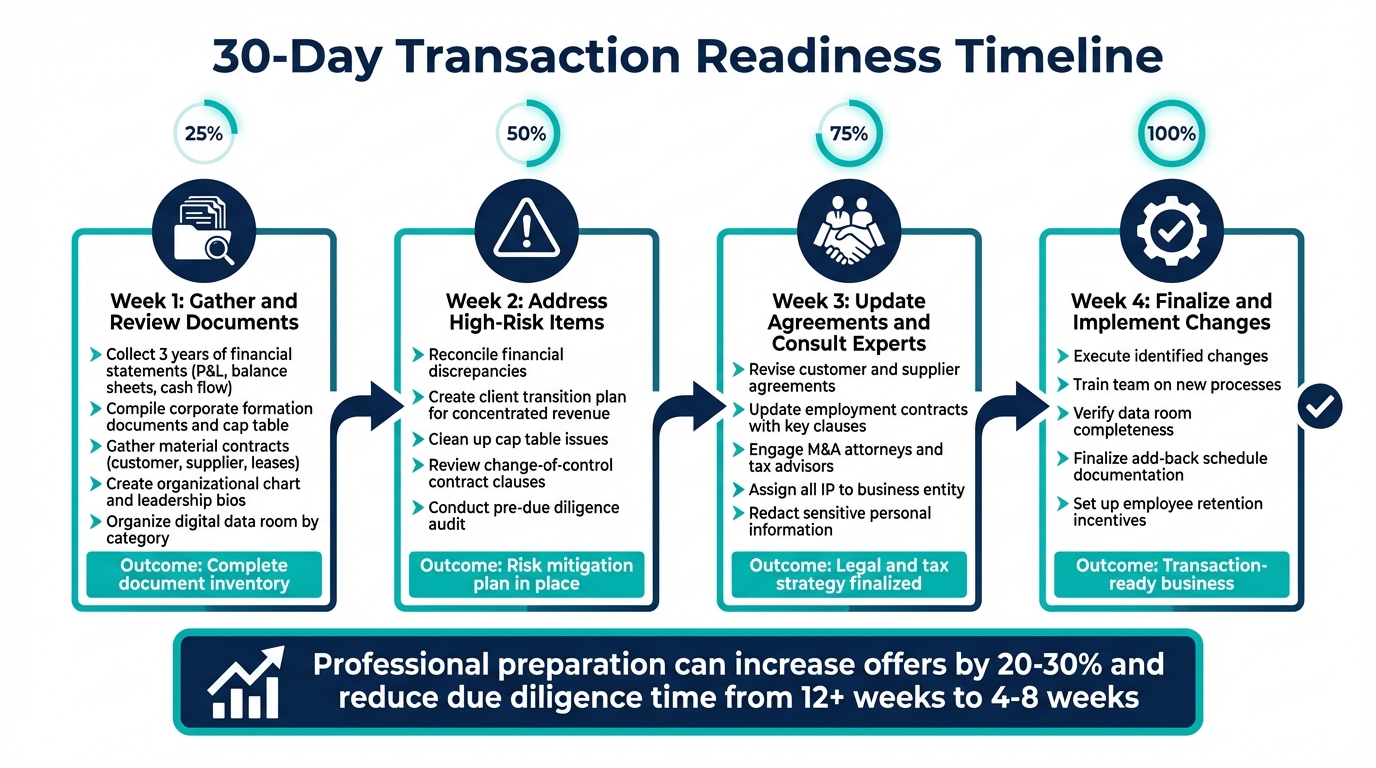
30-Day Transaction Readiness Timeline for Small Business Sales
Getting your business ready for a transaction in just 30 days might seem challenging, but breaking it into weekly steps makes it achievable. This timeline simplifies the process into four focused weeks: gathering documents, tackling critical issues, refining details with expert help, and implementing final changes. By the end, you’ll have transformed your preparation into actionable steps that align with your financial, legal, and operational goals.
Week 1: Gather and Review Documents
The first step is collecting and organizing all the essential documents buyers will expect to see. This includes three years of reconciled financial statements (profit and loss, balance sheets, and cash flow statements) and corporate formation documents like the cap table and board meeting minutes.
You’ll also need to compile material contracts (customer agreements, supplier contracts, leases), an updated organizational chart, leadership biographies, and employment agreements with key clauses like non-compete and non-solicit provisions. Don’t forget operational documents (process manuals, KPI reports), intellectual property records (patents, trademarks), insurance policies, and details of any lawsuits.
Make sure your financials are clean – exclude personal expenses and include an add-back schedule. Organize everything in a digital data room, categorizing documents into sections like Corporate, Financial, and Contracts.
"A well-prepared advisory group can populate a clean data room quickly and respond to diligence questions without delay. That efficiency signals operational discipline and reduces the likelihood of surprises during the transaction process." – Alan Salomon, CPA/ABV, CVA, Advisor Legacy
| Category | Specific Documents to Gather |
|---|---|
| Financial | 3 years of P&L and tax returns, forward-looking projections, EBITDA add-back schedules, and net working capital reports. |
| Legal/Corporate | Articles of incorporation, bylaws, cap table, and regulatory filings. |
| Contracts | Customer/supplier lists, strategic partner agreements, equipment leases, and vendor contracts. |
| Human Resources | Org charts, employee turnover data, compensation structures, and training manuals. |
| Sales/Marketing | Customer segmentation data, growth metrics, and descriptions of products/services. |
| Risk/Insurance | Insurance policies, environmental reports, and intellectual property filings. |
Week 2: Address High-Risk Items
Once your documents are organized, it’s time to address potential red flags. These might include financial statements that don’t match tax returns, unresolved legal disputes, over-reliance on a single client, or a business that’s too dependent on you as the owner. Use a "Ready, Partially Ready, or Not Ready" framework to assess each item, and prioritize resolving those marked "Not Ready."
Start by reconciling your financials – discrepancies are a major concern for buyers. If your revenue is heavily concentrated with one client, create a transition plan to shift relationships to others in your team. Clean up your cap table by addressing issues like phantom equity or multiple stock classes, which could complicate the sale. Review contracts for change-of-control clauses that could trigger terminations during a sale.
Be transparent about unresolved high-risk items, and document your plans to address them. Consider hiring experts like TC Advisors for a pre-due diligence audit. They can identify issues early and help you model different tax scenarios, potentially increasing your after-tax proceeds by 15% to 25% with strategic planning.
Week 3: Update Agreements and Consult Experts
With the high-risk items under control, focus on updating contracts and consulting with experts. Start by revising customer and supplier agreements to ensure they’re up to date and include clear transferability clauses. Update employment agreements for key team members, making sure they include essential provisions like non-compete and intellectual property assignment clauses. Standardize client agreements to reflect your current service offerings and renegotiate long-term obligations to eliminate ambiguities.
This is also the time to bring in professionals. M&A attorneys can fine-tune your legal structure and corporate governance documents, while tax advisors can guide you through the tax implications of various deal structures. If your business relies heavily on your personal relationships, create a staged transition plan to shift those responsibilities to others.
"Hire proven professionals (experienced advisors, transaction attorneys) who you have good chemistry with and try to view them as investments to help achieve your goals versus an expense." – Neal England, Founders Advisors
Redact sensitive personal information from all documents, and ensure all intellectual property is legally assigned to the business. This will prevent disputes later in the process.
Week 4: Finalize and Implement Changes
The last week is all about execution and ensuring everything is ready. Implement the changes you’ve identified, finalize governance documents, and double-check that every item in your data room is complete and accurate. Train your team on any new processes or systems you’ve established, and set up procedures to maintain compliance moving forward.
Review your data room one last time to ensure it’s thorough and organized. Make sure your add-back schedule is well-documented and defensible, and that your financial projections are realistic and tied to past performance. If you haven’t already, finalize plans for employee retention bonuses or profit-sharing incentives to keep your team motivated during and after the transaction. With these final steps, you’ll be well-positioned for the next stage of the transaction process.
Next Steps
Once you’ve checked off every item on your preparation list, it’s time to move into action. The real work begins now – transitioning from self-assessment to execution. This is where experienced advisors, like M&A specialists, transaction attorneys, and CPAs, come into play. These professionals can help you navigate the intricate legal and tax structures that directly affect your final proceeds. As industry experts often point out, the right advisors can turn potential risks into strategic opportunities.
Start by organizing a virtual data room with all verified documents. This step is critical for building investor trust and keeping the deal on track. A well-maintained data room not only boosts investor confidence but also helps maintain momentum. On the flip side, a poorly managed one can lead to lower valuations or even jeopardize the entire deal. Another key step is conducting a sell-side Quality of Earnings (QoE) report. This preemptive measure addresses potential buyer concerns and strengthens your valuation. Without it, buyers might lower the purchase price – for instance, reducing a multiple from 6x to 5.25x EBITDA – if they find your financials lacking.
Tax strategy is another area you can’t afford to overlook. Before signing a Letter of Intent (LOI), consult with your advisors to determine whether an asset sale or stock sale is the better option for you after taxes. Smart tax planning can make a significant difference in your final payout. At the same time, finalize succession plans and consider retention bonuses to keep key team members motivated during the transition. A proactive tax strategy and clear succession planning ensure that your well-organized operations translate into maximum value when the deal closes.
For tailored guidance, TC Advisors offers a range of services, including due diligence, Quality of Earnings analysis, and M&A tax planning. Their team specializes in identifying risks early and streamlining complex transactions to help you achieve the best possible outcome. Visit TC Advisors to see how their proactive approach can help you reach your goals and maximize the value of your business.
FAQs
Do I need a Quality of Earnings (QoE) report?
A Quality of Earnings (QoE) report is a key tool when you’re buying or selling a business. It dives deep into the company’s financial performance, offering a clear picture of its earnings and any potential risks. This detailed analysis plays a critical role in due diligence, helping both buyers and sellers make well-informed decisions. By ensuring transparency, a QoE report builds trust and confidence on both sides of the transaction.
What should go in a virtual data room?
A virtual data room needs to house well-organized, easily accessible documentation essential for due diligence. This includes financial statements, tax returns, bank statements, legal documents, contracts, employee records, leases, and insurance policies. These documents provide a thorough look into the business’s operations and ensure compliance with necessary standards.
How do I reduce key-person risk before selling?
To prepare your business for sale and minimize key-person risk, it’s crucial to focus on making the company less dependent on any single individual. Start by systematizing operations – document every critical process so the business can run smoothly without constant oversight. Next, build a strong leadership team that can step in to manage essential functions and decision-making. Finally, share customer relationships across your team to ensure clients feel connected to the business, not just one person.
Key actions to take include:
- Documenting business processes: Create clear, accessible guidelines for all major operations.
- Developing a succession plan: Identify and prepare individuals to take on critical roles.
- Empowering team members: Train and trust your team to handle high-stakes tasks.
These steps not only make your business more scalable but also reassure potential buyers by showing that the company can thrive without heavy reliance on the owner. This, in turn, increases its market value and attractiveness.


