

Customer profitability segmentation helps businesses figure out which customers are making them money – and which ones aren’t. Research shows that 20% of customers often drive 150%–300% of profits, while the least profitable 10%–20% can cause losses of 50%–200%. The goal? Focus resources on high-profit customers with strategic financial leadership, improve mid-tier profitability, and reduce costs (or even cut ties) with unprofitable ones.
Key Takeaways:
- High-Profit Customers: Dedicate top resources, offer personalized perks, and focus on retention.
- Low-Profit Customers: Use automation, adjust pricing, or shift to cost-effective services.
- Methods to Segment Customers:
- Horizontal Segmentation: Group by demographics or firmographics (e.g., location, industry).
- Value-Based Segmentation: Rank customers by profit margins using metrics like Lifetime Value (LTV).
- Behavioral Segmentation: Analyze actions like purchase frequency and transaction size.
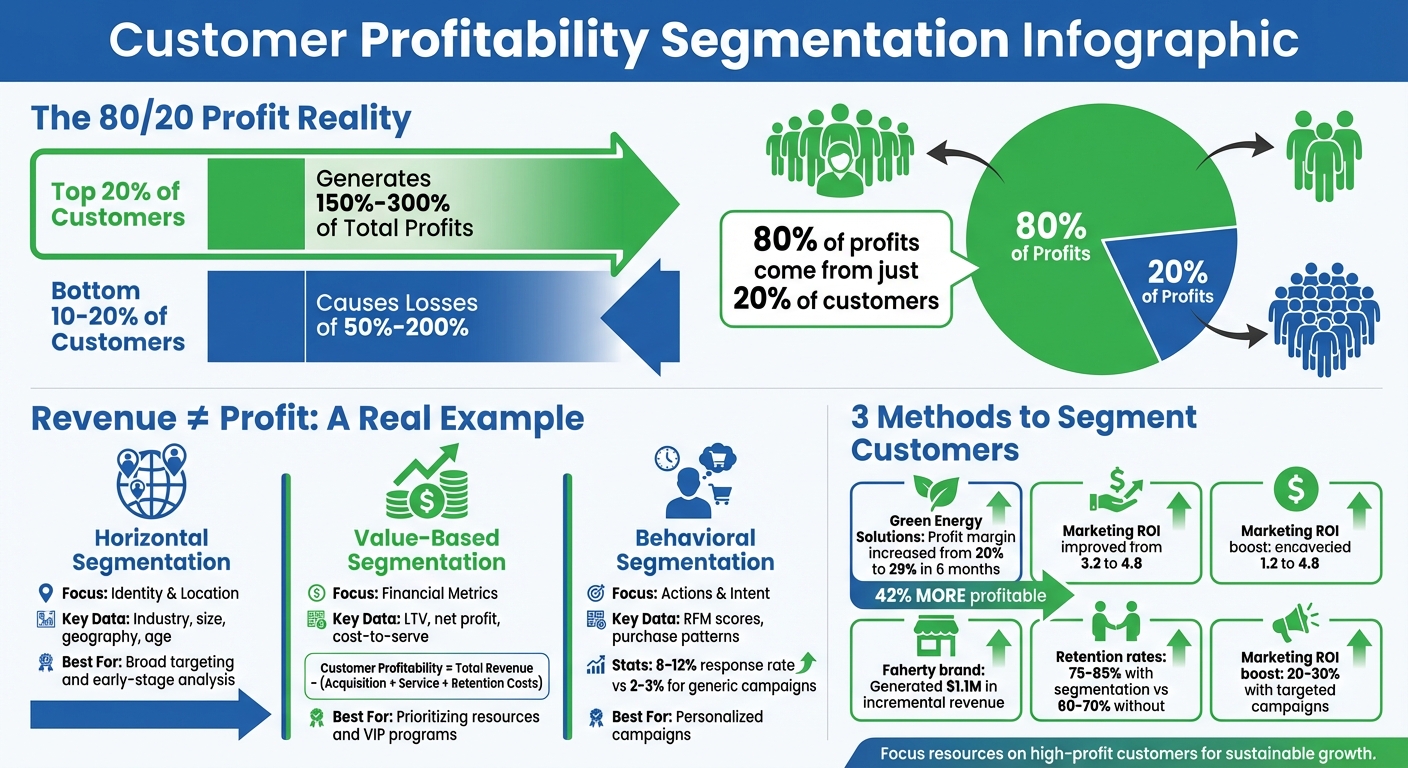
Customer Profitability Segmentation: Key Statistics and Impact on Business Profits
Analyzing Customer Profitability
sbb-itb-85dd802
Why Customer Profitability Segmentation Matters for Small Businesses
Small businesses operate with tight budgets, limited staff, and precious time, so every decision has to count. Customer profitability segmentation helps identify which customers truly contribute to your bottom line and which ones quietly drain resources – even if they appear valuable at first glance. This insight can reshape how you allocate resources, trim unnecessary expenses, and grow revenue in a smarter way.
Allocating Resources to Profitable Customers
By understanding which customers bring in the highest margins, you can dedicate your best resources to those accounts. Instead of spreading your team thin across all clients, focus your top talent on high-margin projects for the best return on investment (ROI).
Here’s a striking statistic: 80% of your profits likely come from just 20% of your customers. Without segmentation, you could end up treating two $100,000 clients the same – even if one requires minimal support and the other demands constant attention, dramatically affecting profitability.
Take Ilija Brajković, CEO of Kontra Agency, as an example. In 2024, he implemented real-time profitability tracking and discovered that two long-standing clients were actually costing the company money. Their fees didn’t cover salaries, fixed overhead, or variable overhead costs.
"We ended up terminating contracts with two of our oldest clients… it turned out that we were losing money because the money they paid us did not cover salaries, fixed overhead per hour, and variable overhead per hour." – Ilija Brajković, CEO, Kontra Agency
This principle also applies to marketing. Instead of running broad, expensive campaigns, use "lookalike" targeting to find new customers similar to your most profitable ones. For instance, Faherty, an apparel brand, partnered with Saras Analytics to create audience segments based on profitability data. This approach generated $1.1 million in incremental revenue. Concentrating your efforts on high-profit customers ensures better returns with less wasted effort.
Cutting Costs on Low-Profit Customers
Once you’ve optimized resources, the next step is minimizing costs tied to low-profit customers. Revenue alone doesn’t equal profit. Some customers require so much support – whether through returns, labor, or customization – that they actually generate losses despite their spending.
Here’s an example: Customer A spends $100 per transaction, while Customer B spends $75. At first glance, Customer A seems more valuable. But when you account for costs like labor, fulfillment, and customer service ($30 vs. $10 for shipping; $12 vs. $6 for service), Customer A only nets $33 in profit, while Customer B delivers $47. High revenue doesn’t always mean high profit.
"Scope creep" is another common issue, especially for service-based businesses. Nearly 20% of agencies report over-servicing clients, often due to unclear project boundaries or poor communication. Every unbilled hour eats into your margins. While the average gross profit percentage in 2022 was 40%, experts recommend aiming for above 50%.
Segmentation highlights these problem areas so you can act. For low-margin customers, you might raise prices to reflect actual costs, shift them to automated or self-service solutions, or, in some cases, end the relationship altogether. Additionally, regularly updating rate cards – at least once a year – helps ensure that long-term contracts remain profitable despite rising costs. Addressing these cost drains directly improves both margins and efficiency.
Increasing Revenue with Targeted Strategies
Profitability segmentation also helps you tailor strategies to increase customer lifetime value. High-margin customers deserve personalized attention, exclusive offers, and dedicated account managers to deepen loyalty. Mid-tier customers benefit from retention programs and efficiency improvements, while low-margin segments can be served more cost-effectively through automation.
This approach prevents wasted marketing dollars by aligning offers with the customers who will appreciate them most. As Eric Stables, Director of Banking Strategy at Profit Resources, Inc., puts it:
"Segmentation allows you to know who your audience is before you start talking to them. By understanding their preferences, behaviors and what’s most important to them, you can tailor campaigns and messages that resonate." – Eric Stables
For example, Green Energy Solutions, a company specializing in energy-efficient products, shifted its marketing focus to high-profit customers. Within six months, their profit margin jumped from 20% to 29%, and their marketing ROI improved from 3.2 to 4.8. By prioritizing high-value customers, they significantly boosted returns.
Segmentation also helps you identify high-value customers who may be at risk of leaving. Offering personalized incentives can help retain these customers, which is often cheaper than acquiring new ones. Together, these strategies create a solid framework for leveraging customer profitability segmentation to grow your business effectively.
Methods for Customer Profitability Segmentation
Choosing the right segmentation method is crucial for understanding your customers’ profitability. Small businesses often rely on three primary approaches, each offering a unique perspective. Combining two or more methods often gives a more complete understanding of where profitability lies.
Horizontal Segmentation
Horizontal segmentation organizes customers based on demographic or geographic factors. For consumer-facing businesses, this could mean grouping by age, gender, or income. In B2B settings, it involves firmographics like company size, industry, or region.
This method helps spot profitability trends across broad categories. For instance, you might find that serving remote customers is less profitable due to higher shipping or service costs. Similarly, certain industries may require extra support, exposing hidden costs. Research often shows that a small percentage of customers account for a disproportionate share of profits:
"The most profitable 20 percent of customers generate between 150 percent and 300 percent of total profits." – Robert Kaplan and V.G. Narayanan, Harvard Professors
Horizontal segmentation is especially helpful for businesses just starting out or those without fractional CFO services or advanced tracking tools. It can highlight which accounts deserve personalized, high-resource attention versus those better suited for standardized, lower-cost services. Identifying unprofitable segments, like customers from specific regions or industries, allows businesses to shift these groups toward self-service models or adjust pricing to better reflect their costs.
Value-Based Segmentation
Value-based segmentation focuses on ranking customers by the financial return they bring, using metrics like Lifetime Value (LTV) and net profit after accounting for acquisition and service costs. Unlike horizontal segmentation, which focuses on customer identity, this method zeroes in on profitability.
The formula is straightforward:
Customer Profitability = Total Revenue – (Acquisition + Service + Retention Costs).
This approach helps businesses avoid wasting resources on customers with high acquisition costs who never turn profitable. Instead, it prioritizes retention strategies for top-tier accounts. For example, two customers generating the same revenue might have vastly different profit margins – one requiring minimal support while the other needs constant attention.
Value-based segmentation also supports "value-based selling", where sales teams focus on accounts likely to renew or expand. By categorizing customers into high, medium, and low-value groups, businesses can better allocate resources. Targeted campaigns based on this segmentation can boost marketing ROI by 20% to 30%. Companies that use segmentation often achieve retention rates of 75% to 85%, compared to 60% to 70% for those that don’t.
Behavioral and Transactional Segmentation
Behavioral segmentation examines customer actions, such as purchase frequency, recency, and transaction size. RFM analysis – Recency, Frequency, and Monetary value – plays a central role in this method.
This approach uses actual purchase data to predict future behavior. For instance, a frequent buyer who made a recent purchase is more likely to return than someone who hasn’t ordered in months. Behavioral segmentation can also minimize margin leakage by identifying different groups’ willingness to pay, ensuring prices match perceived value. Charging higher margins for add-ons, for example, can increase profit margins by 2 to 3 percentage points.
Marketing campaigns based on behavioral data tend to perform significantly better, with response rates between 8% and 12%, compared to 2% to 3% for generic campaigns. Targeted strategies can also boost conversion rates by three to four times compared to one-size-fits-all approaches. By linking customer actions to financial outcomes, this method enables personalized messaging at the right stage of the customer journey, driving better results.
| Segmentation Method | Focus | Key Data | Best Use Case |
|---|---|---|---|
| Horizontal | Identity & Location | Industry, size, geography, age | Broad targeting and early-stage analysis |
| Value-Based | Financial Metrics | LTV, net profit, cost-to-serve | Prioritizing resources and VIP programs |
| Behavioral | Actions & Intent | RFM scores, purchase patterns, site activity | Personalized campaigns and re-engagement |
With these segmentation methods outlined, the next step is to apply these insights to real-world strategies.
How to Implement Customer Profitability Segmentation
Implementing customer profitability segmentation involves gathering data, analyzing it, and continuously refining your approach. It’s a process that starts with understanding costs and revenues and evolves to ensure your segments stay relevant as your business grows.
Collecting Customer Data
The first step in segmentation is collecting accurate and comprehensive data. This means pulling information from every customer interaction – sales calls, support tickets, social media, and purchase histories. These touchpoints help you track both revenue and costs.
Start by recording net revenue (invoice price minus any discounts) using your accounting software or CRM. Then, break down expenses into two categories:
- Direct costs: These include fulfillment, shipping, returns, and restocking.
- Indirect costs: Think salaries, software subscriptions, rent, and marketing.
One of the biggest hurdles is consolidating data from different platforms. For example, e-commerce businesses might use Shopify, Amazon, Meta Ads, and separate CRM tools. To streamline this, consider using ELT (Extract, Load, Transform) tools to automate data collection and centralize it into one source. This ensures consistency and simplifies profitability analysis. If automation isn’t an option, sampling a portion of customer service interactions can help identify which groups are resource-intensive.
Don’t ignore the hidden costs of serving customers. Beyond fixed expenses, additional services like custom reporting, dedicated account managers, or faster response times can significantly affect profitability. For instance, apparel brand Faherty used KPI-driven segmentation through Saras Analytics in 2025 and saw $1.1M in incremental revenue gains.
Calculating Profitability by Segment
Once you’ve organized your data, the next step is calculating profitability for each customer segment. Use the following formula:
Customer Profitability = Total Revenue − (Acquisition Cost + Service Cost + Retention Cost) .
Here’s how to break it down:
- Calculate the true price (invoice price minus discounts).
- Add up the true costs (fixed expenses plus any extra service costs).
- Subtract total costs from net revenue to determine net profit.
For example, imagine one customer group generates $100 per transaction with costs of $67, resulting in $33 of profit. Another group generates $75 per transaction but only incurs $28 in costs, yielding $47 in profit. Although the second group brings in less revenue, it’s about 42% more profitable .
"This is all about calculating the true profitability of a customer, assessing what this client is worth to you." – Ajay Sirsi, Director at the Centre for Customer Centricity, Schulich School of Business
Once profitability is calculated, classify customers into three categories:
- A: Highly profitable
- B: Neutral or break-even
- C: Unprofitable
This classification helps allocate resources effectively. For instance, high-touch services might be reserved for "A" customers, while "C" customers could be shifted to self-service options. Keep in mind, a 10% profit margin is often considered healthy, though industries like marketing agencies may achieve 20% or more. In retail, the top 20% of customers often drive about 80% of profits.
With these insights, you can focus on monitoring and refining your strategy as conditions change.
Monitoring and Adjusting Segments
Customer profitability segmentation isn’t static – it requires ongoing adjustments. As market dynamics shift and customer behaviors evolve, regular reviews are essential. For fast-moving industries, consider monthly evaluations, while more stable sectors may only need annual reviews. Reassess segments after major events like price changes, new product launches, or shifts in competition.
Track metrics beyond revenue, such as Customer Lifetime Value (CLV), cost-to-serve, churn rate, and revenue concentration (the percentage of revenue contributed by top customers). Real-time dashboards integrated with your CRM or business intelligence tools can help detect trends or profitability issues as they arise . These insights can guide your acquisition strategies, like targeting lookalike audiences for marketing or nudging less profitable customers toward self-service options .
It’s also important to validate your data regularly. Eliminate duplicates, update contact details, and ensure purchase histories are accurate. This keeps your segmentation actionable and reliable.
For small businesses, working with financial professionals – like the team at TC Advisors – can provide tailored advice to align your segmentation efforts with broader business goals. Continuous refinement and expert input will help ensure your segmentation strategy delivers measurable results.
Tools and Best Practices for Customer Profitability Segmentation
Tools for Profitability Analysis
Having the right tools can simplify and improve customer profitability segmentation. Many businesses start with Excel for basic calculations. While useful, manual tracking often introduces errors and lacks the speed and real-time insights necessary for quick decision-making.
CRM platforms like Salesforce or HubSpot, when paired with accounting software such as QuickBooks or Xero, provide a more integrated approach. These tools help connect customer interactions to profit margins, offering a clearer picture of profitability.
For e-commerce businesses managing multiple platforms, data integration tools are a lifesaver. For example, Saras Daton consolidates data from over 200 sources – including Shopify, Amazon, and Meta Ads – into a single warehouse for easier analysis. An apparel brand recently used Saras Analytics to refine its segmentation strategy, resulting in a boost in incremental revenue.
Service-based businesses often benefit from project management tools like ActiveCollab, which track billable versus non-billable hours with precision. On the other hand, e-commerce platforms can leverage TrueProfit, which provides automated, real-time profit analysis and even offers a free Net Profit Margin Calculator to help businesses get started. For those focusing on customer success, Velaris uses AI-driven insights and health scores to highlight high-maintenance accounts and uncover growth opportunities.
These tools create a solid foundation for smarter financial decisions, but it’s the human expertise behind the numbers that truly drives strategic success.
Working with Financial Professionals
While technology handles data collection and analysis, translating those insights into actionable strategies requires expert guidance. This is where financial professionals come in. Firms like TC Advisors offer fractional CFO services and business consulting specifically designed for small and mid-sized businesses. They can help you turn profitability data into meaningful strategies.
A fractional CFO can assist in setting realistic profit margin targets. For instance, while a 10% margin is considered healthy, industries like marketing agencies often achieve 20% or more. They also bring expertise in activity-based costing, ensuring indirect expenses are accurately distributed across customer segments. This approach helps you understand the true cost of serving each customer.
"This is all about calculating the true profitability of a customer, assessing what this client is worth to you." – Ajay Sirsi, Director, Centre for Customer Centricity, Schulich School of Business
Beyond crunching numbers, financial advisors play a key role in strategic decision-making. They can guide you in renegotiating terms with unprofitable customers, optimizing resource allocation, and aligning segmentation efforts with larger business objectives. TC Advisors, for example, offers year-round support with quarterly planning sessions to ensure your segmentation strategy evolves alongside your business. Their expertise extends to tax planning, bookkeeping, and transaction advisory, connecting profitability insights to cash flow management and overall strategic goals.
Strategies to Improve Profitability by Segment
Understanding your customer segments and tailoring strategies for each can make all the difference. Research shows that the top 20% of customers often contribute between 150% and 300% of a company’s total profits, while the bottom 10–20% can actually drain profits by 50% to 200%. That’s why segment-specific strategies are key to driving sustainable growth.
Strategies for High-Profit Customers
Your high-profit customers are the backbone of your business, and they deserve focused attention and resources. These are the customers who not only bring in significant revenue but also do so without excessive service costs. To keep them loyal and engaged, consider these approaches:
- Personalized Marketing and Experiences: Use purchase histories to recommend premium or complementary products. Tailor their web experiences and marketing messages to make them feel valued.
- Upselling and Cross-Selling: Leverage their purchasing data to suggest higher-end products or complementary items that align with their needs.
- Exclusive Perks: Introduce tiered loyalty programs offering benefits like early access to new products, VIP events, or progressive rewards. These perks build a sense of exclusivity and strengthen retention.
- Subscription Models: For businesses with replenishable products, subscription plans can secure recurring revenue and foster long-term relationships.
Additionally, premium pricing strategies can boost profitability. High-profit customers are often less sensitive to price increases, so consider offering tiered incentives like "spend $100 and get 10% off" or bundling high-margin items into attractive packages.
Strategies for Low-Profit Customers
Low-profit customers require a different approach – one centered on cost efficiency. These strategies aim to either improve profitability or minimize the resource drain:
- Automation: Shift low-profit customers to self-service options like automated support or standardized service packages. This reduces the need for manual intervention and keeps costs manageable.
- Cost Tracking: Pay attention to non-billable hours, such as time spent on meetings or support tickets, to fully understand the costs associated with these customers.
- Pricing Adjustments: Introduce fees for additional services like extra revisions, eliminate free shipping for low-value orders, or restructure contracts to better align costs with revenues. Volume discounts or minimum order requirements can also encourage higher transaction values.
- Prevent Overservicing: Avoid scope creep by setting clear boundaries. Keep an eye out for warning signs like delayed payments, excessive demands, or unclear respect for project limits.
If a low-profit customer consistently fails to align with your business goals, tough decisions may be necessary. Raising prices to sustainable levels or even ending the business relationship could be the best move for your bottom line. As Tivazo aptly puts it:
"Revenue is not profit. Revenue is what keeps your business going but profit is what allows your business to grow, invest and sustain itself."
Strategic nudges, such as discounted upsells, may help convert low-profit customers into more valuable ones. However, when conversion isn’t possible, pruning unprofitable segments can free up resources for higher-value opportunities.
| Customer Segment | Service Strategy | Resource Allocation |
|---|---|---|
| High-Profit (Tier 1) | Personalized, VIP-level perks | Dedicated account managers, priority support |
| Mid-Profit (Tier 2) | Efficiency-focused, upselling | Standardized support with growth potential |
| Low-Profit (Tier 3) | Automated, lean offerings | Minimal manual intervention, self-serve tools |
Conclusion
Customer profitability segmentation is a powerful tool for making smarter decisions in pricing, service, and resource allocation. As Thomas Fitzgerald from Earnest & Associates explains:
"Customer segmentation isn’t just about categorizing accounts. It’s about creating a lens that sharpens every decision, from pricing to service to compensation".
The data speaks volumes: top-tier customers can contribute over 150% of profits, while less profitable groups may actually erode margins. This highlights a critical truth – revenue does not equal profit. A customer bringing in $50,000 annually might still be a net loss if their support demands outweigh their contributions.
By leveraging strategies like cost-to-serve analysis and tiered service models, you can focus your resources where they’ll generate the greatest returns. This approach ensures that operational efforts and investments are aligned with profitability, driving better results.
For small businesses, profitability analysis often comes with unique hurdles, such as fragmented data systems and siloed information. Partnering with strategic consulting and advisory services can bridge these gaps. Services like those offered by TC Advisors integrate CRM, accounting, and payment data into actionable insights, creating a clear picture of customer profitability and enabling data-driven decisions.
The goal isn’t to serve every customer equally but to serve the right customers strategically. High-revenue, low-cost "Passive" customers deserve premium attention, while low-profit, high-cost "Aggressive" segments may require transformation – or even a strategic exit. Aligning your business operations with true customer profitability lays the groundwork for sustainable, long-term growth.
FAQs
What’s the easiest way to calculate true customer profit?
To figure out how much profit a customer actually brings in, take the revenue they generate and subtract the costs associated with serving them. The formula looks like this: Customer Profitability = Revenue per Customer – Costs per Customer.
Start by collecting data on the revenue each customer contributes. Then, account for expenses such as marketing, customer service, delivery, discounts, and any returns. This straightforward method gives you a quick and clear understanding of how profitable each customer is.
How do I estimate cost-to-serve when my data is messy?
When your data is all over the place, estimating cost-to-serve can feel like trying to solve a puzzle with missing pieces. The key is to focus on cleaning up your data and improving how costs are allocated.
Start by pinpointing the major cost drivers in your operations. Then, simplify your data collection process to consistently capture the most relevant expenses. Break down costs into segments – whether by customer, product, or service type – to make the data more manageable and actionable.
Next, refine your data sources to cut down on errors and inconsistencies. This step is crucial for reducing discrepancies that could throw off your calculations. Finally, make it a habit to measure and tweak your approach regularly. Over time, this will help you achieve more accurate and detailed cost allocations that better reflect how resources are actually being used.
When should I raise prices or drop unprofitable customers?
If certain customer segments are draining resources without contributing to your bottom line, it might be time to make some tough decisions. This is where customer profitability analysis comes into play. It helps you figure out which customers bring in more revenue than they cost to serve.
For those high-value customers who are willing to pay more, consider increasing prices. On the flip side, if some customers cost more to serve than they bring in, it might be best to part ways. Regularly evaluating your customer segments ensures you’re making smart, strategic moves to boost overall profitability.


