

When starting a business, saving on taxes can make a big difference. This guide covers how startups can reduce taxable income with key deductions, including:
- Startup Costs: Deduct up to $5,000 in your first year, with excess costs amortized over 15 years.
- Equipment: Use Section 179 to deduct the full cost of qualifying assets or apply bonus depreciation for additional savings.
- Recurring Expenses: Write off rent, utilities, professional fees, software subscriptions, and business-related travel.
- Employee Benefits: Deduct retirement contributions and health insurance premiums, plus take advantage of tax credits for retirement plan setup.
- Qualified Business Income (QBI): Pass-through businesses can deduct up to 20% of eligible income, subject to income thresholds.
Keeping detailed records and working with a CPA ensures compliance and maximizes savings. Let’s dive into the specifics.
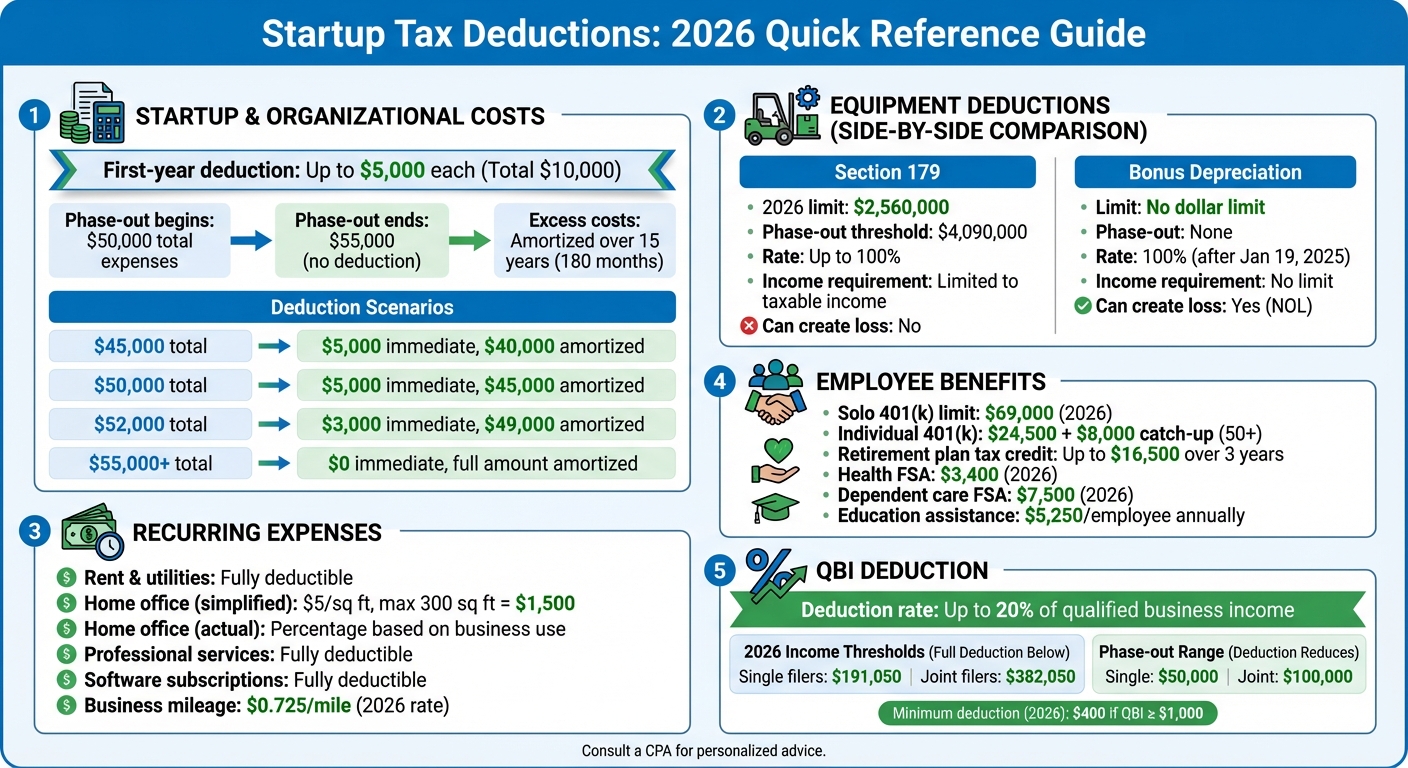
Startup Tax Deductions Overview: Key Categories and Limits for 2026
Startup and Organizational Costs
Qualifying Startup and Organizational Expenses
The IRS splits startup and organizational costs into two distinct categories, and keeping them separate can help you maximize your first-year deductions. Startup costs, as defined under IRC Section 195, include things like market research, pre-opening advertising, employee training, travel to meet suppliers, and consultant fees. Organizational costs, outlined in IRC Section 248, cover legal fees for drafting articles of incorporation or operating agreements, state filing fees, and accounting fees for setting up your entity’s books.
You can deduct up to $5,000 each for startup and organizational costs in your first year, adding up to a total of $10,000. However, these deductions phase out dollar-for-dollar once your total expenses exceed $50,000 and disappear entirely at $55,000.
"A cost qualifies as a startup expense only if it would have been deductible as an ordinary and necessary business expense had the business already been operating (under IRC Section 162)."
– LegalClarity Team
Certain expenses – like equipment, furniture, vehicles, inventory, real estate, interest, taxes, or R&D costs – are not included in these categories. These items fall under different tax rules. For instance, computers and furniture can often be deducted more quickly using Section 179 or bonus depreciation, which typically provide faster write-offs than the 15-year amortization period.
If your startup costs exceed the $5,000 limit, the remaining amount must be amortized, as explained below.
Amortization of Excess Costs
Any startup or organizational costs over the $5,000 first-year deduction must be amortized over 15 years (180 months). The clock for this amortization starts the month your business officially begins operations, even if you haven’t made a sale yet.
"The amortization period starts with the month that you began operating the business."
– Wolters Kluwer
If your total expenses are nearing the $50,000 threshold, you might want to hold off on additional spending until after your business officially opens. Once operational, these costs can often be deducted immediately as regular business expenses, avoiding the need for 15 years of amortization. You’ll report amortization on IRS Form 4562, Part VI, and the IRS automatically applies a deemed election if you claim these costs on your first timely filed tax return.
| Total Startup Costs | Immediate Deduction | Remaining to Amortize (180 Months) |
|---|---|---|
| $45,000 | $5,000 | $40,000 |
| $50,000 | $5,000 | $45,000 |
| $52,000 | $3,000 | $49,000 |
| $55,000+ | $0 | Full Amount |
Equipment and Asset Deductions
Section 179 Deductions
Section 179 lets businesses deduct the full cost of qualifying equipment, software, and furniture in the same year they start using it, rather than spreading the deduction out over several years. For the 2026 tax year, the maximum deduction is $2,560,000, but this benefit starts to phase out dollar-for-dollar once your total equipment purchases exceed $4,090,000.
To qualify, the equipment must be in use by December 31 – just ordering or receiving it isn’t enough. Both new and used items can qualify, as long as they’re being used by your business for the first time.
"Section 179 lets you write off the full cost of qualifying business purchases right away, rather than having to depreciate them over time. It’s one of those rare tax rules that actually feels like it’s working in your favor."
– Jacob Dayan, CEO, Community Tax LLC
However, there are limits. Section 179 deductions can’t create a tax loss – they’re capped at your taxable income for the year. But if you don’t use the full deduction, you can carry the unused portion into future years. The asset must also be used for business purposes more than 50% of the time. For items like vehicles or laptops, it’s a good idea to keep detailed usage records.
Here’s another advantage: financed equipment qualifies for the full deduction. This means your tax savings could exceed your first-year loan payments. Certain heavy vehicles, like SUVs and trucks with a gross vehicle weight rating over 6,000 lbs, can qualify for the full Section 179 deduction. Vehicles under 6,000 lbs, however, have a lower limit of $31,300 for 2026.
If Section 179 doesn’t fully cover your equipment costs, bonus depreciation can help fill the gap.
Bonus Depreciation
Bonus depreciation is another way to front-load deductions when Section 179 doesn’t cover everything. Under the One Big Beautiful Bill Act (OBBBA), the bonus depreciation rate is 100% for assets acquired and placed in service after January 19, 2025.
Unlike Section 179, bonus depreciation has no dollar limit or spending cap, making it ideal for startups with significant equipment investments. Even better, bonus depreciation can create a net operating loss, which Section 179 cannot. This means if your equipment costs exceed your revenue, you can use the loss to offset taxes in other years.
Typically, businesses use Section 179 first for specific assets and apply bonus depreciation to the remaining balance. While both deductions require business use of more than 50%, Section 179 allows you to pick and choose which assets to deduct, whereas bonus depreciation generally applies to entire asset classes. This flexibility makes it easier to plan your tax strategy.
| Feature | Section 179 | Bonus Depreciation |
|---|---|---|
| 2026 Deduction Rate | Up to 100% (within limits) | 100% |
| Annual Limit | $2,560,000 | No dollar limit |
| Spending Cap | $4,090,000 phase-out | None |
| Income Requirement | Limited to taxable income | No income limit; can create a tax loss |
| Flexibility | Choose specific assets | Applies to all eligible assets |
Top 9 Tax Write Offs for NEW Businesses & Startup Costs
Recurring Business Expense Deductions
Recurring expenses that are both ordinary and necessary can help reduce taxable income. Keeping an accurate record of these expenses not only maximizes deductions but also strengthens your startup’s financial position.
Office Space, Utilities, and Home Office Deductions
If you rent a commercial property – whether it’s an office, warehouse, or retail space – you can deduct the full amount of rent and utilities like electricity, gas, water, trash service, and internet costs. Additionally, if you prepay rent for up to 12 months and it doesn’t extend into the next tax year, you can deduct that amount as well.
For those running their business from a home office, the space must be used exclusively and regularly as your primary place of business. If the area doubles as a guest room or a family space, it won’t qualify for the deduction. You have two ways to calculate your home office deduction:
- Simplified Method: Deduct $5 per square foot of your office space, up to 300 square feet, with a maximum deduction of $1,500. This option is straightforward and requires minimal recordkeeping – just measure your office area.
- Actual Expense Method: Deduct a percentage of home-related costs, such as rent, mortgage interest, utilities, insurance, and repairs, based on the proportion of your home used for business. For instance, if your home office occupies 200 square feet of a 2,000-square-foot house, you can deduct 10% of these expenses.
"The simplified method is intended to reduce that burden." – Internal Revenue Service
Direct expenses, like painting or repairs in your home office, are fully deductible. Indirect expenses, such as heating or electricity, are deductible based on the percentage of business use. If you opt for the actual expense method, make sure to keep detailed records of all home-related bills throughout the year.
Professional fees and technology subscriptions are other recurring expenses that can reduce your tax liability.
Professional Services and Business Technology
The costs of hiring accountants, attorneys, or business consultants are fully deductible if they’re related to your business. This includes services like tax preparation, legal advice on contracts, or strategic business planning. Keep all invoices and receipts for these services.
Recurring software subscriptions – such as cloud platforms, accounting tools, or project management software – are also fully deductible. Unlike permanent software licenses that may need to be depreciated, these subscriptions are treated as regular business expenses, directly lowering your taxable income.
Travel-related expenses, particularly transportation and vehicle costs, offer another avenue for deductions.
Transportation and Vehicle Expenses
While commuting from home to your workplace isn’t deductible, travel for business purposes is. If you have a qualified home office, trips from there to meet clients or visit vendors are considered deductible business miles. For 2026, the IRS standard mileage rate is 72.5 cents per mile.
You can choose between two methods for vehicle-related deductions:
- Standard Mileage Rate: Multiply your total business miles by $0.725. To use this method, keep a log of each trip, including the date, destination, and business purpose.
- Actual Expense Method: Track all vehicle-related costs – such as gas, repairs, insurance, and registration – and calculate the percentage of use attributable to business. If you own the vehicle, starting with the standard mileage rate in the first year allows you to switch methods in later years.
Regardless of the method, parking fees and tolls incurred for business trips are separately deductible.
For expert advice on managing these recurring expenses and ensuring compliance with IRS guidelines, consult a professional CPA service like TC Advisors (https://tcadvisorscpa.com).
sbb-itb-85dd802
Tax and Compliance Deductions
For startups working with limited budgets, tax and compliance deductions can make a big difference. These deductions help reduce your tax liability by allowing you to subtract certain taxes and fees from your taxable income.
Deductible Taxes
Startups can deduct several types of taxes, including the employer’s share of Social Security and Medicare taxes (FICA) and the Federal Unemployment Tax (FUTA). Sole proprietors report these on Schedule C, while corporations include them in the appropriate corporate tax return. For 2025, the maximum earnings subject to Social Security payroll tax increased to $176,100.
State and local income taxes, property taxes on business assets, and gross receipts taxes are also deductible. If your business is subject to gross receipts taxes, you can claim these deductions where applicable. Additionally, sales tax paid on goods or services used for business is typically added to the cost of the item rather than deducted separately. Federal excise taxes paid for business purposes are also deductible.
What you cannot deduct: IRS fines, penalties, and late fees are not deductible. For California LLCs, the $800 annual tax is non-deductible, but the LLC fee based on income (ranging from $900 to $11,790) can generally be deducted.
Next, let’s look at how licenses and registration fees can be deducted.
Licenses and Registration Fees
Annual fees for business licenses, operating permits, and regulatory registrations required by state or local governments are fully deductible in the year they are paid. This also includes costs for professional memberships, trade association fees, and chamber of commerce memberships.
However, project-specific permits must be treated differently. These costs are capitalized and depreciated over time, typically over 39 years for nonresidential real property. Keeping these fees separate from your annual license costs in your accounting system is key to ensuring proper tax treatment.
To ensure you’re maximizing deductions while staying within IRS guidelines, it’s a good idea to consult a professional CPA service like TC Advisors (https://tcadvisorscpa.com).
Employee Benefits and Retirement Contributions
Employee benefits and retirement plans not only help reduce tax liability but also make your business more appealing to top talent. Startups can deduct contributions to retirement plans and various employee benefits, which lowers taxable income while creating a competitive benefits package.
Retirement Plan Contributions
Contributions to retirement plans like SEP IRAs, SIMPLE IRAs, and 401(k)s are tax-deductible, helping to reduce taxable income. For 2026, the Solo 401(k) contribution limit is $69,000, while individual 401(k) contributions are capped at $24,500, with an additional $8,000 catch-up for those aged 50 and older (or $11,250 for ages 60–63).
Startups establishing retirement plans may also qualify for up to $16,500 in tax credits over three years, which can be claimed using IRS Form 8881. These deductions work in tandem with other employee benefit strategies discussed below.
Employee Benefit Deductions
Employee benefits beyond retirement plans also offer meaningful tax advantages. For example, health insurance premiums paid for employees are fully deductible. If traditional group health plans aren’t feasible, Qualified Small Employer Health Reimbursement Arrangements (QSEHRAs) offer a flexible alternative. Amy Skinner, Founder of White Jay Consulting, explains:
"Instead of funding a group health plan, employers can set a monthly budget for benefits and reimburse employees tax-free for plans they choose on the individual market".
Through Section 125 cafeteria plans, employees can pay for health, dental, and vision benefits using pre-tax dollars. This reduces both employer payroll taxes and employees’ taxable income. For 2026, the health FSA contribution limit is $3,400, and the dependent care FSA limit is $7,500.
Employers can also offer up to $5,250 annually per employee for tuition or student loan repayment as a tax-free benefit, a provision made permanent starting in 2026. Additionally, certain fringe benefits, such as programs for AI literacy or skill development, remain tax-free if they enhance employees’ job-related skills. However, starting in 2026, expenses for providing food and beverages through on-site eating facilities will no longer be deductible.
For tailored advice on navigating these deductions, reach out to TC Advisors.
Qualified Business Income (QBI) Deduction
The Qualified Business Income (QBI) deduction, often referred to as Section 199A, offers pass-through business owners the chance to deduct up to 20% of their qualified business income from federal income taxes. This deduction applies to sole proprietors, partnerships, S corporations, and certain trusts or estates. Thanks to the One Big Beautiful Bill Act, this tax benefit is now a permanent fixture, providing ongoing relief for startups.
You can claim the deduction whether you itemize or take the standard deduction. For S corporation owners, it’s important to note that only business profits count – W-2 wages paid as reasonable compensation are excluded. Starting in 2026, taxpayers with at least $1,000 in QBI will qualify for a guaranteed minimum deduction of $400, even if other limitations would otherwise reduce the deduction to zero.
Eligibility and Income Thresholds
For 2026, the full QBI deduction is available if your taxable income is below $191,050 for single filers or $382,050 for joint filers. If your income exceeds these limits, the deduction begins to phase out over a range of $50,000 for individuals and $100,000 for joint filers. Beyond the phase-out range, additional restrictions kick in, which depend on W-2 wages paid and the unadjusted basis of qualified property.
Keeping an eye on your taxable income throughout the year is key. If you’re approaching the thresholds, consider strategies like increasing retirement contributions or accelerating business expenses to lower your taxable income. For those with income above the limits, the deduction becomes tied to W-2 wages. S corporation owners, in particular, need to carefully balance reasonable compensation to maximize their deduction. This structure also introduces unique considerations for businesses classified as specified service trades.
Specified Service Business Considerations
If your business falls under the category of a Specified Service Trade or Business (SSTB) – such as health, law, accounting, consulting, or financial services – your QBI deduction eligibility depends heavily on your income. When taxable income is below the $191,050/$382,050 thresholds, SSTB status doesn’t limit the deduction, allowing you to claim the full 20%. However, as your income enters the phase-out range, the deduction gradually decreases, and once it exceeds the upper range, SSTBs lose the deduction entirely.
There’s also a helpful de minimis exception: if less than 10% of your gross receipts (for businesses with under $25 million in receipts) come from specified services, your business won’t be classified as an SSTB. For startups that combine service and product-based operations, maintaining separate accounting for these activities can help ensure the non-service portion remains eligible for the QBI deduction. Monitoring revenue streams closely can make a big difference in preserving eligibility.
For tailored advice on making the most of your QBI deduction, connect with TC Advisors.
Conclusion
Navigating tax deductions might feel overwhelming, but understanding them can significantly impact your startup’s financial health. By focusing on key areas – like startup and organizational costs, equipment deductions, recurring business expenses, and the Qualified Business Income (QBI) deduction – you can reduce expenses, improve cash flow, and minimize future taxable income. Considering that around 4.7 million startups are launched annually in the United States, having a solid tax strategy from the outset can set your business apart.
"Maximizing tax deductions is crucial for startups to maintain healthy cash flow and reinvest in growth."
– Bob Mason, Founder, Coast Financial Services Inc.
The importance of tax planning goes beyond immediate savings. Proper tax management also plays a critical role during funding rounds and acquisitions. By ensuring compliance and capturing all eligible deductions, you can build a strong foundation for long-term growth.
For startups looking to stay ahead, partnering with experts can make all the difference. Professional guidance ensures compliance with IRS regulations and helps uncover every possible deduction. TC Advisors specializes in tailored tax preparation, planning, and advisory services, helping startups optimize their deductions and strengthen their financial footing for scalable success.
FAQs
What’s the difference between Section 179 and bonus depreciation for startups?
Section 179 provides startups with a way to deduct the entire cost of qualifying assets – like equipment or software – in the year those assets are put into use. There’s an annual limit on the amount you can deduct, but this method can help lower taxable income right away, which is a big advantage for businesses focused on managing cash flow.
Bonus depreciation works a little differently. It allows businesses to deduct a percentage of an asset’s cost, often up to 100%, in the first year – without worrying about a total spending cap. This can be especially helpful for larger purchases or when you’ve already maxed out your Section 179 deductions.
Both of these tools are designed to make it easier for businesses to invest in their growth. However, the right choice for your startup will depend on your specific financial situation and goals. It’s always a good idea to consult a CPA to figure out the best approach for your needs.
What steps can startups take to maximize their Qualified Business Income (QBI) deduction?
Startups aiming to take full advantage of the Qualified Business Income (QBI) deduction should ensure their business is set up as a qualifying pass-through entity, like an LLC, S corporation, or sole proprietorship. Another key step is to meticulously track and document all eligible business expenses to calculate deductions accurately.
Partnering with a tax professional can be a smart move. They can help pinpoint opportunities, interpret IRS rules, and ensure you meet all necessary requirements. Additionally, proactive tax planning throughout the year can better position your business to claim the highest deduction possible.
What are startup costs, and how can they impact your first-year tax deductions?
Startup costs refer to the expenses you rack up before your business officially opens its doors. These can include things like market research, advertising campaigns, employee salaries, legal fees, and even consultant fees.
The good news? The IRS lets you deduct up to $5,000 of qualifying startup costs during your first year in business. If your expenses exceed this limit, the rest can be spread out (or amortized) over 15 years, giving you a way to recover those costs while keeping your tax situation manageable.


