

Fractional CFOs help small and mid-sized businesses solve cash flow challenges without the cost of a full-time hire. They focus on improving financial forecasting, managing accounts receivable and payable, and controlling expenses. By using tools like 13-week rolling forecasts, real-time dashboards, and scenario planning, they provide clarity on where money is going and when it’s coming in. This approach helps businesses cover expenses, avoid cash shortages, and plan for growth.
Key Takeaways:
- Cost-Effective Expertise: Fractional CFOs work on a part-time basis, offering high-level financial guidance for $8,000–$16,000/month versus $250,000+ for a full-time CFO.
- Cash Flow Solutions: They address issues like delayed payments, unpredictable revenue, and overspending.
- Forecasting & Planning: Tools like rolling forecasts and scenario models prepare businesses for financial uncertainties.
- Expense Management: They cut unnecessary costs and negotiate better vendor terms.
- Real-Time Insights: Dashboards provide instant access to key financial metrics for better decision-making.
Fractional CFOs are a practical solution for businesses needing financial leadership to stabilize and grow cash flow without overspending.
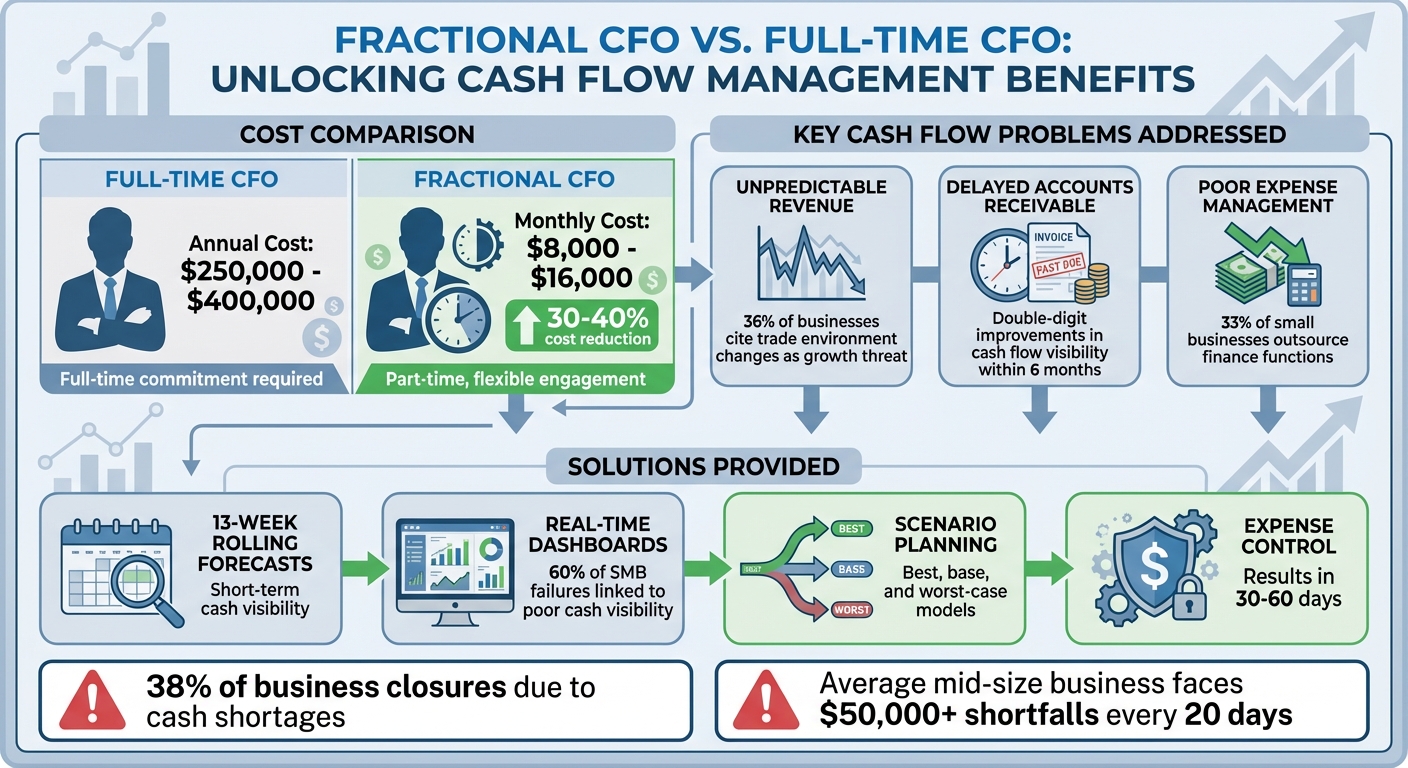
Fractional CFO vs Full-Time CFO Cost Comparison and Cash Flow Solutions
Episode 1: How Fractional CFO Services Work | The Cash Flow CFO Podcast
Common Cash Flow Problems Businesses Face
Even businesses that are turning a profit can run into cash flow troubles when their recorded revenue doesn’t align with their actual bank balances. Recognizing these common issues is essential to sidestep liquidity challenges. This is where the expertise of a fractional CFO can make a noticeable difference in managing cash flow effectively.
Unpredictable Revenue Streams
For retailers and service providers, seasonal sales fluctuations and economic uncertainties can make it tough to predict monthly cash flow. According to a 2025 McKinsey survey, 36% of respondents highlighted changes in the trade environment as a significant threat to their company’s growth. On top of that, supply chain disruptions can delay order fulfillment, creating revenue bottlenecks precisely when it’s needed most.
"A fractional CFO can help businesses anticipate these changes by analyzing past trends and adjusting forecasts accordingly. This proactive approach allows companies to make informed decisions about inventory levels and resource allocation, ensuring they remain financially stable even during unpredictable market conditions." – Brendan O’Connor, CPA
Delayed Accounts Receivable
Slow-paying customers can create a frustrating gap between recognizing revenue and actually receiving cash. You might have delivered a product or service, issued the invoice, and recorded the sale, but your bank account tells a different story. This mismatch can make it difficult to meet payroll or pay vendors on time. Factors like inefficient invoicing systems, vague payment terms, and a lack of follow-up on overdue invoices only worsen the problem. Interestingly, businesses that bring in a fractional CFO often see double-digit improvements in cash flow visibility and cycle times within the first six months.
"Understanding the difference between profit and cash flow is crucial for business health." – Brendan O’Connor, CPA and Tax Consultant, Cohesion
Poor Expense Management
Unchecked spending can quietly drain cash reserves before you realize there’s a problem. Common red flags include outdated vendor contracts, inefficient team setups, and pricing strategies that don’t fully account for costs. Shrinking profit margins often signal that expenses are outpacing income. Another common misstep is relying solely on a current bank balance to gauge financial health instead of using proper forecasting tools, which leaves businesses vulnerable to cash shortages. Rushed or unplanned spending can make matters worse. It’s no surprise that 33% of small businesses in the U.S. now outsource finance and accounting functions to gain better control over overhead and access specialized expertise. Addressing these spending inefficiencies is a key area where fractional CFOs excel.
"Fractional CFOs spot margin leaks and inefficiencies. They analyze unit economics, pricing, vendor contracts, team structure, and spending patterns." – Jared Sorensen, Fractional CFO
How Fractional CFOs Solve Cash Flow Problems
Fractional CFOs focus on plugging cash flow gaps by implementing strategies that bring clarity to your financial picture. They create systems that reveal exactly where your money is going and when it’s expected to return.
Cash Flow Forecasting and Scenario Planning
Fractional CFOs replace outdated annual budgets with rolling forecasts that adapt to real-time data and shifting market conditions. One key tool they rely on is the 13-week rolling forecast, which offers a detailed, short-term view of your cash flow. This forecast helps you plan for immediate needs like payroll and vendor payments without relying on guesswork. Considering that cash shortages account for about 38% of business closures, these tools are critical.
Beyond short-term planning, fractional CFOs build scenario models to prepare for various market conditions. These models often include best-case, base-case, and worst-case scenarios, helping leadership teams understand how different variables – like rising material costs or declining sales – could affect the bottom line. Through sensitivity analysis, they test how small changes impact cash flow, and for more extreme situations, they use stress tests to simulate significant disruptions, such as a 25% drop in demand.
"In taking the extremes to model out the worst case scenario and then dialing that back for medium and best case, the CEO and decision makers have some sort of banded decision-making of what they can look at depending on where they fall." – Brooke S., Fractional CFO, Paro
To ensure decisions are based on the most current information, forecasts are updated weekly. This proactive approach naturally improves the management of both receivables and payables.
Improving Accounts Receivable and Payable Processes
Fractional CFOs address cash flow challenges by optimizing both accounts receivable (AR) and accounts payable (AP) processes.
On the AR side, they introduce automated invoicing systems that send bills immediately after work is completed, rather than waiting for a monthly cycle. Automated follow-up reminders are also implemented to reduce delays, while customer payment patterns are analyzed to flag high-risk clients who may require adjusted credit terms.
For AP, fractional CFOs align payment schedules with incoming cash from receivables. This ensures vendor payments are timed to match customer collections. They also renegotiate vendor terms, such as extending payment deadlines from net-30 to net-45 or net-60, allowing more breathing room without straining relationships. When cash flow allows, they may even negotiate early payment discounts with suppliers and offer similar incentives to customers, like a small discount for paying within 10 days.
The average mid-size business faces unexpected cash shortfalls of over $50,000 every 20 days. By streamlining AR and AP processes, fractional CFOs reduce the time cash is tied up in operations and help prevent these frequent shortfalls. Once cash cycles are optimized, the next step is rigorous expense management.
Expense Control and Cost Management
Fractional CFOs regularly review expenses to ensure spending supports your business goals. They monitor your burn rate – the speed at which cash is consumed – to identify inefficiencies like redundant software or costly procurement practices. Quick fixes, such as tightening collections or adjusting payment schedules, often yield results within 30 to 60 days.
They also classify expenses into fixed and variable categories, cutting non-essential costs to create more flexibility. For inventory-heavy businesses, they implement strategies like just-in-time or reorder-point systems to avoid tying up cash in excess stock. By negotiating extended payment terms with vendors and using real-time dashboards to track spending, they provide instant insights into expense patterns.
This comprehensive approach – combining expense control, forecasting, and streamlined AR/AP management – builds a solid cash flow system that keeps your business financially resilient.
sbb-itb-85dd802
The Importance of Continuous Monitoring and Reporting
Building on earlier strategies, continuous oversight plays a critical role in ensuring that corrections happen promptly and effectively. For small and medium-sized businesses (SMBs), continuous monitoring is a cornerstone of solid cash flow management. In fact, 60% of SMB failures are linked to poor real-time cash visibility. Fractional CFOs address this issue by implementing robust reporting systems designed to catch potential problems before they escalate.
To meet the demand for real-time insights, fractional CFOs rely on advanced digital tools.
Custom Dashboards and Financial Reporting
Gone are the days of waiting for monthly financial statements. Fractional CFOs now use real-time dashboards that monitor your cash position around the clock. These cloud-based tools integrate seamlessly with accounting software like QuickBooks or Xero, offering instant access to key metrics such as the Cash Conversion Cycle, Days Sales Outstanding (DSO), and Working Capital Ratio.
For example, in 2023, SaaS startup Traxo partnered with Graphite Financial to streamline its increasingly complex financial operations. Graphite Financial implemented advanced dashboards that drastically reduced the time required to gather metrics and prepare investor presentations.
"Flaws and concerns can be masked within a condensed income statement and balance sheet, whereas a cash flow statement… can provide keen insight into how a business is operating."
– Rich Martorano, CFO
These real-time dashboards empower businesses to make data-driven decisions. With instant visibility into your burn rate and upcoming expenses, you can confidently decide when to hire, invest in equipment, or delay discretionary spending.
Variance Analysis and Corrective Actions
Variance analysis compares projected cash flow against actual results to uncover discrepancies. Fractional CFOs conduct these reviews weekly, analyzing why revenue might have fallen short or why certain costs unexpectedly increased. This process identifies trends – like slower customer payments or rising vendor costs – that require immediate attention.
When issues arise, fractional CFOs act quickly. For example, if receivables are delayed, they might tighten invoicing procedures or offer discounts for early payments to speed up collections. If expenses start climbing, they could pause non-essential spending, such as marketing or travel. For inventory-heavy businesses, fractional CFOs may audit stock levels to identify items sitting for over 90 days and launch targeted promotions to turn slow-moving inventory into cash. By updating forecasts weekly and comparing them to actual performance, they refine financial models and improve future predictability, helping businesses stay ahead of potential cash flow problems.
When routine adjustments aren’t enough, more aggressive crisis management measures come into play.
Crisis Management and Recovery Planning
In cash flow crises, fractional CFOs step in as turnaround experts. They assess the company’s capital structure, address immediate liquidity needs, and craft recovery plans designed to stabilize operations while preserving essential functions.
Preemptive strategies, such as drawing on a line of credit before cash shortages occur, can also provide a safety net. Additionally, fractional CFOs may renegotiate debt terms, restructure leases, and identify temporary expense reductions that won’t harm the core business.
Consider the healthcare sector, where 43% of businesses fail within their first five years, often due to weak financial systems rather than poor service. Fractional CFOs help these companies establish strong monitoring systems and crisis protocols, ensuring they can endure tough times and emerge stronger. This proactive, vigilant approach aligns with earlier financial management strategies, keeping businesses resilient and prepared for whatever challenges arise.
Why Choose TC Advisors for Fractional CFO Services
When cash flow challenges arise, having expert guidance tailored to your needs is crucial. TC Advisors brings the expertise of Big Four accounting firms to small and mid-sized businesses across the United States. They deliver the precision and insight of a large firm at a fraction of the cost of a full-time CFO. While hiring a full-time CFO typically costs between $250,000 and $400,000 annually, TC Advisors offers fractional CFO services for $8,000 to $16,000 per month – cutting CFO-related expenses by 30% to 40%. This cost-effective model ensures businesses can access top-level financial leadership without straining their budgets.
Year-Round Cash Flow Management Expertise
TC Advisors works with clients throughout the year, holding quarterly check-ins and using proprietary forecasting tools to spot revenue leaks and uncover cost-saving opportunities. This proactive strategy helps businesses avoid unexpected financial hurdles and ensures their financial plans remain aligned with market trends. By anticipating slow periods and significant expenses, TC Advisors keeps operations running smoothly and efficiently.
Customized Financial Strategies
Beyond managing cash flow, TC Advisors takes a personalized approach to financial planning. Their four-step process starts with a comprehensive review of your business structure and long-term objectives. From there, they craft a tailored tax and financial strategy to meet your specific needs. Clients work directly with a dedicated CPA, ensuring consistent and focused attention.
"We act as your partner in growth, delivering the same rigor and forward-thinking strategies you’d expect from a large firm, but with the accessibility and responsiveness of a boutique CPA practice." – TC Advisors
This personalized approach means TC Advisors can adapt to the needs of businesses across industries. Whether you’re a tech startup scaling rapidly, a real estate investor managing multiple properties, or a retail business handling seasonal trends, their strategies are designed to align with your unique cash flow patterns.
Scalable Solutions for Growing Businesses
As businesses grow, financial management becomes more complex. TC Advisors helps companies navigate these transitions without overspending. Their fractional CFO model provides the high-level leadership needed to manage increasing demands while staying cost-efficient. Using secure digital tools and modern financial platforms, they enable real-time collaboration and transparency. Their strategies focus on scalability – identifying tax deductions and credits to reduce costs and free up funds for reinvestment.
As your business evolves, TC Advisors adjusts its support to meet your changing needs. Whether you’re making decisions about hiring, purchasing equipment, or expanding operations, they provide the strategic insights necessary for confident, informed choices.
Conclusion
Cash flow issues can disrupt even the most promising businesses, but a fractional CFO brings the strategic expertise needed to stabilize and grow cash flow. By utilizing tools like real-time dashboards and rolling forecasts, fractional CFOs transform how businesses manage their finances. This forward-thinking approach helps avoid the cash shortages that often lead to business failures – even more frequently than a lack of sales or profits.
Fractional CFOs don’t just address immediate financial concerns; they provide executive-level insights at a fraction of the cost of a full-time hire. Many businesses see measurable results within just 90 days. Whether you’re dealing with seasonal cash flow swings, planning for expansion, or navigating rapid growth, their data-driven guidance empowers smarter, more confident decision-making.
"Fractional CFOs are more than just glorified accountants. They are your trusted financial and strategic partner." – Dark Horse CPAs
This approach opens the door to specialized, ongoing support. At TC Advisors, we combine precision typically seen at Big Four firms with personalized, year-round services. From quarterly reviews to tailored strategies, our solutions are designed to keep your business financially clear and in control. Instead of reacting to past financial data, you’ll gain a proactive financial roadmap that helps you anticipate challenges and seize opportunities for sustainable growth.
Let TC Advisors help you turn cash flow management into a powerful edge for your business.
FAQs
What tools do fractional CFOs use to manage cash flow effectively?
Fractional CFOs leverage a range of tech tools to streamline cash flow management. For instance, they use financial software platforms that handle tasks like bookkeeping, invoicing, and managing accounts payable and receivable. Automating these processes not only minimizes errors but also frees up time for more strategic financial planning. Additionally, cash flow forecasting models play a critical role in predicting cash inflows and outflows, helping identify potential gaps and enabling proactive adjustments to spending plans.
To deliver practical insights, fractional CFOs often build KPI dashboards that monitor essential metrics such as working capital, liquidity trends, and payment cycles. They also turn to scenario planning tools, which allow them to assess various financial outcomes and make sound decisions. On top of that, benchmarking tools are commonly used to measure a company’s performance against industry standards, highlighting areas for improvement. These combined technologies ensure businesses can maintain consistent cash flow and make well-informed financial choices while aligning with U.S. financial regulations and reporting norms.
How can a fractional CFO help manage cash flow for businesses with unpredictable income?
A fractional CFO can be a game-changer for businesses dealing with unpredictable revenue. They craft custom cash flow forecasts that align with your specific financial patterns, helping you stay prepared for ups and downs. By using scenario-based budgeting, they plan for potential income shifts, ensuring your business remains agile in the face of change. Plus, with real-time working capital management, they help you spot potential cash gaps early, allowing you to make smarter spending choices and keep your finances steady.
At TC Advisors, we specialize in offering fractional CFO services tailored for small to mid-sized businesses, startups, and entrepreneurs. Our goal is to provide the strategic guidance you need to confidently manage fluctuating revenue streams.
What are the main cost and benefit differences between a fractional CFO and a full-time CFO?
A fractional CFO brings top-tier financial expertise to the table, much like a full-time CFO, but at a fraction of the cost. To put it into perspective, a full-time CFO typically earns over $190,000 annually, and when you factor in benefits and equity, that number often exceeds $250,000. On the other hand, fractional CFO services generally cost between $3,000 and $10,000 per month (equivalent to about $36,000 to $120,000 annually) or an hourly rate ranging from $150 to $400. Plus, since fractional CFOs aren’t employees, businesses save on payroll taxes, health insurance, and office-related expenses.
The differences between the two roles go beyond cost. A full-time CFO provides daily, in-house leadership and becomes deeply embedded in the company’s long-term operations. In contrast, fractional CFOs typically work 5 to 15 hours per month, offering flexible, on-demand support for specific strategic needs such as cash flow management, financial forecasting, and fundraising. This approach makes fractional CFOs a great fit for small to mid-sized businesses that need senior-level financial guidance without the commitment and expense of a full-time hire.
TC Advisors specializes in providing affordable fractional CFO services, empowering U.S. businesses to streamline cash flow and make smarter financial decisions – all without the hefty price tag of a full-time executive.


